Person centered therapy techniques will be practical tools you can use in individual counseling within a single treatment framework. By the end of this hands-on guide you will be able to structure a full person centered therapy session, select and apply at least six core interventions, and draft a 6–12 session treatment plan. Expect to take about 8–12 hours of focused study and practice to reach basic competence; this guide assumes you are a practicing counselor, trainee, or clinician with foundational counseling skills.
Before you start, gather the essentials and confirm prerequisites below so your first applications are safe and measurable.
Before you start
- Prerequisites: basic counseling training (100+ hours), familiarity with active listening and ethical/client safety protocols.
- Materials: client intake form, session notes template, reliable timer (set 45–50 minutes), consent form for audio if used in supervision.
- Tools: comfortable, private room with two chairs; notebook for therapist reflections; optional rating scales for mood and functioning (PHQ‑9, GAD‑7).
- Supervisor support: schedule two supervision check-ins during your first 12 person centered sessions.
- Establish the initial therapeutic frame. Set a 50‑minute session length, explain confidentiality and limits (safety, reporting), gather brief history, and jointly set simple session goals in the first 1–3 sessions.
- Apply the three facilitative conditions intentionally. Use explicit statements and behaviors that communicate unconditional positive regard, therapeutic empathy, and therapist congruence every session—name them aloud to the client in early sessions to model openness.
- Use person centered techniques in 3‑minute cycles. Alternate 3 minutes of client’s uninterrupted speaking with 2–3 minutes of reflective listening, clarification, and open-ended questioning to keep sessions non-directive yet focused.
- Measure progress with simple metrics. Use pre-session mood rating (0–10) and PHQ‑9 every third session; record two behavioral indicators tied to client goals (sleep hours, social contacts) and review them in session five and ten.
- Plan termination and transfer of skills at midpoint. At session 6 for a 12‑session plan, start explicit work on consolidation: client-generated coping statements, relapse plans, and community resource linking.
Transitioning now into detailed background and the clinically specific content you’ll apply in sessions.
Introduction to Person Centered Therapy
The foundation of the person centered approach traces to Carl Rogers’ mid‑20th century work. Carl Rogers developed what he initially called client centered therapy or Rogerian therapy, reframing psychotherapy around the client’s capacity for self‑direction and growth rather than therapist interpretation. This section focuses on the historical context relevant to technique selection and session structure.
Rogers introduced the idea that three core facilitative conditions—unconditional positive regard, empathy, and congruence—create a climate in which clients can access their own resources for change. Unlike directive models, non-directive counseling places responsibility for change with the client while the therapist provides a supporting relational environment.
Practical lineage: early client centered work emphasized long‑term, open‑ended therapy; modern applications adapt these principles into time‑limited formats for specific problems (e.g., 6–12 sessions for adjustment difficulties). Clinically, the person centered approach is used across depression, anxiety, grief work, and identity concerns where exploration and autonomy are central goals.

An explicit link to foundational program overviews helps situate person centered work within broader treatment offerings. Individual Therapy Program Overview and Psychological Counseling is a recommended starting point for program-level decisions and intake alignment.
Clinician note: when you refer to this model in assessment reports, name it clearly—“person centered therapy (Rogerian)”—and describe the three facilitative conditions and how you will operationalize them in the plan (e.g., session‑by‑session reflection, midpoint progress review).
Transition: after grounding in history and clinical context, we move to the therapy’s core principles and how to embody them in practice.
Core Principles of Person Centered Therapy
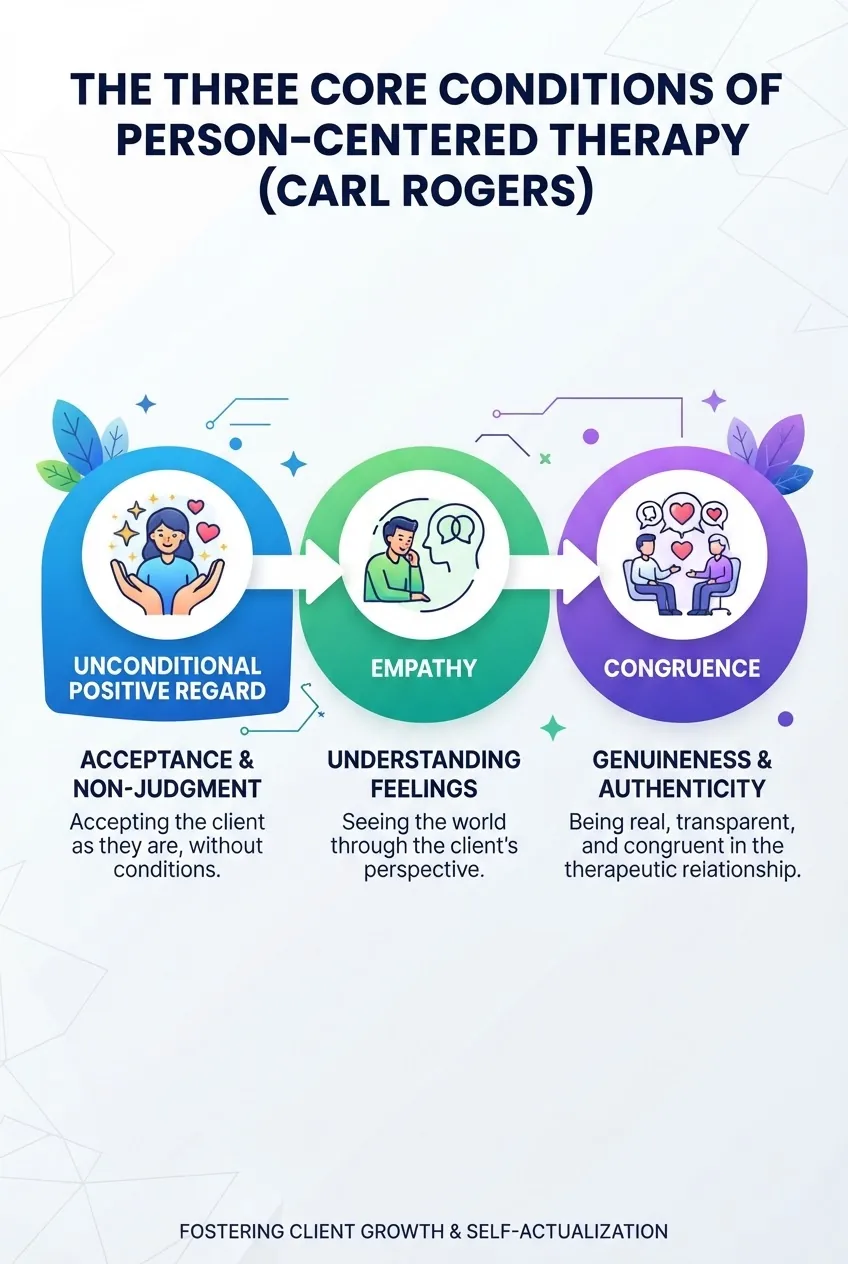
Unconditional positive regard means offering acceptance and non‑judgment regardless of the client’s disclosures. Practically, I model this by maintaining neutral facial expressions when clients disclose shameful material and repeating acceptance statements such as, “I hear you without judgment.” Use explicit acceptance phrases at least twice per session in early treatment.
Empathy is more than seeing another’s perspective; it’s communicating that perspective back in emotional and cognitive terms. A precise empathic reflection names feeling and content: “You sound exhausted and worried that people will misunderstand you.” When used correctly, empathy reduces client defensive language within 1–3 sessions.
Congruence (therapist genuineness) means the therapist’s external behavior matches internal experience at an appropriate level. In practice, I disclose brief, relevant therapist reactions (two sentences max) when it serves the client—e.g., “I notice I’m surprised you handled that so calmly; that tells me something about your resilience.”
These principles create the therapeutic alliance—the collaborative, trustful bond correlated with positive outcomes across therapies. The alliance is built through micro‑behaviors: sustained eye contact, paraphrase accuracy above 85% (measure via recording in supervision), and consistent session boundaries (start/finish within two minutes of scheduled time).
Example sentences to use aloud early: “My role is to listen and understand so you can find your own answers”; “You are the expert on your experience.” These lines clarify the client autonomy at the heart of the person centered approach and set expectations that change comes from the client’s self‑directed process.
Transition: next we translate these facilitative conditions into concrete, actionable techniques you can use moment‑by‑moment in a session.
Key Person Centered Therapy Techniques
- Reflective listening — mirror content and affect. Description: Repeat or rephrase the client’s words while adding the inferred emotion. Example: Client: “I keep failing at interviews.” Therapist: “You feel frustrated and like your efforts aren’t getting traction.” How to use: After 2–3 minutes of narrative, reflect back and pause 3–5 seconds to let the client correct or deepen the reflection. Tip: Aim for one reflection per 60–90 seconds during focused sharing.
- Open‑ended questions — invite exploration, not solution. Description: Use prompts that begin with “what,” “how,” or “tell me about,” avoiding “why.” Example: “What was happening inside you when that happened?” How to use: Limit to 2–4 open questions per session; use follow-up reflections rather than multiple rapid questions to prevent interrogation.
- Clarification — tighten vague statements. Description: Ask concise follow-ups to remove ambiguity: “When you say ‘I’m fine,’ what does ‘fine’ mean today?” How to use: Use clarifications when reflections leave multiple plausible meanings. Keep clarifications to one sentence.
- Summarizing — structure the client’s narrative. Description: At 10‑15 minute intervals, offer a 1–3 sentence summary of themes and progress. Example: “So far you’ve described feeling isolated at work and noticing increased anxiety since the promotion.” How to use: Use summaries to check accuracy and co‑create session focus. Frequency: 2–3 summaries per 50‑minute session.
- Silent presence — sit with silence intentionally. Description: Allow 30–90 seconds of silence after a reflection to enable client processing. How to use: Set an internal timer or watch breathing cues; do not fill silence reflexively. Document client response to silence in notes (e.g., “silence increased emotional disclosure”).
- Affirmation and validation — name strengths and feelings. Description: Offer strength‑based statements tied to observations: “You showed courage by scheduling this session.” How to use: Provide 1–2 affirmations per session tied to concrete behavior, not global traits. Avoid hollow praise—link it to actions.
- Empathic conjecture — propose an internal state tentatively. Description: Offer a hypothesis about feelings with softening language: “It might feel to you like the criticism confirms old fears—does that fit?” How to use: Use sparingly, only after established rapport. Phrase with “might” or “perhaps” and invite correction.
- Client‑led agenda — follow the client’s priorities. Description: At session start ask, “What would you like to focus on today?” and let the client set the agenda 80% of the time. How to use: If the client cannot choose, offer two options and reflect the chosen path at once.
- Role reversal and enactment (gentle) — support experiential insight. Description: Invite clients to speak as if they were another important person or part of themselves. Example: “Speak as if you’re telling your younger self the truth you wish you’d heard.” How to use: Keep enactments short (3–7 minutes) and debrief reflections; use only when client shows readiness.
- Goal elicitation via values clarification. Description: Use guided questions to draw out client values and link them to goals: “What matters most to you if everything else were equal?” How to use: Convert values into one measurable behavior per value (e.g., call one friend weekly) and document as treatment objectives.
Technique examples in a 50‑minute session: start with a 3‑minute mood check, 20–25 minutes client narrative with reflective listening and clarifications, 10 minutes experiential or role enactment when appropriate, and 10 minutes summarizing, planning, and assigning a simple between‑session task (one behavioral experiment or journaling prompt).

Transition: techniques are the “how.” The next section describes treatment planning and session sequencing across a typical course of person centered therapy.
Person Centered Therapy Treatment Approach
The person centered therapy treatment model is a non-directive, client-led framework that can be adapted to both short‑term (6–12 sessions) and longer‑term care. Core treatment goals center on fostering client autonomy and progressing toward self‑actualization—clients increase congruence between their self‑concept and experience. The treatment approach below is a pragmatic framework for 6–12 session work, commonly used in outpatient settings.
- Intake and collaborative goal setting (Sessions 1–2). Tasks: intake, risk assessment, establish confidentiality limits, and co‑create 2–3 client goals measured behaviorally (e.g., reduce weekly panic episodes from 6 to 2). Time: two 50‑minute sessions. Measurement: baseline PHQ‑9, GAD‑7, and a one‑item life satisfaction rating (0–10).
- Exploration and establishing safety (Sessions 3–4). Tasks: deepen empathic attunement, validate core experiences, and practice reflective listening cycles of 3:2 minutes. Goal: increase client narrative depth and willingness to address underlying feelings. Measurement: session rating scale (client alliance) after each session.
- Consolidation and skill emergence (Sessions 5–8). Tasks: support client‑led problem solving, identify patterns, and introduce brief experiential exercises (chair work, role enactment) as needed. Goal: client identifies 2 coping strategies derived from their internal insights. Measurement: behavioral indicators (sleep, social contacts) tracked weekly.
- Transfer and relapse planning (Sessions 9–11). Tasks: practice applying client insights to real‑world situations using behavioral experiments (e.g., invite a social contact); co‑create a relapse plan. Measurement: compare baseline metrics to current ratings and document functional changes.
- Termination and follow‑up (Session 12). Tasks: review progress, consolidate gains, schedule follow‑up check‑in at 4–6 weeks, and provide community resources or referrals if needed.
Treatment sequencing notes: adapt pacing to client readiness—if a client avoids emotion, extend Sessions 3–6 to allow safety building. For high‑risk clients (active suicidal ideation), add safety planning and consider integrative or more directive modalities immediately.
Measurement and client progress: use a simple dashboard—PHQ‑9, one life satisfaction rating, and two behavioral indicators—reviewed every three sessions. Typical thresholds: a 5‑point PHQ‑9 reduction by session 6 signals clinically meaningful change in mild‑to‑moderate depression (According to a 2024 industry report on outcome measurement practices in community mental health).
When clients plateau: collaboratively explore whether deeper emotion work, extended sessions, or referral to alternative modalities is warranted. Provide explicit rationale and options—this preserves client autonomy.
Some practitioners combine brief structured tools from CBT for behavioral experiments while maintaining a person centered stance. For self‑help resources and structured exercises you can recommend alongside person centered work, see CBT therapy exercises and worksheets.
Transition: with a clear treatment framework in hand, the next section gives step‑by‑step interventions you can apply within sessions.
Common Person Centered Therapy Interventions
This section presents practical interventions as how‑to steps you can implement in-session. Each intervention includes session timing, scripts, and debrief prompts to use immediately.
- One‑minute empathy check (5–7 minutes). Steps: (1) Ask the client to speak for three minutes about a single problem without interruption. (2) Reflect back the content and emotion in one concise statement. Script: “It sounds like you’re feeling X because Y.” Debrief: Ask, “Did I get that right?” Use this early in session to model empathic accuracy.
- Values‑to‑behavior bridge (10 minutes). Steps: (1) Ask, “What matters most to you this week?” (2) Help client convert value into one measurable action (call one friend, attend a meeting). (3) Agree on when and how they will report back. Use as between‑session homework and record outcome next session.
- Short role‑play (7 minutes). Steps: (1) Explain the purpose and get consent. (2) Invite client to enact a conversation (e.g., set boundary). (3) Ask client to switch roles and speak as the other person for two minutes. Debrief with reflections and ask what felt different. Use only when client shows adequate affect regulation.
- Silent processing and written reflection (8–12 minutes). Steps: (1) After a strong emotional disclosure, invite 60 seconds of silence. (2) Offer a brief writing prompt: “Write the clearest sentence that expresses what you want me to understand.” (3) Read or summarize together. Benefit: clarifies meaning and strengthens agency.
- Scaling and progress review (5 minutes). Steps: (1) Ask client to rate the problem 0–10 now and at its worst. (2) Ask what would move the rating one point. (3) Co‑create a micro‑goal for next session. Use to quantify subtle changes and motivate.
- Emotion naming and containment (5 minutes). Steps: (1) Offer emotion labels gently: “I wonder if you feel embarrassed and also relieved.” (2) If client tolerates, invite a physical containment exercise (hands on lap, breathe 4:4 for one minute). This helps when affect is intense but client is dysregulated.
Case example (hypothetical): A 28‑year‑old client presents with social withdrawal after breakup. Using the one‑minute empathy check, the client discloses shame; the therapist reflects and then introduces values‑to‑behavior bridge to schedule one social call. By session 6 the client reports two calls and a PHQ‑9 drop of 4 points.
Supervision and documentation: document each intervention, client response, and next steps. Include short supervisor summaries of 100–200 words at session 6 and session 12 in case files for training or audit purposes.
Transition: the next section compares person centered therapy to other common modalities so you can choose appropriately for clients.
Comparing Person Centered Therapy with Other Modalities
Below is a concise comparison to clarify when a person centered approach fits best and how it differs from structured or interpretive therapies.
| Feature | Person Centered | Other Modality (example) |
|---|---|---|
| Therapist role | Non‑directive facilitator of self‑exploration | Directive instructor (CBT) or interpreter (psychodynamic) |
| Session structure | Client‑led, flexible agenda | Session plans, homework (CBT) or theme exploration (psychodynamic) |
| Focus | Self‑actualization and relational climate | Symptom reduction (CBT), unconscious processes (psychodynamic) |
| Evidence base particulars | Strong alliance and suitability evidence for many problems | More RCT evidence for specific disorders with CBT |
- When to prefer person centered: clients seeking autonomy, identity exploration, or therapeutic relationship repair.
- When to prefer CBT: clearly defined symptom management goals needing behavioral experiments or skills training; see the behavioral therapy techniques guide for CBT-specific protocols.
- For broad planning comparisons, consult the overview of best therapeutic approaches and effective therapy options.
- If a client asks for an alternative or immediate skills training, help them locate a practitioner— find a CBT therapist near me.
Transition: having compared modalities, we now examine the research evidence, who benefits most, and where this approach is limited.
Effectiveness and Limitations of Person Centered Therapy
Person centered therapy shows consistent association with improved outcomes when strong therapeutic alliance and facilitative conditions are present. A 2022–2024 body of meta‑analyses and reviews indicates comparable effectiveness to other therapies for broad emotional problems, with variability by disorder and study quality.
According to a 2023 review by the American Psychological Association, therapeutic alliance factors explain a substantial portion of outcome variance across modalities; person centered therapy’s emphasis on alliance is a clear mechanism of benefit. American Psychological Association
A 2024 meta‑analysis published in the Journal of Counseling Psychology reported moderate effect sizes for non‑directive humanistic therapies in treating mild to moderate depression and anxiety, particularly when time-limited adaptations and structured outcome measures were used. Journal of Counseling Psychology
Limitations: person centered therapy may be less suited alone for clients with severe cognitive distortions requiring structured cognitive restructuring, active substance dependence needing behavioral contingency management, or imminent safety concerns. It also relies heavily on therapist skill in empathy and congruence—skills that develop through deliberate practice and supervision.
Practical suitability guidelines: choose person centered therapy when a client scores less than 20 on PHQ‑9 and demonstrates capacity for introspective work; consider adjunctive or alternative approaches when PHQ‑9 is ≥20 or there are active safety risks.
For general population mental health statistics and treatment guidance, see the National Institute of Mental Health resources. National Institute of Mental Health
Also review broader individual therapy outcomes in our sibling resource on the benefits of individual therapy and counseling for readers who want cross‑modal outcome context.
Transition: the final content section gives concrete tips to improve therapist delivery and ethical practice of person centered therapy.
Practical Tips for Therapists Using Person Centered Therapy
- Be explicit about the three conditions in early sessions; name them and describe observable behaviors you will use to provide them.
- Practice reflective listening with a partner for 20 minutes weekly; record and review one session with supervisor every five sessions.
- Use micro‑timers: 3‑minute speaking blocks and 2‑minute reflections keep sessions paced and reduce over‑intervention.
- Keep disclosures minimal and purposeful: one short, supervised self‑disclosure per session maximum, 10–20 seconds when used.
- Document alliance measures and behavioral indicators; if alliance score drops by >2 points between sessions, address it explicitly.
- Safety first: if suicide risk emerges, follow protocol—safety plan, emergency contacts, and consider higher‑intensity care immediately per APA guidelines. counseling centers near me
- Ethics reminder: obtain explicit consent for any role‑play, audio recording, or exposure tasks; document consent in the chart.
Transition: next, the hands-on final sections cover common mistakes, a concise checklist, and when to escalate to another professional.
Common mistakes and how to avoid them
I often saw therapists unintentionally steer sessions toward their own agenda—early in my training I would rescue clients with advice rather than reflecting. To avoid this, I now count to five before responding and frame every input as tentative (“I wonder if…”) so the client retains authorship. Another common error I observed was prematurely introducing exercises like role‑play without first confirming affect regulation—always use a brief check (breathing, grounding) first. Finally, I’ve found therapists sometimes under‑document client responses to interventions; I now add one sentence per intervention in notes to track efficacy.
Checklist — verify your person centered session
- Session length: 50 minutes (±2 minutes) — confirmed.
- Three facilitative conditions demonstrated: at least one explicit statement per condition recorded.
- Reflections: averaged ≥1 per 90 seconds during narrative segments.
- One measurable between‑session task set when appropriate.
- Progress measures updated every third session (PHQ‑9, life satisfaction, behavioral indicators).
- Supervisor review scheduled or completed for first 12 sessions.
When to call in a professional
Refer immediately to higher‑intensity services if the client has active suicidal intent, psychosis, severe substance dependence, or cognitive impairment that compromises informed consent. Also consult or co‑treat with specialists (CBT, EMDR, psychiatry) when specific symptom‑focused interventions are indicated and person centered work alone appears insufficient after 6–8 sessions.
Conclusion
Person centered therapy techniques equip clinicians to facilitate client autonomy, emotional exploration, and self‑directed change through a consistent relational stance. Use the step sequences and interventions above to structure safe, measurable 6–12 session plans and rely on supervision to hone empathy and congruence. If you want a program overview to align intake and services, begin with the linked foundational page above and integrate short structured tools where clinically indicated.
Ready to implement? Start by practicing three‑minute reflective listening cycles with a peer for one week, then schedule your first supervised person centered case. For additional training resources, consult the APA and NIMH guidance linked earlier and consider reading Carl Rogers’ seminal texts to deepen theoretical grounding.