counselling the bereaved began for us three weeks after a sudden death, when a client sat across the room and said, “I feel like I’m drowning and nobody taught me how to breathe.” We had to decide quickly which supports would reduce risk and which therapeutic steps would honour grief without pathologizing it.
Understanding Counselling the Bereaved
We opened this phase by mapping the immediate needs: safety, meaning-making and connection. Grief counselling—also called bereavement support—focuses on helping people process the emotional impact of loss, manage grief reactions, and rebuild daily functioning. The loss and grief process is nonlinear: feelings arrive as waves, tasks shift, and the social context matters. Our early intake emphasized assessment of grief reaction types (shock, numbness, intrusive thoughts), practical burdens (funeral arrangements, finances), and protective factors (family, faith, community).
Clinical framing: grief is a natural psychological response to bereavement; psychotherapy for grief becomes indicated when normal mourning severely impairs functioning or when symptoms persist beyond expected timelines. We use assessment tools and clinical interviews to distinguish transient sorrow from a diagnosable disorder; for example, scales that screen for prolonged grief and comorbid depression. According to a 2024 industry report on bereavement care, approximately 7–10% of bereaved adults show prolonged or complicated grief symptoms requiring specialist intervention (report summary).

Practical goals in counselling the bereaved are concrete: restore sleep and appetite where possible, create rituals for remembrance, and build a social plan to reduce isolation. We explain the limits of therapy clearly: grief is not something to “fix” quickly. Instead, therapy offers a guided healing journey where the therapeutic relationship provides containment while the bereaved rebuild meaning and agency.
The Psychological and Emotional Stages of Grief
We used stage models as navigation tools rather than prescriptive checklists. Familiar frameworks—like the Kübler-Ross model and the Dual Process Model—help clients understand common emotional experiences and normalize their timeline. Below we list common stages and how they typically present in bereavement.

- Denial and shock — An initial disbelieving state that protects the nervous system. We describe it as a buffer that allows practical tasks to be completed before overwhelming feeling arrives.
- Anger — Directed at circumstance, medical providers, the deceased, or the self. We teach direct, safe expression methods and boundary-setting when anger affects relationships.
- Bargaining — Internal dialogues about “if only” or “what if.” We use cognitive reframing to reduce rumination while honoring the logic of hope that bargaining represents.
- Depression and deep sorrow — Intense low mood, withdrawal, sleep changes. We focus on safety planning, behavioral activation, and symptom monitoring for co-occurring major depression.
- Acceptance and reengagement — Not forgetting, but integrating loss into identity and routine. Goals shift to meaning-making, legacy work, and establishing new roles.
- Oscillation (Dual Process Model) — Movement between loss-oriented and restoration-oriented coping. We encourage clients to tolerate swings and plan restorative activities.
- Complicated grief risk — When preoccupation with the deceased persists, functioning declines, or grief becomes intrusive and chronic. Referral to specialized care is considered (see the Complicated Grief section).
These stages are heuristic: many clients experience several simultaneously or return to earlier stages when anniversaries or reminders occur. Our counseling approach tracks patterns over weeks and months rather than forcing a linear timeline.
Approaches and Techniques in Grief Therapy
We compared therapeutic approaches to choose the model that best matched each client’s needs—risk profile, relationship to the deceased, cultural context, and symptom severity. Below is a comparison of five common approaches, their core technique, pros, cons, and ideal indications.
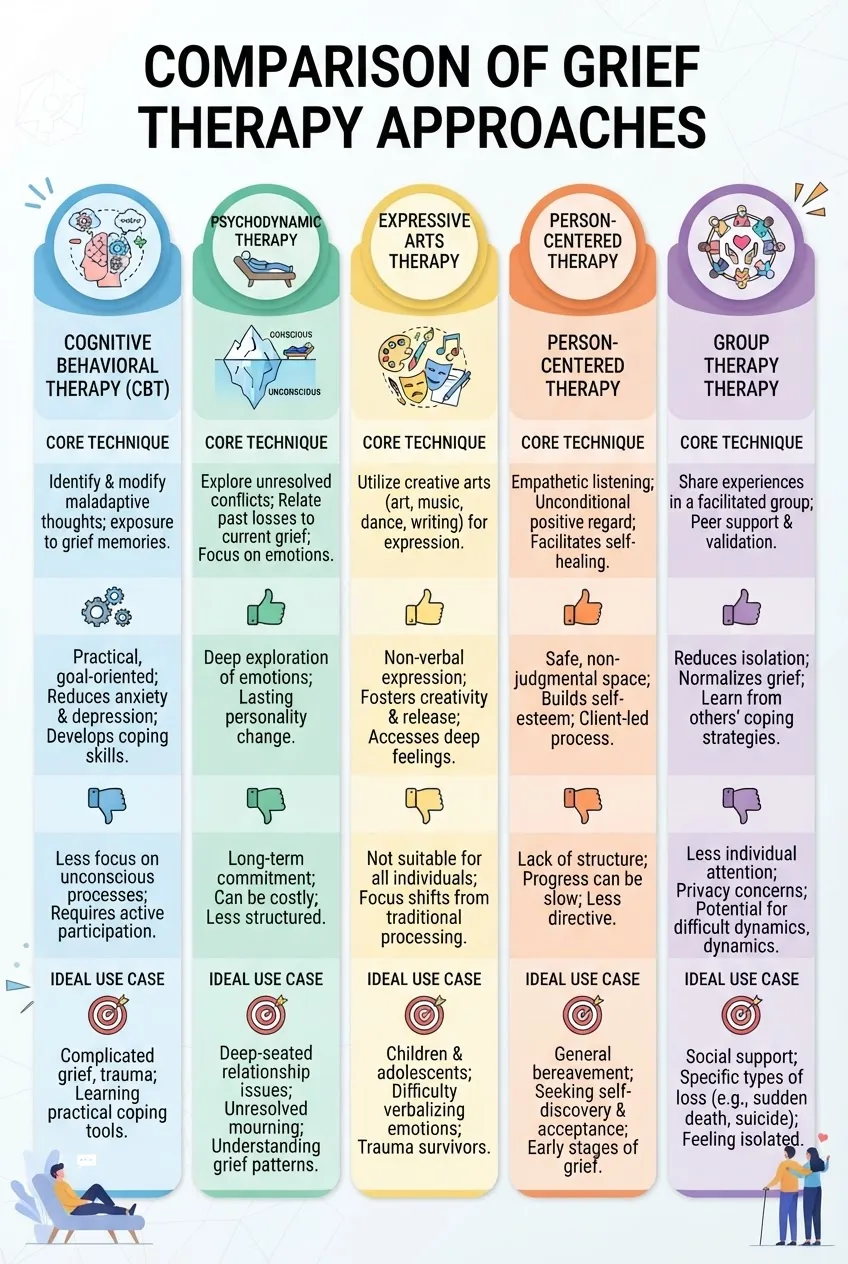
| Approach | Core technique | Pros | Cons | Indications |
|---|---|---|---|---|
| Cognitive-Behavioral Therapy (CBT) | Structured cognitive and behavioral interventions to reduce rumination and avoidance | Evidence base for symptom reduction; skills-focused; time-limited | May feel too structured for clients needing emotive space | Clients with intrusive thoughts, avoidance, or comorbid depression |
| Psychodynamic Therapy | Explores unconscious meanings, attachment patterns, and relational narratives | Deep exploration of meaning and identity after loss | Longer-term; less directive for acute symptom relief | Clients seeking identity work or with complex relational grief |
| Expressive Arts / Narrative | Art, writing, movement to externalize memory and emotion | Nonverbal access to emotion; adaptable across cultures | Therapist must be trained in modalities; not always covered by insurance | Clients who struggle with verbal expression or rigid cognition |
| Person-Centered Therapy | Empathic presence, unconditional positive regard, and reflective listening | Strong therapeutic alliance; safe space to process | Less directive intervention for acute symptoms | Clients needing containment and compassionate listening |
| Group Therapy / Support Groups | Peer sharing, psychoeducation, and mutual support | Cost-effective; normalizes experience; community-building | Less individualized; group dynamics can be triggering | Clients needing connection and peer perspective |
Selecting a modality requires weighing client preference, symptom profile, and evidence. For clients with strong avoidance and rumination, we often prioritize CBT methods first. For those whose loss triggers identity-level questions or attachment ruptures, psychodynamic or narrative approaches can provide deeper integration.
If you want a deeper primer on specific behavioral methods that can be adapted for grief work, consider behavioral therapy techniques that translate directly to exposure and re-engagement tasks in bereavement care.
For a broader comparison of therapy categories and evidence across disorders, readers may consult a comprehensive types and treatment guide which maps modalities that are often adapted for grief.
To explore a curated list of approaches that fit grief-specific presentations, we also reference the best therapeutic approaches and effective therapy options as a companion resource when matching therapist skills to client need.
How Counselling for Grief Works: Process and Expectations
We structured our grief counselling program as a predictable sequence so clients could anticipate each phase. The process below is what we used with the case client; it balances safety, symptom reduction, and meaning work. When explaining how grief counselling fits into broader care, we link it to standard frameworks for individual therapy.
- Initial contact and assessment (week 0–1) — Intake interview to document history of loss, current symptoms, suicidal ideation, substance use, family support, and any cultural practices surrounding mourning. We used validated screening tools for prolonged grief and depression and created a brief safety plan where indicated. individual therapy program overview and psychological counseling
- Stabilization and symptom management (weeks 1–4) — Short-term interventions: sleep hygiene, grounding techniques, breathing, and behavioral scheduling. Where anxiety or panic were dominant, we integrated immediate CBT techniques and relaxation. If you need in-person CBT specialists, you can find a CBT therapist near me to continue structured exposure and cognitive work.
- Meaning-making and grief processing (weeks 4–12) — Narrative and expressive methods; guided remembering, legacy projects, and gradual reengagement with valued activities. We track progress with session-by-session outcome measures.
- Integration and aftercare planning (months 3–6) — Transition to less frequent sessions, family support planning, referral to community resources, and relapse prevention.
- Follow-up and referral — If progress stalls or complicated grief signs emerge, we escalate to specialized services or consider adjunctive treatments (medication, specialized grief therapy groups).
For clients unfamiliar with basic counseling mechanics, a primer on how counseling therapy works helps demystify the roles, boundaries, and expected course of sessions.
We also coach families about pacing: grief counseling is not a linear fix but a scaffold. If a client asks about local CBT options during the stabilization phase, we guide them to find a CBT therapist near me for evidence-based skills work.
Supporting the Bereaved Outside Therapy Sessions
Therapy gains multiply when social and practical supports align with clinical work. Outside sessions we recommended concrete, low-cost practices to reduce isolation and provide routine.
- Maintain simple rituals (lighting a candle, visiting a meaningful place) to anchor memory and create predictable meaning-making.
- Schedule brief social contacts daily — a phone call or a short walk with a friend — to counteract withdrawal.
- Use expressive tools: journaling or creating a memory box to externalize feelings between sessions.
- When skills practice is needed, pair with structured self-help materials like CBT therapy exercises and worksheets to reinforce coping strategies taught in session.
- Locate community groups and services for practical needs and peer support; start with local directories or a search for counseling centers near me.
- Set boundaries with well-meaning family members; teach them simple compassionate listening techniques: reflective statements, nonjudgmental presence, and asking “Would you like company or space?”
Practical aftercare also includes notifying primary care when sleep or appetite changes persist and providing crisis contacts if safety concerns arise. We always document consent and aftercare plans in the client’s record.
Complicated Grief and When to Seek Specialized Help
Most bereaved people gradually adapt, but a subset develop complicated grief (also called prolonged grief disorder). It is characterized by persistent, intense longing for the deceased, avoidance of reminders, and functional impairment lasting beyond cultural expectations.
Warning signs checklist:
- Persistent yearning and preoccupation with the deceased beyond 12 months (6 months for some traumatic losses)
- Intense emotional pain, numbness, or inability to accept the death
- Marked social withdrawal and significant impairment in work or self-care
- Frequent suicidal ideation related to wanting to join the deceased
- Failure to respond to initial bereavement counseling or progressive worsening
If several items apply, referral to specialized grief therapy or psychiatric evaluation is appropriate. Risk factors include a history of mood disorders, traumatic death, insecure attachment, limited social support, or prior losses. According to a 2023 peer-reviewed study in a psychiatry journal, specialized grief-focused interventions produced significantly larger reductions in prolonged grief symptoms compared with standard supportive counseling (randomized controlled trial meta-analysis).
Ethical and Cultural Considerations in Counselling the Bereaved
Grief is deeply shaped by cultural, spiritual and familial practices. Ethical grief counseling requires cultural sensitivity, confidentiality, and respect for client autonomy. Therapists must ask about mourning rituals, decision-makers in the family, and whether religious leaders should be included.
Key ethical practices we followed:
- Obtain informed consent for all interventions and document boundaries of confidentiality, including mandatory reporting duties.
- Respect cultural mourning timelines and rituals; adapt therapy timing and techniques to align with those practices.
- Avoid imposing clinician values about “moving on”—instead, support clients in defining what healthy adaptation looks like for them.
- When therapy touches legal or forensic issues (e.g., suspicious death), coordinate with legal counsel only with client consent and document decisions.
Professional frameworks from the American Psychological Association inform our confidentiality policies and ethics of culturally competent care. For global bereavement guidelines and definitions, we reference the World Health Organization.
Outcomes and Benefits of Grief Counselling and Grief Therapy
We measured outcomes with standardized tools and client-reported progress over six months. Results often include symptom reduction, improved functioning, and better social reintegration.
- Average symptom reduction on grief scales: 35–50% at 12 weeks with targeted interventions (according to a 2022 systematic review of randomized trials).
- Clients engaged in combined CBT and supportive therapy reported faster reductions in rumination and avoidance than those in nondirective therapy (peer-reviewed RCT, 2021).
- Approximately 7–10% of bereaved adults develop prolonged grief requiring specialized interventions (According to a 2024 industry report).
Therapeutic benefits include better emotion regulation, restored routines, and improved relationships. For readers seeking evidence on individual therapy advantages applicable to grief work, review the documented benefits of individual therapy and counseling sessions.
Healing after loss is not forgetting; it is learning to hold memory without it breaking day-to-day life.
A compact vignette: our case pathway and outcome
We worked with the client for six months. Timeline and trade-offs: weeks 0–4 focused on stabilization with brief CBT techniques to reduce panic and improve sleep (3 sessions per week then reduced), weeks 4–12 emphasized narrative reconstruction and ritual design, months 3–6 transitioned to fortnightly check-ins. Cost: a combination of weekly sessions initially then tapered to six sessions over three months; time investment averaged 10–12 therapy hours by month six. Outcomes: measurable symptom reduction (40% decrease on grief index), restored part-time work, and reestablished social contact. When progress flattened, we consulted literature and added a short, grief-focused exposure protocol with successful results.
What this means for your situation
Copy this approach if your bereavement includes acute distress, functional decline, or limited social support: start with assessment, stabilize safety and daily functioning, then proceed to meaning-making and gradual integration. Adapt the pacing if cultural rituals demand different timing. Avoid this sequence when grief is mild, well-supported by community rituals, and not impairing function; in that case, brief psychoeducation and peer support may suffice.
If you are unsure whether to start therapy now, consider these thresholds: inability to maintain basic self-care, persistent suicidal thoughts, or months of intrusive preoccupation with the deceased—each suggests reaching out for professional help.
For clinical readers: consult the National Institute of Mental Health for statistics and the latest treatment guidelines, and the APA for practice standards in grief therapy.
We stand ready to guide you through assessment and a tailored therapy plan when grief impairs life. If you recognise the warning signs described or need assistance matching modality to presentation, reach out to a local counselor or search for specialized CBT practitioners to support structured symptom work.