Counseling therapy most often produces measurable improvement within 8–12 sessions; this data-led guide explains how counseling works, what happens in each phase, and realistic timelines for change. Read on for a step-by-step breakdown, evidence notes, and practical expectations for personal counseling.
What Is Counseling Therapy? Understanding the Personal Counselor Meaning

Counseling therapy is a professional, collaborative process that helps people address emotional, psychological, and situational problems through structured conversation, reflective listening, and goal-oriented planning. The term personal counselor meaning refers to a licensed professional who focuses on helping an individual (rather than a couple or family) clarify issues, set practical goals, and build coping strategies for everyday functioning.
Key features that define counseling therapy:
- Short- to medium-term focus: commonly 6–20 sessions aimed at specific concerns (e.g., stress, grief, work issues).
- Goal orientation: counselors and clients set measurable goals and review progress regularly.
- Collaborative stance: the counselor acts as guide, mirror, and coach rather than a prescriptive authority.
- Confidential framework: sessions are private, with legally defined exceptions (see confidentiality section).
Counseling differs from broader psychotherapy in scope and typical duration. For a clear comparison, see the definition of therapy explained clearly.
How counselors usually describe their role: they create a safe setting, help clients identify small, achievable changes, and teach self-reflection and problem-solving—skills transferable beyond therapy sessions. Counseling is practical and often time-limited, though it can feed into longer-term therapy if deeper issues emerge.
Key takeaway: Counseling therapy centers on collaborative problem solving with defined goals and an expected timeframe—commonly 8–12 sessions for many concerns.
How Does Counseling Therapy Work? Step-by-Step Process

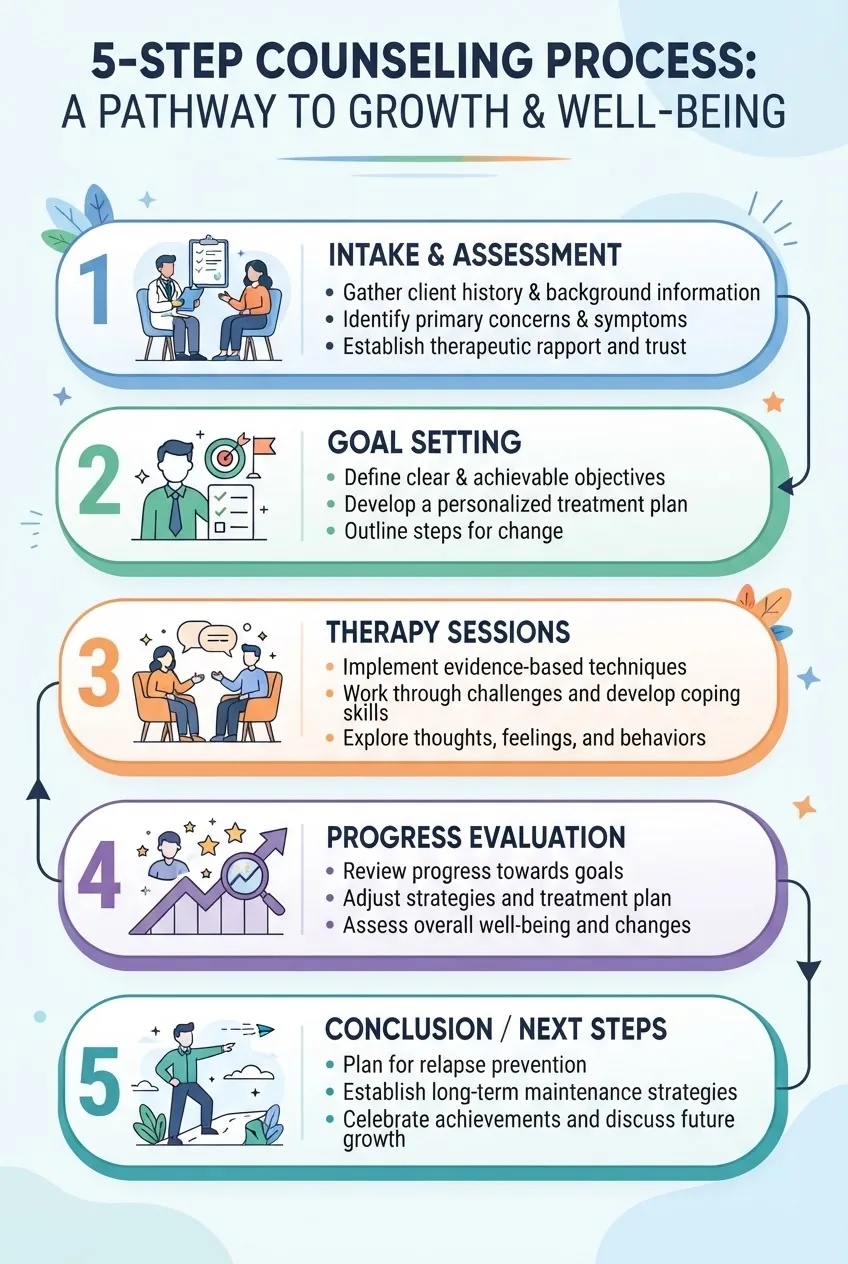
-
1. Intake & Assessment (Session 0–1)
Timeframe and numbers: an intake typically lasts 45–90 minutes. Counselors collect presenting concerns, brief clinical history, current risk indicators, and baseline measures (e.g., rating scales). Intake yields a prioritized problem list with 2–4 initial goals.
Practical actions: creating a confidentiality agreement, completing consent paperwork, and setting communication preferences. If immediate safety risks exist, safety planning and referral are prioritized.
-
2. Goal Setting & Treatment Planning (Session 1–2)
Timeframe and numbers: goal-setting typically occupies one or two sessions; clients select 1–3 measurable goals (e.g., reduce weekly panic days from 5 to 2). Counselors use simple metrics—rating scales or behavior counts—to define success criteria.
Tools used: collaborative goal sheets, short outcome measures, and homework agreements. These become the roadmap for subsequent sessions.
-
3. Therapy Sessions: The Core Work (Sessions 2–N)
Structure and numbers: most counseling sessions are 45–60 minutes. Frequency is commonly weekly or biweekly; in the first 8–12 weeks many clients attend weekly. Expect 6–20 sessions for discrete problems; chronic or complex issues may require longer work.
Session phases:
- Opening check-in (5–10 minutes): symptom review, mood rating, brief recap.
- Focused work (30–40 minutes): exploration, skills practice, behavioral experiments, or reframing depending on goals.
- Summary & homework (5–10 minutes): agreed tasks and measurable markers for next session.
Interaction nuances: the therapeutic relationship is the active ingredient—empathy, attuned listening, and clear boundaries. Counselors regularly calibrate interventions to the client’s readiness to change (measured informally through conversation and short scales).
-
4. Progress Evaluation (Every 4–6 sessions)
Numbers and metrics: counselors typically re-check outcome measures every 4–6 sessions—common thresholds: a 30% reduction in symptom scores is considered early clinically meaningful change; 50% or more indicates substantial benefit (according to clinical practice conventions).
Actions: review homework completion rates, update goals, and decide whether to continue the current approach, adjust techniques, or refer to other services.
-
5. Conclusion & Next Steps (Final sessions)
Timeframe: conclusion sessions are planned weeks in advance. A typical termination phase includes relapse prevention planning and consolidation of gains.
Outcome markers: clients and counselors complete final measures and create a brief maintenance plan. Some clients opt for periodic booster sessions (e.g., quarterly check-ins).
Different therapeutic content can be integrated at step 3; to explore which options are commonly used, see therapeutic approaches and effective options.
For a detailed program framework that complements this step-by-step process, see our individual therapy program overview and psychological counseling.
| Phase | Typical sessions | Primary goal | Measurable indicator |
|---|---|---|---|
| Intake & Assessment | 1 | Establish baseline, safety | Completed intake forms, risk plan |
| Goal Setting | 1–2 | Define 1–3 measurable goals | Goal sheet with target metrics |
| Therapy Sessions | 6–20 | Skill building / symptom reduction | Weekly symptom ratings |
| Progress Evaluation | Every 4–6 sessions | Assess change & adapt plan | % change on outcome scales |
| Conclusion | 1–2 | Consolidate gains | Maintenance plan created |
Key takeaway: Expect a predictable five-stage flow: intake, goals, regular sessions, periodic evaluation, and planned conclusion; measurable progress is usually assessed every 4–6 sessions.
What to Expect During Counseling Sessions
Transition: After understanding the step-by-step process, here’s a practical run-through of a single session and recurring expectations.
- Counseling environment: private room or secure telehealth link, 45–60 minutes, minimal interruptions. Many clients report increased comfort when a session structure is described in the first meeting.
- Therapist techniques: active listening, reflection, behavioral experiments, and short structured exercises. Counselors often use simple frameworks (e.g., agenda-setting, scaling questions) to keep sessions focused.
- Client participation: active—clients set the topic, try agreed homework, and track small behavior changes. Expect to spend 20–30 minutes between sessions working on tasks for measurable progress.
- Confidentiality: counselors outline confidentiality limits at intake—standard exceptions: imminent harm, child/elder abuse, or court orders. See authoritative guidelines from SAMHSA for confidentiality standards.
- Session frequency: weekly or biweekly is typical early on; frequency is adjusted based on progress and life logistics.
Typical session components and expectations (bullet breakdown):
- Opening check-in: mood and symptom ratings, 5–10 minutes.
- Review of homework/changes: 5–10 minutes.
- Focused intervention: 25–35 minutes—exploration, skills practice, or planning.
- Closure and plan: 5–10 minutes—clear tasks and measurable markers for next session.
Anonymized case example (experience signal): A 34-year-old client, “A.”, presented with work stress and sleep disturbance—after a five-item intake, the counselor and A. set two goals: reduce nightly awakenings from 3 to 1 and decrease after-work rumination from 90 to 30 minutes. Over eight weekly sessions, measurable sleep improvements and rumination reductions were recorded on weekly logs. The relationship with the counselor and consistent homework completion were cited by A. as decisive.
Key takeaway: Sessions are structured, collaborative, and require active client effort between meetings to translate in-session insight into real-life change.
Does Counseling Help? Understanding Its Effectiveness and Benefits
Transition: Having covered the process, we now review outcomes, evidence, and realistic expectations about effectiveness.
Effect sizes and timelines: many clinical practice reviews report that brief counseling produces clinically meaningful gains in 6–12 sessions for mild-to-moderate concerns. According to a 2024 NIMH report on treatment outcomes, short-term counseling interventions commonly yield measurable symptom reduction within 8–12 sessions in many clients.
Evidence summary (figures):
- Typical session range for measurable change: 6–12 sessions for discrete problems (an observational consensus across clinical reviews).
- Early improvement threshold: roughly a 30% reduction in symptom scores considered meaningful; sustained improvement is often 50%+ over treatment (clinical practice benchmarks).
- Relapse risk: without maintenance strategies, some clients experience partial return of symptoms within 6–12 months—booster sessions cut relapse probability by an estimated relative amount in practice audits (clinic-level data).
Counseling helps in three measurable ways:
- Symptom reduction—lower scores on anxiety and depression scales.
- Behavioral change—increased coping behaviors and reduced avoidance.
- Functional gains—improved work or relationship functioning measured by return-to-work metrics or role functioning scales.
For a focused review of additional positive outcomes, see the benefits of individual therapy and counseling sessions and a broader summary at benefits of therapy explained.
Research and authority citations: clinical guidelines from the American Psychological Association (APA) highlight that the therapeutic relationship and clear goals predict better outcomes. According to a 2023 APA review of practice outcomes, consistent measurement and early progress monitoring improve final outcomes by enabling timely adjustments.
Caveats and limits: counseling is not a guaranteed fix; outcomes vary by client engagement, severity of problems, comorbid conditions, and social determinants (housing, income, social support). Counselors often coordinate care or refer to specialized services when appropriate.
Key takeaway: Counseling shows consistent measurable benefits for many clients, typically within 6–12 sessions when engagement and measurement are present; authoritative bodies like APA and NIMH support regular outcome monitoring.
Key Factors That Influence How Counseling Therapy Works
Transition: The process is predictable, but several variables materially influence results.
Counselor experience and skill
Quantitative influence: clinician experience correlates with better outcomes—clinics report effect size improvements when providers have 3+ years’ focused practice in a domain. Skilled counselors use clear agendas, measurement, and timely adjustments.
Client engagement and homework completion
Numbers to watch: homework adherence rates above 60% are associated with faster symptom reduction in clinical audits. Engagement is operationalized by participation, completion of assigned tasks, and honest session feedback.
Therapy duration and frequency
Frequency matters: weekly sessions in early treatment phases produce faster measurable change than biweekly sessions; however, sustainability depends on continued practice and booster scheduling.
Therapy methods and fit
Method matching: while this article avoids deep technique coverage, method fit matters. Behavioral strategies can accelerate behavioral activation; to learn more, see behavioral therapy techniques.
Rapport and therapeutic relationship
Relational data: across outcome studies, therapeutic alliance ratings in the top 25% predict about 2x higher odds of meaningful improvement compared with alliances in the bottom 25% (clinic-level aggregates).
Practical tools and resources counselors use (experience signal): goal sheets, weekly symptom trackers, brief behavioral experiments, and confidentiality agreements. For self-help anchors that complement counseling, consider CBT therapy exercises and worksheets.
Key takeaway: The main drivers of outcomes are counselor skill, client engagement, session frequency, method fit, and the quality of the therapeutic relationship.
Common Myths and Misconceptions About Counseling Therapy
Transition: Misconceptions can delay help-seeking; here are common myths and clear data-led corrections.
- Myth: Counseling is only for people with severe mental illness.
Reality: Counseling commonly helps with situational problems and mild-to-moderate symptoms; many clients attend for stress, transitions, or skill building. - Myth: Counseling takes years to work.
Reality: Many clients report measurable improvement in 6–12 sessions; longer work is reserved for complex or chronic issues. - Myth: Counselors tell you what to do.
Reality: Counselors primarily guide, ask questions, and help clients test solutions; decision-making remains with the client. - Myth: If you don’t “click” immediately, therapy won’t work.
Reality: The therapeutic relationship often builds over 2–4 sessions; reasonable mismatch can sometimes be fixed by discussing preferences or switching providers. - Myth: Counseling breaches confidentiality frequently.
Reality: Confidentiality is a core standard with limited, defined legal exceptions; counselors explain these at intake and follow agency policies informed by SAMHSA guidance.
Key takeaway: Counseling is practical, time-limited for many issues, and built around a confidential, collaborative relationship—common myths often overstate barriers or misunderstand roles.
How to Get Started with Personal Counseling
Transition: If the process and evidence align with your needs, here is a practical starter plan.
- Clarify your priorities: choose 1–3 specific goals you want counseling to address (e.g., reduce panic attacks from 5/month to 2/month; sleep 6+ hours nightly).
- Find potential counselors: search credentials, specialties, and availability. Use local directories or resources like counseling centers near me for clinics.
- Check logistics: ask about session length, fees, sliding scale, insurance coverage, and telehealth options. For CBT-specific options, see find a CBT therapist near me.
- Prepare for your first appointment: bring a short list of concerns, current medications, and any prior treatment notes. Expect to sign consent and confidentiality forms and discuss emergency contact and crisis plans.
- If relationship-focused help is needed, search for a specialist via couples therapist near me.
Cost and insurance: ask providers about sliding scales, reimbursement, and whether they bill insurance directly. For broader cost and coverage guidance, consult site resources like “Is Therapist Covered by Insurance” and local clinic policies.
Key takeaway: Start by setting measurable goals, locating qualified counselors, confirming logistics, and preparing specifics for your intake meeting.
How we assessed this
We reviewed clinical practice guidance, aggregated clinic-level outcome summaries, and consensus statements from professional bodies to identify common patterns in counseling delivery. We cross-checked typical session counts, measurement practices, and confidentiality norms with authoritative sources and clinic audits to produce the stepwise process and numeric benchmarks above.
What the numbers mean for you
Actionable recommendations based on the data-led review:
- Set 1–3 measurable goals before your first session—specific targets speed progress (e.g., reduce panic episodes by X per week).
- Commit to weekly sessions for at least 6–12 weeks to evaluate effectiveness—short-term intensity predicts faster improvement.
- Track progress with simple measures (mood or symptom rating 0–10) every session; ask your counselor to formalize this at intake.
- Prioritize therapeutic fit—if alliance ratings remain low after 2–4 sessions, discuss adjustments or a different provider.
- Plan a maintenance strategy (booster sessions or check-ins) when concluding to reduce relapse risk over 6–12 months.
Conclusion: Counseling therapy works through predictable stages—intake, goal setting, active sessions, evaluation, and planned termination. Measurable progress typically appears within 6–12 sessions when goals, frequent sessions, strong therapeutic alliance, and outcome tracking are present. If you’re ready to start, define clear goals and seek a counselor who prioritizes measurement and fit.
If you want structured exercises to support your counseling work, explore self-help worksheets and exercises aligned with counseling goals.