Definition of therapy: by the end of this guide you will be able to explain what therapy means, describe its core purpose, and outline the basic steps of the therapeutic process — this takes about 60–90 minutes of careful reading and assumes no prior clinical training.
This hands-on guide breaks the concept of therapy into actionable pieces, explains common terms clearly, and gives practical examples you can use to talk about therapy or prepare a conversation with a clinician.
Before you start
- Curiosity and patience — allow 60–90 minutes to read carefully and take notes.
- Notebook or device for jotting examples and questions (5–10 minutes).
- Access to reputable sources for follow-up reading: American Psychological Association (APA), National Institute of Mental Health (NIMH), World Health Organization (WHO).
- Open mindset: therapy is a process, not an instant fix.
Move now into a step-based exploration: the following numbered steps form the core of this guide and are designed so you can teach or explain therapy to someone else.
What Is Therapy? The Basic Definition Explained
Therapy — often used interchangeably with counseling and psychotherapy — is any structured, collaborative process in which a trained practitioner and a client work together to understand and respond to emotional, psychological, behavioral, or relational challenges. For a concise professional wording, the American Psychological Association defines therapy as structured psychological treatment aimed at improving mental well-being and functioning (According to the American Psychological Association (APA), 2023 report).

To put that into everyday language: therapy is a focused conversation with a trained professional about thoughts, feelings, and actions, guided by a plan or goal. It is not simply venting; it is a methodical, confidential partnership intended to produce change. When people ask “what does therapy mean?” they usually want this practical description — a guided process for exploring and resolving issues.
Examples:
- Someone feeling overwhelmed by work uses therapy to identify stress patterns and set limits.
- A person with recurring relationship conflict uses therapy to learn communication strategies and explore emotions.
- A teen experiencing low mood meets with a therapist to map symptoms and create a step-by-step plan for recovery.
If you want more detailed program information about individual therapy, see our comprehensive
Individual Therapy Program Overview and Psychological Counseling.
Transition: understanding the definition leads naturally to the question of why people choose therapy — the next section outlines those core purposes.
The Purpose of Therapy: Why Do People Seek It?
At its core, the purpose of therapy is to create change that improves a person’s functioning, reduces distress, and helps someone meet meaningful life goals. Therapists articulate this through clear counseling goals and measurable outcomes.
Common, practical purposes of therapy include:
- Manage symptoms: Reduce anxiety, depression, intrusive thoughts, or other distressing symptoms through structured support and strategies.
- Improve relationships: Learn communication, set boundaries, and repair attachment patterns.
- Build skills: Develop coping mechanisms, emotional regulation, problem-solving, and decision-making skills.
- Clarify values and goals: Align daily choices with long-term life goals and identity work.
- Support through transitions: Navigate grief, career changes, parenting, illness, or relocation with guided emotional support.
- Address behavioral patterns: Identify and change behaviors that cause harm or limit functioning (see our resource on behavioral therapy techniques for method-specific insight).
- Facilitate healing and recovery: Work through trauma, addiction recovery, or chronic mental health conditions with structured plans focused on long-term outcomes.
Therapy provides emotional support and a safe environment to explore problems; this nurturing setting is sometimes called the cornerstone of the therapeutic process. The typical therapy outcomes people seek range from symptom reduction to improved life satisfaction and sustainable coping strategies.
For those interested in the specific advantages of individual sessions, visit our guide on the
benefits of individual therapy.
Transition: now that you know why people go to therapy, the next section explains how the therapeutic process typically unfolds in practice.
How Therapy Works: An Overview of the Therapeutic Process
The practical heart of therapy is the therapeutic process: a sequence of steps from assessment to outcomes. Below is a stepwise, hands-on map that a practitioner might follow and that you can use to explain therapy to others.
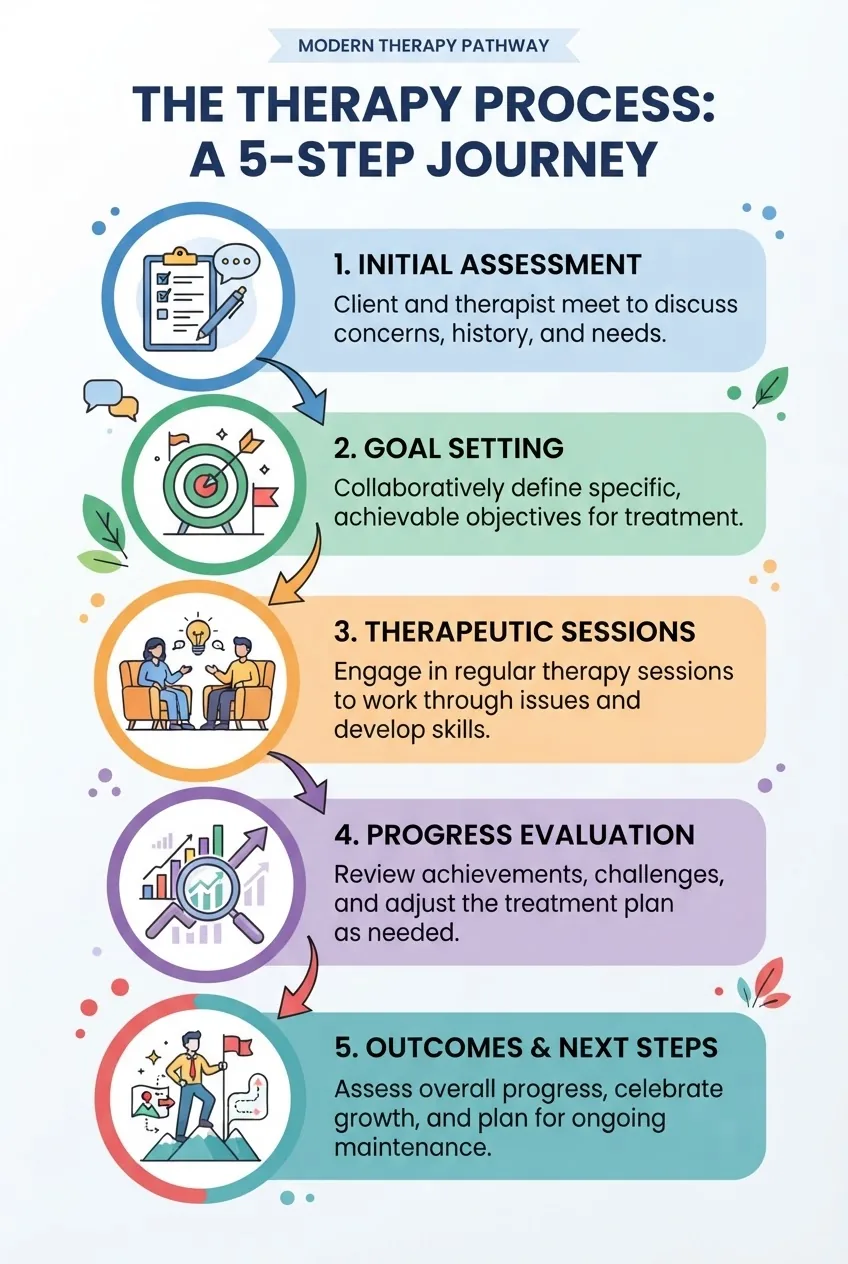
- Conduct an initial assessment. The clinician gathers history, current symptoms, and immediate risks (suicidality, harm) over a typical 45–90 minute intake. They may use standardized measures (PHQ-9 for depression, GAD-7 for anxiety) to create baseline scores.
- Set collaborative goals. Within 1–3 sessions the therapist and client identify 2–5 concrete counseling goals (e.g., reduce panic frequency from daily to fewer than once a week; improve nightly sleep to 6–7 hours). Goals are specific, measurable, and time-framed (6–12 weeks is common).
- Develop a treatment plan. The plan lists session frequency (weekly is common), methods to use (talk therapy elements, skill training, tracking), and expected milestones. This plan is reviewed every 4–8 sessions to check progress.
- Engage in regular therapeutic sessions. Sessions usually last 45–60 minutes. The practitioner uses a blend of listening, reflection, psychoeducation, and exercises tailored to goals. Early sessions focus on safety and rapport; middle sessions focus on skill practice and insight; later sessions emphasize maintenance and relapse prevention.
- Track progress and adjust. Therapists use outcome measures, client self-report, and behavioral indicators. If progress stalls after 6–12 sessions, the therapist will revise goals, consider different evidence-based approaches, or refer to specialty care.
- Conclude and plan next steps. When agreed goals are met or progress plateaus, the therapist and client plan tapering and maintenance (monthly check-ins, booster sessions). The aim is durable recovery and transferable skills.
Practical tools commonly used in the process include symptom checklists, mood tracking, journaling, behavioral experiments, and structured communication exercises. Therapists may draw from multiple therapy modalities depending on goals and evidence, while focusing on the agreed plan.
Real-world scenario: A client named Maya enters therapy reporting nightly panic attacks. Initial assessment (1 session) uses a PHQ-9 and a panic frequency log. Collaborative goals: reduce panic attacks to fewer than two per month within 12 weeks and regain the ability to attend evening classes. Treatment plan: weekly 50-minute sessions for 12 weeks with CBT-informed tools and breathing exercises, plus homework: daily 10-minute breathing practice and a panic log. By week 8 Maya’s panic frequency drops by 60%, sleep improves, and she returns to classes, illustrating how clear therapy outcomes translate from goals to measurable change.
For a deeper dive into practical techniques and where to find trained therapists, see our resource on
best therapeutic approaches,
find a CBT therapist near me,
CBT therapy exercises and worksheets, and
how counseling therapy works.
Transition: knowing how therapy works helps us identify and correct widespread misunderstandings, which is the next section.
Clarifying Common Misconceptions About Therapy
Below are frequent myths about therapy followed by concise facts that correct them.

- Myth: “Therapy is only for people with severe mental illness.” Fact: Therapy supports a wide range of issues from everyday stress to clinical disorders; many people use therapy for growth, not just crisis.
- Myth: “If I go to therapy, it means I’m weak.” Fact: Seeking help is an adaptive response and a sign of self-awareness; research links help-seeking to better long-term outcomes (According to a 2023 APA report on help-seeking behavior).
- Myth: “All therapists do the same thing.” Fact: Practitioners vary in training and methods — psychotherapy, counseling, and other approaches can differ in focus and techniques.
- Myth: “Therapy fixes everything quickly.” Fact: Therapy is process-driven; typical meaningful change often takes weeks to months, depending on goals and complexity.
- Myth: “Talking is the only tool in therapy.” Fact: Talk is central, but therapists frequently use practical tools (exposure exercises, behavioral activation, skills training) and measure outcomes objectively.
- Myth: “Psychotherapy and therapy are different.” Fact: Psychotherapy is a formal term for clinically oriented therapeutic work; in everyday usage psychotherapy and therapy overlap heavily, though psychotherapy often denotes longer-term or clinically framed work. See our comparison at Is Psychotherapy the Same as Therapy? Clear Comparison Guide.
- Myth: “Therapy is a one-size-fits-all solution.” Fact: Effective therapy is tailored to the client’s goals, culture, and circumstances; evidence-based practice blends research, client preferences, and clinical judgment.
- Myth: “Who needs therapy?” Fact: Anyone seeking change, emotional relief, or skill-building can benefit — need is not limited to diagnosis. For loss-related help, see our grief therapy and support guide.
Transition: having dispelled common myths, we now broaden the definition to show therapy’s many forms and contexts beyond traditional counseling.
The Broader Meaning of Therapy Beyond Traditional Counseling
The word therapy extends past talk-based counseling to include diverse practices that support healing and functioning. When people use the term more broadly they might mean creative, physical, or community-based interventions that share core aims: reduce distress, build capacity, and support recovery.
Comparative notes:
| Type | Primary focus | Typical setting |
|---|---|---|
| Traditional counseling / psychotherapy | Emotional insight, behavior change, mental health | Private clinic, community center |
| Creative therapy (art, music) | Nonverbal expression and processing | Group studios, therapy rooms |
| Physical therapy (rehab) | Mobility, pain, physical recovery | Clinics, hospitals |
| Holistic/community approaches | Social support, lifestyle, public health | Community centers, online groups |
Note the distinction: physical therapy addresses bodily function, whereas psychological treatment addresses mental health and emotional functioning. Both are valid uses of the word therapy, but they have different professions, training standards, and outcomes. When you explain “therapy meaning” to someone, clarify the domain (psychological vs. physical vs. creative).
To find local resources that match these broader definitions — for example relationship-focused work — see our directory for couples therapist near me and for general support see counseling centers near me.
Transition: with the broader meanings mapped, the final section sums up the core role therapy plays in mental and emotional health.
Conclusion: Understanding Therapy’s Role in Mental and Emotional Health
Therapy — whether called counseling, psychotherapy, or psychological treatment — is a structured, collaborative process designed to support mental health, relieve distress, and enable recovery and growth. It relies on a trusted client-therapist relationship, clearly stated counseling goals, and measurable therapy outcomes. According to a 2023 APA report and mental health trends summarized by the NIMH (According to a 2023 NIMH statistical brief), structured therapy remains one of the most consistently effective routes to symptom reduction and functional improvement.
If you want an in-depth look at various therapy types and their benefits, review our full guide on the benefits of therapy explained.
Call to action: If you or someone you know is considering therapy, prepare a short list of goals, ask about the clinician’s training and approach, and schedule an initial assessment to see if the relationship feels right. Therapy is a journey toward healing and recovery — it works best when tailored, measured, and collaborative.
Hands-On Steps: Core Practice Guide
This numbered protocol is a practical, teachable sequence for explaining or initiating therapy in a real-world setting.
- Explain the definition clearly (5–10 minutes). State: “Therapy is a structured, collaborative process to address emotional or psychological challenges.” Use the simple examples above. Keep language nonclinical and concrete.
- Conduct a focused intake (45–90 minutes). Collect history, current symptoms, safety concerns, and baseline measures (PHQ-9, GAD-7). Record frequencies (e.g., panic attacks/day) and functional thresholds (work hours missed per week).
- Define 2–5 measurable goals (10–30 minutes). Example format: “Reduce panic episodes from 5/week to 1/month in 12 weeks.” Attach a timeframe (8–12 weeks) and minimal tracking method (daily log).
- Create a time-limited plan (5–15 minutes). Specify session frequency (weekly 50 minutes), homework (15 minutes/day), and review points (every 4 sessions). Agree on confidentiality limits and emergency contacts.
- Implement sessions with practical tools (weekly). Use concrete exercises: breathing practice (10 minutes/day), behavior activation (schedule 3 positive activities/week), communication role-play (15 minutes in session). Track metrics weekly.
- Evaluate progress at set milestones (every 4–8 sessions). Re-administer measures, compare baseline scores, adjust interventions if no improvement of at least 25% on primary measures after 6–8 sessions.
- Plan for maintenance and ending (2–3 sessions). Schedule tapering (biweekly to monthly) and a relapse-prevention checklist listing 3 warning signs and 3 coping steps.
Common mistakes and how to avoid them
I’ve seen clinicians and newcomers make predictable errors: I once scheduled weekly sessions but never set measurable goals — progress was vague and client engagement declined. Fix: set explicit targets (frequency, intensity, timeframe). I also observed therapists over-rely on talk without practical homework; fix by assigning 10–20 minute daily practices tied to goals.
Checklist — verify your explanation and plan
- Definition delivered in plain language and examples given.
- Initial assessment documented with baseline measures.
- 2–5 specific, measurable counseling goals identified.
- Treatment plan with session frequency and homework established.
- Progress review schedule set (every 4–8 sessions).
- Exit and maintenance plan drafted with relapse signs.
When to call a professional
Contact a licensed clinician if you encounter suicidal ideation, severe self-harm, psychosis, or rapid functional decline. For specialized care (trauma-focused treatment, medication evaluation, intensive outpatient programs), seek referrals to qualified professionals immediately.