A couples therapist near me provides relationship counseling services to help partners improve communication, resolve conflict, and heal from relationship trauma; many local providers accept insurance or offer sliding scale options, making evidence-based therapy accessible to couples seeking practical, nearby support. This guide shows how to find, evaluate, and afford local couples therapy.
What Is Couples Therapy and Relationship Counseling?
Answer: Couples therapy, also called relationship counseling, is a short- to long-term clinical process where two partners meet with a licensed therapist to address communication, conflict, intimacy, and behavioral issues; therapy often uses evidence-based models like Emotion-Focused Therapy (EFT) or CBT to improve relationship functioning.
Term: Couples therapy — a form of psychotherapy focused on relationship dynamics between partners to resolve interpersonal problems and increase relationship satisfaction.
Couples therapy is distinct from individual therapy because it centers the dyad: the interactions, patterns and shared goals of the partners. Typical goals include repairing trust after infidelity, reducing repeated conflict cycles, improving sexual or emotional intimacy, or managing the impact of external stressors (work, parenting, finances).
Examples of common therapy approaches used in couples counseling:
- Emotion-Focused Therapy (EFT): focuses on identifying and reshaping partners’ emotional responses and attachment needs.
- Cognitive Behavioral Therapy (CBT) for couples: addresses distorted beliefs and teaches skill-based behavior change.
- Gottman Method: targets observed interaction patterns and builds practical skills for communication and repair.
- Integrative approaches: combine family systems, narrative, or trauma-informed methods when histories complicate couple dynamics.
An anonymized example scenario: a couple repeatedly escalates over child discipline, leading to withdrawal and resentful silence; a therapist uses structured communication exercises, conflict-mapping and weekly homework to shift their interaction pattern, resulting in fewer escalations and more consistent co-parenting decisions over three months (based on typical clinical progress patterns).
Couples therapy often overlaps with other counseling services — family counseling or adolescent therapy — when issues involve children or wider family systems. For an overview of how individual and couples work fit together, see Individual Therapy Program Overview and Psychological Counseling.
To learn more about the varied therapy types that support couples, consult Benefits of Therapy Explained with Types and Treatment Guide.

Transition: Now that you understand what couples therapy is, the next section explains exactly how to find a qualified couples therapist near you who fits logistical and insurance needs.
How to Find a Couples Therapist Near Me: Step-by-Step Guide
Answer: To find a couples therapist near me, use a stepwise approach: identify needs, search local directories and insurance portals, check credentials and reviews, contact potential therapists about availability and coverage, and book an initial consult to assess fit.
Term: Behavioral health — an umbrella term covering mental health services, including therapy for anxiety, depression, and relational issues.
- Define what you need. List primary goals (communication, trauma healing, co-parenting), preferred modality (in-person vs. teletherapy), scheduling constraints (evening hours), and whether you need a provider who accepts insurance or Medicaid.
- Search local directories and maps. Use Google Maps queries like “couples therapist near me,” but also search specialized directories (AAMFT, Psychology Today) to filter by specialty, location, and insurance. Also try local counseling centers and community clinics.
- Use your insurance portal. Log into your insurer’s provider search to find therapists who take your plan and list their clinic locations. For Medicare/Medicaid details check your plan documents or provider directories.
- Check credentials and specialties. Look for licensed marriage and family therapists (LMFT), licensed professional counselors (LPC), or licensed clinical social workers (LCSW); verify state licenses and training in couples work (EFT, Gottman, IBCT).
- Read reviews and ratings. Scan counselor reviews, star ratings, and testimonials; check separate review platforms and ask local friends or your primary care clinician for recommendations.
- Confirm logistics and cost. Ask about session length, sliding scale availability, evening/flexible hours, in-person office locations, parking, and whether they accept Medicaid or your private insurance.
- Request an initial consult. Many therapists offer brief phone/video consultations; use this to assess communication style, experience with relationship trauma, and whether you both feel safe and heard.
- Evaluate fit and move forward. If a therapist isn’t the right fit, request referrals — many therapists can recommend specialists (e.g., relationship trauma therapist near me) or other family and adolescent counselors.
Practical tools and resources to speed the search:
- Local counseling centers: search for comprehensive services and sliding scale care — see Counseling Centers Near Me: Find Therapy Resources and Support.
- Find CBT options when appropriate: Find a CBT Therapist Near Me for Professional Therapy Sessions.
- General tips for locating therapists: How to Find a Therapist: Tips for Getting Counseling Support.

Example local-search checklist to copy into your phone:
- Search terms: “couples therapist near me,” “relationship trauma therapist near me,” “therapist near me that take insurance.”
- Filter: within 5 miles, accepts my insurance, evening hours, LMFT or LCSW, accepts couples/partners.
- Contact: verify availability, confirm cost, ask about intake forms and confidentiality policies.
Transition: After you locate potential providers, the next section clarifies the different counseling services and specializations you may find locally and when each is appropriate.
Understanding Different Counseling Services and Specializations Available Locally?
Answer: Local counseling services span couples therapy, family counseling, individual therapy, child and adolescent therapy, and behavioral health services—each has different training, focus, and typical referral pathways depending on needs like relationship trauma, adolescent issues, or co-occurring anxiety and depression.
Term: Adolescent therapy — therapy focused on teenagers’ emotional, behavioral and developmental needs, often involving family systems work.
Comparison of common counseling types and when to choose them:
| Service | Who it serves | Typical focus |
|---|---|---|
| Couples therapy | Romantic partners | Communication, intimacy, infidelity, patterns |
| Family counseling | Whole family or multiple members | Systemic issues, parenting, blended families |
| Adolescent / child therapy | Children and teens | Behavioral problems, school issues, anxiety, depression |
| Individual therapy | Single adult clients | Personal mental health, trauma, mood disorders |
| Behavioral health clinics | Individuals and families | Integrated care, medication management, therapy |
Specializations to look for when choosing local providers:
- Relationship trauma therapist near me: look for trauma-informed training, EMDR or somatic approaches if there’s a history of abuse or severe betrayal.
- Therapists for anxiety and depression near me: often provide individual and couple-adapted CBT and skills training to manage symptoms that impact relationships.
- Family and adolescent counselors near me: choose providers with experience in parenting coordination and teen engagement strategies when children’s behavior affects the couple.
- Behavioral health therapist near me: typically found in integrated clinics offering medication coordination plus therapy for serious mood or substance concerns.
For a deeper dive into behavioral therapy approaches that are sometimes used in couples or family work, see Behavioral Therapy Techniques Guide for Effective CBT Training, and for broader effective approaches consult Best Therapeutic Approaches and Effective Therapy Options Guide.
Transition: With an understanding of service types, the next section explains insurance, cost, and flexible payment options for couples therapy near you.
Insurance, Costs, and Payment Options for Couples Therapy Near Me?
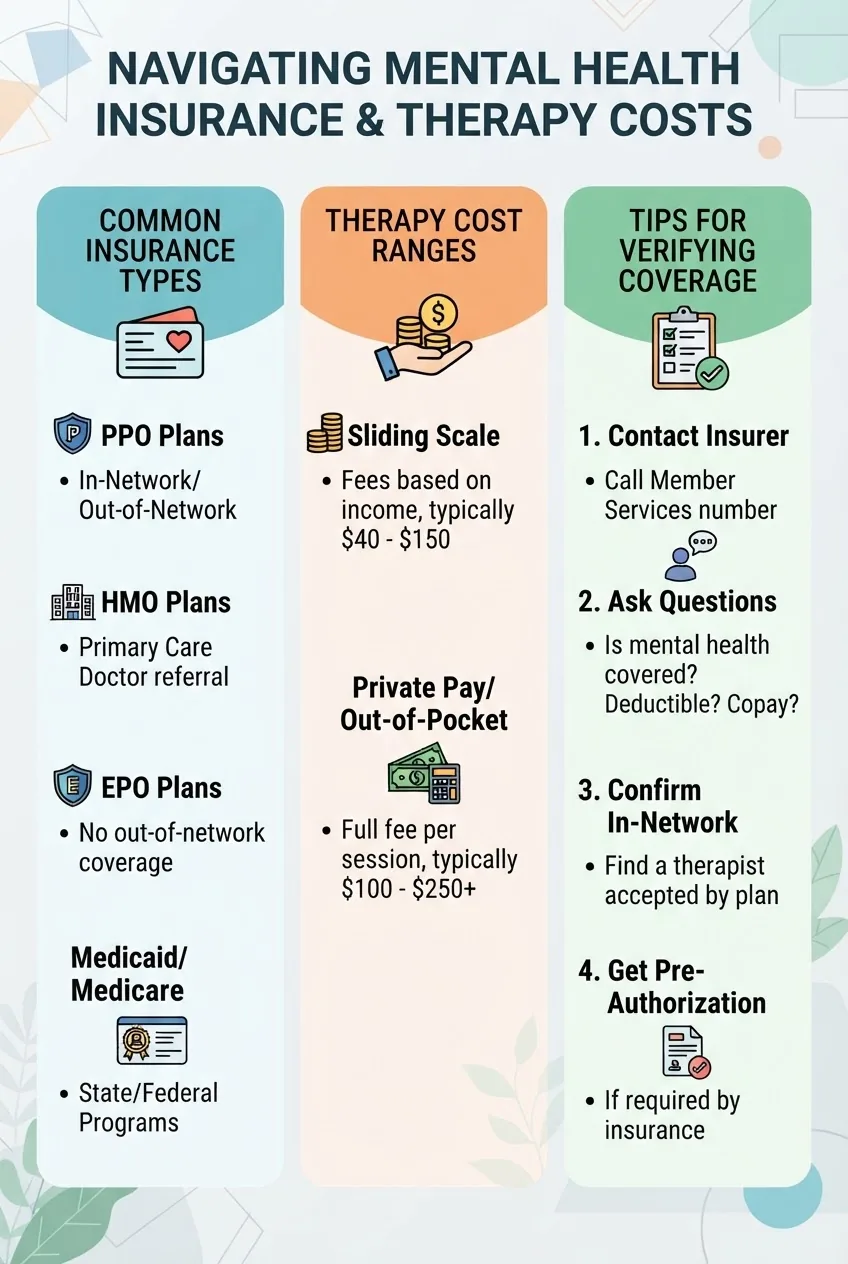
Answer: Couples therapy costs vary—many therapists accept private insurance, some accept Medicaid, and many offer sliding scale or private-pay rates; verify coverage by checking insurer directories, getting CPT codes from therapists, and confirming whether couples sessions are covered.
Term: Medicaid — a government insurance program providing health coverage for low-income individuals and families; coverage and provider participation vary by state.
How to verify insurance coverage step-by-step:
- Ask your therapist for the CPT codes they bill (e.g., 90837 for individual, 90847 often used for family/couples work) and the taxonomy code for couples or family therapy.
- Call your insurer’s provider line or check the online provider directory to confirm the clinician’s NPI and participation status.
- Confirm whether your plan covers couples therapy specifically—some plans cover individual therapy but not couple sessions billed to both partners.
- If your therapist is out-of-network, ask about a Superbills policy for reimbursement from your insurer.
Typical cost ranges (private pay and sliding scale):
| Payment Option | Typical Cost per Session | Notes |
|---|---|---|
| Insurance-covered (in-network) | $10–$50 copay (varies by plan) | Verify preauthorization and whether couples sessions are permitted |
| Out-of-network / Private pay | $100–$250+ | Ask about Superbills for partial reimbursement |
| Sliding scale | $30–$120 | Income-based discounts at community clinics or private practices |
FAQ-style common insurance questions:
- Does insurance cover couples therapy? Coverage varies; many plans cover individual therapy more consistently than couples sessions—check your policy or call your insurer.
- Can I use Medicaid? Some clinicians accept Medicaid; search your state Medicaid provider directory or ask community counseling centers about Medicaid participation.
- Are evening hours available? Many therapists offer evening or flexible hours; ask when contacting offices or filter directories for availability.
External resources for verification and standards:
- American Association for Marriage and Family Therapy (AAMFT) — standards for couples and family therapists and searchable directories.
- National Alliance on Mental Illness (NAMI) — resources on navigating mental health services and insurance basics.
- Healthcare.gov — general insurance coverage explanations and marketplace plans.
Disclaimer: Coverage and costs differ by insurer, state, and clinician; always verify benefits directly with your insurer and provider. Outcomes also vary by couple and therapist approach.
Transition: Once you understand costs and coverage, use the evaluation checklist below to pick the best therapist for your relationship.
Evaluating and Choosing the Best Couples Therapist Near You?
Answer: Evaluate couples therapists by checking licensing, specialization in couples/family therapy, evidence-based training, practical logistics (location, hours, insurance), and client reviews; use a structured checklist and trial session to confirm fit.
Term: Sliding scale counseling — a payment model where fees are adjusted based on income to increase affordability.
Practical evaluation checklist (use when comparing 2–4 candidates):
- License and credentials: state license type (LMFT, LCSW, LPC) and board certifications.
- Specialization: experience with couples, relationship trauma, or co-occurring anxiety/depression.
- Modality and approach: EFT, Gottman, IBCT, CBT—does it match your goals?
- Insurance and payment: in-network, out-of-network, sliding scale, Medicaid acceptance.
- Location and hours: therapist office and clinic locations, evening/flexible therapy hours, parking or transit access.
- Client feedback: counselor reviews and ratings; check multiple platforms for patterns.
- Communication and rapport: did both partners feel heard during the consult?
- Practical policies: cancellation, confidentiality, telehealth options.
How to weigh reviews and ratings:
- Look for repeated themes (consistent praise for communication skills or recurring complaints about scheduling).
- Value verified reviews from provider directories and local community sources over anonymous single-platform ratings.
- Ask therapists for references or anonymized case outcomes that mirror your concerns (they can share non-identifying vignettes).
Checklist for the first contact call (use this script):
- “Do you work with couples and what methods do you use?”
- “Are you in-network with [insurance name]/do you accept Medicaid?”
- “What are your fees, sliding scale options, and evening availability?”
- “How do you handle confidentiality when both partners attend?”
Transition: After you select a therapist, the following section explains exactly what to expect at your first couples therapy session and how to prepare.
What to Expect During Your First Couples Therapy Session?
Answer: The first couples therapy session is an assessment-focused meeting where the therapist gathers history from both partners, clarifies goals, explains confidentiality and logistics, and proposes a treatment plan—expect questions, short exercises, and a plan for next steps.
Term: Therapist intake — the initial assessment process where clinicians collect background, symptoms, and treatment goals to form a care plan.
How to prepare:
- Agree on logistics beforehand (who attends, child care, confidentiality boundaries).
- Bring insurance info and any prior mental health records if relevant.
- Identify 2–3 concrete goals each partner wants from therapy (e.g., “reduce weekly fights,” “restore trust,” “improve sex life”).
Typical structure of the first session (60–90 minutes):
- Introductions and informed consent: scope of confidentiality and limits (e.g., danger to self/others).
- Relationship history and problem mapping: key events, patterns, and recent triggers.
- Assessment of mental health: screening for anxiety, depression, trauma that affect the couple dynamic.
- Initial interventions: communication mapping, safe-time exercises, or brief skill-building.
- Treatment plan and homework: frequency of sessions, expected length, and next steps.
For foundational counseling session mechanics that apply to both individual and couples work, see How Counseling Therapy Works: A Guide to Personal Counseling.
Transition: Understanding session flow helps you recognize when to seek couples therapy and the potential benefits—covered next.
Benefits of Local Couples Therapy and When to Seek Relationship Counseling?
Answer: Local couples therapy provides faster access to in-person support, community-based resources, and continuity of care; seek counseling when conflict is frequent, trust is broken, communication fails, or when anxiety/depression impair relationship functioning.
Term: Relationship counseling benefits — measurable improvements in communication, conflict resolution, emotional intimacy, and partner satisfaction following structured therapy.
Key benefits of local couples therapy:
- Convenience and continuity: nearby therapist offices offer easier scheduling and follow-up.
- Access to multidisciplinary care: local clinics often coordinate with psychiatrists, pediatricians, or social services.
- Community resources: referrals to local parenting classes, mediation, or support groups.
- Faster response in crises: in-person clinics can provide same-week sessions for urgent situations.
Signs it’s time to seek couples counseling:
- Recurring conflict that doesn’t resolve after attempts to change.
- Communication breakdowns, emotional withdrawal, or avoidance of important topics.
- Infidelity, repeated betrayals, or suspected relationship trauma.
- Relationship stress caused by anxiety, depression, or substance use impacting daily functioning.
- Planning major transitions (marriage, childbirth, relocation) where guided alignment is helpful.
For deeper reading on the personal benefits of therapy alongside couples outcomes, see Benefits of Individual Therapy and Counseling Sessions Guide.
According to a 2024 industry report, community-based therapy clinics reported increasing demand for evening hours and affordable sliding scale options as local appointment wait times expanded in many regions, highlighting the importance of flexible scheduling when searching “therapist with evening hours near me.”
Conclusion: Local couples therapy offers practical, evidence-based options to address relationship distress, and with careful search and verification you can find a nearby therapist who fits your insurance, schedule, and therapeutic goals. Start by identifying priorities, using insurer directories and local counseling centers, vetting credentials and reviews, and scheduling an initial consult to confirm fit. If you’re ready, book a consult with a local therapist to begin rebuilding communication and trust.
Call to action: If you need help locating in-network couples providers, search local counseling centers and insurer directories now or contact a nearby clinic to request a referrals list and evening availability.