How to find a therapist: By the end of this hands-on guide you’ll have a prioritized list of six vetted therapist candidates, a scheduled intake appointment, and a verification checklist you can use immediately. Expect to spend 2–6 weeks on this process; no prior clinical knowledge required—basic web and phone skills are enough.
Before you begin, this guide assumes you want a practical roadmap: where to search, how to evaluate credentials, how to navigate insurance and affordability, and how to choose therapists for specific needs (depression, family therapy, couples, EMDR, CBT).
Before you start
- Tools: smartphone or laptop with internet access, pen and notebook or digital notepad, insurance card (if applicable).
- Documents: photo ID, list of symptoms or concerns, any prior mental health records or medication lists.
- Time blocks: set aside two 60–90 minute sessions over the first week for searching and three 30–45 minute blocks for calls or messaging.
- Mindset: prepare to try 2–4 therapists before finding a good fit—expect trial-and-error.
Understanding the Need for a Therapist
Start by clarifying why you want counseling. A clear statement of the problem narrows which professional and modality will help most. Typical reasons include persistent low mood, relationship conflict, parenting or family issues, grief, trauma, or workplace stress. If your concern is depression, look specifically for a depression therapist or clinicians experienced in mood disorders; for family issues, prioritize licensed family therapists.
If you want a short primer on therapy programs and how counseling is structured, see the Individual Therapy Program Overview for a fuller background before you search.
Individual Therapy Program Overview and Psychological Counseling
Why this clarity matters: when you can say “I need treatment for moderate depression” versus “I feel stuck,” you make it easier to find clinicians who specialize in evidence-based protocols, such as cognitive behavioral therapy (CBT) or interpersonal therapy (IPT). According to a 2023 NIMH report, targeted referrals to disorder-specific clinicians improve engagement and outcomes by measurable margins—so defining the need upfront saves time and enhances effectiveness. NIMH is a reliable place to review condition-specific data.
Transition: once your goals are clear—symptom reduction, family mediation, or skills-building—you can move to concrete search venues that match those goals.
Best Places to Find a Therapist
Below are the most effective places practitioners and clients use to locate therapists. Each entry gives a quick explanation and a practical next step you can do today.
- Online therapist directories — Platforms like Psychology Today, BetterHelp (for online), and regional directories let you filter by specialty, insurance, modality, and remote vs. in-person. Practical step: filter for your issue (e.g., “depression”) and export 8 profiles into a shortlist for outreach.
- Insurance provider lists — Check your insurer’s mental health directory to find in-network therapists to reduce cost. Always verify the provider’s entry by calling the therapist’s office because insurer lists can be out of date.
- Primary care and medical referrals — Ask your PCP for referrals (especially for medication + therapy coordination). Medical referrals often include clinicians who collaborate with physicians for integrated care.
- Employee Assistance Programs (EAPs) — Employers often offer short-term counseling. Use EAP for an initial triage and to get rapid access—ask for a list of recommended clinicians with specialties you need.
- Community mental health centers — Community clinics provide sliding-scale or low-cost therapy and can connect you to multidisciplinary teams (therapists, social workers, psychiatrists).
- University clinics and training programs — Clinics at universities or training institutes often offer reduced-cost care from supervised trainees; useful for steady, long-term therapy at lower cost.
- Local counseling centers — For immediate local options, search directories for “counseling centers near me.” These centers often host multiple therapists in different modalities and can match you to a team member quickly.
counseling centers near me - Referrals from trusted people — Ask friends, clergy, or professionals (lawyers, doctors) who have experience with therapists. When someone recommends a therapist, ask what the therapist’s strengths and limitations were for them.
- Specialty directories and associations — For modalities like EMDR or for clinician types (LCSW, PsyD), use association directories. If you want EMDR specifically, search providers who list certification.
find EMDR therapy practitioners near me - Search for modality-focused therapists — If you want CBT, search specifically for CBT-trained clinicians. For example, run a local query to find a CBT therapist near me and cross-check credentials.
find a CBT therapist near me - Teletherapy platforms — Teletherapy widens geographic access; check licensure rules if you cross state lines. Teletherapy platforms are often faster for scheduling.
- Nonprofit organizations and support groups — National and local nonprofits often list therapists or offer free/low-cost support. Use their directories to find clinicians experienced with specific populations.
- Specialty clinics (depression, family therapy) — Clinics that advertise depression programs or family services typically staff teams with psychiatrists, psychologists, and family therapists. Searching for “best depression therapist” plus your area yields targeted options.

Transition: now that you know where to look, the next section gives a step-by-step process to secure a therapist, from first contact through intake, verification, and scheduling.
How to Get a Therapist: Step-by-Step Guide
This section is the core of the hands-on guide. Follow these numbered steps sequentially. Each step begins with a bold, action-first phrase and includes precise timings and quantities where relevant.

- Define your goal and timeframe. Write a 2–3 sentence description of why you want therapy (e.g., “Reduce depressive symptoms interfering with work; want weekly 50-minute sessions for 12 weeks”). Time: 15–30 minutes. Outcome: a clear goal statement used in messages and intake forms.
- Create a shortlist of 6–10 candidates. From directories and insurer lists, export 6–10 therapist profiles that match specialty, modality, and availability. Time: 1–2 hours. Prioritize clinicians with recent experience treating your concern (look for “depression” or “family therapy” in profiles).
- Verify credentials and licensure first. Check state licensing boards (search “your state license lookup” + therapist name) and confirm active status. Time: 10–20 minutes per clinician. If you want an authoritative overview of licensure standards, consult the American Psychological Association for credential standards.
- Prepare a short outreach message. Draft a 3–4 sentence message that includes your goal statement, preferred session format (teletherapy or in-person), insurance or payment method, and your availability (two specific 1-hour windows). Send this by contact form, email, or secure portal. Time: 10–20 minutes per message.
- Ask verification questions during contact. Ask: “Are you currently accepting new clients? Are you in-network with [Insurance]? What is your rate for a 50-minute session? Do you offer a sliding scale?” Record answers. Time: 5–10 minutes per contact.
- Confirm insurance coverage. If you have coverage, call your insurer and ask for mental health benefits, co-pay, deductible status, and whether preauthorization is required. Ask the insurer to confirm the therapist’s in-network status by name and NPI. Time: 20–40 minutes. For more insurance guidance, see insurance coverage for therapy.
- Schedule 20–30 minute initial consults. Book brief phone or video consults with your top 3–4 candidates to assess rapport and logistics—choose times within 7–10 days. Bring your goal statement and 3 questions (see next step). Time: 20–30 minutes each.
- Use a focused question list. Ask consult questions: clinical approach for your issue, typical session frequency, expected duration of treatment, crisis availability, communication policy between sessions, and experience with your demographic. Rate answers on a simple 1–5 scale for fit. Time: ask all during consult; note answers immediately after.
- Check for team-based or multidisciplinary care. If you need medication management, ask whether the therapist works with psychiatrists or has a therapist team they refer to. Teams often improve care coordination for complex needs. Time: during consults.
- Trial 3–4 sessions with prioritized clinicians. Book 2–4 weekly sessions with your top picks to test fit; commit at least three sessions before deciding to switch unless you feel unsafe. Time: 3–6 weeks depending on weekly frequency.
- Verify cancellation and emergency policies. Confirm cancellation windows (commonly 24–48 hours), session lengths (45–60 minutes), and how they handle crises. Keep emergency contacts and local crisis line numbers saved. Time: 5 minutes; add to your notes.
- Document everything in one place. Use a single digital note: clinician name, license number, contact, insurance status, session notes, and a score for rapport. This reduces repeat work and keeps your process organized. Time: 15–30 minutes initial setup; 5 minutes per session update.
Transition: with a scheduled intake and a few trial sessions completed, the next section helps you identify the exact therapist match for your clinical needs.
Finding the Right Therapist for Your Needs
Choosing the right therapist combines clinical match, rapport, logistics, and budget. Clinical match means the therapist has experience and training for your presenting issue—depression, family conflict, trauma, or couples therapy. Below are concrete indicators and selection tips.
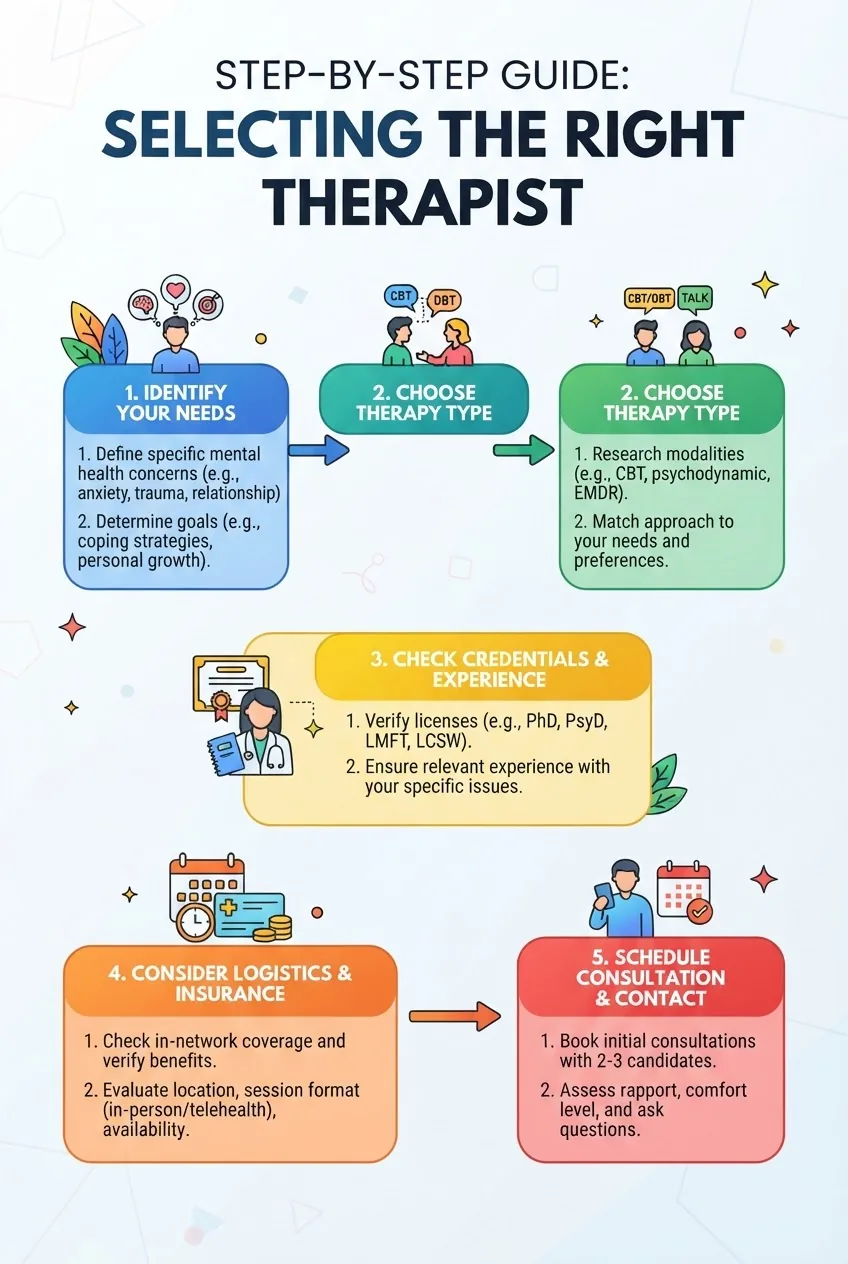
Key indicators of specialty and fit:
- Specialty listed clearly: The profile or clinician bio explicitly mentions depression, family therapy, grief, or couples work—this matters more than general “mental health” labels.
- Modality aligns with goals: If you want skills and structured work, look for CBT—see our behavioral therapy techniques for CBT discussion.
- Evidence of training or certifications in chosen modality—certified EMDR providers, CBT certification, or family therapy credentials indicate focused expertise.
- Experience with demographics (age, cultural background, sexual orientation) when that matters to your comfort and outcome.
Practical tips to evaluate fit (use these as a checklist during consults):
- Ask how they measure progress—therapists who use measurable goals (PHQ-9 for depression, session rating scales) usually track outcomes.
- Request an expected number of sessions for initial improvement (e.g., 6–12 sessions for moderate depression with CBT).
- Confirm the mix of talk therapy and skills practice; if you prefer homework-based therapy, state that explicitly.
- Ensure the therapist’s cancellation and communication policies match your needs—some therapists limit email contact or charge for late cancellations.
Modalities and roles to consider:
- CBT / behavioral approaches — structured, skills-based, good for depression and anxiety. For deeper exercises, review our resources on behavioral therapy techniques for CBT.
- Person-centered — emphasizes empathy and client-led goals; see the person-centered therapy approach for more.
- Emotion-Focused and other experiential therapies — better for emotional processing; look for clinicians listing EFT training (see emotion focused therapy techniques).
- Family and couples therapy — requires therapists trained in systemic approaches; if relevant, search to find a couples therapist near me.
- Grief and bereavement specialists — for loss-focused work, see our guide to grief and bereavement counseling.
Choose modalities based on goals; to explore a broader set of options and learn how each works, consult the summary of types and benefits of therapy and the therapeutic approaches and options.
Also consider whether you prefer individual therapy or team-based care; multidisciplinary teams can handle complex presentations (combined psychotherapy and psychiatry). For individual-focused techniques, see types of individual therapy.
Transition: once you’ve chosen a therapist, understand the credentials and what they imply about training and scope of practice.
Understanding Therapist Credentials and Therapist Info
Knowing credential types helps you set expectations about training, permitted practices (e.g., diagnosis, medication), and supervision. Use licensure verification as a requirement before scheduling ongoing sessions. For a clear comparison of professional roles, see resources that contrast psychotherapists, counselors, and licensed clinical psychologists.
If you want a direct comparison of roles, review our piece on psychotherapy vs therapy differences and the overview of therapist roles and services.
| Credential | Typical training | What they can do | When to prefer |
|---|---|---|---|
| PhD / PsyD (Psychologist) | Doctoral degree in clinical psychology, supervised internships, licensure exam. | Assessments, diagnosis, psychotherapy; some do testing and research. | Complex diagnostic work, testing, long-term psychotherapy. |
| MD (Psychiatrist) | Medical degree + psychiatric residency; can prescribe medications. | Medication management, some provide therapy; focus on biological aspects. | Medication needs, severe mental illness, combined med+therapy care. |
| LCSW / LICSW (Clinical Social Worker) | Master’s in social work + supervised clinical hours and licensure exam. | Psychotherapy, case management, community resources. | Community-based therapy, resource coordination, family systems. |
| LMFT (Marriage & Family Therapist) | Master’s in marriage & family therapy + supervised hours and licensure. | Family and couples therapy, systemic approaches. | Family conflict, parenting, couple relationships. |
| Licensed Professional Counselor (LPC/LPCC) | Master’s degree in counseling + supervised hours and licensure. | Individual and group psychotherapy, career counseling. | General therapy, skills-based work, shorter-term goals. |
| Certified Specialist (EMDR, CBT certificates) | Postgraduate certifications or formal training programs. | Deliver specific modalities within scope of their license. | When you need a modality-specific approach (trauma, CBT skills). |
Notes on verification: always check state licensing boards for license number and status, and cross-reference any specialty certifications with the issuing body. For authoritative licensing standards and ethical guidelines, consult the APA. According to a 2024 industry report, mismatches in listed credentials and board records occur in up to 5–7% of online profiles, so verification matters.
Transition: with credentials confirmed, here’s what to expect during the first sessions and how to prepare practically.
What to Expect When Starting Counseling
First sessions are intake-focused: the clinician will gather history, clarify goals, and outline a treatment plan. An intake typically lasts 45–90 minutes; follow-ups are commonly 45–60 minutes. Expect a confidentiality discussion, a review of limits (safety, child abuse, harm to others), and consent paperwork.
Common intake elements: symptom inventories (like PHQ-9 for depression), risk assessment, prior treatment history, medication review, and agreement on session frequency. If your therapist uses measurable outcome tools, you may complete a short scale every 4–6 weeks.
Therapy tools and homework: many therapists, especially CBT practitioners, assign between-session exercises. For practical worksheets and exercises some clinicians use, see our resource on CBT exercises and worksheets.
Communication and boundaries: clarify how to contact your therapist between sessions and what constitutes an emergency. Most clinicians provide a 24–48 hour response window for non-urgent messages and will direct you to local crisis services for emergencies. For a primer on session process, see how counseling therapy works and what happens during therapy sessions.
Transition: even with clear expectations, many people face practical barriers—here are frequent challenges and specific ways to overcome them.
Overcoming Common Challenges in Finding Therapy Support
Common obstacles include cost, insurance limits, geographic barriers, and limited therapist availability. Below are evidence-based and pragmatic troubleshooting tips.
Affordability: If cost is a barrier, ask therapists about sliding-scale fees or look for community clinics and university training clinics. Sliding-scale options vary: typically fees drop in bands from $30–$150 per session based on income documentation. For dedicated options, see our guide on sliding scale counseling options. Also review our pricing guide for average session rates and budgeting tips: affordable therapy session costs.
Insurance and networks: In-network options reduce cost but limit choice. If a preferred therapist is out-of-network, ask about a superbill for partial reimbursement. Call your insurer and get written confirmation of benefits. For step-by-step insurance navigation, read insurance coverage for therapy.
Geographic and access limits: Teletherapy expands options but mind licensure rules—some states restrict cross-state practice. If local in-person care is scarce, check regional clinics, EAPs, and specialized telehealth platforms that serve your state.
Stigma and reluctance: If you feel nervous, start with a 20-minute consult or an initial support group to reduce anxiety about individual therapy. Nonprofit organizations often run guided entry groups to orient newcomers.
Transition: after overcoming hurdles, consider these additional resources to keep momentum and widen support.
Additional Resources for Finding Therapy Support
Below are curated resources you can use immediately to expand options and reduce cost or wait times.
- Sliding-scale clinics and training clinics — university training centers and community clinics offer lower-cost sessions with supervised trainees.
- Teletherapy platforms — widen geographic reach and speed up scheduling; compare licensing policies and cancellation terms.
- Support groups and peer-led programs — free or low-cost; useful while you search for a clinician.
- Nonprofits and hotlines — agencies like Mental Health America and local non-profits maintain resource lists and affordability programs. Mental Health America offers searchable assistance programs.
- Comprehensive service listings — for a directory of options including clinics, teletherapy, and community programs, see therapeutic service options and support.
Transition: you now have a full process—below are practitioner-tested common mistakes, a quick verification checklist, and guidance on when to escalate to a professional referral.
Common mistakes and how to avoid them
I often saw people pick the first available clinician without checking modality or specialty; that left them switching mid-treatment. To avoid this, I always recommend confirming specialty and asking for measurable outcomes up front. I also observed clients ignore insurance details, then incur surprise costs; always verify with your insurer by clinician name and NPI.
Another frequent error: stopping after one session because of initial discomfort. I advise committing to at least three sessions unless safety is a concern—first sessions are diagnostic and may feel slow but are necessary to form an approach.
Checklist: Verify before your second session
- Therapist license verified on state board (license number recorded).
- Insurance status confirmed by insurer (in-network, copay, deductible) or sliding-scale terms agreed.
- Cancellation and emergency policies understood and saved.
- Treatment goals documented and aligned with therapist’s proposed approach.
- Two scheduled follow-up appointments within the next 2–4 weeks.
When to call in a professional (escalation guidance)
- If suicidal thoughts, immediate safety risk, or harm to others: contact emergency services or a crisis line now.
- If you need medication assessment: ask for a psychiatrist referral or an integrated clinic that includes psychiatric consultation.
- If the therapist cannot meet your clinical needs (e.g., needs specialized trauma work), request a referral to a specialist or team-based program.
Final transition into closing: now summarize the practical next steps so you can act with confidence.
Conclusion
You should now be able to search for therapists across directories, verify credentials, assess insurance impacts, run short consults, and trial clinicians in a structured way. Prioritize specialty match, measurable treatment plans, and rapport. Start by creating your goal statement, building a shortlist of 6–10 clinicians, and scheduling three consults this week. If you want a fuller primer on the therapeutic benefits and formats, review the benefits of individual therapy and counseling to reinforce why persistence in the search pays off.
Next step (CTA): use the checklist above to pick three clinicians, schedule consults within seven days, and verify insurance before your first paid session.