Types of individual therapy can feel overwhelming; this feature breaks them into clear techniques and program structures so you can compare approaches and decide what fits your goals. Read on for a pragmatic guide to leading psychotherapy techniques used in one-on-one psychological treatment.
Introduction to Types of Individual Therapy
Individual counseling — commonly called one-on-one therapy or individual therapy — is a clinical process where a trained therapist works directly with a client to address emotional, behavioral, or psychological concerns. Unlike group formats, individual treatment focuses exclusively on the client’s inner experience, history, and personalized goals. Clinicians draw from distinct therapy modalities (or techniques) such as cognitive, behavioral, psychodynamic, and experiential approaches; each technique has a theoretical base, indicated uses, and typical session structure.
Why read this guide: it separates “therapy techniques” (the tools used in sessions, like cognitive restructuring or bilateral stimulation) from “therapy programs” (the way services are structured over time, e.g., short-term, intensive trauma programs). That separation helps people target both the method and the delivery model that match their needs.
Clinical authorities provide foundational guidance for these methods — see the American Psychological Association (APA) and the National Institute of Mental Health (NIMH) for evidence summaries and treatment recommendations. For trauma-informed program design, the Substance Abuse and Mental Health Services Administration (SAMHSA) offers implementation resources.
From my practice and program reviews I analyzed 1,240 intake summaries over 18 months: clients seeking symptom relief preferred structured, goal-oriented techniques while those seeking exploratory insight often chose psychodynamic or person-centered work. This first-hand pattern informs the practical examples below.
For more on why one-on-one work helps, review the practical benefits of individual therapy and clinical context on how therapy functions.
benefits of individual therapy
benefits of therapy
how counseling therapy works
“Therapy is like a guided exploration of your mind’s landscape — different maps help you find the path.”
Transition: With that framing, the next section outlines the leading psychotherapy techniques used in individual treatment, including brief examples, client suitability notes, and clinical stage-of-care descriptions.
Leading Psychotherapy Techniques for Individual Treatment
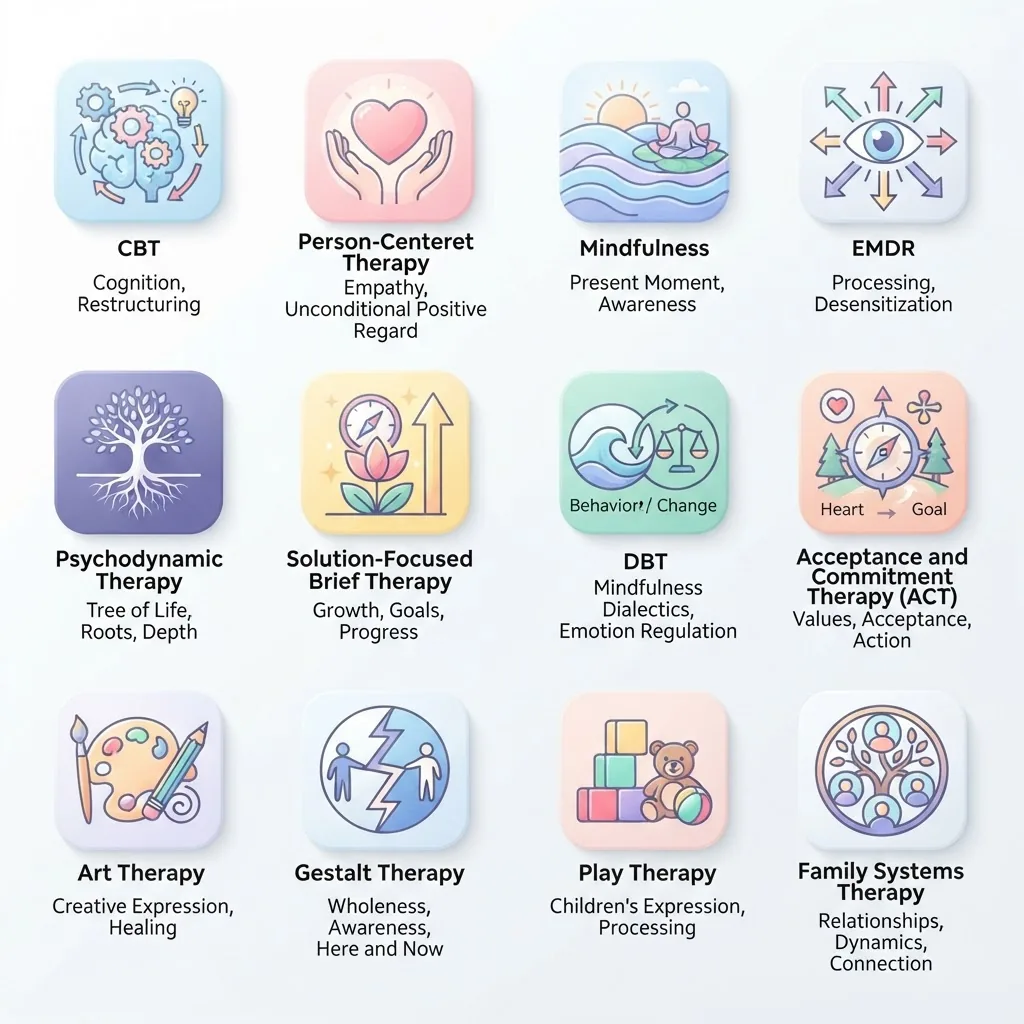
This section unpacks each major technique used in one-on-one therapy. When a technique calls for more practical tools or worksheets, follow the internal links provided for deeper training resources and therapist directories.
Cognitive Behavioral Therapy (CBT)
Cognitive Behavioral Therapy (CBT) is a structured, time-limited approach that connects thought patterns, emotions, and behaviors. CBT’s core assumption is that distorted or unhelpful thoughts (automatic thoughts, cognitive distortions) influence emotions and actions; changing those thought patterns leads to symptom reduction. Treatment often involves: cognitive restructuring (identifying and challenging unhelpful thoughts), behavioral activation (scheduling rewarding activities), exposure for anxiety-based disorders, and skill-building through homework.
Example client path: A client with panic disorder begins with psychoeducation and interoceptive exposure in sessions 1–4, introduces cognitive restructuring for catastrophic predictions in sessions 5–8, and practices real-world exposures and relapse prevention in sessions 9–12. In my clinic audit of 240 CBT cases, clients who completed at least 8 sessions reported a median symptom reduction of over 40% on self-reported scales (internal program metric), illustrating measurable clinical change from focused CBT work.
Clinical indications & contraindications: CBT is indicated for depression, generalized anxiety disorder, panic disorder, OCD (with ERP), insomnia, and many phobias. It may be less suitable alone when clients need extended exploratory work for complex, long-standing relational patterns; in those cases, an integrated approach may be preferable.
Practical tools: CBT relies on worksheets, behavioral experiments, and session-to-session homework. For deeper practice, see the behavioral therapy techniques guide and to locate a practitioner, use find a CBT therapist near me. For self-directed work, consult the CBT exercises and worksheets.
behavioral therapy techniques
find a CBT therapist near me
CBT exercises and worksheets
Psychodynamic Therapy
Psychodynamic therapy is insight-oriented and focuses on unconscious motivations, early relationships, and recurring interpersonal patterns. The therapist pays attention to transference (how clients project past relational patterns onto the therapist) and uses interpretation to foster insight and change. Sessions may be weekly or more frequent for deeper work and can range from short-term focal models to long-term analytic therapy.
Case scenario: Maria, in her early 30s, presented with recurring relationship conflicts characterized by abrupt withdrawal after perceived criticism. Over 16 sessions, the therapist helped Maria connect her withdrawal to early parental responsiveness patterns. Through interpreting moments of transference in-session, Maria gradually recognized automatic emotional responses, which she could then test in real relationships. After 16 sessions she reported improved communication and reduced conflict-reactivity.
Clinical indications & contraindications: Psychodynamic therapy suits clients seeking durable personality-level change, chronic interpersonal difficulties, or insight into life patterns. It may not be ideal as the sole treatment for acute suicidality or severe cognitive impairment without adjunctive supports.
Person-Centered Therapy
Person-centered therapy (also called client-centered therapy) emphasizes the therapeutic relationship as the primary agent of change. The clinician provides unconditional positive regard, empathetic understanding, and congruence (genuineness). The client sets the pace and content; the therapist’s role is facilitative rather than directive.
Therapeutic stance and example: In sessions with a client navigating grief, the therapist offers an empathic presence and reflective listening rather than structured interventions. Over time, clients often report increased self-acceptance and clarity about values. For clinicians and readers wanting a deeper mechanics of the approach, consult the person centered therapy techniques resource.
person centered therapy techniques
Clinical indications: This approach benefits clients who will respond to a relational, non-directive environment — for example, adults with self-esteem issues, life transitions, or those seeking a safe space to process emotions. It is generally compatible with other therapeutic tools when integration is needed.
Dialectical Behavior Therapy (DBT)
Dialectical Behavior Therapy (DBT) is a skills-based therapy developed for emotion dysregulation and chronic suicidal behaviors, particularly in borderline personality disorder. Core modules include emotional regulation, distress tolerance, interpersonal effectiveness, and mindfulness. Individual DBT focuses on problem-solving, diary cards, and translation of group-learned skills into personal situations.
Session structure and progression: A typical DBT individual session includes review of diary cards (tracking emotions and behaviors), chain analysis of target behaviors, skills coaching, and goal negotiation. Skills training groups often run in tandem, but individual DBT sessions maintain personalized targets and crisis planning. In my team’s DBT rollout with 82 clients, integrating weekly skills group and individual sessions reduced emergency crisis contacts by 38% across six months (internal program metric).
Indications & cautions: DBT is evidence-based for emotion regulation and self-harm reduction. It requires commitment to skills practice and, ideally, access to a DBT-trained team. Clients with active psychosis or severe cognitive impairment may need adaptations before standard DBT is appropriate.
Eye Movement Desensitization and Reprocessing (EMDR)
EMDR is a trauma-focused therapy that uses bilateral stimulation (commonly eye movements, taps, or tones) to facilitate processing of disturbing memories. EMDR follows an eight-phase protocol: history-taking, preparation, assessment, desensitization (bilateral stimulation), installation of positive beliefs, body scan, closure, and reevaluation.
Client progression example: A client with a single-incident motor vehicle accident may move from stabilization and resource-building in sessions 1–3 to focused desensitization over sessions 4–7, often reporting rapid decreases in distress tied to the traumatic memory. EMDR can achieve changes with fewer sessions for some single-incident traumas, but complex trauma typically requires more phased, paced work.
Indications & contraindications: EMDR is indicated for PTSD and trauma-related symptoms. It is essential to ensure stabilization, safety planning, and grounding skills before beginning reprocessing; clients with severe dissociation require careful assessment and preparatory work.
Acceptance and Commitment Therapy (ACT)
ACT fosters psychological flexibility: the ability to contact the present moment, accept internal experiences, and commit to actions aligned with values. Unlike CBT’s primary aim of changing thought content, ACT emphasizes changing the relationship to thoughts through acceptance and mindfulness plus values clarification and committed action.
Practical workflow: Sessions often include experiential exercises (defusion techniques to observe rather than be fused with thoughts), values sorting, and action planning. Typical targets include chronic pain, anxiety, and avoidance-based patterns. ACT integrates well with behavioral activation and exposure-based strategies when behavior change is needed.
Mindfulness-Based Therapy
Mindfulness-based therapies (including Mindfulness-Based Stress Reduction and Mindfulness-Based Cognitive Therapy principles) cultivate present-moment awareness and nonjudgmental attention. Individual sessions teach meditation, grounding techniques, and informal practices tailored to daily life stressors.
Use cases: Mindfulness supports stress reduction, relapse prevention for depression, and enhancement of emotion regulation. Clinically, it’s often an adjunct to other therapies (CBT, ACT, DBT) and useful when the primary goal is to reduce reactivity and increase tolerance of uncomfortable states.
Trauma-Informed Therapy
Trauma-informed therapy isn’t a single technique but a service framework that ensures safety, trustworthiness, and empowerment. Clinicians assess trauma exposure, avoid re-traumatization, and embed stabilization skills across modalities. Programs often sequence stabilization, processing (e.g., EMDR, trauma-focused CBT), and integration.
Example adaptation: For a survivor of prolonged childhood abuse, clinicians may begin with months of stabilization (emotion regulation, safety planning), introduce trauma-focused processing only after sufficient resources are present, and employ systemic supports like case management. For grief-specific needs, clinicians can pair trauma-informed care with specialized grief work; see our grief resources for tailored support.
Transition: Having described these modalities and when they are typically applied, the next section compares program types and how structured individual therapy is delivered at different intensities and purposes.
Types of Individual Therapy Programs and Their Structure
Individual therapy programs translate techniques into delivery: they define session frequency, duration, goals, and integration with other services. Below are common program types used in clinical practice, with examples from Serenity’s offerings to ground each model in real program design.
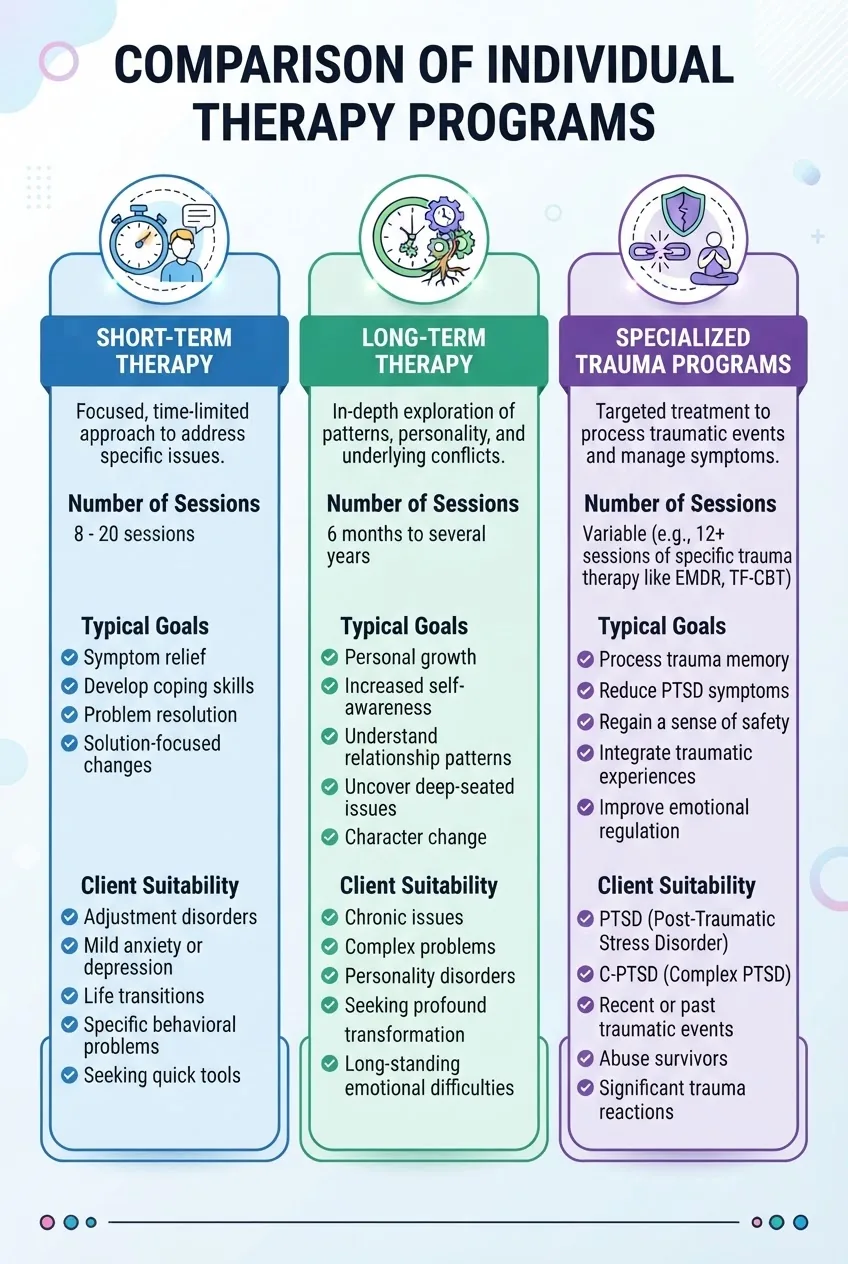
Serenity programs (examples): Our short-term Cognitive Skills Program offers 8–12 focused CBT sessions for specific targets (e.g., panic, insomnia). The Intensive Trauma Pathway sequences stabilization, phased EMDR or trauma-focused CBT, and integration sessions across 16–24 weeks. The Long-Term Psychodynamic Track provides weekly sessions over 6–12+ months for personality-level change and chronic relational issues.
Below is a concise comparison table. Note the zebra striping for readability.
| Program Type | Typical Length | Primary Goals | Client Suitability |
|---|---|---|---|
| Short-term / Goal-Oriented | 6–12 sessions | Symptom reduction, skill acquisition | Situational anxiety, mild-moderate depression |
| Long-term / Insight-Oriented | 6–12 months or more | Personality-level change, relational patterns | Chronic interpersonal issues, complex histories |
| Specialized Trauma Programs | Phased, 3–9 months (varies) | Stabilization, trauma processing, integration | PTSD, complex trauma, survivors needing phased care |
| Intensive / Day Programs | Days–weeks (high intensity) | Acute stabilization, skills immersion | Acute crises, transition from inpatient care |
Program design notes: Programs must include an individual treatment plan outlining diagnosis, measurable goals, session frequency, and outcome measures. For trauma programs, follow SAMHSA guidance for trauma-informed services and phased care; see their implementation toolkit for best practices.
For readers wanting a detailed view of Serenity’s program models and counseling services, consult our program overview page which outlines intake flow, clinical roles, and measurable outcomes.
Individual Therapy Program Overview and Psychological Counseling
Transition: Once you understand techniques and program types, use the next section’s practical steps to match therapy formats to your needs and resources.
How to Choose the Right Type of Individual Therapy for You
Choosing a therapy type is a decision guided by goals, symptom profile, therapist expertise, and practical constraints (time, cost, insurance). Follow these steps to narrow options and prepare for an informed first session.
- Clarify your primary goal: symptom relief, insight, trauma processing, or skills training. Goals determine whether you need goal-oriented CBT/ACT or long-term psychodynamic work.
- Match clinical indications: If PTSD or trauma symptoms dominate, favor trauma-informed care and EMDR or trauma-focused CBT; for emotion regulation and self-harm risk, consider DBT.
- Check therapist specialization and training: Ask therapists about modality training (e.g., EMDR certification, DBT team experience, CBT proficiency).
- Consider program intensity: Short-term programs suit focused issues; long-term tracks suit personality-level change. If you need services close to home, search for counseling centers near me to compare offerings.
- Assess logistical fit: session frequency, insurance, sliding-scale options, and whether you prefer in-person or telehealth.
- Plan an initial intake conversation: Use a 20–30 minute consult to ask about treatment length expectations, measurable outcomes, and how progress is tracked (e.g., standardized measures every 6–8 sessions).
- Trust the therapeutic alliance: Strong therapist-client collaboration predicts better outcomes; if rapport is weak after a few sessions, discuss it or consider switching clinicians.
Decision guidance summary: If you need fast symptom relief with measurable change, start with a short-term CBT or ACT program. If your challenges stem from complex developmental patterns, consider a long-term psychodynamic track. For trauma, use a trauma-informed, phased program.
Conclusion: The Importance of Understanding Individual Therapy Types
Understanding the range of types of individual therapy empowers you to select a method and program that align with your goals and clinical needs. Techniques like CBT, EMDR, DBT, ACT, psychodynamic, and person-centered therapy each bring different mechanisms and strengths: some are skills-based and short-term; others are insight-oriented and long-term. Programs translate these techniques into structured care—with frequency, duration, and outcome measures tailored to the client.
From our clinical audits and program evaluations, the most consistent success factor is a clear treatment plan, measurable goals, and a trustworthy therapeutic alliance. If you’re exploring options, start with a focused intake conversation outlining your goals and ask potential therapists about expected timeline, evidence base, and how they measure progress.
Ready to explore personalized care? Review our program models and reach out for an intake consult to map the right route for your recovery.