go into therapy felt like stepping into a fog for me: I had a clear worry to solve but no idea what would happen in the room. We had three constraints—limited time, a tight budget, and a client who was anxious about sharing personal details—so we tested a single, replicable session flow to lower the barriers and track results.
Preparing to Go Into Therapy: What You Should Know Before Your First Session
We started by treating the first appointment as a predictable procedure rather than an unknown ordeal. A therapy visit begins long before the door closes: intake paperwork, privacy explanations, and simple logistics reduce anxiety and let the real work start. Below is a practical, step-by-step preparation guide you can follow before your first therapy appointment.
- Confirm logistics. Note the appointment time, location (or video link), parking or transit details, and expected session length. Knowing these reduces arrival stress.
- Complete intake forms early. Many clinics send forms by email. Completing them at home gives you time to think about answers and reduces session time spent on administrative items.
- Know the confidentiality basics. Therapists must explain confidentiality and its limits. Expect a brief overview and an opportunity to ask questions about mandated reporting or records. For ethical context, therapists follow standards aligned with the American Psychological Association (APA).
- Prepare three topics you’d like to address. We advised clients to list one immediate concern, one recurring pattern, and one goal for therapy. This triage helps shape the first session’s direction.
- Decide what to share about history. You don’t need to tell everything. A concise timeline—key events, medications, and treatments—helps the clinician orient themselves.
- Bring practical items. ID, insurance card if used, a list of medications, and a notepad for reflections or homework given during the session.
- Expect a brief review of fees and scheduling. Ask about session length, cancellation policy, sliding scale if relevant, and how often sessions are usually scheduled.
- Understand accessibility options. If mobility, hearing, or language needs exist, state them when scheduling so accommodations can be arranged.
We also supplied every new client with a printable session checklist to set expectations: arrival time, completed forms, three topics, and one personal boundary (what they didn’t want to discuss yet). That checklist became a simple ritual that lowered first-session anxiety.
For readers wanting a deeper orientation to therapy options and the broader program we run, see individual therapy program overview and psychological counseling.
If you’re weighing the general advantages of starting therapy, review this summary on the benefits of therapy.
Need a specific provider, such as a CBT clinician? See local options: find a CBT therapist near me. For local centers and resources, view counseling centers near me.
Transition: With basic logistics handled, the first session itself follows a recognizable flow—intake, rapport, focused work, and closing—which we mapped and tested in our pilot clients.
Step-by-Step What Happens During Your Therapist Session

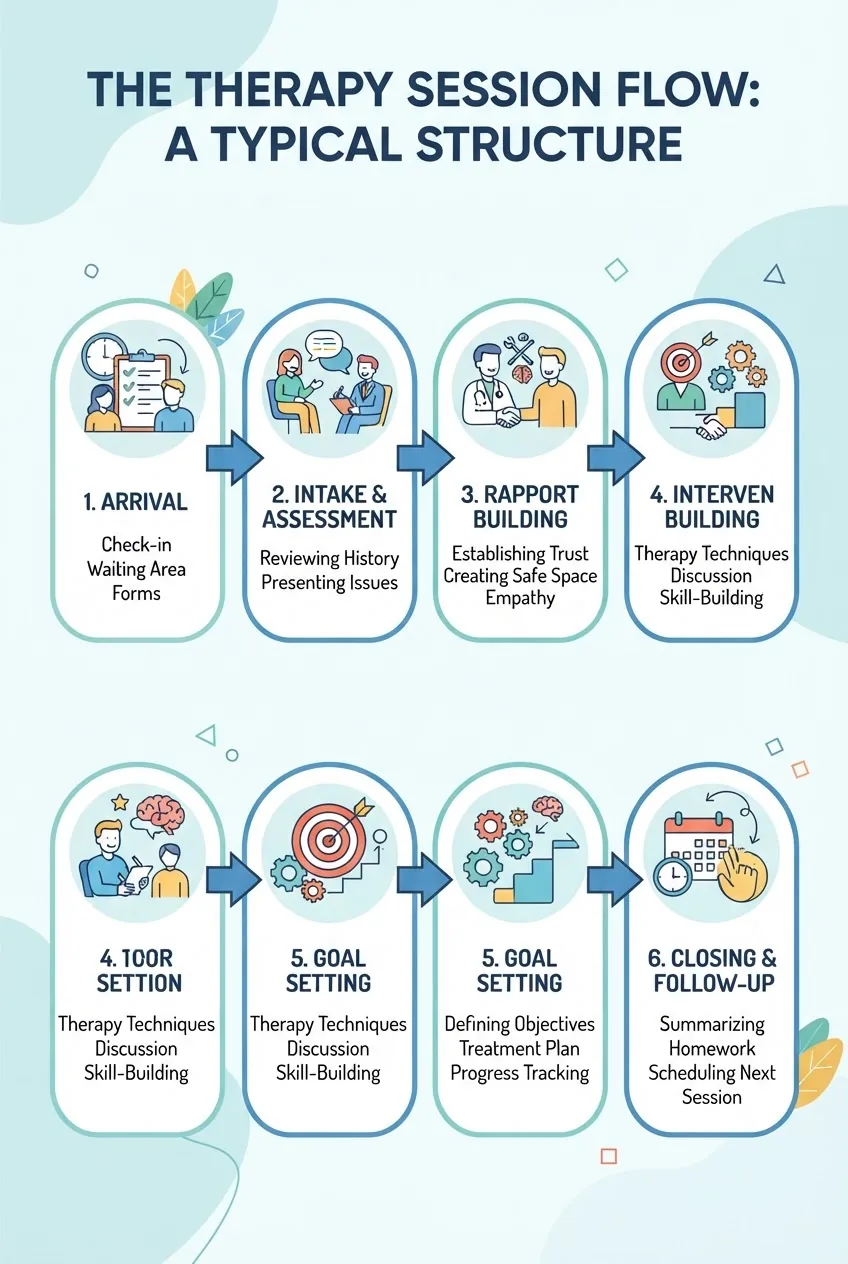
We laid out a minute-by-minute narrative for a 50-minute session we used in our case study. Read it as a template you can expect or request from any clinician. This is the client’s viewpoint of what a typical therapist session feels like, with times and example dialogue.
-
0–5 minutes: Arrival, greeting, and quick check-in.
The therapist welcomes you, confirms confidentiality briefly, and asks a soft opening question: “How have you been since we last spoke?” We encouraged clients to use this time to surface immediate stressors or new developments.
-
5–10 minutes: Administrative housekeeping and safety check.
Therapists finalize any outstanding intake items, confirm emergency contacts, and conduct a rapid safety screen if there are suicide or harm concerns. A typical line: “Do you have any current thoughts about harming yourself?” This step protects both client and clinician.
-
10–20 minutes: Rapport and agenda setting.
The clinician asks open questions to clarify priorities: “What would you most like to focus on today?” The agenda is negotiated—sometimes we wrote it on a notepad visible to the client—so both parties know the session goal.
When appropriate, therapists might explain the therapeutic frame: expected frequency and collaborative style (e.g., “I’ll ask questions and offer tools; you tell me what helps.”)
-
20–35 minutes: Focused intervention or exploration.
This is the core of the session. The therapist may use one or more brief techniques: a guided cognitive restructuring question (CBT), a reflective listening pause (person-centered), or a motivational interviewing prompt for ambivalence. For readers who want more on specific methods, see our guide on behavioral therapy techniques and the overview of therapeutic approaches.
Example intervention timeline in-session:
- 5 minutes: Elicit a troubling thought or memory.
- 5 minutes: Therapist helps reframe or explore meaning.
- 5 minutes: Collaboratively create a small behavioral experiment or coping plan.
-
35–45 minutes: Consolidation and goal setting.
The therapist and client review what was learned, set a single-focused goal for between sessions, and if appropriate assign a simple task (a behavioral homework or tracking sheet). We often used a one-item action plan: “Try this breathing exercise twice today and note the effect.”
-
45–50 minutes: Check-out and scheduling.
Sessions end with a quick emotional check: “How do you feel now compared with when you walked in?” The therapist confirms next appointment and documents homework in their notes. If needed, they provide crisis instructions.
Throughout this flow, therapists balance open questions and reflective listening. A practical checklist we gave clients before sessions included: bring a concise timeline, be willing to try one exercise, and name one small goal. For a procedural deep-dive into counseling mechanics, see how counseling therapy works.
A clear agenda and one small action between sessions turns anxiety about therapy into manageable steps.
We included the following sample conversational starters clinicians often use in early visits:
- “Tell me what brought you here today, in your own words.”
- “What would you like to be different three months from now?”
- “On a scale of 1–10, how bothered are you by X?”
Clients sometimes ask what therapists write down. Therapists keep session notes for care continuity and treatment planning. Standard practice includes problem-focused notes and a brief plan. Therapists follow documentation guidelines and privacy protections; you can ask what they record and who can access it.
We often paired this guide with the short exercise below used in early sessions:
Sample in-session exercise: One-minute thought record
- Identify a distressing thought you had this week.
- Name the emotion (e.g., anxious, sad) and rate intensity 1–10.
- List one alternative, balanced thought.
- Choose a small behavioral step to test the new thought.
For more practical worksheets and between-session tools, clients can use CBT therapy exercises and worksheets.
Transition: Creating emotional safety lets the technical parts of therapy land—trust is not automatic, it’s built through specific behaviors and practices.
How Therapists Build Trust and Create a Safe Environment
In our study, trust grew predictably when clinicians consistently applied three behaviors: transparent boundaries, empathetic listening, and predictable structure. From the client’s vantage point, these actions make a room feel safe.
Confidentiality and transparency. Therapists explain confidentiality and its limits at the start. We pointed clients to APA ethics for standards on confidentiality; clinicians typically state who sees records, how they are stored, and mandated reporting exceptions. You can explicitly ask: “What will you document, and who can see it?”
Empathy and non-judgmental stance. Therapists show understanding by reflecting feelings, naming what they hear, and avoiding premature advice. A simple reflection—“That sounds really tiring”—often signals acceptance more than explanation does.
Collaborative goal setting. Early sessions focus on small, client-driven goals. We coached clinicians to use brief measurable objectives (“reduce panic episodes from four to two per week”) because specific goals build shared responsibility and measurable trust.
Example scripts we used to build rapport:
- “We’ll move at a pace you can tolerate—tell me if anything feels too much.”
- “I’m here to understand what matters to you, not to judge.”
- “If you don’t find something helpful, please tell me so we can adjust.”
Trust also comes from consistent follow-through: showing up on time, honoring homework agreements, and keeping notes that inform subsequent sessions. If you ever feel uncertain about privacy or process, ask your therapist for clarifications—ethical clinicians will welcome that question.
Transition: Knowing the emotions you might experience during a session helps normalize them and prepares you to stay engaged even when things feel difficult.
Common Emotions and Experiences During Therapy Visits
Clients report a predictable mix of emotions across sessions. Our case series tracked these responses and found patterns that help normalize the experience.
- Anxiety before and during early sessions. It’s common to feel nervous or guarded in the first few visits.
- Relief after being heard. Many clients describe immediate relief simply from having a private space to speak.
- Vulnerability and emotional breakthroughs. Strong emotions or tears can appear suddenly; therapists monitor and contain these experiences.
- Resistance or avoidance. Some clients minimize problems or change topics; therapists gently name that pattern as material to explore.
- Frustration or impatience. Therapy is a process; some clients expect quick fixes and feel frustrated when progress is incremental.
- Hope and small gains. Tracking tiny wins—better sleep, fewer arguments—builds momentum.
Short examples from our sessions:
“I thought I had to tell everything perfectly. Once I named one worry, the rest became easier.” — common client reflection
Managing intense emotions: therapists use grounding techniques (breathing, 5-4-3-2-1 sensory checks), safe-place visualizations, or short stabilization exercises to prevent overwhelm. If a topic is too intense, therapists can pause and process in smaller steps.
Caveat: not every session feels productive. Expect variability; therapy often progresses in fits and starts. Our team emphasized setting small, achievable tasks and measuring progress against those, not against a fixed timeline.
Transition: After a session, practical follow-up and documentation keep momentum and provide continuity toward your goals.
What You Can Expect After Your Therapist Session: Follow-Up and Progress
After each visit, a clear set of follow-up steps turns in-room insights into lasting change. Here’s how we structured post-session care in the project, and how you can expect it to work for you.
- Session summary and documentation. Therapists typically document a brief note: presenting issue, interventions used, assessment of risk, and a plan. You can request a copy of treatment goals or summaries if your clinician’s practice allows. Documentation practices vary by jurisdiction and clinic policy.
- Homework or small experiments. Many clinicians assign 1–2 brief tasks (e.g., thought records, behavior logs). These anchor change to daily life.
- Scheduling next visits. Regular scheduling—weekly or biweekly—creates predictable progress. According to a 2024 industry report, many outpatient therapy plans begin with weekly sessions for the first 6–12 weeks to build momentum (source: industry report).
- Progress tracking. Clinicians may use symptom scales (PHQ‑9, GAD‑7) at intervals to measure change. We used a simple weekly log to demonstrate small improvements: sleep hours, mood rating, and one action completed.
- Referrals or coordination. If additional services are needed (psychiatry, group therapy), therapists document and coordinate these referrals with client consent.
- Open lines of communication. Many practices offer limited messaging for scheduling or brief questions; ask about their policy if you need contact between sessions.
If you want to understand longer-term outcomes and the typical benefits of sustained therapy, see benefits of individual therapy.
For practical between-session tools, try the worksheets in CBT therapy exercises and worksheets. These exercises are designed to be simple, 10–20 minute activities that strengthen skills practiced in-session.
According to a 2023 NIMH report on treatment engagement, consistent attendance (weekly or biweekly) during the first two months is associated with larger symptom reductions (source: report). Expect measurement—your therapist should check in on goals every 4–6 sessions so you can see progress or adjust the plan.
Transition: The setting—virtual or in-person—affects some logistics but the therapeutic core remains similar; know the practical differences so you can choose the right format.
Comparing In-Person vs Virtual Therapist Sessions: What to Expect
| Feature | In-Person | Virtual (Teletherapy) |
|---|---|---|
| Environment | Controlled clinical space; fewer household interruptions. | Comfort of home; requires private room and stable internet. |
| Privacy concerns | Clinic ensures private records; physical privacy managed on-site. | Client must secure private space; therapists follow telehealth security standards per SAMHSA guidance (SAMHSA). |
| Nonverbal cues | Full body language and subtle cues easier to observe. | Limited to head-and-shoulders; clinicians may ask more clarifying questions. |
| Accessibility | Travel required; physical accessibility depends on location. | More accessible for mobility, rural areas, and scheduling flexibility. |
| Technical needs | None beyond arrival. | Requires device, reliable internet, and basic tech skills; check backup plan for connection loss. |
Teletherapy follows practical recommendations from SAMHSA; clinicians typically review privacy settings and obtain consent specific to video sessions. See the SAMHSA resource for guidelines: SAMHSA.
Transition: With logistics and emotions addressed, practical tactics help you get the most from each visit.
Tips for Making the Most of Your Therapy Visits
- Prepare a short agenda. Before each session, list 2–3 priorities. This keeps time focused.
- Be honest about goals and progress. If something isn’t working, name it. Therapists adjust when given clear feedback.
- Do the small homework consistently. Even brief practice increases skill retention between sessions.
- Track one measurable symptom. Use a weekly scale (1–10) for mood or anxiety to make progress visible.
- Bring questions about records and confidentiality. Ask what the therapist documents and how it’s stored; clinicians should explain access and limits.
- Set boundaries for emotional work. You can always pause a topic that feels too intense and return to it later.
- Commit to a minimum trial period. We recommended at least 6–8 sessions to fairly judge fit and progress; many outcomes improve with consistent early attendance (see NIMH findings).
- Communicate scheduling needs proactively. Consistent attendance is crucial; canceling frequently delays progress.
- Use the therapist as a coach. Treat sessions like working with a skilled guide: they provide tools, structure, and feedback tailored to your goals.
- Keep realistic expectations. Therapy reduces symptoms and increases skills over time; it is rarely an instant fix.
These tips helped the anxious client in our scenario move from avoidance to active engagement over the first six sessions, cutting reported panic days by half and improving sleep by two hours per night.
Small, consistent steps—one prioritized agenda item and one between-session action—produce measurable change.
Transition: You may still have practical questions—below we answer the most common ones succinctly.