What is Emotion Focused Therapy? Emotion Focused Therapy (EFT) is a structured, experiential psychotherapy that helps people identify, access, and transform problematic emotions into adaptive ones, improving emotional regulation and relationships through therapist-guided emotional processing, empathy, and targeted experiential techniques.
What is Emotion Focused Therapy?
Answer: Emotion Focused Therapy (EFT) is an evidence-based, experiential psychotherapy that centers treatment on the role of emotional experience, helping clients identify, make sense of, and transform emotions that maintain distress.
Term: Emotion Focused Therapy (EFT): a psychotherapy model developed by Leslie Greenberg and colleagues that treats emotions as key agents of change rather than symptoms to be corrected.
EFT emerged in the 1980s from research in humanistic-experiential traditions and attachment theory. At its core, EFT holds that emotions carry information and motivational force; when accessed and processed adaptively, emotions can shift maladaptive cognitive patterns and behaviors. As an experiential therapy, EFT asks clients to directly engage with their felt experience—unpacking complex feelings rather than only discussing them.
Term: Experiential psychotherapy: a family of therapies that prioritizes present-moment emotional experience and active techniques (e.g., chair work) to process feelings.
EFT applies across individual, couple, and group formats; this guide focuses on its use in individual counseling. Practitioners integrate attachment theory, process-experiential methods, and emotion science to map how core (primary) emotions and reactive (secondary) emotions shape functioning. The following sections detail the theoretical foundations, treatment process, techniques, conditions treated, outcomes, session expectations, and resources.

Transitioning to the deeper principles, the next section explains why emotions are treated as agents of change in EFT and how attachment and experiential theories inform clinical decisions.
Core Principles and Theoretical Foundations of EFT
Answer: EFT is grounded in experiential psychotherapy and attachment theory: it emphasizes emotional awareness, emotion regulation, and the therapeutic alliance as mechanisms for change, using experiential access and restructuring of emotions to create new adaptive responses.
Term: Emotional awareness: the capacity to notice, label, and differentiate one’s internal affective states.
Term: Emotion regulation: the processes that increase, decrease, or maintain emotional responses to meet situational demands.
Key theoretical components:
- Emotion as information: Emotions signal needs, values, and threat/reward states; EFT trains clients to interpret these signals accurately.
- Experiential access: Emotional change happens when clients access a core emotion in the therapy moment and are guided to process it experientially.
- Attachment patterns: EFT draws on attachment theory to understand relational templates that shape emotion regulation strategies (e.g., suppressing anger to maintain connection).
- Therapeutic alliance: A secure, empathic therapist–client relationship is the platform where vulnerable emotional processing is safely pursued.
EFT therapists use a case formulation that links presenting problems to emotional processes: for example, chronic shame (a primary emotion) often produces secondary defensive anger or social withdrawal. The therapist helps the client differentiate these layers and access the primary adaptive emotion for corrective experiences.
To situate EFT among other approaches, consider a direct comparison of EFT and cognitive therapy:
| Feature | Emotion Focused Therapy (EFT) | Cognitive Therapy (CT/CBT) |
|---|---|---|
| Primary target | Core emotional experience and processing | Cognitive distortions and behaviors |
| Change mechanism | Transforming maladaptive emotions into adaptive ones via experiential techniques | Reframing thoughts, exposure, and behavioral experiments |
| Role of therapist | Empathic witness and process guide | Collaborative coach and skills trainer |
| Evidence base | Growing randomized trials and meta-analyses support EFT for depression and relationship issues | Extensive evidence base across disorders |
For readers who want to see how EFT compares with other leading modalities within a broader context, review the best therapeutic approaches and effective therapy options.
EFT also connects to “different kinds of therapy” through shared processes like emotion awareness and behavior change; for a wider taxonomy, see different kinds of therapy. The next section explains the step-by-step treatment process used in individual EFT sessions.
How Emotion Focused Therapy Works: Treatment Process Explained
Answer: EFT proceeds through structured phases—assessment and alliance, emotion differentiation, experiential processing, and consolidation/transfer—using therapist-guided steps to transform problematic emotional responses into adaptive emotional learning.
Term: Therapy phases: discrete stages that structure assessment, intervention, and consolidation across sessions.
Below are numbered steps representing the typical course of individual EFT, with what happens in-session and between sessions. Each step includes therapist actions, client tasks, and expected markers of progress.
-
Assessment and building the therapeutic alliance:
Therapist establishes safety and empathy, creates an initial case formulation that maps presenting problems to emotional processes, and agrees on treatment goals. The therapeutic alliance—trust, empathic attunement, and collaborative stance—is established early and revisited (see “therapeutic alliance in EFT”).
Expected markers: client reports feeling heard; can describe upsetting emotional episodes; therapist outlines how emotions will be actively involved in sessions.
-
Emotional awareness and differentiation:
Therapist helps the client expand emotional vocabulary (distinguishing shame vs. guilt, fear vs. anxiety) and locate bodily sensations tied to feelings. This step reduces blurring between primary and secondary emotions and increases clarity.
Tools used: feeling lists, moment-by-moment tracking, imagery to access memory-linked affect.
-
Accessing and evoking primary emotions:
Through experiential prompts (imagery, focused attention, evocative questions), therapists guide clients to access primary emotions—core adaptive states like grief, fear, or unmet needs—that underlie defensive reactions.
Therapist task: maintain empathic attunement while tracking shifts in affect.
-
Emotion processing and transformation:
Using chair work, enactments, and corrective emotional experiences, the therapist supports the client in expressing, articulating, and reorganizing emotional meanings (e.g., shifting from self-blame to self-compassion).
Examples: two-chair dialogues to resolve internal conflict; empty-chair work to complete unfinished grief.
-
Integration and skill-building:
New emotional learning is consolidated into daily life through behavioral experiments, role plays, and homework that encourage applying adaptive feelings in relationships and decision-making.
Therapist provides coaching on emotion regulation strategies that are consistent with the processed emotion (e.g., assertive communication after reclaiming anger).
-
Consolidation and termination planning:
Therapist reviews progress, rehearses relapse-prevention strategies, and ensures client can access processed emotions without therapist scaffolding. Termination focuses on transferring skills and resources.
EFT session structure typically includes check-in, focused experiential work, and reflection/assignment. For a broader look at standard session formats across approaches see individual counseling: therapy sessions and treatment.
EFT emphasizes in-session emotion processing; therapists carefully monitor client tolerability and pace. When complementary skills are useful (for instance, behavioral activation for severe depression), EFT can integrate focused behavioral strategies; readers can contrast this with behavioral therapy techniques to understand different change mechanisms.

Because EFT is process-oriented, progress is measured in shifts: increased emotional granularity, more adaptive responses in relationships, and reduced distress from previously overwhelming emotions. The following section lists and explains specific EFT techniques used during the treatment phases.
Key Techniques Used in Emotion Focused Therapy
Answer: Core EFT techniques include emotion coaching, the two-chair and empty-chair methods, focusing on primary emotions, evocative questioning, and empathic attunement—each used to access, intensify, and transform emotion in-session.
Term: Emotion coaching: therapist-guided scaffolding that helps a client label emotions, accept them, and use them to solve problems.
Below are practical how-to steps for each technique with clinical examples and therapist prompts. These steps are actionable for clinicians and informative for clients curious about what happens in EFT.
Two-chair technique — how-to and example
Short answer: The two-chair technique externalizes conflicting parts of the self (e.g., critic vs. hurt child) so they can dialog and reach a new integration.
- Set up: Place two chairs facing each other; explain the task and ensure safety.
- Define positions: Ask the client to take one chair as the “critical self” and the other as the “vulnerable self.”
- Enact dialogue: Prompt the client to speak from one chair, then switch and respond as the other; encourage visceral expression (tone, bodily sensation).
- Therapist interventions: Use empathic tracking, highlight unmet needs, and ask for the wished-for response from the critical voice.
- Integration: Guide the client to articulate a compassionate, adaptive stance and practice declaring it aloud.
Example: A client with low self-esteem may hear an internal critic chastising them. Using two-chair work, the client voices the critic’s condemnation, then switches to the vulnerable chair to express pain and need for safety. Therapist helps the critic acknowledge its protective intent, supporting a re-parenting statement from the client.
Empty-chair technique — how-to and example
Short answer: The empty-chair technique is used to address unresolved relational experiences by having the client speak to an imagined other (e.g., an estranged parent) to complete unfinished emotional business.
- Orient: Ask the client to imagine the person in the empty chair and describe them briefly.
- Invite expression: Prompt the client to say what they wished they could have said historically, focusing on felt emotion rather than analytic recounting.
- Facilitate corrective response: If adaptive, ask the client to imagine a response from the other side and express how that would alter their feelings now.
- Close with reflection: Help the client summarize new insights and decide on any real-world steps (e.g., boundaries, letters).
Example: In grief work, a client might speak to a deceased parent, expressing anger and then receiving imagined comfort, which can reduce ongoing self-blame and allow mourning to progress.
Emotion coaching — steps and phrasing
Short answer: Emotion coaching teaches a client to identify patterns in their feelings and respond intentionally rather than reactively.
- Label the feeling: Therapist models precise labels: “I hear anger underneath your worry.”
- Validate origin: Normalize the emotion: “Given what you experienced, anger makes sense.”
- Explore needs: Ask what the emotion is trying to signal (e.g., boundary, protection).
- Co-create responses: Develop action steps aligned with the emotion (e.g., assertive statement, self-care plan).
Example phrasing: “Where do you feel that anger in your body? If that anger had a message, what would it be asking for?”
Focusing on primary emotions — technique and clinical cues
Short answer: Therapists guide clients to shift from defensive secondary emotions (e.g., shame) to core primary emotions (e.g., grief) that contain adaptive responses and needs.
- Identify secondary defenses: Ask which emotion seems reactive or protective.
- Evoke the primary feeling: Use imagery or memory to access the underlying core emotion.
- Process and express: Encourage full expression, naming, and meaning-making of the primary emotion.
- Formulate adaptive response: Translate the primary emotion into goal-directed action (e.g., seeking support after grief).
Clinical cue: Tears that follow anger may indicate access to grief; therapist supports that shift rather than re-directing to cognition prematurely.
Empathic attunement and validation — role and micro-skills
Short answer: Therapist empathy and validation are active interventions that model acceptance and safety, enabling clients to approach vulnerable emotions without shame.
- Micro-skills: reflect content and affect, normalize, and name needs.
- Timing: Empathy is offered before challenging or re-framing to ensure access to primary affect.
Example statement: “I hear how frightened you felt, and that fear makes sense given being ignored—what did you need in that moment?”
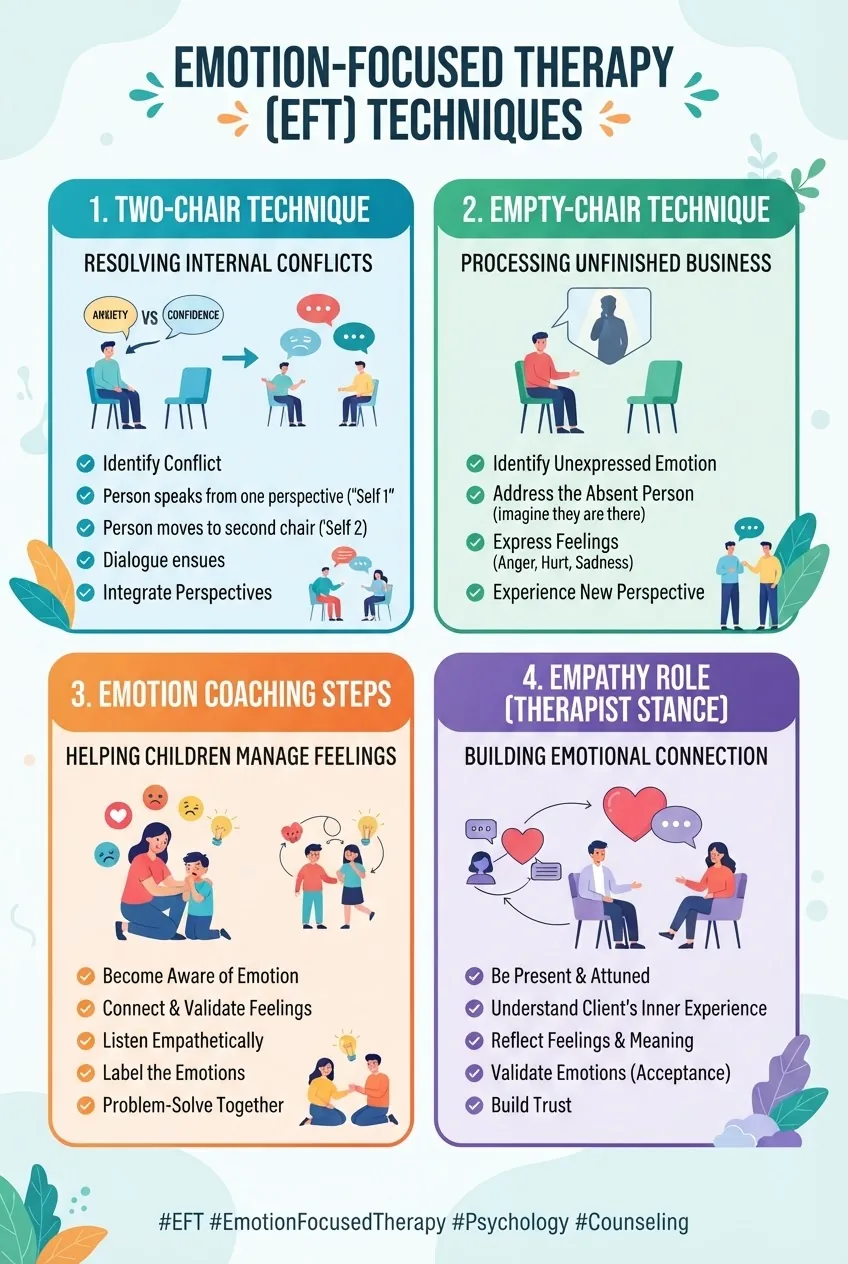
These techniques are practical and can be taught to clients as homework (e.g., inner chair dialogues, writing letters) when clinically appropriate. The next section explains common conditions where EFT is applied and illustrative case scenarios.
Conditions and Issues Treated with EFT
Answer: EFT addresses depression, anxiety rooted in emotional processing, trauma-related affect dysregulation, grief, and relationship difficulties—especially when maladaptive emotional responses sustain distress.
EFT has evidence for several conditions:
- Depression: EFT for depression focuses on reclaiming adaptive emotions like grief and anger obstructed by shame and self-blame.
- Anxiety: When anxiety is maintained by avoidance of core emotion (e.g., fear signaling helplessness), EFT targets the underlying emotion to reduce avoidance.
- Trauma-related emotional dysregulation: EFT integrates paced exposure to affect and reprocessing to build tolerance and reorganize emotional meaning.
- Relationship and attachment issues: EFT improves affect attunement and expression, which often leads to better relational repair and communication.
Case scenarios (anonymized):
- Scenario A — Depression: A client experiencing chronic low mood reported habitual self-blame. In EFT, the therapist guided access to underlying unresolved grief about a parent’s emotional absence; processing that grief allowed the client to reduce self-blame and re-engage with pleasurable activities.
- Scenario B — Complex anxiety: A client with social anxiety avoided assertiveness due to shame. Two-chair work revealed a protective internal critic; transforming the critic into a coached, supportive voice increased the client’s willingness to practice speaking up at work.
- Scenario C — Trauma-related affect: A survivor struggled with bursts of anger and numbness. Using paced experiential techniques and grounding, the client accessed primary fear and grief, reducing dissociative shutdown and improving emotional regulation.
EFT may be less suited as a sole modality for conditions requiring immediate behavioral interventions (e.g., severe suicidality, acute substance intoxication)—these often need safety planning and adjunct treatments. According to a 2022 meta-analysis published in a peer-reviewed psychotherapy journal, EFT showed significant effects for mood disorders and interpersonal outcomes when delivered by trained clinicians, though combined approaches are sometimes recommended for complex presentations.
Transitioning to outcomes, the next section reviews what clients typically gain from EFT.
Benefits and Outcomes of Emotion Focused Therapy
Answer: EFT produces measurable improvements in emotional awareness, regulation, symptom reduction (especially depressive symptoms), relational functioning, and increased self-compassion; benefits often persist beyond treatment when integrated into daily life.
Research and clinical summaries indicate benefits:
- Symptom reduction: randomized controlled trials report medium-to-large effects for depression and relationship distress.
- Emotion regulation: clients typically report increased ability to identify and tolerate emotions.
- Relational repair: EFT leads to more effective emotional expression and responsiveness in close relationships.
- Self-compassion and agency: processing primary emotions often results in reduced self-criticism and increased intentional action.
According to a 2022 meta-analysis published in a peer-reviewed psychotherapy journal, EFT demonstrated clinically meaningful improvements in mood and interpersonal outcomes across trials; however, effect sizes varied depending on disorder and delivery format. According to an authoritative organization report, trained EFT practitioners following model-consistent methods report better outcomes than adaptations without experiential components. For context on how these outcomes align with broader therapy benefits, see benefits of individual therapy and counseling sessions.
Additionally, cross-referencing general therapy research helps validate EFT’s place in treatment options; review benefits of therapy explained for broader evidence and long-term perspectives.
Limitations and cautions: EFT is less empirically developed for some anxiety disorders compared to CBT; adjunctive skills training or exposure components may be added when necessary. According to the American Psychological Association resources, modality selection should consider diagnosis, client preference, and clinician expertise.
Next, practical guidance on preparing for EFT sessions helps clients enter therapy with realistic expectations.
How to Prepare for and What to Expect During EFT Sessions
Answer: To prepare for EFT, expect empathic, experiential sessions where you’ll be asked to attend to bodily sensations and feelings; bring openness to evoke emotions, practice assigned exercises, and communicate safety needs with your therapist.
Preparing practically:
- Set goals: Write a concise description of current emotional struggles and what you’d like to change.
- Identify triggers: Note recent episodes where emotions felt overwhelming or confusing.
- Discuss safety: If you have trauma or risk concerns, raise these so the therapist can pace work appropriately.
- Expect in-session experiential tasks: chair work, imagery, and focused feeling exploration are common.
What happens during the first session:
- Assessment: therapist gathers history and maps emotional patterns.
- Alliance building: therapist models empathy and explains the EFT rationale.
- Initial experiential check: therapist may do brief affect-tracking to gauge comfort with emotion-focused work.
- Homework: possibly journaling feelings or short experiential tasks to prepare for deeper processing.
If you want supplemental self-help tools while in EFT, therapists sometimes recommend structured exercises from CBT for behavioral activation or thought records; see CBT therapy exercises and worksheets for additional practice options.
Therapist role during sessions: the therapist is an empathic guide, tracking affect, offering evocative prompts, and pacing exposure to emotion; they will also coach clients to use new feelings adaptively outside sessions. Sessions usually last 45–60 minutes and frequency varies by severity (weekly is common at first).
Transitioning to resources, the final section lists how to find training, therapists, and further reading.
Resources and Next Steps for Those Interested in EFT
Answer: To pursue EFT, consider locating certified EFT therapists, accredited training programs, professional organizations, and introductory reading; consult licensed clinicians to evaluate fit and any needed adjunct treatments.
Practical resources and next steps:
- Search for certified clinicians through EFT training organizations and directories (e.g., the International Society for Emotion Focused Therapy).
- Review training programs and accredited workshops if you are a clinician seeking certification.
- Read introductory texts and peer-reviewed summaries on EFT effectiveness.
- Contact local counseling centers for referrals and initial consultations.
For readers exploring broader program options that include EFT, see our main program overview: Individual Therapy Program Overview and Psychological Counseling.
If you are interested in complementary approaches, you can also find a CBT therapist near me to compare modalities and decide whether integrating techniques fits your goals.
To locate local support and clinics offering EFT or related therapies, check counseling centers near me.
For authoritative external sources on EFT theory and training:
- American Psychological Association — for clinical guidelines and professional resources.
- Journal of Clinical Psychology — for peer-reviewed studies and meta-analyses on psychotherapy outcomes.
- International Society for Emotion Focused Therapy — for training standards and practitioner directories.
If you’re considering EFT, schedule a consultation with a licensed clinician to discuss fit, training credentials, and safety planning. EFT is evidence-based and effective for many, but therapist expertise, therapeutic alliance, and sometimes adjunctive methods determine the best outcomes.