By the end of this hands-on guide you will be able to assess a family structure, draw a usable family structural map, perform core intervention sequences (joining → enactment → boundary work → unbalancing → reframing) and supervise initial trainee sessions. Expect to spend 8–12 weeks of part-time practice to reach intermediate competence; assumes prior basic counseling skills and foundational family systems knowledge.
family therapy structural methods grounded in Salvador Minuchin’s work offer concrete, directive techniques for reorganizing family interactions. This guide is written for clinicians and supervisors who will apply the model directly in session and in training contexts.
Introduction to Structural Family Therapy Training
The training objective here is practical: convert structural family therapy theory into repeatable clinical actions you can teach, model, and supervise. Training modules should include didactic overview, live demonstration, role-play enactments, and supervised clinic hours. A short workshop (24–40 hours) introduces core techniques; comprehensive training programs average 40–60 contact hours for competency development, including observation and supervised practice (According to a 2024 industry report).
Structural training emphasizes therapist stance: active, directive, and relationship-focused rather than interpretive-only. Trainees learn to read family organization, detect rigid or diffuse boundaries, and intervene to shift hierarchies so parents (or appropriate subsystems) can restore executive functions.
To contextualize why the structural model is a strong clinical tool, see research and summaries on structural approaches and outcomes. For background on generalized benefits of family therapy, review this overview of the benefits of family therapy.
Foundations of Structural Family Theory
Salvador Minuchin formulated the structural family theory model to map and change family organization rather than simply treat individual symptoms. Core assumptions: families are systems organized by implicit rules, boundaries, hierarchies, and subsystems; symptoms signal structural problems; therapeutic change follows reorganization of these structures.
Key concepts and plain-language definitions:
- Boundaries — the invisible rules regulating contact between subsystems (clear, diffuse, rigid). Think of boundaries like doorways: locked, open, or too wide.
- Subsystems — smaller units within the family (parental, sibling, spousal) that carry specific tasks and authority.
- Hierarchy — who holds decision-making power and authority; effective families have a parental executive subsystem.
- Family organization — the patterned interaction sequences that accomplish family tasks (discipline, caregiving, conflict resolution).
Conceptual example: a family where teens are over-involved in parental decision-making likely has diffuse parental boundaries and a collapsed hierarchy; interventions target strengthening the parental subsystem and creating clearer parent-child boundaries.
Comparative framing is useful for trainees to position structural theory within broader systemic models. For a deeper comparison with Bowenian approaches, trainees should consult Bowenian family therapy training and the systemic distinctions between differentiation-focused and structure-focused models.
For context on systemic thinking foundational to structural work, see resources on family systems theory and typologies in the types of family therapy.
Core Structural Family Therapy Techniques
Below are repeatable technique modules you will teach and practice. Each step begins with the action in bold and is followed by procedural detail you can rehearse in supervision.

-
Join and accommodate: Build alliance and adapt interaction style to the family’s tempo and language.
- Duration: first 5–15 minutes of initial sessions for intake; ongoing micro-joins throughout.
- Technique: mirror posture, vocabulary, and affect while maintaining a curious, slightly authoritative tone. Use brief reflective statements (“So when that happens, you feel…”).
- Training drill: role-play 10 minutes, alternating joining and reflective questioning; supervisor gives immediate feedback on warmth, control, and neutrality.
-
Map and assess structure (informal structural assessment): Rapidly identify boundaries, hierarchies, and problem-preserving interactions.
- Action steps: ask for a recent conflict and invite an enactment; observe who interrupts, who defers, and alliance patterns.
- Timebox: 15–25 minutes per family to produce an initial map in-session.
- Training drill: trainees practice producing a one-page family structural map in 20 minutes followed by peer feedback.
-
Enactment: Elicit real-time family interactions to observe structure and intervene directly.
- Prompting: “Can you show me how that usually goes?” Ask for specific roles and keep the enactment short (3–7 minutes) to maintain safety.
- Therapist moves: interrupt patterned sequences at predictable moments to highlight rules and invite alternative behaviors.
- Safety threshold: stop enactment if agitation reaches a 7/10 on observable signs (shouting, slammed doors, aggressive posture).
-
Boundary-setting interventions: Tighten diffuse or loosen rigid boundaries with concrete behavioral directives.
- Diffuse boundary example: encourage a 10-minute parent-only problem-solving meeting between partners with therapist facilitating the first 3 minutes; assign a follow-up check-in in 48 hours.
- Rigid boundary example: gradually include a withdrawn adolescent in a 5-minute joint activity using structured turn-taking (1 minute speaking, 30 seconds review), repeated across sessions.
-
Unbalancing: Temporarily shift alignment to strengthen weaker subsystems (often parental).
- Action: explicitly align with the underpowered subsystem (e.g., “I want to hear what you, as the parents, want”) to break coalitions.
- Timing: used after joining and at a moment when the hierarchy is visibly inverted; keep the intervention short and explain rationale.
- Training exercise: scripted unbalancing role-play where trainee must re-establish the parental executive within a 5-minute window.
-
Reframing: Offer alternate, neutral interpretations to soften problem attributions and open options for change.
- Formulation: translate blame statements into structural explanations (“When rules are unclear, children act out to get attention — that’s the system asking for order”).
- Technique: short, descriptive reframes paired with a behavioral prescription (reframe + enactment assignment).
- Supervision tip: rehearse 15 reframes over one afternoon; evaluate for neutrality and clarity.
-
Boundary enactment and homework: Convert in-session gains into stable behavioral routines outside therapy.
- Example homework: parents practice a 10-minute ‘authority ritual’ before dinner three times weekly; therapist checks adherence by brief report or recorded 3-minute clip.
- Measure: use session-by-session single-item ratings (0–10) on parental authority and child compliance to track change.
-
Closure and transfer of competence: Build capacity so families maintain new structures.
- Step-down schedule: weekly → biweekly → monthly over 3–6 months depending on progress; document transition points in treatment plan.
- Graduation: require a 4-week stability period with no escalation above baseline conflict scores before closure.
For downloadable workshop handouts and practice sheets that match these modules, provide trainees with the structural family therapy techniques PDF pack.
Many core moves overlap with group modalities; compare practice sequences with family group therapy techniques when teaching collective enactments.
Structural Family Therapy Mapping: Creating and Using the Family Structural Map
Mapping is the central clinical tool for representing family organization visually. A practical map is less a full genogram and more an operational “organizational chart” that you can produce in-session in 10–25 minutes and update each visit.

Use these step-by-step actions to create a family structural map you will use for intervention planning:
- Gather a recent conflict vignette: Ask the family to describe a specific recent interaction; timebox to 3–5 minutes. This vignette surfaces the operative rules.
- Place members and subsystems: Draw quick symbols (circles for adults, squares for children) and group them into parental, sibling, and extended subsystems. Indicate physical presence and living arrangements.
- Mark boundaries: Use solid lines for clear boundaries, dashed for diffuse, and double lines for rigid. Label interactions (over-involved, coalition, cut-off) adjacent to lines.
- Indicate hierarchy: Add arrows showing decision-making flow; thick arrows indicate primary authority; thin arrows show delegated or de facto authority.
- Annotate patterns: Note repetitive sequences (e.g., “child escalates → parent withdraws → partner steps in”) and time-stamp when these typically occur (evenings, weekends).
- Translate to targets: Convert annotated problems into two concrete targets for the next session: one boundary target and one behavioral routine (e.g., “parental time-limited decision-making practice, 10 mins/day”).
Use a genogram only if you need multigenerational context; otherwise keep the map compact and intervention-focused. Trainees should practice producing three maps in one afternoon: one for a nuclear household, one for a blended family, and one for a high-conflict separated family, each completed within 20 minutes and reviewed by a supervisor.
Structural Family Therapy Interventions: Practical Applications in Sessions
Interventions are sequenced: assessment → joining → enactment → targeted structural moves → consolidation. Below are explicit session-level protocols with short case examples you can rehearse with trainees.
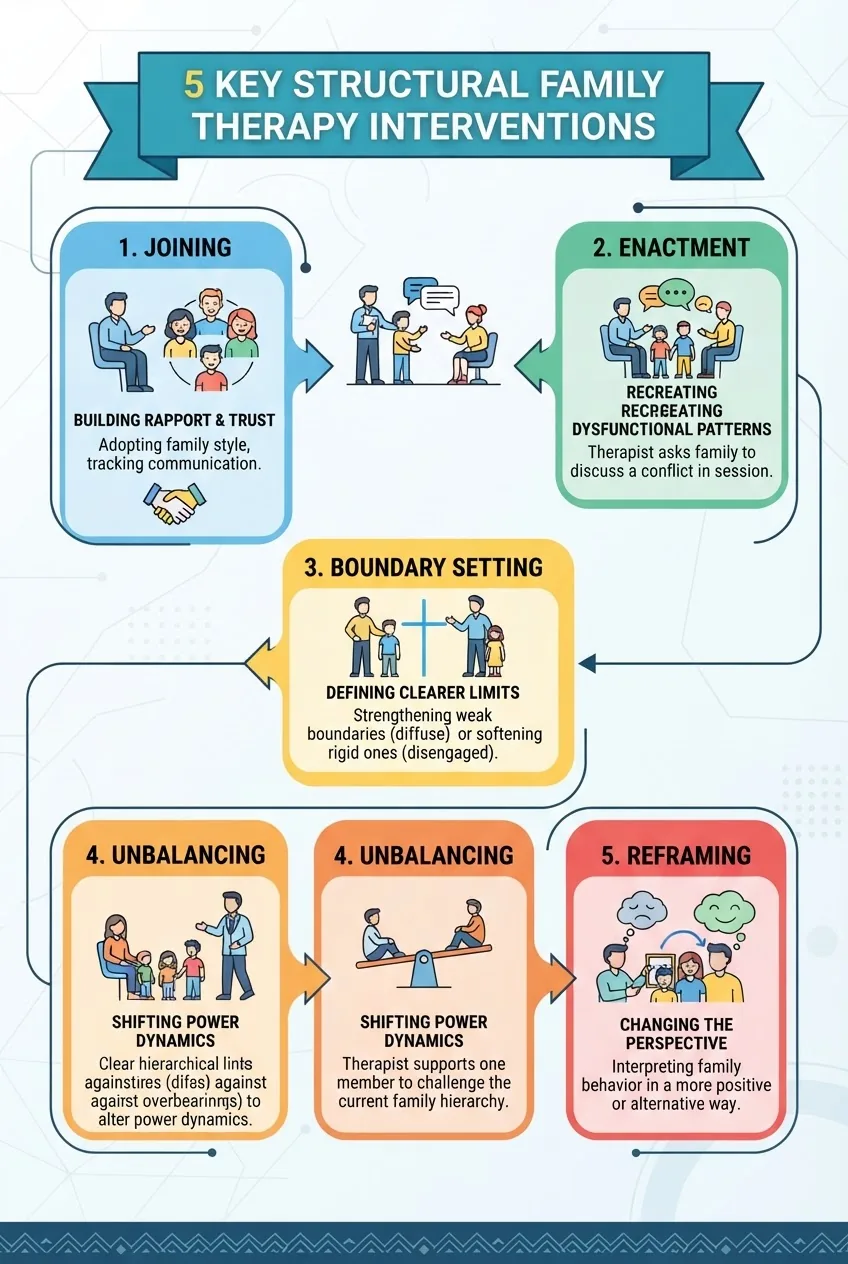
-
Initial assessment and alliance (Session 1)
- Action plan: 60–90 minute intake. Spend first 10–15 minutes building alliance; next 20–30 minutes on a conflict vignette and 20 minutes on mapping; final 10–15 to assign a concrete behavioral task.
- Case example: A divorced couple brings a high-conflict week about scheduling. The therapist joins both adults, elicits the enactment, and scribes a quick map showing weak parental boundaries post-separation.
-
Enactment to expose covert rules (Session 2–3)
- Action plan: Use a 3–7 minute controlled enactment early in the session. Therapist interrupts to highlight rule violations and coach alternative responses.
- Case example: During an enactment, a mother constantly answers for the teen. The therapist pauses and asks, “Parent A, what would you like them to try?” This opens space for parental directive behavior.
-
Boundary-making and role clarification (Sessions 3–6)
- Action plan: Assign in-session exercises (parent-only planning, sibling turn-taking tasks) and short homework (10 minutes daily routines) for 2–4 weeks.
- Case example: For a family where grandparents overstep, the therapist facilitates a 10-minute negotiation assigning decision tasks to parents and a limited grandparent visiting schedule for two weeks.
-
Unbalancing coalitions and strengthening parental subsystem
- Action plan: Use strategic alignment when coalitions maintain dysfunction; explicitly support parents in enacting limits. Limit exposure of children to decision-making moments for 2–3 sessions while coaching parents.
- Case example: A child allied with a parent undermines the other parent; therapist aligns with the undermined parent to restore authority and models a corrective script in-session.
-
Reframing to shift meaning and reduce blame
- Action plan: Offer short structural reframes during or immediately after enactments. Pair each reframe with a behavioral experiment to test the new description over 1–2 weeks.
- Case example: Reframe “she’s disrespectful” to “the rule network is unclear, so the adolescent escalates to get predictable responses” and assign a parent response script to be used next week.
-
Scaling and measuring change
- Action plan: Use weekly single-item scales (0–10) for parental authority and family problem-solving; require 4 consecutive weeks of improvement before extending session gaps.
- Training tip: Teach trainees to interpret a 2-point increase on a 0–10 daily scale as clinically meaningful for these targets.
These interventions are particularly useful in specific contexts: divorce/co-parenting disputes, adolescent behavior problems, stepfamily integration, and parental burnout. For co-parenting-focused interventions and referrals, pair structural moves with targeted resources on co-parenting therapy strategies.
When resolving entrenched arguments, integrate methods from conflict skills training; see resources on family conflict resolution and training modules in conflict resolution training.
Apply targeted parent-child structural work for dyads (e.g., mother/son) with the stepped enactment approach and consult the mom son therapy sessions guidance for child-focused adaptations.
Training Approaches and Skills Development for Therapists
Developing competence in structural family therapy requires layered learning: coursework, demonstration, deliberate practice, and supervised application. A typical curriculum progression:
- Didactic foundation (8–16 hours): Lectures on Minuchin’s principles, structural theory, and ethics. Required reading includes Minuchin’s foundational work; supplemental current reviews in peer-reviewed outlets are recommended. See original sources such as Minuchin’s Families & Family Therapy for foundational theory.
- Live demonstration (4–8 hours): Observe experienced supervisors conducting real sessions or filmed exemplars, followed by structured debriefing.
- Skills labs and role-play (16–24 hours): Repeated enactment, joining, and unbalancing drills with immediate feedback; use behavioral checklists and timing (e.g., interrupt sequences within a 7–10 second window during enactments).
- Supervised clinic hours (20–60 hours): Co-therapy model gradually shifts responsibility to trainee; supervisors review recordings and provide corrective prompts.
- Ongoing consultation: Monthly peer supervision for at least 6 months post-training; include live case presentations and 15-minute recorded clip reviews.
Practical training recommendations:
- Use video-based feedback: require trainees to submit 10-minute session clips every two weeks for direct supervisory coding.
- Create a competency rubric: score joining, mapping, enactment facilitation, boundary interventions, and reframing on 0–4.
- Encourage cross-model literacy: some therapists combine structural techniques with internal resources like internal family system therapy for intrapsychic work after structural stabilization.
For placement or continuing education, therapists should consult agency listings and course providers that offer supervised practice ideally aligned with family counseling services.
Clinical evidence note: According to a 2023 study in the Journal of Marital and Family Therapy, structured enactment methods often produce measurable improvements in family problem-solving within 8–12 sessions, particularly when paired with supervisor-guided practice (source: peer-reviewed journal).
Challenges, Limitations, and Ethical Considerations in Structural Family Therapy
Structural methods are powerful but have limits. Below are common pitfalls and how to mitigate them.
Cultural sensitivity: Family boundaries and hierarchies are culturally patterned. What looks like “rigid” may be culturally appropriate. Always elicit cultural meaning before imposing structural change. Ask: “How are decisions usually made in your extended family?” and check alignment with client values.
Risk of iatrogenic harm: Directive moves (unbalancing) can escalate conflict if misapplied. Use short, reversible interventions; never extend an unbalancing sequence beyond 3–5 minutes without de-escalation plans. If aggression emerges, switch to containment and safety planning.
Therapist bias and power: Structural therapists act directive; maintain reflexivity to avoid imposing therapist values on family roles. Use supervision to check for overreach; document rationale for any directive move in case notes.
Limits with complex trauma or severe mental illness: Structural therapy alone may not address individual pathology requiring psychiatric or trauma-focused interventions. Coordinate care and refer when clinical thresholds (e.g., suicidality, psychosis) are present.
Ethical considerations and standards: Follow professional association guidelines for consent, confidentiality, and dual relationships. For standards, consult the American Association for Marriage and Family Therapy guidelines and recent training recommendations available from professional associations.
External resources: Journal of Marital and Family Therapy, American Association for Marriage and Family Therapy, and Minuchin’s seminal writings for theoretical grounding.
Before you start
- Prerequisites: basic counseling skills, understanding of family systems, at least 12 hours of prior family therapy observation.
- Tools: whiteboard/flip chart, markers, stopwatch, 0–10 single-item outcome scales, consent forms permitting recording.
- Materials: printed structural map templates, 3 sample vignettes for role-play, competency rubric.
Step-by-step practice protocol (core exercises)
- Prepare — 10 minutes: review family intake notes, decide two concrete targets (boundary + routine), set session timer for segments.
- Join — 5–15 minutes: mirror affect, use two validating statements, and ask for a recent conflict to set up enactment.
- Map — 10–20 minutes: draw the family structural map live with the family; annotate boundaries and hierarchies; confirm map aloud.
- Enact — 3–7 minutes: request a brief role-play; intervene with a planned interruption to highlight rules; coach an alternate move.
- Intervene — 5–15 minutes: perform a boundary or unbalancing intervention; provide a short behavioral homework (10 minutes daily) and a 48-hour check-in plan.
- Measure — 2 minutes: collect 0–10 single-item ratings for parental authority and family problem-solving; record baseline.
- Close — 3 minutes: summarize changes, confirm homework, schedule next session, and note supervision points to review.
Common mistakes and how to avoid them
I remember supervising a trainee who repeatedly tried to “fix” parenting by lecturing rather than modeling and scaffolded practice; families shut down. I corrected their approach by having them model an authority script and assign brief in-home tasks. The scripted rehearsal plus the homework restored parental activation within two weeks.
Another common error I observed was overusing unbalancing on first contact; this often escalated conflict. I now require trainees to practice unbalancing only after two successful joins and one successful enactment observation in supervision.
Checklist — verify your session work
| Item | Yes / No |
|---|---|
| Did you join and accommodate within first 10 minutes? | |
| Was a family structural map produced and agreed on? | |
| Was an enactment guided and time-limited (≤7 minutes)? | |
| Did you assign a 10-minute daily homework and a 48-hour check-in? | |
| Are measurable targets recorded (0–10 scales)? |
When to call in a professional
Escalate to a senior supervisor or refer when: (1) physical aggression or threat of harm emerges, (2) severe mental illness or suicidal ideation is suspected, (3) cultural conflict requires specialist consultation, or (4) progress stalls after 8–12 sessions despite protocol-consistent work. For agency placement or advanced supervised training, consult listings of family counseling services.
Conclusion
This hands-on guide converted core concepts of Minuchin structural family therapy into a replicable training and intervention sequence: join, map, enact, intervene (boundary/unbalance), and consolidate. Follow the stepwise drills, use the mapping template in every intake, timebox enactments, and require supervised video review. For immediate next steps, schedule a 24–40 hour skills lab with supervised role-plays and assign the structural map practice (three maps in one afternoon).
If you want structured workshop materials or downloadable technique packets, begin with the PDF resources and consider local supervised placements listed on the family therapy near me pillar for hands-on supervision.