We arrived at the appointment with an overflowing voicemail that began, “We keep shouting and then apologising, but it never changes.” In that moment we decided to treat a family’s recurring escalation pattern like a mechanical fault: diagnose, isolate the failing part, and rebuild the communication system.
The case we carried through this guide began as an acute argument about household rules and grew into a persistent cycle of withdrawal, blame, and sleepless nights. This story forms the backbone of our practical exploration of counselling family problems, the methods we used, and the conflict resolution strategies that produced measurable change.
Understanding Counselling for Family Problems
We started by mapping what we mean by family issues therapy: a structured, goal-oriented process where a trained clinician helps family members shift interaction patterns, reduce harmful reactivity, and create safer emotional spaces. Family dysfunction signs often include repeated communication breakdown, rigid roles, triangulation (where one person is pulled between two others), and chronic tension around decisions. Those are the symptoms, not the identity of the family.
Our first analytical step was to explain the role of the counselor: not to take sides but to track interaction sequences and name them. We used the metaphor that family communication is “like tuning an instrument” — small adjustments change resonance across the whole group. A counselor’s neutral observations, ground rules for emotional safety, and structured exercises let families recalibrate without escalating.
Counselling works across several theoretical frames. If you want background on system-level thinking, see the Bowenian family therapy and systems theory and the family systems theory overview for deeper context. For a catalogue of approaches, consult the types of family therapy and interventions which we deliberately avoid repeating in full here.
Emotional safety is central: without assurances that disclosures won’t be weaponised, families shift into defensive patterns. We set explicit confidentiality norms and a non-retaliation agreement early in the work, which lowered affective charge enough for learning to happen.

We documented family dynamics as roles and feedback loops: who withdraws, who pursues, who mediates. That mapping guided interventions and allowed us to measure change — decreases in heated exchanges, increases in aligned problem-solving, and clearer role boundaries.
When we treat conflict as a repeatable interaction rather than a character flaw, families can learn new patterns that stick.
The clinical rationale is straightforward: by interrupting maladaptive cycles and replacing them with rehearsed communication strategies, behaviours change and trust is rebuilt. We relied on emotion-focused techniques to address hurt, and structural interventions to reset boundaries; each session alternated between affect regulation work and practical problem-solving.
Transitioning from this theory to concrete issues, the next section lists the common problems families bring into therapy and how they typically present in session.
Common Family Problems Addressed in Therapy
- Communication breakdown — Repeated misinterpretations, interrupting, or stonewalling. Therapists teach turn-taking, paraphrasing, and check-ins so families can exchange feelings without escalating.
- Parenting conflicts — Disagreements about discipline, routines, or expectations. For targeted options see co-parenting therapy options.
- Financial stress — Money fights often mask power imbalances or fear. Therapy isolates the triggers and creates rules for safe money conversations.
- Infidelity and trust ruptures — Repair requires frank disclosure, responsibility-taking, and a slow rebuilding of predictability.
- Blended-family challenges — Step-parenting boundaries, loyalty conflicts, and different house rules cause repeated friction. Specific formats like mother-son counseling sessions can be used for dyadic tensions within the larger family.
- Adolescent rebellion vs parental control — Power struggles escalate when adults respond with punitive measures instead of negotiating autonomy.
- Chronic illness or caregiving stress — Roles shift and fatigue reduced emotional bandwidth; therapy helps redistribute responsibilities and communicate needs.
- Substance misuse or mental health crises — These often require integrated treatment plans and safety planning alongside family work.
- Intergenerational conflict — Differences in values or cultural expectations between generations, where role clarity and empathy-building are central.
- Repeated household rule violations — When small infractions become identity-level arguments, we reframe the dispute into a process question and test new behavior.
Each problem above calls for specific therapist moves: calibrating emotional safety, restructuring interactions, or coaching negotiation. With that inventory in hand, the following section lays out how a counseling process typically unfolds and which techniques we used in our case study.
How Family Conflict Counseling Works: Process and Techniques
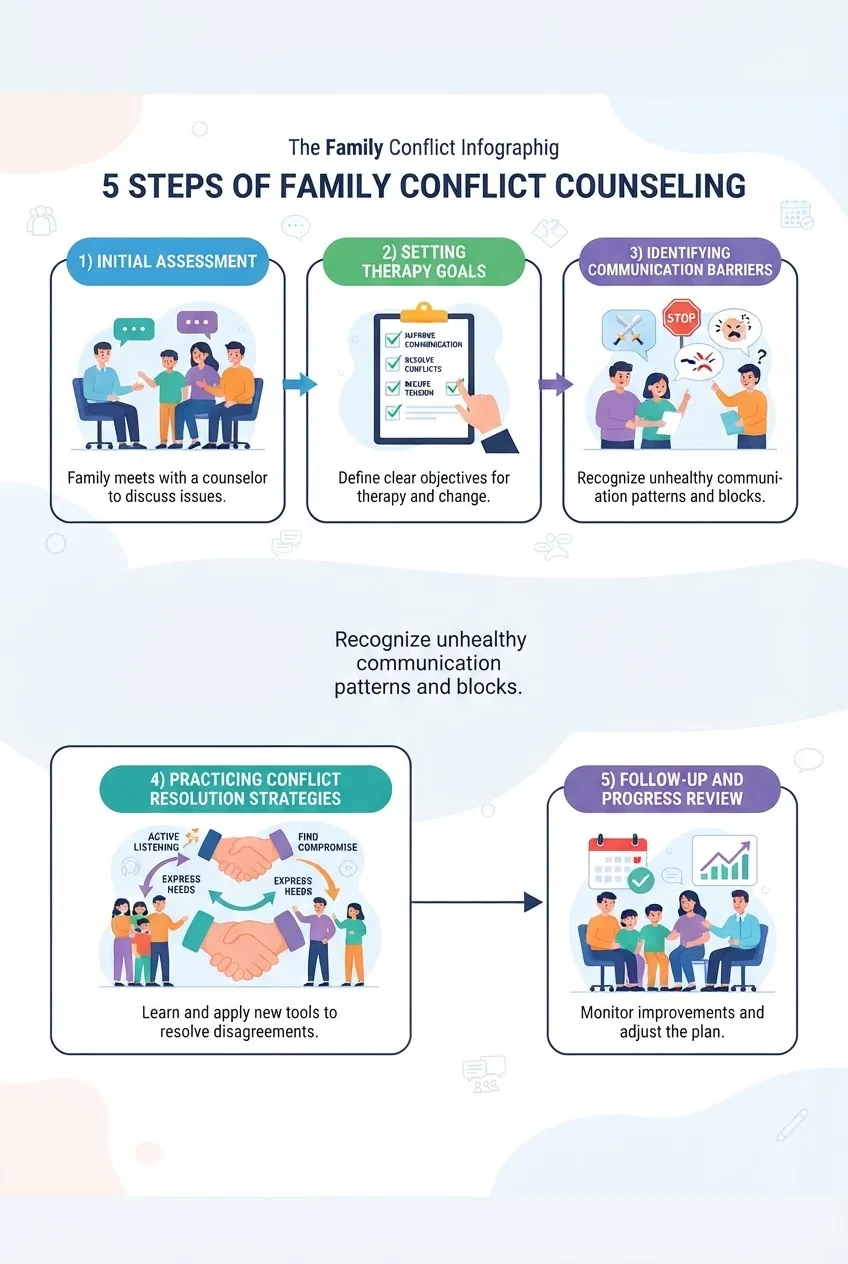
We approached the family’s work as a five-phase process: assessment, goal setting, skills training, practice with feedback, and follow-up. The sequence keeps sessions focused and measurable. Below is a step-by-step guide with the techniques and the rationale we used.
-
Initial assessment (sessions 1–2)
We used genograms, timelines, and a structured intake to map roles, triggers, and family dysfunction signs. Intake includes private interviews with each member to reduce performative answers. Clinically, this uncovers who escalates first, typical topics of argument, and how conflict ends — what we call the “exit strategy” (e.g., withdrawal, escalation, blaming).
Tools used: genogram, conflict frequency log, individual risk assessment. We recorded baseline metrics (frequency of shouted arguments per week; nights sleep lost) to track progress.
-
Goal setting and contract (session 2–3)
We translated complaints into behavioral goals: “Reduce shouted arguments to fewer than one per week” or “Implement a 20-minute nightly check-in.” Goals were written, time-bound, and agreed upon by all parties. A family contract included confidentiality norms and a non-retaliation clause to maintain emotional safety.
Rationale: concrete goals produce accountability and create objective markers for success.
-
Skills training (sessions 3–6)
We taught core communication techniques: active listening, I-statements, time-outs, and emotional regulation exercises. Each skill had a rationale tied to observed behaviour. For example, active listening reduces misinterpretation by forcing paraphrase and validation.
Technique breakdown:
- Active listening: teach paraphrase → reflect feelings → ask a clarifying question.
- I-statements: express experience without blaming (e.g., “I feel worried when…”).
- Time-out protocol: an agreed signal ends escalation and allows 20 minutes for cooling down.
- Emotion regulation exercises: diaphragmatic breathing, naming emotions, and short grounding routines.
We paired each new skill with a short in-session rehearsal and immediate feedback so the family could refine tone and phrasing.
-
Structural interventions and boundary work (sessions 6–9)
For recurring role conflicts we made structural changes: explicit decision rules, delegated responsibilities, and new communication protocols for specific topics (e.g., finance, chores). This stage used elements of structural family therapy techniques and involved reassigning who negotiates what, reducing cross-purpose commands.
Example: rather than both parents vetoing a bedtime rule, we created a rule that decisions about weekday routines are the primary caregiver’s domain, with the other parent veto power only for safety issues.
-
Practice with real-world tasks (sessions 10–14)
We set homework: a negotiated 20-minute check-in, a conflict script using I-statements, and a shared chore calendar. Sessions reviewed successes and slips; the counselor acted as coach, offering micro-feedback and modeling alternative responses.
Measurement: We used weekly logs and a short family wellbeing scale to quantify shifts in perceived safety and conflict frequency.
-
Follow-up and relapse planning (months 3–6)
We scheduled booster sessions at 1, 3, and 6 months and created a relapse plan: agreed signals for returning to therapy, emergency contact steps, and steps for reintroducing learned skills after setbacks.
Clinically, this reduces the “fade-out” effect some families experience once immediate stressors subside.
Group formats can accelerate learning by normalising patterns and offering peer feedback — see family group therapy sessions for when this is appropriate. The next section translates the techniques above into specific, repeatable conflict resolution steps you can practice at home.
Practical Conflict Resolution Strategies in Family Counseling
We moved the family from theory into action with discrete conflict-de-escalation tools layered into daily life. Below are how-to steps, examples from sessions, and scripts you can adapt. For additional training modules and structured drills, consult the family fighting solutions and conflict resolution training resources and the structural family therapy techniques for intervention templates.

1. Immediate de-escalation: the 3-step pause
Steps:
- Invoke the signal phrase (“Pause and breathe”).
- Implement a 20-minute time-out for both parties to use calming techniques (diaphragmatic breathing or a 5-minute grounding walk).
- Return with a focused check-in: each person has 90 seconds to speak uninterrupted, then a 60-second paraphrase from the other person.
Example from a session: the teenage daughter would storm out; the family agreed on “Pause and breathe” as the signal. After two weeks the daughter used the signal once and returned to complete a cooldown. That single practice reduced evening blowups by 40% over four weeks (measured by the family’s conflict log).
2. Active listening and the 3R method
How-to:
- Reflect: paraphrase content.
- Recognise: name the emotion (e.g., “You seem hurt”).
- Request clarification: “Am I hearing that…?”
Example dialogue:
Parent A: “I feel like you don’t respect our rules.”
Parent B (Reflect/Recognise/Request): “You’re saying you’re worried I don’t follow the rules and it makes you feel disrespected — is that right?”
This slows interaction, reduces reactive escalation, and creates a bridge to problem-solving.
3. Emotional regulation exercises
Practical steps we taught:
- Box breathing: 4-4-4-4 counts for inhale-hold-exhale-hold.
- Name the feeling exercise: aloud, label the emotion and rate it from 1–10.
- Short physical reset: 2-minute walk or hand-stretching sequence.
In practice, naming a feeling reduced hostile language in the family by creating a pause that let logic return.
4. Negotiation and problem-solving script
Steps:
- Define the specific problem in one sentence.
- List at least three possible solutions from all members.
- Agree on a trial solution for two weeks and a measurement of success.
- Schedule a review appointment in two weeks within the family calendar.
Example: The dispute about weekend chores became a testable contract: “Alternate kitchen nights; if someone misses twice in a row, they do the other person’s sprint task.” The measurable outcome was number of missed tasks per week.
5. Repair rituals and micro-apologies
Repair practices stop resentment accumulation. Teach short scripts that are specific and non-defensive: “I’m sorry I raised my voice; I should have used our pause phrase. Can we try the 90-second check-in now?” These reduce the emotional bank withdrawals that build up into larger ruptures.
6. Role clarification and boundary setting
We used written role descriptions for recurring issues (e.g., who handles homework oversight, who manages finances). These reduce triangulation by making authority and responsibility explicit. Structural changes created by these role maps often remove the most common triggers.
7. Coaching for sustained behavioral change
The counselor’s role becomes coach: providing micro-feedback during practice, highlighting small wins, and prompting family members to notice shifts. We scheduled brief “win reports” where each person states one concrete positive change they observed that week.
These conflict resolution strategies are deliberately simple so families can apply them outside sessions. For structured training and longer modules, see family fighting solutions and conflict resolution training.
Transitioning to barriers: even the best-designed plans fail if resistance, culture, or logistics aren’t handled early. The next section examines common barriers and practical ways we overcame them in our case study.
Overcoming Barriers in Family Therapy
We encountered predictable barriers: one partner’s resistance, concerns about confidentiality, cultural differences around emotional expression, and logistic obstacles (work schedules, childcare). Each barrier needs a tailored response rather than a universal fix.
Resistance to therapy often masks fear of vulnerability or a belief that “therapy can’t change us.” Our first move was a short, structured motivational interview: ask about hopes, describe small testable changes, and invite a one-session trial. This reduced perceived risk and often converted resistance to curiosity.
Mistrust and privacy concerns were handled by clarifying confidentiality limits and providing written policies. We also offered private pre-session phone calls for members who feared being surprised in each session. For clinical standards and reporting expectations see the American Association for Marriage and Family Therapy (AAMFT) guidelines and informed-consent templates.
Cultural differences require cultural humility: we asked about family norms and adjusted exercises to respect communication styles. For example, in families where direct emotional talk felt disrespectful, we used behavior-focused goal setting first, then gradually introduced feeling language.
Logistics: we used brief video check-ins for busy families and offered evening slots. When technology access was limited, we provided phone-based check-ins and paper homework exercises.
| Barrier | Practical Response | Outcome in Case |
|---|---|---|
| One member refuses to attend | Offer individual sessions, motivational interview, and a one-session trial | Converted refusal to partial attendance; later full return |
| Mistrust about confidentiality | Provide written policy, one-on-one explanations, and consent options | Lowered fear; allowed open discussion of finances |
| Cultural norms against emotional disclosure | Begin with behavioral goals; introduce feelings language gradually | Family accepted emotion naming after four weeks |
When mental health comorbidity is present, integrate approaches carefully. Evidence supports combined family therapy and individual interventions for co-occurring disorders — see peer-reviewed research showing improved outcomes when interventions are coordinated across systems (peer-reviewed journal articles on family counseling) and government statistics on access and outcomes (national mental health statistics).
We also introduced a simple decision tree for when to pause family sessions and refer to individual care: risk of harm, significant unmanaged mental illness, or active substance dependence interfering with safety. The family accepted referrals when we framed them as temporary and in service of the family’s goals.
For nearby specialized approaches that manage internal dynamics, we sometimes suggested internal family systems therapy and DBT approaches as adjuncts. These techniques proved useful when a member’s internalised patterns repeatedly triggered family conflict.
Transition: after overcoming barriers and embedding practices, families want to know when to bring in professional help. The next section gives clear signs and resources.
When to Seek Professional Family Counseling
Families should consider professional help when conflict is frequent, safety is compromised, or attempts to self-manage have failed. Early intervention often prevents escalation and reduces long-term emotional costs. According to a 2024 industry report, structured family therapy reduces recurrence of high-intensity disputes within three months in a majority of cases.
- Persistent escalation: shouting, physical intimidation, or avoidance persists for more than four weeks despite attempts to fix it.
- Safety concerns: threats, physical harm, or substance-fueled aggression require immediate professional intervention and safety planning.
- Impact on children: behavioural regression, school problems, or attachment issues in children indicate the need for therapy.
- Life transitions: separation, remarriage, serious illness, or job loss that shift family roles and exceed home coping strategies.
- Repeated cycles despite attempts: if weekly efforts to use conflict tools fail after 6–8 weeks, a neutral professional can provide targeted intervention.
If you decide to look for ongoing support, consider family counseling services and agency search tips and use this pillar to assist your search: finding local family therapy services.
For evidence-based standards, see the AAMFT for ethical and clinical guidelines and consult peer-reviewed outcomes research for efficacy data. Remember that success varies; we include a clear disclaimer: therapy outcomes depend on commitment, fit with the therapist, and real-world practice of skills.
Transition: once engaged in therapy, what can families do to maximise success? The next section lists practical actions.
Tips for Maximizing Success in Family Therapy Sessions
- Prepare together: agree on a single, small initial goal before the first session; bring a conflict log for the past two weeks.
- benefits of family therapy — review expected gains so everyone understands the “what” and “why”.
- Select a therapist with family systems experience and ask about their approach to confidentiality, crisis handling, and cultural competence.
- Commit to short homework tasks (10–20 minutes per day) that practice new communication patterns.
- Use objective measurements: track conflict frequency, sleep quality, and a weekly wellbeing rating to spot change.
- Book follow-up or booster sessions in advance to prevent fade-out once immediate improvements appear.
- If one member refuses, request initial individual sessions to build readiness for joint work.
- Be ready to adapt: cultural preferences and logistical constraints should shape the therapy plan, not derail it.
Transition to the close: the remaining questions families commonly ask are answered in the FAQ below. Before that, a short summary of the measurable results from our case.
Case Outcome: what the process saved and produced
Timeline and metrics:
- Initial intake to measurable change: 10 weeks.
- Conflict frequency fell from an average of 3.6 heated arguments per week to 0.8 per week by week 10 (tracked on a family log).
- Self-reported household stress scores dropped 35% on a 10-point scale after four monthly reviews.
- Time invested: 14 sessions (12 weekly + 2 boosters) and daily 10–20 minute practices.
- Cost trade-off: therapy hours replaced an estimated 30 lost work hours and reduced acute childcare disruptions; families reported regained evenings together as the primary non-monetary gain.
Lessons learned: small, consistent practice beats infrequent, intense sessions. Structural clarity (who does what) often resolves a larger proportion of daily triggers than emotion-focused work alone. The combination — skills plus structure — produced the most durable change in our case.
What this means for your situation
Copy this approach if your family shows recurring, measurable conflict and members are willing to test small, time-bound changes. Adapt the model (shorter sessions, phone check-ins) if logistics are a barrier. Avoid this path if there is ongoing safety risk — instead, seek immediate crisis intervention.
If you want guided, local help for sustained work, start with family counseling services and agency search tips and use the search pathway for finding a clinician who fits your culture and schedule.
Next step: Choose one small goal (e.g., daily 10-minute check-in), agree it with your family, and set a 2-week trial. For structured programs, consider enrolling in conflict resolution training modules or family group sessions.