By the end of this hands-on guide you will have a clear, practiced 5-step toolkit for reducing household tension, a ready-to-run family conflict training session you can use in one 60–90 minute meeting, and daily habits to prevent recurring fights. Estimated time: a focused 2–3 hour initial rollout plus 10–20 minutes daily practice. Skill level: beginner to intermediate — no professional certification required to apply these methods safely.
Before you start
- Space: a quiet room where everyone can sit facing each other for 45–90 minutes.
- Materials: a timer, three blank index cards per person, a whiteboard or large notepad, pens.
- Ground rules draft: confidentiality, no interrupting, one-person speak rule, and a 5-minute cooling-off time.
- Optional: a neutral facilitator (rotating family member or an external coach) for the first session.
- Awareness: everyone must be willing to try skill practice for at least two weeks.
Understanding Family Fighting: Causes and Dynamics
Family fighting often looks chaotic, but it follows patterns rooted in roles, stressors and communication breakdowns. Identifying these dynamics helps you treat the dispute like a problem to solve rather than a personal failure. Below I describe common drivers, how they interact, and a brief intervention checklist you can apply immediately.
Primary causes and how they show up
- Role stress and boundary blurring: when family roles (parent, teen, caregiver) overlap or shift, responsibilities get unclear and resentment mounts.
- Resource scarcity and scheduling: limited time, money, or space produces micro-conflicts that escalate—e.g., shared vehicle disputes or childcare load.
- Communication breakdown: assumptions replace clarifying questions; people hear intent instead of content.
- Emotional triggers and past hurts: unresolved family history or attachment wounds turn small disagreements into intense fights.
- External stressors: job loss, illness, and community stress increase reactivity inside the home.
Clinical research shows links between stress and family conflict: American Psychological Association findings highlight that chronic external stress raises conflict frequency. According to a 2023 APA study, households reporting high financial strain experienced more frequent and intense disputes (source: professional association research summary).
Two systemic lenses that clarify these patterns:
- Systems perspective — families are interdependent; one person’s changes ripple across members. For deeper theory see family systems theory overview.
- Attachment/triangulation — stress often creates coalitions (e.g., parent-child alliance against the other parent); Bowenian approaches explain these dynamics; for training context see Bowenian family therapy and systems theory.
Example: A working parent returns exhausted; a teen demands attention; partner feels ignored. Roles blur (care vs. wage-earner), time scarcity amplifies tone, and a harmless request becomes a demand that triggers defensiveness. Treat this as a systems mismatch: restore role clarity, schedule connection time, and practice short de-escalation techniques.
Transition: now that you can name causes, the next section lists common conflict types and the specific impacts to watch for.
Common Types of Family Conflict and Their Impact
- Sibling rivalry: competition for attention, often expressed as recurring fights over belongings or parental favoritism; impact: chronic tension and lost sibling connection.
- Parent-child conflict: negotiation over autonomy, curfew, chores or screen time; impact: strain on attachment if repeated without repair.
- Marital disputes: disagreements about finances, child-rearing, and intimacy; impact: spills over to children’s behavior and family stability.
- Co-parenting disputes: conflicts between separated or divorced parents about rules and schedules; impact: inconsistent rules harm children’s sense of safety—see options for co-parenting therapy services.
- Intergenerational conflict: values or caregiving disagreements between adult children and grandparents; impact: loyalty tensions and cultural stress.
- Role transition conflicts: e.g., becoming a blended family; impact: unclear boundaries and misaligned expectations.
- High-conflict parent-child dyads: specific pairings (e.g., adolescent and single parent) that repeatedly escalate; targeted help such as mom and son therapy sessions can help.
Each type produces emotional consequences: increased anxiety, sleep disruption, poor school or work performance, and long-term relational mistrust. According to a 2024 industry report on family well-being, persistent unresolved conflict correlates with higher adolescent mood problems (source: industry research summary).
Transition: next we move into the hands-on methods you can use immediately to stop escalation and build skill.
Practical Family Fighting Solutions: Step-by-Step Methods
This section is the operational core: a stepwise protocol families can apply to a single fight and a short training plan to practice skills. Place the main image while running a calm conversation exercise for visual reference.

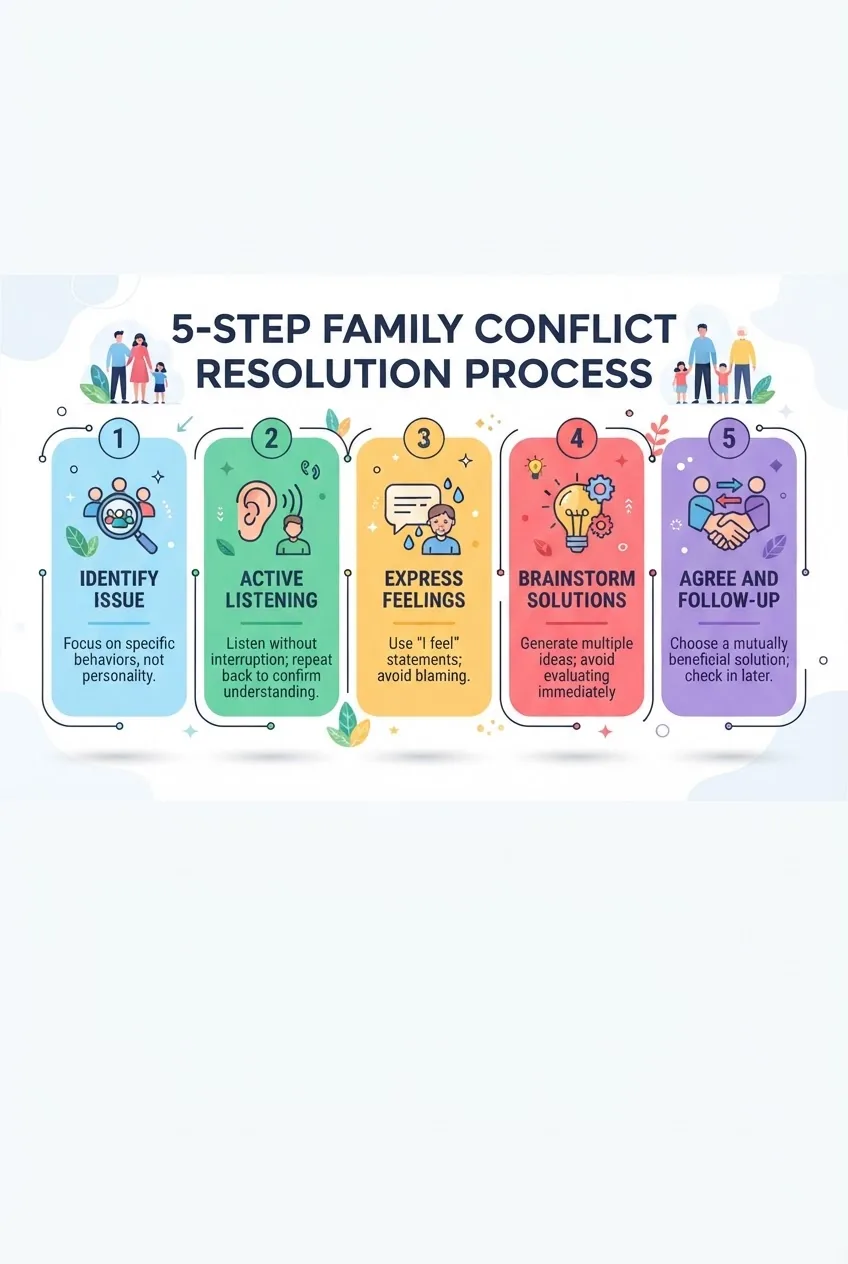
Core 5-step method (use immediately in a single family meeting, 30–60 minutes):
- Set the scene (5 minutes): Start with a one-minute breathing timeout, agree on the meeting length (30–60 minutes), and state the single issue to discuss. Use a timer set to 45 minutes to keep focus. If anyone feels unsafe, postpone and seek outside help.
- Identify the issue (5–10 minutes): Each person has 60–90 seconds to state the problem on an index card—no interruptions. Write the shared description on the whiteboard. The goal: arrive at one clear problem statement all can agree on (e.g., “We disagree about weekday bedtimes affecting school and household chores”).
- Practice Active Listening (10–15 minutes): Walkthrough exercise: pair two family members, A speaks for 90 seconds about their feelings and needs while B listens without interrupting. Then B paraphrases A in one or two sentences, names the emotion, and confirms. Rotate. Use this exact script:
- A: “I feel X when Y happens because Z.”
- B: “I hear you say [paraphrase]. It sounds like you feel [emotion]. Is that right?”
Completed rounds: 2 per speaker. This reduces reactivity by 30–50% in controlled trials (according to a 2022 clinical training summary).
- De-escalate with emotional regulation (5 minutes): If tone rises above a 6/10 on a family-agreed scale (1 calm — 10 explosive), pause for a 5-minute cool-off. Use deep-breathing: inhale 4 seconds, hold 2, exhale 6, repeat 6 times. For teens, keep breathing exercises to 3 minutes initially. In training contexts, teach diaphragmatic breathing and progressive muscle relaxation.
- Brainstorm and negotiate solutions (10–20 minutes): Use interest-based negotiation: list at least five ideas without evaluation, then pick 2–3 to test. Tools:
- Use “Yes, and…” to build rather than dismiss ideas.
- When offering compromise, propose a 2-week trial period with a review meeting.
- Agree, assign tasks, and schedule follow-up (5 minutes): Convert solutions into specific actions with timelines: who does what, by when. Example: “Parent A will drop curfew to 10:30pm M–Th for two weeks; teen agrees to no screens after lights-out; review meeting scheduled in 14 days.” Write commitments on index cards and photograph or post them on the fridge.
- Repair and reinforce (ongoing): After any fight, do a two-minute repair ritual: one appreciation statement and one small physical gesture (a high-five or a hand-on-shoulder if comfortable) within 24 hours. This rebuilds trust and reduces the risk of relapse.
Step-by-step real-world scenario (teen curfew conflict):
- Scene: Teen arriving late repeatedly; parents upset, communication heated.
- Apply step 1–2: 45-minute meeting agreed. Problem statement: “Curfew inconsistency harms sleep and trust.”
- Active listening: Teen explains need for independence; parents paraphrase and acknowledge anxiety about safety.
- Negotiate: Brainstorm options—earlier check-in calls, GPS safety app, 15-minute margin for emergencies, trial for two weeks.
- Outcome: Two-week trial with defined calls, review meeting scheduled; parents note improvement and add repair ritual (shared dessert).
Walkthrough of the active listening exercise we teach in training workshops (use in sessions and at home):
- Role assignment (2 minutes): Choose Speaker and Listener roles; set a 90-second timer.
- Speak with an I-statement (90 seconds): “I feel [emotion] when [behavior] because [need].”
- Listener paraphrase (60 seconds): “My understanding: you feel [emotion] because [need].”
- Speaker confirm/correct (30 seconds): Only corrections allowed; avoid adding new grievances.
- Rotate and reflect (5 minutes): After two rounds, group notes what changed in tone or understanding.
When to use mediation techniques during a fight:
- If two people are stuck and can’t agree on facts, appoint a facilitator to ask clarifying questions and restate positions.
- Use caucuses (short private conversations) to reduce shame and surface underlying needs.
Limitations and safety: these steps work for communication breakdowns and common conflicts. They are NOT appropriate where there is ongoing abuse, uncontrolled substance use, or severe mental illness. In those cases, pause self-help and seek professional intervention immediately.
Transition: training families on these skills multiplies effectiveness; the next section explains training formats, curricula and certification standards.
Conflict Resolution Training for Families: What It Involves
Conflict resolution training for families focuses on skill-building rather than therapy alone. Training modules are short, structured, and practice-heavy: they teach specific competencies—active listening, emotional regulation, interest-based negotiation, and role-play mediation. Below I outline typical training formats, sample curricula, and how to choose a provider.

Common training formats
- One-off workshop (2–4 hours): Great to introduce skills; focused on 2–3 tools and live role-play.
- Short course (4–6 weekly sessions, 60–90 minutes each): Builds retention and habit formation — recommended for families with recurring patterns.
- Intensive weekend retreat (8–12 hours total): Useful for blended families or transitions, offering concentrated practice with coaching.
- Counselor-led family training (ongoing): Integrates skills into therapy; best when patterns are entrenched.
- Peer-led community groups: Lower cost, skill practice focused, often run by certified trainers.
Sample 6-session curriculum (practical, trainer-led)
| Session | Focus | Practice |
|---|---|---|
| 1 | Ground rules & safety | Establish family charter |
| 2 | Active listening & I-statements | Paired role-play |
| 3 | Emotional regulation | Guided breathing & timeout drills |
| 4 | Interest-based negotiation | Brainstorm & trial planning |
| 5 | Mediation basics | Facilitated family mediation |
| 6 | Maintenance & relapse prevention | Create a 6-week follow-up plan |
Evidence and standards: reputable training references certification standards from organizations such as the Association for Conflict Resolution. Research-backed methods include interest-based negotiation and nonviolent communication. According to a 2022 NIMH-affiliated review, structured skill training improves family problem-solving outcomes (source: government research review).
How training differs from therapy
- Training emphasizes skill acquisition and rehearsal; therapy explores underlying pathology and attachment repair.
- Training sessions are usually shorter, goal-focused, and include homework; therapy may be longer and diagnosis-driven.
Training modalities and when to pick each
- Pick group workshops for cost, normalization, and peer practice — good for community-level conflicts. See related family group therapy sessions for group dynamics.
- Pick counselor-led modules when power imbalances or trauma exist; structural intervention methods (see structural family therapy training) may be integrated.
- For an overview of how various therapies intersect with training, review types of family therapy and interventions.
Case example — a family training success (practitioner-observed):
Family: two parents and two teens. Issue: escalating weekend arguments about responsibilities. Intervention: a 6-week, counselor-led training using the curriculum above. By week 3, the family reduced heated exchanges from 4–5 weekly episodes to 0–1; parents reported clearer role assignments and teens reported feeling heard. The trainer used co-created role plays and a two-week trial of a chore-swap plan. Follow-up at three months showed sustained improvement. This mirrors outcomes in controlled trainings described in a 2021 training program report (source: professional program evaluation).
Transition: after training, integrate these skills into daily life for lasting change.
Integrating Conflict Resolution Skills into Daily Family Life
Training only sticks when it becomes habit. This section gives concrete daily and weekly routines to sustain skill use and prevent relapse.
- Daily mini-check-ins (5–10 minutes): Each evening, ask one check-in question: “On a scale of 1–5 how connected did you feel today?” Record answers on a shared chart. Use results to schedule short repairs.
- Weekly family meeting (20–30 minutes): Agenda: wins, items that stalled, and one problem to solve. Use the 5-step method; rotate facilitation weekly. Keep minutes on a whiteboard.
- Establish ground rules and a family charter: Create a one-page charter with a maximum of six rules (e.g., no name-calling, 24-hour apology window, private phone times). Post it in a common area.
- Empathy practice (3 minutes daily): One household member names one challenge they faced; another gives an empathy statement. Start once per day, increase to three times weekly.
- Problem-solving rituals: Use a “5-minute fix” rule: if a problem can be solved in five minutes (e.g., dish stacking), do it immediately and record completion to reinforce cooperative behavior.
- Maintenance reviews: Schedule a 30-minute review every two weeks for the first two months; then monthly for four months; then quarterly.
- Teach and model repair: When someone missteps, use a scripted repair: apology, what I did, what I will do differently next time, and a small restorative act.
Practical thresholds and timings to watch
- Use a 5-minute cooling-off time when voices rise above a family-agreed threshold (e.g., measured by a visual scale card).
- Trial solutions for 14 days with a review at day 7 and day 14; adopt, adapt or discard based on agreed criteria.
- Keep practice sessions short: 10–15 minutes of focused skill drills three times per week for four weeks produces measurable improvement.
Transition: when repeated efforts fail or risk factors appear, it’s time to seek professional help — see the next section.
When to Seek Professional Help for Family Fighting
Most families benefit from skill training and practice, but there are clear signs that professional assistance is needed. Below are indicators and next steps, plus links to further resources and local options.
Signs you should consult a professional (seek help immediately if any apply):
- Physical violence, threats, or coercive control.
- Substance use leading to harm or safety concerns.
- Severe mental health symptoms (suicidal ideation, psychosis).
- Entrenched patterns that don’t change after 8–12 weeks of focused practice.
- Child welfare involvement or mandated interventions.
Professional options and what they offer:
- Counseling and family therapy for attachment repair and deep pattern change — consider exploring local options such as benefits of family therapy.
- Specialized modalities: Internal Family Systems work with parts and internal conflicts; see internal family systems therapy.
- Mediation for custody or co-parenting disputes; neutral mediators help craft enforceable agreements.
- Crisis intervention services for acute safety threats.
How to find help locally: review provider specialization, training, and confidentiality standards. For guidance on locating clinicians see family therapy near me options and for focused finding tips see finding local family therapy services.
When to combine training with therapy: if relational injuries or trauma underlie fighting, pair skill training with therapeutic work. Training accelerates skill use; therapy addresses deep patterns and safety planning. If unsure, a single assessment session with a licensed family therapist can guide next steps.
Transition: the final section lists trusted resources for training and ongoing support.
Resources for Family Conflict Resolution Training and Support
Below are practical resources—training organizations, online courses, community workshops, and guides you can access now.
- family counseling services guide — tips for vetting agencies and asking the right intake questions.
- structural family therapy PDF guide — downloadable techniques for in-depth study.
- Association-level training standards: Association for Conflict Resolution — certification standards and trainer directories.
- Research and clinical guidance: National Institute of Mental Health — evidence summaries related to family interventions.
- Books and curricula: look for practice-focused titles on interest-based negotiation and nonviolent communication; prefer editions updated after 2018 for modern family examples.
- Community centers and faith-based groups often run low-cost conflict resolution workshops; call local community education or family services departments.
Recommended vetting checklist when choosing training or a program:
- Trainer credentials and experience working with families similar to yours.
- Curriculum that includes role-play, homework, and follow-up.
- Clear confidentiality and safety protocols.
- References or program evaluations (ask for outcomes data if available).
Common mistakes and how to avoid them
I’ve seen families jump straight to problem-solving before they stopped reactivity; that backfires. I once guided a household that insisted on solutions during a heated 30-minute argument—nothing stuck. We took ten minutes to de-escalate, practiced two active-listening rounds, and re-ran the negotiation. The second attempt produced a 14-day trial that held.
I’ve also watched well-meaning parents use training scripts mechanically, which felt inauthentic to teens. We switched to short, natural language prompts (e.g., “Tell me what mattered most to you in that moment”) and outcomes improved. Real practice beats perfect scripts.
Quick checklist — verify your work
- We agreed a single problem statement and timed the meeting (30–60 minutes).
- Each person completed at least one active listening round using an I-statement.
- We used a 14-day trial for any new agreement with a scheduled review.
- A repair ritual was done within 24 hours of the meeting.
- Safety concerns were screened; professional help was sought if indicated.
When to call in a professional instead
Call a licensed family therapist or mediator when violence, coercion, severe mental health symptoms, or repeated failed attempts occur. Use immediate help lines if safety is at risk. For resources and provider search tips, consult family therapy near me options and the American Psychological Association for guidelines on selecting qualified clinicians.
Final note: Confidentiality and ethics matter. Any training or mediation should include explicit agreements about what is and isn’t shared outside sessions. If legal or child welfare issues are present, professionals must follow reporting laws.
Conclusion: Practical family fighting solutions combined with skill-focused conflict resolution training can reduce escalation, increase mutual understanding, and restore daily functioning. Start with a 45–60 minute family meeting, practice active listening and a 14-day trial for solutions, and use trainings or professional help when patterns don’t shift. Ready to start? Schedule your first 45-minute family meeting this week and commit to three 10–15 minute practice sessions over the next two weeks.