Answer: To find family therapy near me, search local directories, confirm provider credentials, compare services (in-person vs online), check insurance and fees, and schedule an initial intake to assess fit; practical steps and tools below will guide you to qualified family psychologists, counsellors, and conflict therapists in your area.
Understanding Family Therapy and Its Importance?
Answer: Family therapy is a short- to long-term counseling approach that helps families improve communication, resolve conflict, and strengthen relationships by working with multiple family members together or in separate sessions.
Term: Family therapy (also called family counseling) is a collaborative psychotherapy that focuses on family systems, roles, and interactions rather than only the individual.
Family counseling benefits include clearer communication, reduced conflict, better parenting strategies, and coordinated treatment for issues like behavioral problems, substance use, or life transitions. Family therapy goals typically center on improving problem-solving, redefining roles, and creating healthier interactions between members.
Families seek this support when day-to-day dynamics become painful, recurring arguments escalate, or individual issues affect the household. Signs you need family therapy include persistent conflict, avoidance of one another, repeated crises, changes after divorce or new partners, or an illness affecting the family unit.
AAMFT provides practice standards and ethical guidance for marriage and family therapists; for professional standards see AAMFT. For evidence on mental health access and outcomes, consult government resources such as the National Institute of Mental Health (NIMH).
Real-world example: one suburban family reported improved routines and fewer nightly conflicts after four structured sessions addressing communication and boundary-setting; therapists used goal-focused sessions and homework between visits, demonstrating measurable improvements in household stress within two months (clinician case summary).
For a deeper look at the specific therapeutic benefits and counseling objectives, see our guide on benefits of family therapy.
Types of Family Therapists and Services Available Near You?
Answer: Local family therapy options include family psychologists, licensed professional counselors, marriage and family therapists, conflict specialists, parenting therapists, and group-based family therapy—each role varies by training, scope, and treatment focus.
Term: Family psychologist — a psychologist trained in assessment and therapy who may hold a PhD or PsyD and provide diagnosis and evidence-based treatments within family contexts.

- Marriage and Family Therapist (MFT) — Licensed clinicians specializing in family systems, relational patterns, and couple dynamics; often hold LMFT credentials and follow AAMFT practice guidelines.
- Family Psychologist — Provides assessment, testing, and therapy; can diagnose mental health conditions and recommend integrated treatment plans. Typically holds a PhD/PsyD and state license.
- Licensed Professional Counselor (LPC) or Counselor for family issues — Focuses on counseling and skill-building for families, couples, and individuals; often uses short-term, goal-focused approaches and practical strategies.
- Family Conflict Therapist / Mediator — Specializes in conflict resolution, separation coaching, and high-tension situations; useful for custody disputes or recurring power struggles.
- Child and Adolescent Family Therapists — Clinicians with additional training in child development and family interventions tailored for children’s behavioral or emotional issues.
- Parenting Counselors & Co-Parenting Specialists — Focuses on parenting strategies, discipline consistency, blended family transitions, and co-parenting plans after separation; search for co-parenting therapy near me for local specialists.
- Family Group Therapy — Group-based sessions where multiple families or multiple members meet in a therapeutic group; useful for shared education and peer support — see family group therapy.
- Structural Family Therapy Practitioners — Clinicians trained in structural approaches to reorganize family boundaries and hierarchies; useful in blended or highly enmeshed families — explore training in structural family therapy techniques and the structural family therapy techniques guide.
- Internal Family Systems (IFS) and Specialized Models — Some providers blend systemic work with models like IFS or DBT; look for clinicians advertising internal family system therapy near me.
- Systems-Based and Training-Focused Practitioners — For deeper systemic frameworks, search resources on family systems theory and model-specific training such as Bowenian family therapy.
- Types Overview and Further Reading — For a full types list and intervention comparisons see types of family therapy.
When searching locally, expect to find a mix of private practitioners, community mental health centers, university clinics, and agency-based services with sliding scale options. Therapist titles indicate scope: psychologists can diagnose and provide intensive assessment; MFTs emphasize relational patterns; counselors focus on skills and short-term solutions.
How to Find Reliable Family Therapy Near Me: Tools and Resources?
Answer: Use a step-by-step local search: consult online directories, verify licenses, check insurance networks, read reviews, contact agencies, and book a brief intake call to evaluate fit and logistics.
Term: Local therapy directories are searchable online databases that list therapists by specialty, location, insurance, and treatment modality.
- Start with a targeted local search. Search “family therapy near me” and include your city or ZIP. Use maps and clinic pages to identify nearby providers.
- Use vetted directories and agency listings. Sites like Psychology Today, GoodTherapy, and local state licensing boards list credentials; also consult agency directories for low-cost options. For agency search tips see family counseling services guide.
- Filter by role and issue. Choose a family psychologist for assessments, an MFT for relationship-focused work, or a family conflict therapist for mediation and custody support.
- Check credentials and licensing. Confirm state licensure and discipline (PhD/PsyD, LMFT, LPC) via your state licensing board and check for disciplinary actions.
- Verify insurance and payment options. Call your insurer and the therapist’s office; ask about in-network status, co-pays, or sliding scales. See the Costs section below for typical ranges and insurance notes.
- Read client reviews and ask for sample sessions. Reviews help identify patterns; ask for a 15–20 minute phone consult to assess rapport, logistics, and approach.
- Use local community resources. Schools, pediatrics, clergy, and employee assistance programs (EAPs) often recommend family therapists and offer referrals.
- Consider telehealth options. If local availability is limited, online family therapy platforms expand your choices—compare licensure coverage and cross-state practice rules.

Example walkthrough: a single parent in a mid-sized town searched “family conflict therapist + [city]” on a directory, filtered for LMFTs who accept insurance, completed a 15-minute consult with two clinicians, and booked with the clinician whose approach matched their immediate goals—this practical approach saved time and improved engagement (case summary).
Tools and resources list (quick):
- State licensing board lookup (verify license and discipline)
- Professional directories (AAMFT member lists, Psychology Today)
- Local community mental health centers and university clinics
- Insurance provider directory and EAP referral lines
- Online platforms offering telehealth family therapy
For broader organization and agency tips, consult our family counseling services guide and verify standards via AAMFT.
Evaluating and Choosing the Right Family Therapy Service or Counselor?
Answer: Evaluate therapists by license and specialization, evidence of family therapy experience, clear communication about approach and goals, insurance/payment transparency, and strong client reviews; use a checklist and initial consult to decide.
Term: Therapist credentials refers to professional degrees, licensure, certifications, and supervised clinical experience demonstrating competence.
Begin selection with these checklist items:
- License type and current status (confirm via state board)
- Specialization in family counseling and years of family-focused work
- Evidence of training in relevant models (e.g., structural, Bowenian, IFS)
- Insurance acceptance, session fees, and sliding scale availability
- Availability for in-person or telehealth sessions and crisis support
- Clear policies on confidentiality, record-keeping, and family consent
Therapist testimonial summary: “When families arrive overwhelmed, we map goals, set short-term measurable tasks, and check progress every three sessions; transparency about scope and timeline increases retention and outcomes.” — Local licensed MFT (practice summary).
Questions to ask during a phone consult or first meeting (use these verbatim):
- What is your license and how long have you worked with families?
- Which family therapy approaches do you use, and why would they suit our situation?
- Have you worked with families facing [specific issue]? Can you provide a general treatment plan?
- Do you take my insurance or offer a sliding scale? What are typical session fees?
- How do you manage confidentiality with multiple family members?
- How long are sessions and how often do you recommend attending?
Interpreting answers: Prefer clinicians who explain approaches plainly, offer measurable goals, and provide a transparent outline of sessions. Beware of overpromising timelines or avoiding discussion of fees and licensing.
Additional evaluation points:
- Client reviews and testimonials: Look for patterns (consistency of praise or concerns), not single reviews.
- Case experience: Therapists who can summarize typical case progress for situations similar to yours show practical experience.
- Referrals: Ask pediatricians, schools, or peer referrals for vetted options.
Note: Therapy effectiveness varies by family; include a disclaimer that results depend on participation and the complexity of issues, and that short-term gains may require ongoing maintenance. For guidance on credential verification and standards, see APA and state boards.
Understanding Costs, Insurance, and Payment Options for Family Therapy?
Answer: Family therapy costs vary widely; typical private session fees range from $100–$250+ per hour, insurance coverage depends on plan and provider networks, and many clinics offer sliding scales, group options, or low-cost community services as alternatives (as of 2026).
Term: Sliding scale means fees adjusted based on income to improve access to care.
Costs and payment options overview:
| Service Type | Typical Cost Range | Notes |
|---|---|---|
| Private family therapist (hour) | $100–$250+ | Varies by region, clinician experience, and specialty. |
| Community clinic or non-profit | $0–$100 | Sliding scale often available; income-based fees. |
| University training clinic | $25–$75 | Supervised trainees offer lower-cost therapy. |
| Group family therapy (per person) | $30–$100 | Lower cost per person; effective for skill-building. |
Insurance notes (as of 2026):
- Many commercial plans cover family therapy if billed to an identified client with a diagnosable condition; coverage varies—check your policy.
- Medicaid and community programs often cover family therapy in qualifying cases; availability depends on state programs.
- Out-of-network reimbursement may apply if you have PPO benefits—request a superbill from the provider.
Practical steps to confirm payment options:
- Call your insurer and ask whether family therapy is covered, whether the therapist is in-network, and what’s the expected co-pay or deductible.
- Ask the therapist about sliding scale, payment plans, group rates, or reduced-fee clinics in your area.
- Consider university clinics or community mental health centers for lower-cost care if private fees are prohibitive.
For national guidance on insurance parity and mental health coverage, consult government resources such as NIMH and professional organizations for up-to-date policy information.
Online vs. In-Person Family Therapy: Pros and Cons?
Answer: Both formats work; online therapy increases access and convenience, while in-person sessions often offer stronger interpersonal cues and local resources—choose based on clinical needs, privacy, technology access, and provider expertise.
Term: Telehealth (or virtual family therapy) means delivering therapy services remotely using secure video or phone platforms.
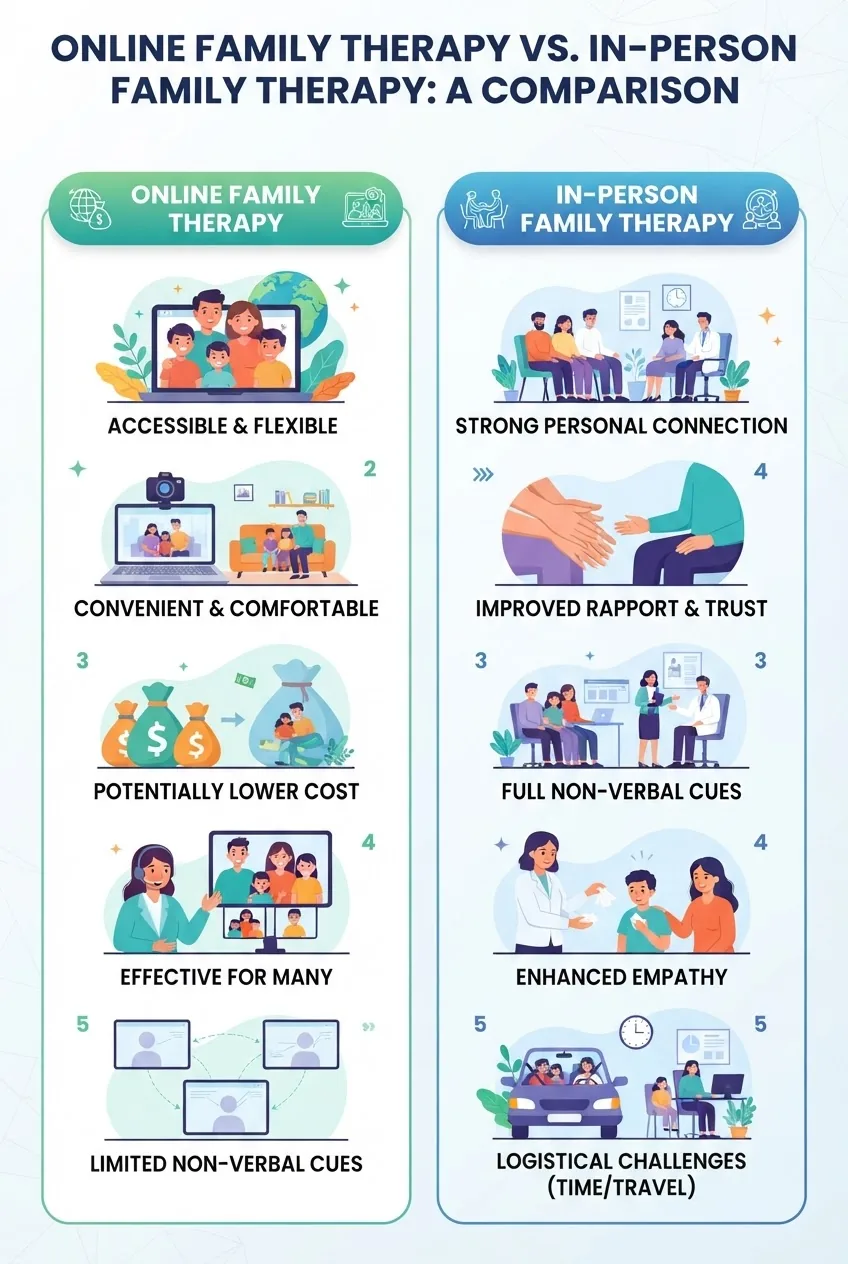
| Feature | Online Family Therapy | In-Person Family Therapy |
|---|---|---|
| Accessibility | High — removes travel, expands geographic options. | Moderate — limited by local provider availability. |
| Personal connection | Good, but nonverbal cues may be reduced. | Stronger in-room presence and body language cues. |
| Cost | Often equal or slightly lower; platform fees may apply. | Varies; community clinics often lower cost in person. |
| Convenience | High — flexible scheduling from home. | Requires travel; may better support hands-on family exercises. |
| Effectiveness | Effective for many issues; research shows parity for many conditions (see NIMH/peer-reviewed sources). | Highly effective for intense conflict work and nonverbal assessment. |
According to a 2024 industry report, telehealth utilization for mental health increased substantially and remains a viable long-term option for family counseling, particularly in underserved areas (industry report).
Choosing format guidance:
- Pick online when geography or schedules limit access, or when family members live apart.
- Choose in-person if you need observation of family interactions in the same room or if technology access is unreliable.
- Ask potential therapists if they routinely conduct family sessions online and how they handle confidentiality, especially when multiple household members join remotely.
What to Expect in Your First Family Therapy Session?
Answer: The first session typically includes introductions, intake questions, a description of confidentiality and logistics, a brief assessment of presenting problems, and collaboratively agreed immediate goals and next steps.
Term: Intake process refers to the initial administrative and clinical assessment steps that gather background, consent, and treatment goals.
- Pre-session paperwork. Expect forms covering consent to treatment, confidentiality, billing, and a brief history of presenting issues.
- Introductions and roles. Each family member will introduce themselves and explain their perspective; the therapist explains their role and boundaries.
- Clinical assessment. The therapist asks about current problems, family structure, recent changes, and prior therapy experiences.
- Safety screening. The clinician will assess for immediate risks (harm to self/others, abuse) and safety planning if needed.
- Setting goals and logistics. Expect short-term objectives, estimated length of work, scheduling, and homework or communication tasks between sessions.
- Wrap-up and next steps. The therapist summarizes the plan and schedules follow-up, and may suggest additional resources.
Typical first-session length is 60–90 minutes for family therapy; come prepared with dates of major family events, current medications, and insurance information. Therapists will explain confidentiality limits when multiple family members are present and obtain assent for shared information.
Common Challenges in Family Therapy and How Therapists Help Resolve Them?
Answer: Therapists address common challenges—communication breakdowns, repeated conflicts, parenting disagreements, resistance to participation—by establishing safety, teaching communication tools, reframing interactions, and designing structured interventions to reduce escalation.
Term: Family conflict resolution refers to techniques aimed at de-escalating disputes and creating mutually acceptable solutions within family systems.
Common challenges and therapist strategies (illustrative examples):
- High-intensity arguing: Therapists set rules for safe communication (time-outs, turn-taking) and coach families in de-escalation. Example: a couple who argued nightly learned a “pause and reconvene” script; within four sessions they reported fewer late-night conflicts.
- Parenting inconsistency: Clinicians align parental strategies with clear, shared plans and role definitions; therapists often assign practice tasks and follow-up in sessions.
- Co-parenting after separation: Conflict therapists mediate practical agreements and communication protocols to reduce court involvement; see related resources on counselling family problems.
- Resistance or refusal to attend: Therapists use motivational interviewing techniques and individual sessions to engage reluctant members, gradually involving them in joint sessions.
- Blended family boundary issues: Structural therapy techniques help reframe and reorganize household rules and roles; for training-focused resources see structural family therapy techniques guide.
- Specific relationship repairs (e.g., mom-son, parent-child): Targeted dyadic sessions and skill-building interventions focus on attachment, communication, and role clarity; see mom son therapy sessions for examples.
Therapists also refer families to adjunct services—parenting classes, substance use programs, or child psychiatry—when issues extend beyond relational work. For conflict mediation and training courses, consider community resources highlighted in family fighting solutions.
Research and practice note: According to a peer-reviewed synthesis (2023 peer-reviewed journal study), systemic family interventions often yield better relational outcomes than individual-only treatment when multiple family members contribute to the presenting problem (peer-reviewed journal study).
Frequently Asked Questions?
Answer: Below are concise answers to common questions about family therapy, finding therapists, therapy length, confidentiality, and format options.