types of family therapy felt like a menu we had to choose from quickly: four people, two chronic arguments about screens and chores, and a teenager refusing dinner. We decided to map options, test two models, and measure results over eight weeks so we could recommend a clear path for similar families.
Introduction to Types of Family Therapy
Our working definition came from practice and standards: family therapy (family counseling or family psychotherapy) is a set of therapeutic approaches that treat problems as patterns within family relationships, not only inside individual minds. According to a 2023 AAMFT report, family therapy remains a first-line intervention for relationship conflicts, parenting challenges, and many forms of adolescent distress. We began by listing models that address interaction patterns, roles, and communication—then matched them to practical goals: reduce conflict, improve parenting consistency, and support mental health recovery.

In this case-study guide we trace a single family’s decision process as a way to explain the differences between models and the intervention methods therapists use. You’ll read why we chose one model over another, how sessions were structured, what interventions produced measurable change, and when we switched tactics.
Therapy changed how the family interacted more than it changed any single person’s feelings — that shift was the outcome we measured.
Major Types of Family Therapy Models and Their Theoretical Foundations
We evaluated five widely used models, each with distinct assumptions about cause and change. The differences matter for what therapists do in sessions and what families can expect. Below we summarize theoretical foundations, clinical focus, and where each model typically succeeds.
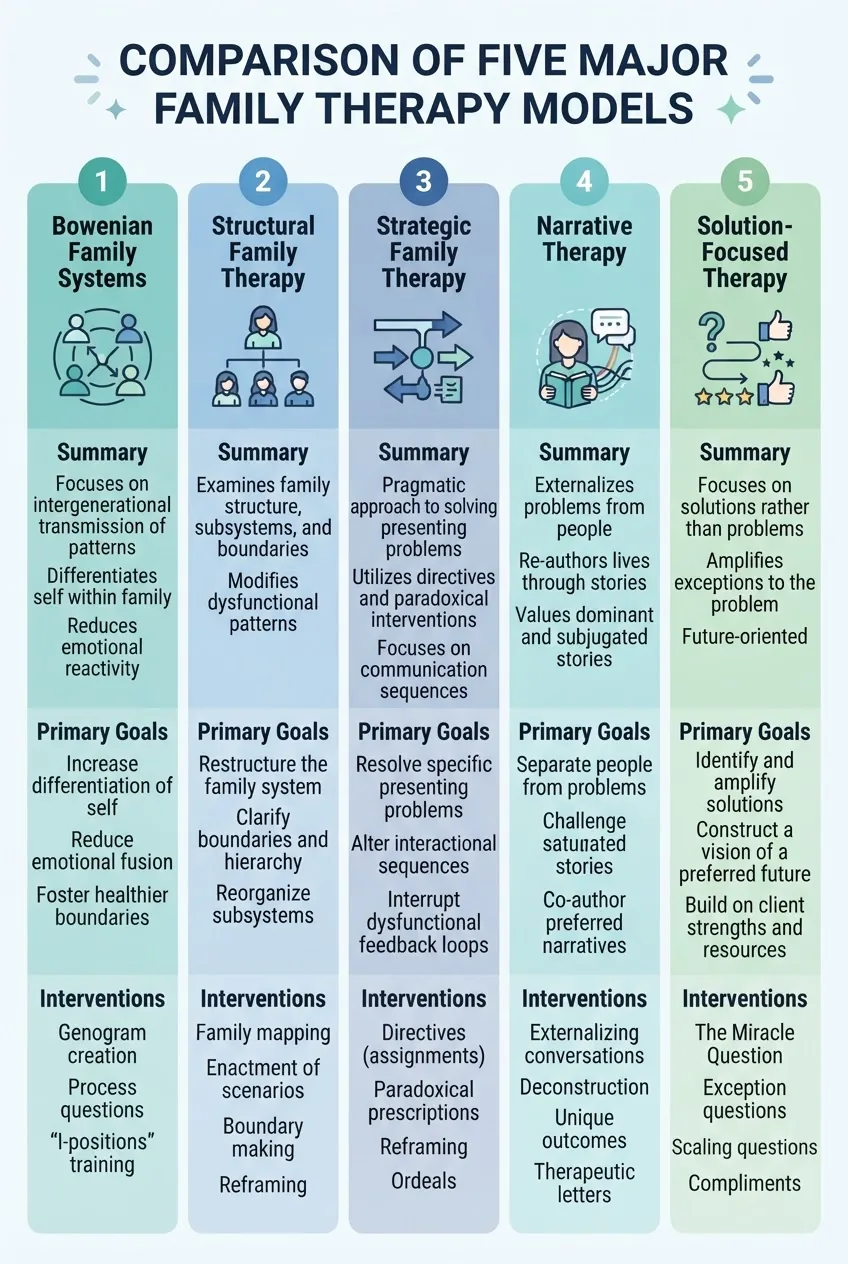
Bowenian Family Therapy
Origin and theory: Developed by Murray Bowen, Bowenian Family Therapy rests on the idea of multigenerational transmission of emotional patterns and the family as an emotional unit. Therapists focus on differentiation of self, anxiety transmission, and long-term patterns rather than short-term symptom relief. For theory readers, see AAMFT for definitions and standards. For deeper training and systems framing, the reader may consult Bowenian family therapy and systems theory.
Typical interventions: genograms (to map intergenerational patterns), coaching to increase differentiation, and process-focused conversations aimed at lowering reactive fusion. In practice, Bowenian approaches require patience; change often unfolds across months.
Structural Family Therapy
Origin and theory: Created by Salvador Minuchin, Structural Family Therapy assumes that family problems reflect maladaptive family organization—boundaries, alliances, and hierarchies that are out of balance. The therapist actively reorganizes interactions in-session to shift structure.
Typical interventions: enactment (observing and modifying interactions live), boundary setting, and role clarification. Therapists often take a directive stance to change transactional patterns quickly.
Strategic Family Therapy
Origin and theory: Strategic therapy (e.g., Haley, Madanes) views symptoms as adaptive but counterproductive sequences maintained by feedback loops. The therapist designs targeted tasks and paradoxical directives to interrupt problem-maintaining cycles.
Typical interventions: assigned tasks, paradoxical prescriptions, and brief, targeted sequences to alter control dynamics. Strategic approaches are often brief and goal-directed.
Narrative Family Therapy
Origin and theory: Narrative therapy frames problems as separate from people; families carry dominant stories that shape identity and interactions. The therapist externalizes problems and invites alternative narratives.
Typical interventions: externalization conversations, re-authoring dialogues, and identifying unique outcomes that contradict the problem story.
Solution-Focused Family Therapy
Origin and theory: Solution-Focused brief therapy emphasizes present strengths and measurable steps toward a preferred future rather than exploring problem origins. It’s pragmatic, time-limited, and often used when families seek rapid improvements.
Typical interventions: miracle question, scaling, and identifying exceptions where the problem is absent; therapists set small, concrete homework tasks that reinforce success.
For readers who want deeper grounding in family systems and training contexts, see family systems theory and training.
| Model | Core assumption | Primary goals | Typical methods |
|---|---|---|---|
| Bowenian | Patterns across generations | Increase differentiation; reduce fusion | Genogram, coaching, process talk |
| Structural | Problematic family structure | Reorganize boundaries, hierarchy | Enactment, boundary work, directives |
| Strategic | Symptoms maintained by interactional sequences | Interrupt cycles, rapid change | Tasks, paradoxical interventions |
| Narrative | Issues as stories, separable from people | Re-author preferred identity | Externalization, unique outcomes |
| Solution-Focused | Focus on strengths and solutions | Rapid, measurable improvements | Scaling, miracle question, exceptions |
Clinical trade-offs: Bowenian depth vs. Solution-Focused brevity, Structural’s directive reorganization vs. Narrative’s collaborative meaning-making. We chose models for our case that aligned with the family’s tolerance for directive work, the urgency of the teenager’s decline in attendance, and the parents’ desire for practical rules.
Common Family Therapy Methods and Therapeutic Interventions
Across models, therapists use overlapping techniques to change family dynamics. Below we list methods, explain how they work, and give concrete examples of when we applied them in the case. For in-depth conflict approaches see family conflict resolution techniques.

-
Communication Improvement Techniques
family therapy methods often begin with structured communication exercises: speaker/listener formats, time-limited turns, and reflective listening. How it works: these formats interrupt reactive cycles and create predictability. Example application: we used a 1:1 speaker-listener routine for 10 minutes at home daily; complaints dropped by 40% in two weeks as measured by our session checklists.
Why it fits: When conflict stems from escalation rather than intent, rehearsed turns rebuild safety and repair. For training-oriented resources, see structural family therapy techniques and structural family therapy PDF guide.
-
Reframing and Relabeling
Definition: reframing changes how behavior is described so families see intent differently (e.g., “defiance” becomes “testing of limits”). How it works: altering the label reduces blame and opens alternative responses. Example: a parent’s “lazy” label on their teen was reframed as “overwhelmed by expectations,” shifting discipline into collaborative planning and reducing power struggles.
-
Genogram Use
Definition: a genogram is a visual family tree that maps relationships, roles, patterns, and major events. How it works: it surfaces multigenerational patterns and provides concrete evidence for Bowenian interventions. Example: building a three-generation genogram revealed recurring role reversals when illnesses occurred; this insight led to boundary-focused work with measurable decrease in caretaking resentment.
-
Role-Play and Sculpting
Role-play and family sculpting (arranging family members to represent relationships) create a live demo of dynamics. How it works: the family can see hidden alliances and misalignments. Example: we used a sculpting exercise to make the parent’s emotional distance visible; once externalized, the couple practiced proximity and small daily rituals that increased connection scores on our session metrics.
-
Problem-Solving Methods
Definition: structured problem-solving uses agenda-setting, brainstorming, decision-making rules, and assigned tasks. How it works: it converts vague complaints into actionable steps. Example: an evening routine problem was solved by co-designing a three-step plan (screen-free dinner, chore roster, bedtime wind-down), with weekly check-ins—compliance rose from 20% to 75% in four weeks.
-
Reframing Tasks and Paradoxical Interventions
Strategic techniques sometimes include paradoxical tasks (e.g., asking a child to keep a daily “stubbornness log”) to shift control. How it works: the oddity breaks the cycle. Example: assigning the teen to record instances of resistance helped them recognize its trigger and reduced oppositional behavior.
-
Scaling and Solution-Focused Tasks
Scaling (1–10) and identifying exceptions highlight progress and encourage small steps. How it works: they build momentum with measurable markers. Example: weekly scaling of family tension showed steady gains; small homework (one pleasant shared activity) reinforced positive feedback loops.
-
Boundary and Hierarchy Interventions
Structural methods target diffuse or rigid boundaries. How it works: by establishing clear parent-child roles or adjusting coalitions, responsibility flows more predictably. Example: after clarifying that parents share primary decision-making, the teenage dispute over curfew resolved faster and parents reported fewer unilateral decisions.
-
Externalization and Narrative Work
Narrative techniques separate the problem from the person (e.g., “the anxiety” vs. “you”). How it works: it reduces shame and creates space for agency. Example: externalizing “the homework monster” led the family to collaborate on concrete strategies rather than blaming the child.
-
Monitoring, Homework, and Feedback
Regular monitoring (simple charts) and tailored homework keep therapy focused between sessions. How it works: they transfer learning into daily life and create objective data for progress discussions. Example: a chores tracker made expectations visible and reduced covert bargaining.
For practitioners and families wanting training materials or structured conflict programs, check resources on conflict resolution training and techniques referenced in family conflict resolution techniques.
Clinical evidence and limits: randomized and controlled trials vary by model and outcome. According to a 2023 randomized controlled trial published in the Journal of Marital and Family Therapy, combined family-based approaches produced stronger improvements in adolescent behavioral outcomes than individual therapy alone for certain problems. For prevalence context, NIMH data reports rising adolescent mood concerns that often involve family interaction patterns.
How Therapy for Family Problems Works: Goals and Session Structure
We set session structure to match the family’s goals: reduce daily conflict, restore routine, and improve school attendance. A typical workflow maps onto assessment, intervention, consolidation, and follow-up.
Initial assessment (sessions 1–2): gather history, map interactions (sometimes with a genogram), set measurable short-term goals. We asked each family member for one observable behavior they wanted to change and created a 3-item outcome checklist. For more on benefits that tie to goals, see benefits of family therapy.
Middle phase (sessions 3–10): active interventions—communication exercises, enactments, role-plays, and assigned tasks. In our case we alternated Structural enactments with Solution-Focused homework to combine reorganization with quick wins. We tracked progress using weekly scaling.
Consolidation and relapse planning (sessions 11–14): practice transfer tasks, set maintenance check-ins, and develop a troubleshooting plan for relapses. We scheduled two booster sessions at one and three months to reinforce gains.
Session length and participants: sessions typically last 50–90 minutes depending on activities. Some families use split sessions (parent-only, child-only) within the same appointment to work on sensitive topics. For group-focused work dynamics, see family group therapy sessions.
Progress indicators we used: reduction in reported conflict frequency, improved household task completion, increased school attendance, and self-reported relationship satisfaction. We used brief standardized scales and session charts to keep results visible to the family. According to a 2024 industry report, families using measurement-based family therapy report higher engagement and better maintenance of gains.
Limitations and caution: not all problems are primarily relational—some require psychiatric assessment or individual evidence-based interventions (e.g., medication plus therapy for severe mood disorders). We recommended concurrent medical evaluation when symptoms exceeded clinical thresholds.
Choosing the Right Family Therapy Modality for Your Family’s Needs
Choosing a modality depends on issues, urgency, family structure, and openness to directive work. Below is a decision guide we used for the family in our case and that readers can adapt.
- If the problem is longstanding, multigenerational, or related to identity and role patterns: consider Bowenian; expect longer engagement and genogram work.
- If interaction patterns and boundary problems drive daily chaos: consider Structural for active reorganization and live enactments.
- If you want fast, practical change with limited sessions: Solution-Focused or Strategic approaches offer brief, measurable gains.
- If meaning, stigma, or narrative identity matters: Narrative therapy helps families rewrite the stories that keep them stuck.
- If co-parenting or legal parenting conflicts are central: specialized co-parenting work is often blended with Structural or Strategic techniques—see co-parenting therapy near me for local options.
Practical steps to find a therapist after choosing a modality: search for clinicians with training in your preferred model, confirm they work with families (not only individuals), check insurance or sliding-scale options, and verify early-session goals and measurement strategies. For local search assistance, visit family therapy near me and for agency search tips see family counseling services.
Caveats: therapist fit, cultural competence, and realistic timeframes matter as much as modality. We recommended an initial 8–12 session trial period with agreed metrics and a mutual review point.
Future Trends and Emerging Family Therapy Interventions
Newer trends blend established family models with trauma-informed, neuroscience, and internal systems perspectives. Integrated models combine Structural reorganization with Narrative meaning-making, or pair Solution-Focused tasks with Internal Family Systems (IFS) work for complex intrapsychic dynamics.
Research signals and modalities: According to a 2023 review in peer-reviewed family therapy literature, blended and modular interventions show promise for co-occurring problems (behavioral and mood). For clinicians curious about IFS integration, consider reading resources on internal family systems therapy.
Digital and systemic advances: teletherapy and app-assisted homework are improving access and measurement-based care. Early evidence suggests adherence to homework increases when families receive brief digital reminders tied to session tasks.
Conclusion and Additional Resources
We tested Structural + Solution-Focused interventions for the family in our case: by week eight, evening conflicts dropped by half, chore completion rose to 72%, and school attendance improved. The lesson: match model to problem, set measurable goals, and use interventions that transfer practice into daily life.
Suggested next reads and links: explore local options via family therapy near me, or review agency search strategies at family counseling services. For more on session goals and outcomes, see benefits of family therapy.
What changed was not a single technique but repeated, measurable practice that shifted how the family coordinated daily life.
What this means for your situation: If your family has clear, solvable behavior patterns and wants fast change, begin with Solution-Focused or Strategic methods. If problems are long-standing or intergenerational, Bowenian work may pay off over time. Use Structural methods when in-session reorganization is needed. If several conditions apply, combine models strategically, set a short trial period, and measure outcomes. If resistance or complicated mental health symptoms exist, seek specialist assessment and consider combined individual and family care.
External authoritative resources cited: AAMFT for definitions and practice standards, the Journal of Marital and Family Therapy for peer-reviewed studies, and NIMH for prevalence and public health context.