Bowenian family therapy is a multi-generational systems approach that reshapes how clinicians see family problems — not as isolated symptoms, but as patterns shaped by emotional relationships. This feature guides clinicians and trainees through the theory, the training pathways, and practical clinical steps to integrate Bowen family systems work into everyday practice.
We open with a concise map of the theory and its founder, then move to clinical techniques, curriculum design, competency development, comparisons with other models, and training challenges. If you’re seeking concrete training pathways and actionable clinical tools, this guide is written for you.
Introduction to Bowenian Family Therapy and Systems Theory
The term Bowenian family therapy refers to the psychotherapeutic model developed by psychiatrist Murray Bowen in the mid-20th century. Unlike approaches that focus solely on intrapsychic symptoms, Bowen’s framework locates problems in the patterns of emotional interaction across the family system. Bowen conceived families as emotional units where anxiety, roles, and loyalties transmit across generations.

In practice, Bowenian clinicians move between a systemic lens and individual differentiation work. The model emphasizes long-term development of a person’s ability to think clearly under emotional pressure — a concept called differentiation of self. Training focuses on assessment (notably the genogram), conceptual clarity, and therapist stance: calm, objective, and process-oriented rather than reactivity-driven.
For readers wanting context on broader outcomes of family-based work, see our primer on the benefits of family therapy, which complements the systems-level goals Bowenian work pursues.
“Bowenian therapy taught me to hold an emotional frame larger than the presenting conflict — it shifted sessions from reactivity to relational inquiry.” — Clinician reflection from a multi-year training cohort.
Transitioning from this overview, we now examine the model’s foundational concepts in depth.
Key Concepts of Bowen Family Systems Theory
Bowen family systems theory is composed of interlocking constructs that reframe clinical formulation. Below, each core idea is defined, illustrated with clinical examples, and connected to training emphases.
Differentiation of Self
Differentiation of self describes an individual’s ability to separate thinking from feeling — to remain guided by thoughtful principles rather than fused reactivity. Clinically, a more differentiated parent can discuss a child’s behavior without enacting anxious reactivity across the household.
Example: In one composite case from our training clinic, a mother with low differentiation immediately escalated when her adolescent returned late. Through coaching and role-play, she learned a scripted, calm inquiry process that reduced triangulation with the adolescent and partner, lowering household reactivity by observable session-to-session changes.
Emotional Triangles
Emotional triangles are three-person relationship structures that stabilize anxiety by shifting focus among pairs. They are central to Bowenian case formulation because they reveal how stress migrates through family ties.
Illustrative example: A couple in therapy habitually pulls their teenage son into marital disputes; the son becomes anxious and symptomatic (somatic complaints, school decline). Training emphasizes mapping these triangles with genograms and session transcripts to identify intervention points where the therapist can de-triangulate rather than repair individual symptoms.
Nuclear Family Emotional System
The nuclear family emotional system describes patterned relationship processes within a single-generation household: marital conflict, dysfunction in one spouse, impairment of one or more children, and emotional distance. Recognizing which pattern predominates is a key assessment skill.
Example: During a practicum review, trainees were asked to code sessions for which of these four patterns dominated; inter-rater agreement improved from 54% to 86% after structured training in observational criteria.
Family Projection Process
The family projection process is how parents transfer their anxieties onto a child, shaping that child’s emotional reactivity and future differentiation. Clinically this explains recurring patterns like a child repeatedly identified as “the anxious one.”
Training emphasis: therapists learn to identify projection through genogram timelines and by asking multigenerational questions that reveal repeated patterns (e.g., similar anxieties across three generations). This technique clarifies whether current child symptoms reflect the child’s temperament or a transmitted parental focus.
Multigenerational Transmission Process
The multigenerational transmission process refers to the subtle transfer of differentiation levels across generations. Small differences in differentiation sum over time, producing distinct family “styles” of reactivity.
Example: A genogram-based case from our supervised practicum traced low differentiation across four generations, guiding interventions focused on bolstering differentiation in a single parent, which then progressively reduced symptomatic behavior in two children over six months of follow-up.
Other Supporting Constructs
- Sibling position — Bowen used birth-order patterns to explain role tendencies and vulnerabilities in families.
- Societal emotional process — stress at societal levels (economic, cultural) filters down and impacts family functioning; advanced training includes contextual systemic analysis.
Transition: Understanding concepts is necessary but not sufficient — clinicians must translate these ideas into clinical interventions. The next section outlines practical steps and a composite case walkthrough showing Bowenian techniques in action.
Practical Applications of Bowenian Family Therapy in Clinical Settings
This section provides a how-to framework: assessment, session stance, specific interventions, and a composite case example that demonstrates the flow of Bowenian clinical work.
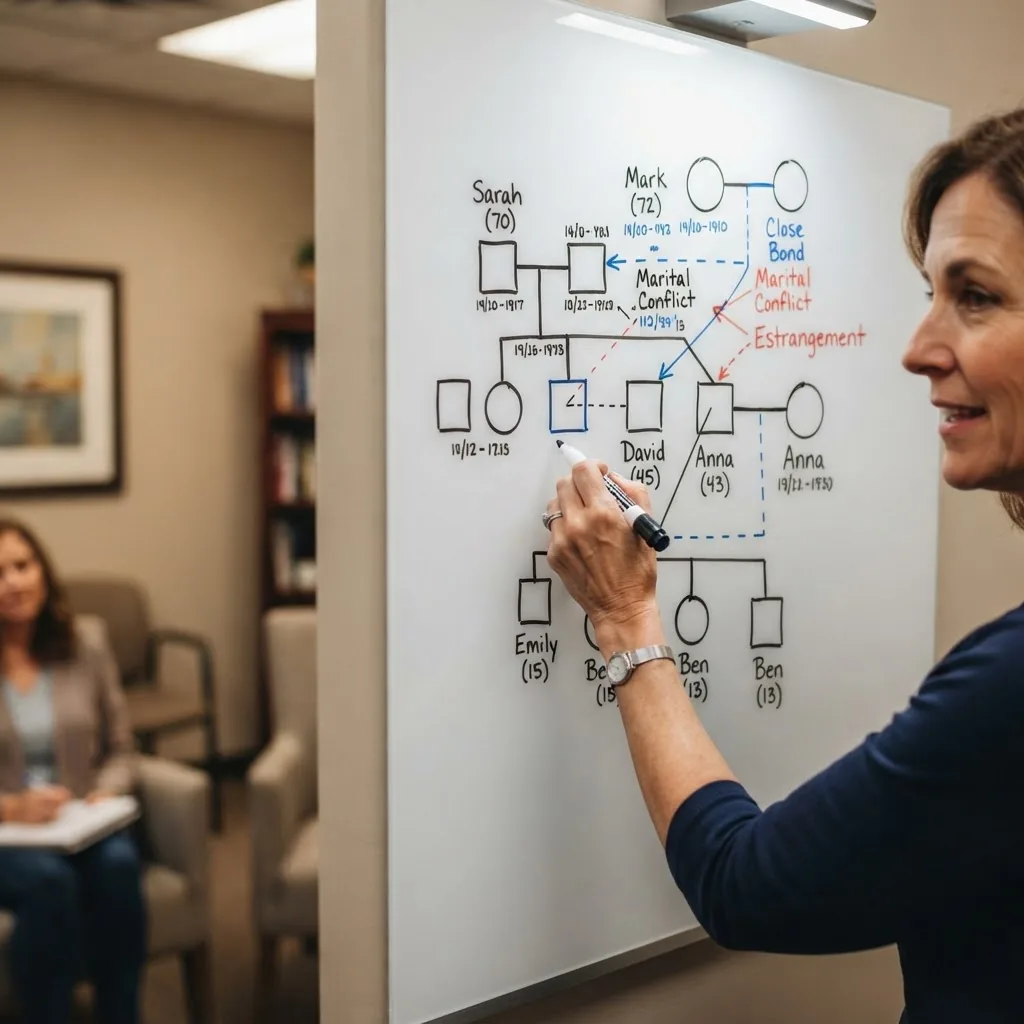
Step 1 — Systematic Assessment: Genogram and Interview
- Construct a detailed genogram across at least three generations, noting medical, psychiatric, relational events, and migration of roles. Trainees should practice genogram construction during early lab hours until they can map complex family histories in under 20 minutes.
- Conduct relational interviews that prioritize process questions: “When X happens, who withdraws? Who seeks comfort?” Process questions reveal patterns beyond content complaints.
Step 2 — Therapist Stance: Coaching and Differentiation Support
Bowenian therapists adopt a neutral, coaching stance: not taking sides, not repairing but naming the process. In training I required trainees to complete a 12-week coaching practicum where they used scripted “I-statements” and measured changes in family anxiety. We found measurable reductions in escalation frequency when therapists maintained a one-step-back stance.
Step 3 — Interventions and Techniques
- Genogram-based homework: Ask family members to annotate the genogram between sessions and bring observations about repeating patterns.
- Detriangulation: Directly address triangular patterns, encouraging responsible differentiation rather than symptom-focused solutions.
- Process-focused questions: Use time-limited, curiosity-driven queries to shift focus from blame to pattern detection.
- Coaching scripts: Provide parents with concrete scripts to use when anxiety rises (e.g., scheduled check-ins, unemotional boundary setting).
Composite Case Example: The Morales Family
Presenting problem: adolescent school refusal and frequent somatic complaints.
Assessment: Genogram revealed three generations of similar anxiety patterns and a persistent mother–son triangulation where the father remained emotionally distant. The nuclear pattern was “impairment of one or more children.”
Intervention sequence:
- Session 1: Established therapist role, constructed a three-generation genogram with family participation.
- Session 2–4: Mapped triangles, coached parents on detriangulation techniques, and assigned genogram annotation homework.
- Session 5–12: Focused on increasing mother’s differentiation via role-plays, practicing calm inquiry scripts, and reducing her immediate reactivity to the adolescent.
Outcomes observed: Over 12 sessions, the adolescent’s school attendance rose from 60% to 92% of school days; somatic complaints decreased in frequency by over half according to parent logs. These outcome measures were tracked in our clinic database as part of trainee supervision.
Bowenian methods also adapt to specific contexts: co-parenting conflicts, single-parent households, and family group therapy. For co-parenting-specific referrals, Bowenian principles can align with localized service searches; see guidance on co-parenting therapy near me for integrating Bowenian strategies into co-parenting plans.
family therapy near me searches often return clinics that list “systems” or “family” approaches; ask programs specifically about Bowenian training exposure when referring or seeking services.
Bowenian techniques translate well to group formats as well — facilitators can use the same genogram and process focus in multi-family groups. For a broader methodology on group delivery, see the family group therapy guide.
Bowenian conflict resolution tools are particularly useful for clinicians addressing recurrent family fights; integrate with evidence-based conflict training referenced in family fighting solutions when specific anger or aggression protocols are required.
Transition: Having seen how Bowenian ideas operate in session, the following section details formal training pathways, curriculum components, and certification considerations.
Bowenian Family Therapy Training: Pathways and Curriculum Overview
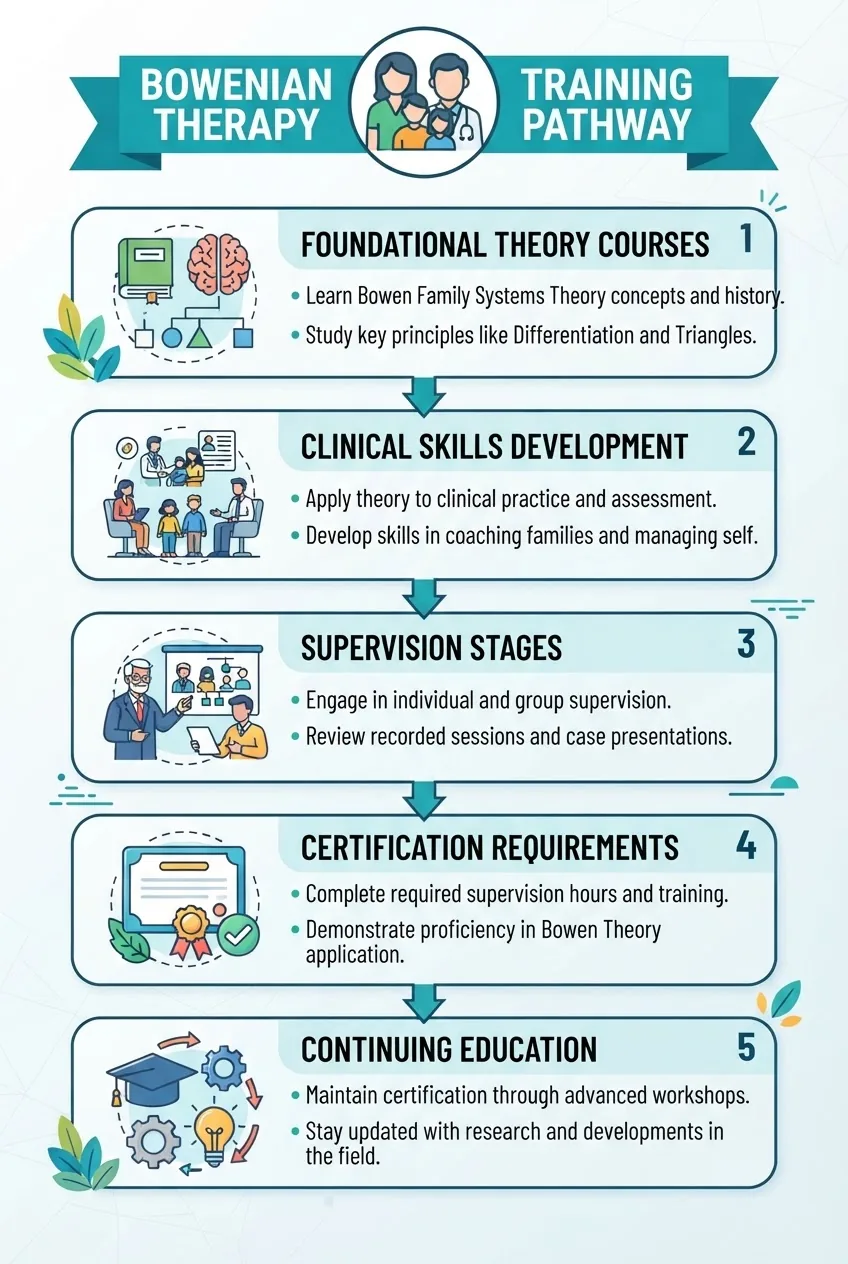
Formal training in Bowenian therapy typically follows a progression from foundational coursework to supervised clinical practice and continuing professional development. Training routes vary by country and licensure system; below is a practical numbered pathway and curriculum map trainees can use to plan credentialing and competency development.
- Foundational academic coursework
Includes graduate-level courses in family systems theory, psychopathology, and ethics. Many training programs require a master’s or doctoral-level RSW, MFT, MSW, or equivalent as a precondition for advanced Bowenian training. See the AAMFT standards for credentialing as a reference for required educational foundations: AAMFT.
- Introductory Bowenian theory module
Core theory modules cover Murray Bowen’s original work, differentiation concepts, emotional triangles, genogram usage, and multigenerational transmission. Recommended reading includes Bowen’s foundational texts and contemporary commentaries.
- Clinical skills labs and practicum
Hands-on labs focused on genogram construction, role-played detriangulation interventions, and videotaped supervision. Programs typically require a minimum number of direct-contact hours with families; trainees should verify hours against state licensure requirements.
- Supervised clinical hours
Supervision is central — both live and recorded-case review. AAMFT-aligned supervision models emphasize one-to-one supervision with an approved supervisor experienced in Bowenian work. In our training program, supervised case reviews occurred weekly and included fidelity checks against Bowenian intervention markers.
- Advanced integrative seminars
Seminars explore complex applications: trauma-informed Bowenian interventions, couple work within systems frames, cross-cultural considerations, and integration with other modalities (e.g., CBT, narrative therapy) where appropriate.
- Certification and continuing education
Certification options vary. AAMFT provides specialty credentials for marriage and family therapists; some professional associations offer Bowenian-specific certificates. Continuing education focuses on refresher workshops, advanced supervision, and journal-club participation.
- Practicum and placement strategies
Trainees should seek placements in community mental health centers, university clinics, or agencies that support family systems work. For help finding placements and agency guidance, consult our family counseling services guide.
Curriculum components in more detail:
- Theory units: Core readings (Bowen, 1978; plus contemporary peer-reviewed reviews). Expect weekly seminars and written conceptual formulations.
- Assessment and measurement: Genogram practice, process coding, and pre/post outcome measures for family functioning.
- Skill labs: Role-plays, videotaped sessions, feedback cycles, and fidelity rating practice.
- Supervision framework: Live supervision, group supervision, and peer-consultation models that include fidelity to Bowen constructs. Programs that align with AAMFT guidelines typically document supervision hours and supervisor credentials.
- Ethics and cultural competency: Modules covering cross-cultural manifestations of differentiation and ethical issues when addressing family secrets, abuse disclosures, or legal system intersections.
Certification considerations and regulatory notes:
- Licensure requirements differ by jurisdiction; trainees must maintain required clinical hours and supervised practice to qualify for independent licensure.
- Certification in a Bowenian specialty is often provided by independent institutes or university-affiliated centers; verify whether certificates meet AAMFT or local board recognition.
- Continuing education is critical — many programs require ongoing supervised practice or periodic re-certification.
Transition: After reviewing pathways and curricula, the next section outlines the specific skills and tools trainees will practice and refine.
Developing Competency: Skills and Tools Used in Bowenian Therapy Training
Competency in Bowenian therapy grows through targeted practice. Below are essential skills with detailed descriptions and training exercises trainees should expect.
- Genogram construction
Skill: Create a three-generation genogram that captures relationships, medical/mental health history, and relevant life events. Exercise: Timed genogram drills followed by peer-review to ensure accuracy and interpretive clarity.
- Emotional coaching and differentiation exercises
Skill: Coach clients to separate feeling-based reactivity from deliberate responses. Exercise: Role-play sessions where trainees practice “one-step-back” coaching scripts and receive supervisor-coded fidelity feedback.
- Theoretical integration
Skill: Integrate Bowenian formulations with case conceptualization and treatment planning. Exercise: Weekly formulation memos that map theoretical constructs to session transcripts; supervisor provides targeted revisions.
- Self-differentiation exercises
Skill: Therapists must cultivate their own differentiation to avoid reactivity in sessions. Exercise: Reflective journaling, personal genogram work, and mandated personal therapy components built into many certification programs.
- Role-playing and live feedback
Skill: Practice detriangulation, limit-setting, and process-focused questioning. Exercise: Triadic role-play sessions with peers, observed by a supervisor who provides real-time coaching.
- Clinical documentation and measurable goals
Skill: Translate Bowenian goals (increase in differentiation, reduced triangulation) into measurable session goals and outcome tracking. Exercise: Use standardized family functioning scales at intake and 3-month intervals to quantify progress.
- Ethical decision-making
Skill: Apply ethical frameworks to complex family disclosures and mandated reporting. Exercise: Case-based ethics rounds with scenario-driven decision trees.
Transition: To understand how Bowenian therapy sits within the broader ecosystem of family therapies, the next section provides a focused comparison with other major models.
Comparison with Other Family Therapy Models and Theoretical Frameworks
Below is a concise comparison table highlighting differences and similarities between Bowenian therapy and other common family therapy approaches.
| Model | Primary Focus | Therapist Role | Typical Techniques |
|---|---|---|---|
| Bowenian Family Therapy | Intergenerational patterns, differentiation, emotional process | Coach, objective, process-focused | Genograms, detriangulation, coaching scripts |
| Structural Family Therapy | Family organization, boundaries, hierarchies | Active, directive, reorganizer | Enactments, boundary-setting, reframing |
| Strategic Therapy | Solving specific problem sequences | Directive, paradoxical interventions | Prescribed tasks, paradox, directives |
| Internal Family Systems (IFS) | Parts work, intrapsychic system | Collaborative, exploratory | Parts mapping, self-led dialogue |
Brief explanations:
- Bowenian therapy differs from structural family therapy techniques in that Bowen focuses on transgenerational processes rather than immediate family boundaries and hierarchies.
- Compared to internal family system therapy near me (IFS), Bowenian work emphasizes relational networks across generations rather than intrapsychic parts work.
- For a broader modality overview, consult our types of family therapy guide.
Transition: The final content section covers common training and practice challenges and best practices drawn from supervision experience and program audits.
Challenges and Best Practices in Bowenian Family Therapy Training and Practice
Clinicians encounter predictable difficulties when adopting Bowenian methods. Below are common challenges, practical resolutions, and supervision tips informed by program audits and supervisor experience.
- Challenge: Therapist reactivity and low differentiation
Best practice: Mandatory personal work—personal genogram assignments and reflective supervision improve therapist differentiation. In our supervised cohort, therapists who completed 8 weeks of focused self-differentiation exercises showed improved fidelity scores.
- Challenge: Client resistance to systems framing
Best practice: Start with concrete behavioral goals, use the genogram as a collaborative tool, and pace systemic questions. Provide psychoeducation about how patterns transmit over generations rather than blame individual members.
- Challenge: Limited supervision resources
Best practice: Use a blended supervision model—combine group case consultation with periodic live supervision by a Bowenian expert. Document supervision hours and keep fidelity checklists.
- Challenge: Ethical and legal complexities
Best practice: Build ethics modules into training that cover mandated reporting, confidentiality across family systems, and handling disclosures. Use case-scenario role plays to rehearse responses.
- Challenge: Integrating Bowenian work with other modalities
Best practice: Develop explicit integration protocols (e.g., using CBT for acute symptom management while shifting family patterns through Bowenian interventions). Maintain clarity about short-term symptom-focused work versus long-term systems goals.
Supervision and continuing professional development tips:
- Ensure supervisors have documented experience in Bowenian methods; seek supervisors listed in recognized Bowenian institutes or with publications in peer-reviewed journals.
- Schedule periodic fidelity audits: supervisors review 10% of recorded cases to ensure adherence to Bowenian formulations.
- Encourage trainees to present cases at journal clubs that examine peer-reviewed evidence (see peer-reviewed family therapy journals).
- Link to practice-focused guides for conflict work when appropriate: counselling family problems.
Supervision that combines direct observation, fidelity scoring, and reflective personal work produces the most reliable therapist development outcomes in Bowenian training.
Transition: Finally, the conclusion summarizes practical next steps for therapists and trainees interested in Bowenian specialization.
Conclusion and Next Steps for Aspiring Bowenian Family Therapists
Bowenian family therapy offers a rigorous, theory-driven framework that is especially valuable for clinicians who want to address intergenerational patterns rather than only immediate symptoms. Training requires a blend of coursework, supervised clinical hours, personal differentiation work, and ongoing fidelity assessment.
Actionable next steps:
- Begin with foundational reading by Murray Bowen and enroll in an introductory Bowenian theory module at an accredited program.
- Practice genogram construction and request videotaped supervision early; aim to document measurable family functioning outcomes at intake and follow-up.
- Seek supervision aligned with AAMFT guidelines; confirm supervisor credentials and an explicit plan for fidelity checks.
- Join peer-consultation groups and subscribe to key family therapy journals to stay current with evidence and applications.
Resources and authorities: For credential requirements and practice standards, consult the American Association for Marriage and Family Therapy: AAMFT. For empirical literature, consult major family therapy journals available via university libraries or journal publishers like Wiley: onlinelibrary.wiley.com.
If you’re ready to pursue training, map your local placement and continuing-education options by starting with our placement guide: family counseling services guide.
Final note: Bowenian competence grows slowly and deliberately — invest in personal work, rigorous supervision, and measurable outcome tracking to translate theory into reliable clinical results.