Family counseling services help families address relationship, behavior, and communication problems through structured sessions that include multiple family members; this guide explains how to identify reputable family counseling agencies nearby and gives step-by-step vetting, search and comparison tactics you can use today.
What Are Family Counseling Services?
Answer: Family counseling services are professional therapeutic programs that work with multiple family members to improve communication, resolve conflicts, and support development or transitions; they are tailored by a licensed clinician to the family’s goals and structure.
Term: Family counseling services — structured therapeutic support involving two or more family members working with a licensed clinician to change patterns of interaction, set goals, and solve relational problems.

Family counseling typically focuses on connection and interaction rather than only individual symptoms. Sessions can target parenting challenges, blended-family issues, adolescent behavior, divorce transitions, bereavement, and long-term relationship patterns. The clinician assesses family roles, communication styles, and goals, then recommends a modality and frequency of sessions.
Term: Counseling process — an initial assessment followed by goal-setting, intervention sessions, and periodic reviews of progress.
Benefits often include better conflict management, clearer boundaries, and improved emotional support. For deeper discussion of therapeutic outcomes and evidence, see the benefits of family therapy.
According to a 2024 industry report, families who complete a recommended course of family therapy report measurable improvement in communication and functioning; for clinical context, the National Institute of Mental Health provides evidence summaries on therapeutic benefits and outcomes — see NIMH.
Common session formats include:
- Joint family sessions with several members present.
- Multiple subsystem sessions (e.g., parents together, teen with parent).
- Family group therapy that includes extended family or combined family groups.
Term: Family group therapy — a format where multiple families or extended-family members participate together; see family group therapy for techniques and suitability.
Types of Family Counseling Agencies: How to Know What Fits Your Needs?
Answer: Agencies vary by size, funding, specialties and delivery method; choose the type that matches your clinical needs, budget, and logistics—private practices for specialized care, community centers for low-cost access, and teletherapy providers for convenience.
Term: Agency size — refers to whether a provider is a solo private practice, small group practice, large multi-disciplinary clinic, community center, or national telehealth network.
- Private practices (solo or small group) — personal clinician relationships, usually specialized care and flexible scheduling; often preferred when seeking a particular therapist expertise or continuity of care.
- Multi-disciplinary clinics — several clinicians under one roof (LPCs, LMFTs, LCSWs), offering coordinated care and easier internal referrals across child, couples, and family specialists.
- Community counseling centers — lower-cost or sliding-scale fees, often funded by nonprofit grants; suitable for families with financial constraints or needing accessible local services.
- School- or agency-linked services — available through schools or child welfare agencies; useful for youth-focused issues and coordination with educational plans.
- National teletherapy platforms — wide provider networks and rapid access, best for scheduling flexibility and geographic portability; consider licensure limits if working across state lines.
- Specialized centers — agencies focused on specific issues such as addiction, trauma, blended-family dynamics, or parenting support; search for centers offering targeted programming like co-parenting therapy or family conflict resolution training.
- System-theory and training centers — clinics attached to training institutes or universities offering evidence-based system approaches; useful if you want clinicians trained in Bowenian family therapy, family systems theory, structural family therapy techniques, or internal family system therapy.
- Online-only specialized providers — platforms or agencies that offer family modules and digital resources; check if they provide live multi-person sessions or only parent coaching modules.
When choosing, weigh clinician expertise versus program infrastructure: private practices often have deeper specialization and consistent clinician fit, while larger agencies offer broader services and in-house coordination. For modality overviews, see the types of family therapy.
Match format to need: if the priority is a parent-adolescent relationship work, look for clinicians with youth experience or programs like mom son therapy sessions. If you need structured intervention techniques, search agencies that advertise structural family therapy or structural family therapy techniques.
Term: Teletherapy — therapy delivered remotely via video or phone; first use defined here because delivery method affects licensure, confidentiality, and session dynamics.
Key Factors to Consider When Searching for a Family Counseling Agency Near Me?
Answer: Prioritize licensure and accreditation, therapist specialization, session formats (in-person vs teletherapy), cost and insurance acceptance, cultural competence, and clear confidentiality policies when choosing a nearby family counseling agency.

Term: Licensed therapists — clinicians certified by a state board (examples: LMFT, LCSW, LPC) who meet training, supervision, and continuing-education requirements.
-
Verify credentials and licensure.
Check state licensure and certification: LMFT (Licensed Marriage and Family Therapist), LCSW (Licensed Clinical Social Worker), LPC (Licensed Professional Counselor). Use state licensing boards and the American Association for Marriage and Family Therapy standards for agency and clinician expectations; see AAMFT for accreditation and practice standards.
-
Confirm the agency’s scope and specialization.
Ask if clinicians specialize in adolescent behavior, trauma, addiction, blended-family dynamics, or parenting — specialization matters more than agency size when you need specific interventions.
-
Check teletherapy options and licensure limits.
If you choose teletherapy, confirm whether the therapist is licensed in your state and whether the platform allows multi-member video sessions; teletherapy can increase access but has cross-state licensing limitations.
-
Assess cultural competence and language accessibility.
Look for agencies with staff who reflect your family’s culture and language or that advertise cultural humility training; ask about interpreter services when needed.
-
Confirm confidentiality protections and consent processes.
Ask about HIPAA compliance, privacy policies, and how notes are stored; for minors, clarify parental consent rules and limits to confidentiality in your state.
-
Understand the intake and client flow.
Request a copy of the intake paperwork and a description of the typical client pathway: initial phone screen, clinical intake session, treatment planning meeting, frequency of sessions, and clinician assignment or rotation.
Example intake workflow: phone pre-screen → 60–90 minute intake with all relevant family members → collaborative treatment plan → weekly or biweekly sessions → 3-month review.
-
Investigate insurance, payment, and sliding-scale policies.
Ask which plans are accepted, whether clinicians bill as in-network or out-of-network, and whether the agency offers sliding scale fees or payment plans.
-
Evaluate client reviews, referrals, and outcome measures.
Look for outcome tracking or satisfaction surveys the agency uses; client testimonials help but verify patterns rather than anecdotes when possible.
-
Consider logistics and accessibility.
Physical location, parking, transit access, childcare options during sessions, and evening/weekend hours may determine feasibility for ongoing care.
-
Ask practical, vetted questions during initial contact.
Useful questions: “What is your experience with issues like ours? Which clinician would we see and what are their credentials? How do you measure progress? What is your cancellation policy?”
According to a 2023 AAMFT report, agencies that publicly outline clinician credentials and outcome measures are more likely to sustain measurable client improvement; for credential validation use state licensing portals or AAMFT resources at AAMFT.
Tip: When speaking to an agency, request a short consultation call to assess rapport and to clarify logistics — rapport in that first call correlates strongly with long-term engagement.
Anonymized example: A family seeking support for teen substance use screened three clinics, prioritized an LMFT with adolescent specialization, confirmed insurance billing practices, and chose a local multi-disciplinary clinic offering both family and individual adolescent sessions.
How to Evaluate and Compare Family Counseling Services?
Answer: Compare agencies across four core dimensions—credentials, cost & insurance, service types, and client feedback—using a structured table to score each option and schedule consultation calls for top contenders.
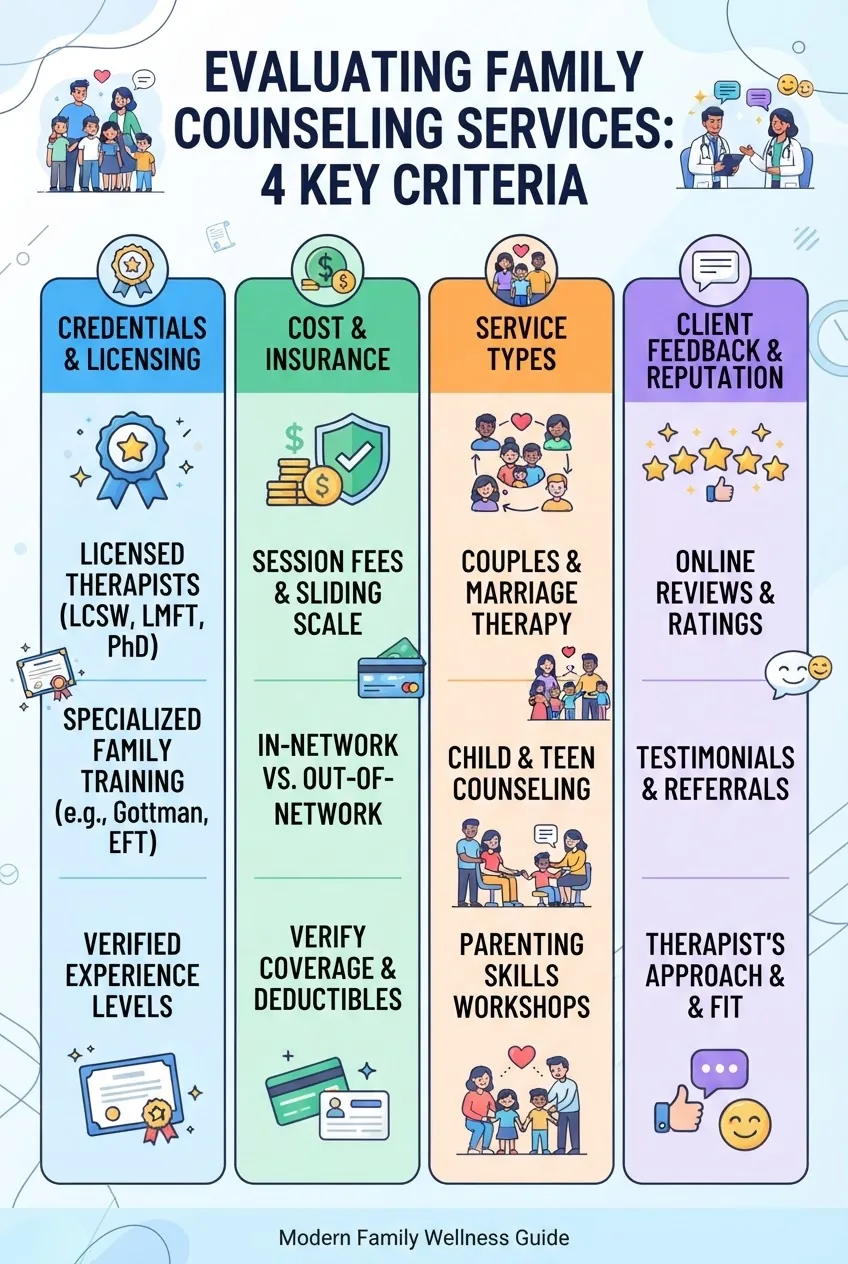
| Evaluation Criteria | What to check | Red flags |
|---|---|---|
| Credentials | Verify LMFT/LCSW/LPC licenses, agency accreditation, clinician experience with family work. | No license info, vague clinician bios, lack of supervision for trainees. |
| Cost & Insurance | Check session fees, sliding scale availability, in-network plans, and billing practices. | No transparent fees, refusal to provide insurance codes, unclear cancellation fees. |
| Service Types | In-person, teletherapy, multi-family groups, specialty programs (co-parenting, trauma). | Only individual therapy offered despite needing multi-member sessions. |
| Client Feedback | Look for consistent reviews, outcome tracking, references or client satisfaction rates. | Only 5-star reviews without dates, no reviews on independent platforms, many unresolved complaints. |
Actionable comparison steps:
- Make a shortlist of 3–5 agencies and score them on the table criteria (1–5 scale).
- Request clinician CVs for top picks and ask for a brief phone consultation.
- Confirm insurance billing codes (CPT codes) and average session length.
- Choose a trial period (e.g., 6–8 sessions) and set objective progress checkpoints with the clinician.
Evaluate reviews using independent platforms and directories (Psychology Today, AAMFT directory); note patterns in scheduling, responsiveness, and reported outcomes. For directory pros and cons, see the tools listed later in the search tips section.
Tips for Finding Local Family Counseling Services Using Online and Offline Resources?
Answer: Use a mix of online directories, insurance provider lists, local referrals, and community resources; combine search filters (specialty, format, insurance) and schedule consultation calls to assess fit.
Term: Online therapy directories — searchable databases (often with clinician profiles, specialties, and availability) such as Psychology Today and the AAMFT directory.
Start with these steps:
- Search directories with filtered queries. Use Psychology Today and the AAMFT finder to filter by specialty, insurance, and telehealth; compare profiles and availability.
- Check your insurance provider list. Most insurers host an online directory of in-network providers—this prevents surprise out-of-network costs.
- Use local health departments and community centers. County health departments and community mental health centers often maintain referral lists and sliding-scale services.
- Ask trusted referrals. Pediatricians, school counselors, clergy, or community organizations often have vetted local referrals and can share practical feedback.
- Search engines with advanced queries. Use queries like “family counseling agency near me + [your city]” and then refine using terms like “LMFT”, “couples”, “co-parenting”.
- Contact agencies for a pre-intake consultation. A brief phone call asking 6–8 preset questions will reveal transparency, response time, and whether their approach matches your needs.
- Use social and community boards cautiously. Local Facebook groups or Nextdoor can provide rapid suggestions but verify credentials independently.
- Check language and accessibility filters. If you need services in another language, use sites that let you filter by clinician language or request interpreter availability.
For more on locating nearby therapists and local services, see the pillar resource family therapy near me — it offers local search templates and contact scripts you can use when calling agencies.
Real search tools and pros/cons:
- Psychology Today — extensive clinician profiles but variable update frequency; good for specialties and blog content search.
- AAMFT directory — focused on marriage and family therapists; reliable credential verification; see AAMFT.
- Insurance provider directories — authoritative for network status, but sometimes slow to reflect new clinicians.
Anonymized example: A couple used Psychology Today to locate three LMFTs, cross-checked licensure on the state board, confirmed insurance coverage on their insurer’s portal, and selected the therapist who both accepted their plan and offered a weekend intake slot.
Understanding Costs, Insurance, and Payment Options for Family Counseling?
Answer: Family counseling costs vary widely—expect session fees between $100–$250+ private pay; insurance coverage depends on in-network status and diagnosis codes, while sliding-scale and community options can reduce out-of-pocket spending.
Term: Sliding scale — a fee structure where the provider reduces cost based on household income; ask agencies what documentation they require.
Typical cost breakdown (averages):
| Service | Average cost (US) |
|---|---|
| Family counseling (50–90 min) | $120–$250 per session |
| Sliding scale/session | $40–$100 (varies by agency) |
| Community clinic/session | Often $0–$75 |
Insurance coverage notes:
- Insurance may cover family therapy if billed under a family-therapy CPT code or if at least one insured member is the identified patient; verification with your insurer is essential.
- Medicaid and some state programs cover family counseling; check your state’s Medicaid portal for eligibility details.”
- For federal program guidance, see Medicaid.gov or Medicare.gov where applicable.
According to a 2024 industry survey, approximately 62% of family counseling clients used insurance or employer benefits to offset costs while 28% used sliding-scale or community services; verify with your insurer because coverage and reimbursement rates change by plan and year (source: 2024 industry report).
Ways to reduce cost:
- Ask about sliding-scale pricing or reduced-fee trainee clinics at university training centers.
- Check if the agency offers group or multi-family sessions, which may be lower per-family cost.
- Negotiate a package rate for a block of sessions if you plan structured short-term work.
Disclaimer: Costs and availability vary significantly by state and local market; confirm current fees during intake calls and ask for written fee schedules.
What to Expect During Your First Family Counseling Session?
Answer: The first family counseling session is an intake: a clinician collects history, clarifies goals, explains confidentiality and policies, and co-creates a treatment plan with the family, typically lasting 60–90 minutes.
Term: Intake process — the initial assessment meeting where clinicians gather background, define goals, and decide immediate treatment steps.
-
Pre-intake paperwork and phone screen.
You may complete consent forms, insurance info, and a brief phone screen to summarize concerns and logistics.
-
Introductions and roles.
The clinician will introduce their role, explain confidentiality, and clarify who will participate in sessions.
-
History and context gathering.
Expect questions about family history, problem onset, prior services, medical or legal issues, and strengths.
-
Goal setting and treatment planning.
The clinician will propose a preliminary plan, recommended modality, and suggested session frequency.
-
Practical details and next steps.
Clarify scheduling, length of sessions, fees, cancellation policy, and how confidential information is stored and shared.
-
Consent and safety planning.
For minors or high-risk situations, clinicians will document consent and make safety plans as needed.
If you want guidance on conflict-focused work in sessions, see family conflict resolution for approaches commonly used after intake.
Common Challenges When Finding Family Counseling Services and How to Overcome Them?
Answer: Common barriers include waitlists, cost, stigma, and language gaps; overcome them by using teletherapy, community clinics, sliding scales, contact scripts, and asking for short-term interim supports.
Term: Wait times — the period between requesting services and receiving the first available appointment; long wait times are common for high-demand specializations.
| Problem | Solution |
|---|---|
| Long wait times | Ask about cancellations list, consider teletherapy, or use interim resources like parenting classes or crisis lines. |
| High cost | Seek sliding scale clinics, university training clinics, group sessions, or negotiate package fees. |
| Stigma or reluctance | Normalize help by framing counseling as skills-building; start with brief consultation calls to reduce anxiety. |
| Language barriers | Request bilingual clinicians, interpreter services, or agencies with cultural competence training. |
Practical contact script (3 opening lines): 1) “We’re calling about family counseling for [issue]. Do you have clinicians with experience in this area?” 2) “Which clinician would we see and are they in-network with [insurer]?” 3) “What is your earliest intake availability?” Use this script during the first call to streamline comparisons.
If immediate support is needed before formal counseling starts, ask agencies about brief crisis sessions, school counselor coordination, or community support groups that can provide short-term stabilization.
Final summary: Choosing a family counseling agency is like choosing a doctor—verify credentials, confirm insurance and policies, compare service formats and client feedback, and use short consultations to test fit. Start with a small trial of sessions and measure progress against agreed goals. For step-by-step local search templates, see our pillar resource family therapy near me.
Call to action: If you’re ready, make a shortlist of three agencies using the comparison table above, schedule consultation calls this week, and decide on a trial 6–8 session plan to evaluate fit and progress.