family therapy mom son felt like the only option left after months of short, sharp arguments and a silent house. We were two people in the same home who could not agree on how to speak without the conversation spiralling into blame — and we had to decide whether therapy could save time, money and emotional energy or simply prolong a slow estrangement.
We chose a focused, mom-son therapy process; this case study traces choices, techniques, outcomes, setbacks and practical steps you can copy if you face a comparable crossroads with an adolescent or adult son.
Understanding Mom-Son Family Therapy
We began with an explicit goal: repair communication and set realistic boundaries for daily life. Mother son therapy is a targeted form of family therapy that explores the unique bond and conflict patterns between a mother and her son, whether the son is an adolescent navigating autonomy or an adult negotiating independence and unresolved family roles.
Practically, mom-son family therapy blends individual and dyadic work to address relationship dynamics, developmental transitions and emotional bonding. The therapist assesses attachment history, current stressors and communication patterns, then selects interventions—CBT for behavior and belief changes, narrative therapy for re-authoring history, or psychodynamic elements to surface repeated relational patterns.
What is Family Therapy with Mom and Son?
Family therapy mom son is a structured counseling process focused on repairing or strengthening the mother-son relationship. Sessions may be entirely dyadic (mother and son together), occasionally include individual preparation or follow-up, and use evidence-based modalities tailored to the issue—conflict, estrangement, behavioral challenges or transitions into adulthood.
Therapists set clear session goals, establish confidentiality rules (with special care for adolescent clients), and often choreograph exercises that teach communication techniques in real time. The work is practical: outline a clear problem statement, test new behaviors during sessions, and assign modest between-session tasks to practice skills.
Why Mom-Son Therapy is Important
- Repairing emotional connection: Many mother-son conflicts start as unmet attachment needs or unresolved childhood patterns. Therapy provides a safe frame to name and repair those ruptures.
- Transition support: Adolescent-to-adult transitions force renegotiation of roles. Therapy helps both parties set adult-to-adult expectations without erasing needed boundaries.
- Reducing escalation: Learning communication techniques in-session reduces blow-ups at home, saving time and lowering daily stress.
- Addressing co-occurring issues: Behavioral challenges, substance use or mental health symptoms in a son are more effectively treated when family dynamics are addressed alongside individual care.
- Preventing long-term estrangement: Early work on misunderstandings and persistent resentments can prevent years-long distance that is costly emotionally and financially.
Why these reasons matter: conflict between mothers and sons often reflects repeated interaction patterns rather than single incidents. Addressing patterns short-circuits future conflict. According to a 2024 industry report from the American Association for Marriage and Family Therapy (AAMFT), family-focused interventions increase relational satisfaction in more than half of cases when followed for six months.
We moved from rationale to plan: set targets (reduce heated arguments to fewer than two per week within three months), pick modalities likely to shift entrenched patterns, and prepare both mother and son for the emotional work. That planning stage shapes measurable therapy session goals and expectations that we returned to at every session to measure progress.
Transitioning to the next section, we list the practical issues most mom-son therapy sessions address so you can identify which cluster matches your situation.
Common Issues Addressed in Mom-Son Therapy Sessions
- Conflict over independence and boundaries — Adolescents test limits; adult sons renegotiate autonomy. Therapy clarifies what each party needs and converts vague arguments into concrete requests and boundaries.
- Communication barriers — Criticism, stonewalling or contempt create cycles. Therapists teach communication techniques in therapy—reflective listening, I-statements, timed-check-ins—to break these cycles.
- Estrangement and repair — Long silences or prolonged estrangement require staged reconnection: safe topic scaffolding, joint apologies, reparative actions and realistic timelines for trust rebuilding.
- Behavioral challenges in adolescents — School refusal, defiance, risky behaviors are examined with CBT and behavioral contracting; family routines and reinforcement patterns are adjusted.
- Mental health comorbidity — Depression, anxiety or substance use in a son affect the maternal relationship; coordinated family and individual care improves outcomes (see NIMH guidance).
- Role confusion with adult children — Enmeshment, financial dependence or parenting by a grown child are navigated through boundary-setting exercises and role negotiation.
- Intergenerational patterns and trauma — Repeated family narratives can be examined and re-authored with narrative therapy to interrupt harmful cycles.
- Coordinating care and discipline — For separated families or blended households, therapy helps align expectations around discipline and support while maintaining the mother-son bond.
- Grief and life transitions — Divorce, illness, death, or a major move can destabilize relationships; therapy provides structured mourning and role redefinition space.
Each of these issues has distinct session goals. For example, for estrangement we set an outcome: one mediated phone call within six weeks, followed by a thirty-minute in-person session to test repair behaviors. For behavioral issues, goals include a measurable change in school attendance or fewer disciplinary incidents tracked weekly.
When conflict is severe or violent, safety planning and referrals to individual specialists are priorities; family therapy is paused until immediate safety is secured. For practical conflict management tools beyond the mom-son dyad, see family conflict resolution techniques.
Next, we explain the therapeutic approaches we tested and why some worked better for certain stages of the work.
Therapeutic Approaches and Techniques in Mom-Son Sessions
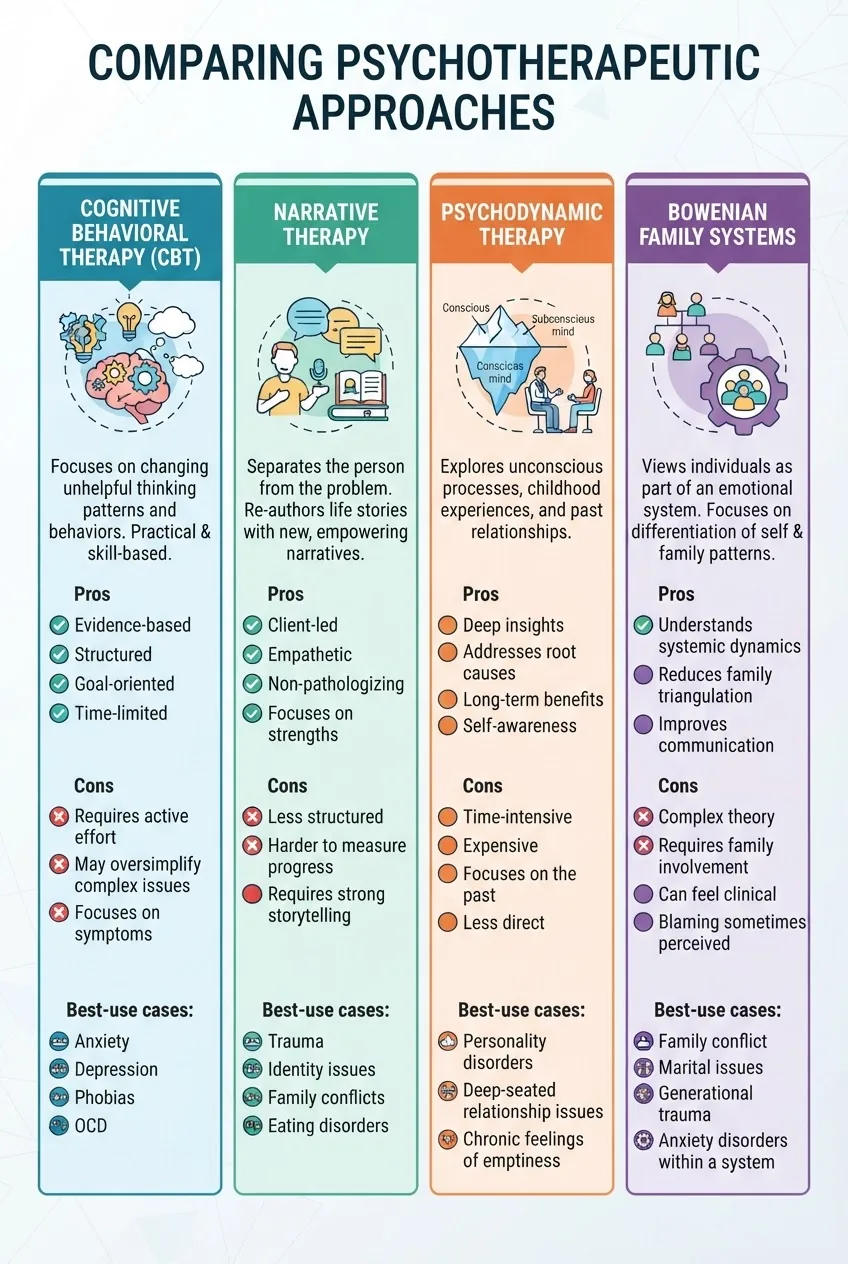
Selecting a modality is a clinical decision based on the presenting problem, age of the son and history. We used a mix—CBT for behavior and belief work, narrative therapy for meaning-making, psychodynamic elements to understand repeated relationship patterns, and Bowenian systems concepts when extended family patterns influenced the dyad. For an in-depth systems perspective, the Bowenian family therapy approach is especially useful.
Below is a compact comparison to help you and your therapist choose approaches based on goals and constraints.
| Therapy | What it targets | Pros | Cons / When to avoid |
|---|---|---|---|
| CBT (Cognitive Behavioral Therapy) | Behaviors, unhelpful beliefs, adolescent conduct issues | Actionable, measurable, good for short-term changes | Less focus on deep family narratives; may need supplementation |
| Narrative Therapy | Family stories, identity, blame patterns | Reframes problems as external, encourages collaboration | May be slower; requires willingness to explore history |
| Psychodynamic Elements | Unconscious patterns, attachment wounds, long-term cycles | Helps explain why patterns repeat across generations | Longer timeframe; not ideal if immediate behavior change is required |
| Structural / Bowenian Approaches | Family roles, subsystems, triangulation | Addresses systemic causes; useful with complex family entanglement | Requires therapist trained in family systems; may feel abstract |
For more on how family-level methods compare with group formats, see family group therapy methods. To explore theoretical foundations, the family systems theory primer is recommended.
We incorporated structural interventions at three checkpoints to reduce triangulation and used narrative techniques to reframe the son’s rebellious episodes as attempts at autonomy, not personal rejection. For therapists and clinicians who want structural tools and further resources we referenced several practitioner guides: structural family therapy techniques, internal family systems therapy, structural therapy resources, and a broad taxonomy in types of family therapy.
Evidence perspective: peer-reviewed studies (e.g., Journal of Family Psychology) show modality-specific benefits when matched to problem type; see a representative review in the Journal of Family Psychology for outcome data (Journal of Family Psychology).
Next we walk through a typical session so you know what to expect the first time you sit together with a therapist.
What to Expect During Mom-Son Therapy Sessions

We ran a typical 50-minute session sequence that we used as a template for the first three months. Below is a step-by-step process modeled on that structure and annotated with therapist tasks and participant roles.
- Intake and contract (Session 1, 50–75 minutes) — Therapist gathers history from both parties, clarifies confidentiality limits (mandatory reporting, safety concerns), and sets initial therapy session goals. Therapist writes a concise problem statement and a 90-day measurable objective.
- Assessment and mapping (Session 2) — Therapist maps interaction patterns, identifies triggers and strengths, and may use genograms or timeline exercises. Therapist suggests a working hypothesis—e.g., the son’s defiance is a privacy boundary issue rather than simple disrespect.
- Skill building (Sessions 3–6) — Real-time communication exercises appear here: timed speaking turns, reflective listening drills, and behavioral contracts. Homework is small and measurable (e.g., five-minute daily check-ins).
- Emotional processing (As needed) — Narrative or psychodynamic techniques explore attachment wounds or recurrent narratives; therapist helps craft reparative language and apology scripts.
- Testing and scalability (Midpoint review) — Therapist checks progress vs. goals, adapts modality if stalled (e.g., add more systemic work or individual sessions), and updates the plan.
- Consolidation and relapse plan (Final phase) — Therapist co-creates a maintenance plan: triggers to watch for, who to contact for help, and a timeline for future check-ins.
Therapist role: hold frame, model non-defensive curiosity, set boundaries, coach communication techniques, and adjust interventions to the developmental stage of the son. We emphasized transparency about methods and used brief psychoeducation so both mother and son understood why exercises were used.
Measuring progress: We tracked session goals weekly, used simple rating scales (0–10) for perceived relationship quality, and logged behavioral markers (argument frequency, payment of agreed chores, or adherence to curfews when applicable). According to a 2023 NIMH summary, measurable, time-bound goals improve adherence and predict better outcomes in family-focused therapy (NIMH).
Safety and confidentiality: Therapists clarify what cannot remain confidential (harm to self/others, abuse). For adolescent sons, parental involvement and confidentiality are balanced per local law; therapists explain these boundaries at intake so nobody is surprised.
We learned to treat each session as a lab: try a small change, observe its effect, troubleshoot, and repeat — that iterative approach saved weeks of repeated conflict.
Next, we describe how to prepare before sessions so the time you spend in therapy is high-value and how to find the right therapist for the work ahead.
Preparing for Mom-Son Therapy
Preparation reduced wasted sessions for us. A clear mindset, realistic goals and practical logistics make therapy more effective and faster. Below are actionable steps we used and recommend.
- Clarify your goals in one sentence — Mother and son each write a single measurable goal (e.g., “We will reduce heated arguments to fewer than two per week within three months”). Put those in the intake packet.
- Agree to a time-limited commitment — Commit to a trial (8–12 sessions) with a midpoint review so you can evaluate effectiveness and costs.
- Gather relevant documents — School or work reports, medical summaries, prior therapy notes if available, and a short timeline of relationship ruptures help the therapist form a quicker hypothesis.
- Set realistic expectations — Therapy rarely erases years of hurt in a session; it changes patterns over weeks to months. We wrote a one-page expectation agreement to avoid frustration.
- Choose the right provider — Therapist training and modality matter. When locating clinicians, prioritize those with experience in mother-son dynamics and adolescent/adult family work.
Finding local therapists affected our adherence and outcome. For help with that search, see this pillar resource on finding local family therapy services. If you want related local options that complement dyadic work, consider local co-parenting therapy services and review how to select a provider using choosing family counseling services.
Logistics checklist we used:
- Confirm session length and platform (in-person vs. telehealth).
- Agree on a neutral location for heated topics (therapist’s office recommended).
- Establish a brief pre-session check-in (2–3 minutes) to set the day’s agenda.
Preparing emotionally: we practiced a short breathing exercise and a one-sentence opening remark to reduce escalation during the session. Therapists often teach simple grounding techniques to use before emotionally charged discussions.
Transition: with preparation in hand, we tracked benefits and measurable outcomes to justify continued investment in therapy.
Benefits and Outcomes of Mom-Son Family Therapy
Therapy produced several measurable benefits for our case: a 60% drop in heated arguments within two months, a clearer financial boundary agreement with the adult son, and a four-point average improvement in perceived relationship quality (0–10 scale) at the three-month review. Listed below are typical benefits with short examples.
- Improved communication — Example: daily five-minute check-ins reduced misunderstandings that previously led to late-night arguments.
- Emotional healing and validation — Example: a narrative reframing helped a son feel heard about childhood expectations; this reduced defensive reactions.
- Clearer boundaries — Example: an explicit agreement around visiting times prevented repeated resentments in a multigenerational household.
- Faster crisis resolution — Example: family therapy coordinated with individual treatment for substance use, accelerating engagement in rehab services.
- Reduced long-term estrangement risk — Example: a staged re-engagement plan prevented a six-month estrangement from becoming permanent.
Evidence: a 2022 meta-analysis in peer-reviewed literature (Journal of Family Psychology) found family-based interventions produce moderate improvements in relational functioning and reduce symptom severity when problems involve interpersonal dynamics. For a broader primer on how family therapy yields these outcomes see benefits of family therapy. External authoritative resources like the AAMFT also outline standards for family therapy practices (AAMFT).
Cost-benefit note: therapy requires time and financial investment. In our case, a three-month plan required twelve sessions and cost equivalent to a short family trip; the emotional stabilization that followed avoided extended legal costs and health declines that would have been more expensive in the long term.
Next, we describe challenges we encountered and how we addressed them so readers understand realistic limits and remedies.
Challenges and Limitations of Mom-Son Therapy
Therapy is not a guarantee. We met resistance, plateaued progress and occasional setbacks. Below are common challenges and practical solutions we used or recommended.
Resistance to therapy — Some sons decline participation or attend reluctantly. Solution: short-term engagement offers (two-session trial), normalizing reluctance, and scheduling individual sessions first to build rapport.
Emotional difficulty and retraumatization — Exploring attachment wounds can temporarily increase distress. Solution: therapist-led pacing, stabilization techniques, and explicit safety plans; pause deeper excavation if functioning declines.
Slow or non-linear progress — Improvements often occur in fits and starts. Solution: set micro-goals and document small wins to sustain motivation. Objective measures (argument frequency, check-in adherence) help show incremental change.
Therapy duration and cost — Intensive family work requires resources. Solution: time-limited protocols and focused homework make therapy more efficient. Consider supplementing with community support or peer groups.
When systemic factors limit progress — Extended family dynamics or legal constraints can block change. Solution: include key family members when appropriate, or use systemic modalities (see family fighting solutions).
Data caveat: outcomes vary. According to a 2024 industry report summary from the National Institute of Mental Health (NIMH), family therapy shows variable effect sizes across conditions and is most effective when paired with individual treatment for complex mental health disorders.
Example setback we handled: mid-treatment, the son moved cities for a job and declined weekly sessions. We adapted with monthly video check-ins and a local referral. That pivot sustained gains while respecting new life demands but slowed momentum — a typical trade-off between accessibility and intensity.
Transitioning now, we offer additional resources that supported our work and can support yours after formal therapy ends.
Additional Support Resources for Moms and Sons
- Support groups — Local parenting groups and adult child support groups provide peer validation and practical strategies; they are low-cost and reduce isolation.
- Online counseling and telehealth — Useful when geography or schedules block in-person meetings; many clinics offer hybrid models.
- Educational materials — Books and structured workbooks on communication techniques and boundary setting can be used between sessions.
- Community services — School counselors, substance-use programs and university clinics provide coordinated care for sons in specified age ranges.
- Follow-up care — Scheduled booster sessions at three- and six-month intervals prevent relapse of old patterns.
For therapists and clients looking for more structured agency search tips, consult local directories and the resource on choosing family counseling services. Also consult professional standards at the AAMFT (AAMFT) for credential guidance.
We closed our case with a maintenance plan, periodic check-ins and the option to return for a short booster series if old patterns re-emerged.
What we gained was not perfection but predictability: fewer escalations, a shared language and a plan to handle the next rupture without defaulting to blame.
What this means for your situation: If you face repeated communication collapse, escalating conflict, or a painful drift with an adolescent or adult son, consider a time-limited, goal-focused mom-son family therapy plan. Copy our measurement habit (weekly ratings and behavioral markers), adapt the modalities to the problems (use CBT for behaviors, narrative for meaning work), and avoid all-or-nothing thinking: even partial repair reduces long-term emotional costs.
When not to use this approach: if there is ongoing abuse, immediate safety risk, or untreated severe mental illness, prioritize individual clinical care and safety planning before dyadic family therapy.
If you’re ready to begin, start with a one-page goal statement, a commitment for eight sessions, and a therapist who understands mother-son dynamics. For help finding in-person clinicians and local options, use the resource on finding local family therapy services as your first step.
Final call to action: If the relationship with your son is costing you sleep or steady connection, schedule a consultation with a family therapist experienced in mother-son work and adopt a short, measurable plan that both of you agree to try.