Answer: Therapeutic service options are organized mental health supports—individual, group, family, teletherapy and specialty services—designed to promote healthy therapy by matching delivery, goals, and support systems to a person’s needs; selecting the right option increases consistency, measurable outcomes, and long-term mental health maintenance.
Understanding Therapeutic Services and Their Role in Healthy Therapy
Answer: Therapeutic services are structured professional supports that help people manage mental health, cope with stress, and reach personalized wellness goals; when aligned with healthy therapy practices they create sustainable change through regular sessions, goal setting, and integrated support systems.
Therapeutic service: a coordinated offering from trained mental health providers that includes assessment, treatment planning, and sessions delivered in a modality suited to client needs.
The core role of therapeutic services is to translate clinical knowledge into consistent, measurable support that improves therapy health—meaning durability of progress, safety, and the client’s capacity to use therapeutic tools outside session. According to a 2023 practice review published by leading clinical organizations, structured services with clear goals lead to higher engagement and better symptom reduction (source type: 2023 clinical practice review).
Therapeutic services vary by target (symptom relief, skill-building, crisis stabilization), format (in-person, teletherapy), and intensity (weekly, biweekly, intensive outpatient). Healthy therapy emphasizes: consistent scheduling, therapist–client collaboration, measurable goals, confidentiality, and integration of external supports such as family or community resources. That combination reduces drop-out and fosters maintenance of gains after formal services end.
How therapeutic services relate to therapy health in practice:
- Assessment and individualized planning create treatment alignment and realistic outcomes.
- Delivery format (in-person vs. teletherapy) affects access and continuity.
- Support systems (family, groups, community) extend therapeutic work between sessions.
For readers wanting deeper frameworks on individual therapy and psychological counseling structures, see this foundational guide for program structure and outcomes:
Individual Therapy Program Overview and Psychological Counseling
Definitions introduced above:
Teletherapy: delivery of therapeutic services via secure video, phone or messaging platforms.
Support systems: informal or formal networks (family, peers, groups, community organizations) that sustain recovery and reinforce therapy health.
Transition: With the role of therapeutic services framed, next we’ll map the common options you’ll encounter and what each offers.
Overview of Common Therapeutic Service Options
Answer: Common therapeutic services include individual counseling, group therapy, family therapy, couples therapy, teletherapy, and specialized programs; each option has distinct structures, typical use-cases, and benefits that influence therapy health and outcomes.

-
Individual counseling services — description and benefits
Answer: Individual counseling is a one-on-one therapeutic service focused on personalized assessment and treatment planning, ideal for targeted symptom work, skill-building, and confidential personal exploration.
Term: individual therapy — a therapeutic relationship between one client and one therapist focusing on tailored goals.
Benefits:
- Highly personalized goals and pace.
- Confidential space for sensitive issues.
- Direct measurement of progress through session notes and symptom scales.
When considering intensity and expected outcomes, many clients begin with weekly sessions and adjust frequency as progress stabilizes. For an in-depth look specifically at individual counseling benefits, consult this resource:
-
Group therapy — description and benefits
Answer: Group therapy brings several clients together under a facilitator to build interpersonal skills, receive peer feedback, and practice coping strategies in a social context, enhancing social support and cost-effectiveness.
Description and benefits:
- Provides peer normalization and mutual encouragement.
- Cost-effective—often lower per-session cost than individual sessions.
- Useful for social anxiety, addiction recovery, grief groups, and skill practice.
Group formats commonly include closed groups (same members throughout) and open groups (rolling membership); the structure affects cohesion and outcomes. For modality-level comparisons including effective options, see this related resource:
-
Family therapy and systemic services — description and benefits
Answer: Family therapy engages relatives to address relational patterns and systemic contributors to an individual’s difficulties, improving communication and role clarity to support healthy therapy outcomes.
Benefits:
- Addresses relational dynamics that maintain distress.
- Improves shared problem-solving and continuity of care at home.
- Often essential for child/adolescent interventions and chronic conditions.
-
Couples therapy for relationship counseling — description and benefits
Answer: Couples therapy focuses on relationship functioning, communication, and mutual goals; it’s best for partners seeking repair, conflict resolution, or improved intimacy.
Benefits:
- Targets relational patterns in real time with both partners present.
- Creates shared action plans and measurable relationship goals.
- Can be combined with individual therapy for complex presentations.
Practical resource for locating couples services:
-
Teletherapy and remote delivery formats — description and benefits
Answer: Teletherapy uses secure video/phone platforms for remote sessions, increasing access for rural clients, those with mobility limits, or people balancing work and caregiving responsibilities.
Benefits:
- Greater scheduling flexibility and reduced travel time.
- Often lower no-show rates and continuity during disruptions (e.g., illness, weather).
- Comparable effectiveness to in-person care for many conditions, per meta-analyses.
Term: teletherapy — clinical services delivered remotely using telecommunications technology.
-
Short-term and brief interventions — description and benefits
Answer: Short-term therapeutic services focus on rapid assessment and targeted goals over a limited number of sessions, suitable for situational crises or focused skill training.
Benefits:
- Clear time-limited goals and measurable progress markers.
- Cost-effective for discrete issues or early intervention.
- Often incorporated into stepped-care models where intensity increases as needed.
-
Specialty services and integrated care programs — description and benefits
Answer: Specialty services (e.g., trauma programs, addiction services, grief support) and integrated care coordinate mental health with medical or community services to manage complex or comorbid needs.
Benefits:
- Multidisciplinary input reduces fragmentation of care.
- Programs often include case management, psychiatry, and community referrals.
- Improves outcomes for multi-system problems (medical, social, psychological).
For technique-level details within behavioral interventions, consult this sibling guide:
-
Community-based and peer-led supports — description and benefits
Answer: Community and peer supports include peer counseling, mutual-aid groups, and community mental health programs that provide lived-experience support and linkage to formal care.
Benefits:
- Enhances engagement and reduces isolation through shared experience.
- Often free or low-cost and locally accessible.
- Serves as an adjunct to professional therapeutic services for long-term maintenance.
To find local counseling resources and centers that integrate professional and community offerings:
-
Day programs, partial hospitalization, and intensive outpatient — description and benefits
Answer: Higher-intensity therapeutic services—day programs, partial hospitalization, intensive outpatient—offer structured, multi-hour treatment several times per week for acute or complex cases requiring more support than weekly outpatient care.
Benefits:
- High touch, multidisciplinary teams and rapid stabilization.
- Step-down care reduces inpatient admissions and supports reintegration to outpatient therapy.
-
Online self-directed programs and blended care — description and benefits
Answer: Online modules and blended care combine therapist guidance with digital tools or homework, useful for skills practice and bridging sessions for greater therapy health.
Benefits:
- Convenient, often lower cost, supports between-session learning.
- Works well with synchronous therapy to reinforce skills.
- Accessible analytics and progress tracking for clients and clinicians.
For broader context on different therapy categories, this overview is helpful:
Transition: Knowing the options, the next section explains a step-by-step approach to choosing services that support healthy therapy and sustained outcomes.
How to Choose the Right Therapeutic Service for Healthy Therapy
Answer: Choose a therapeutic service by assessing your goals, symptoms, availability, therapist qualifications, delivery format preferences, and support network—then match these to service intensity and modality while considering affordability and access.
Term: therapy goals — specific, measurable aims established between client and clinician to guide the treatment plan.
-
Step 1 — Clarify your primary therapy goals
Answer: Start by naming urgent concerns (e.g., panic attacks, relationship conflict, grief) and long-term aims (skill-building, relapse prevention); clear goals steer service choice and session frequency.
Practical tip: write 1–2 short-term goals and 1–2 long-term goals before contacting providers. Use symptom scales (PHQ-9, GAD-7) or a brief intake checklist to measure baseline—tools commonly used by clinicians during assessment.
-
Step 2 — Assess severity, complexity, and support needs
Answer: Determine whether needs are acute (crisis, suicidal ideation), moderate (functional impairment), or mild (situational stress); severity informs whether outpatient, intensive outpatient, or specialty services are appropriate.
Trade-offs: group therapy is efficient for skill practice but less individualized; individual therapy offers customization but higher per-session cost. Consider combinations—individual plus group—to balance personalization and social support.
-
Step 3 — Match delivery format to access preferences and constraints
Answer: Choose in-person if you prefer face-to-face rapport and local services; choose teletherapy if you need flexibility, geographical access, or accommodation for mobility or caregiving duties.
Consider privacy and technology: teletherapy requires a private space and secure internet. Many clinics offer hybrid models to support continuity during travel or illness.
-
Step 4 — Verify therapist qualifications and fit
Answer: Check credentials (licensed psychologist, LCSW, LMFT, LPC), experience with your presenting issue, and whether the clinician uses evidence-based approaches aligned with your goals.
Practical tip: request a brief phone consult to assess rapport, ask about typical session flow, and confirm licensure. If you want specialized CBT work, this directory can help you find a CBT therapist locally:
-
Step 5 — Evaluate session structure, length, and measurable outcomes
Answer: Ask about typical session length, expected treatment duration, outcome measures used, and how progress is tracked; choose services that provide transparent metrics and periodic reviews.
Expectation setting example: many clinicians use 8–12 session reviews for shorter-term goals and quarterly reviews for chronic presentations. Request clarity on the use of standardized measures and what improvement looks like.
-
Step 6 — Assess affordability, insurance coverage, and scheduling
Answer: Compare private-pay rates, sliding-scale availability, and insurance coverage; assert billing codes and in-network vs. out-of-network status when contacting providers.
Tip: ask about teletherapy discounts, reduced-fee trainees, and community clinic schedules. For detailed cost guidance and options, see this sibling article:
-
Step 7 — Combine services for healthy therapy (stepped care)
Answer: Use a stepped-care approach: start with low-intensity options (self-directed programs, group work) and escalate to individual or specialty care if progress is insufficient; this preserves resources and fosters engagement.
Example plan: for mild depression, begin with online modules plus weekly group skills training; if no improvement after 6–8 weeks, add individual therapy and medication evaluation if indicated.
-
Step 8 — Reassess and iterate
Answer: Reevaluate every 6–12 sessions using symptom measures and goal checklists; switch modalities or intensify services when progress plateaus or life circumstances change.
Practical tool: keep a therapy log (session date, goals worked on, homework, measured score) and discuss it with your therapist at reviews to guide changes in plan.
Additional considerations include cultural competence, language match, and accessibility needs such as sliding-scale therapy or clinics offering interpreters. For practical steps on finding therapists generally, this sibling guide is helpful:
Transition: Once you choose a service, integrating external support systems strengthens healthy therapy and long-term maintenance.
Integrating Support Systems Alongside Therapeutic Services
Answer: Integrate support systems—family, peer groups, community resources, and self-help tools—by coordinating communication (with consent), scheduling complementary supports, and using specific between-session strategies to reinforce therapy work.
Examples of structured support integration:
- Brief family check-ins arranged with client consent to align home support with therapy goals.
- Referral to community organizations (housing, employment) that address social determinants affecting therapy progress.
- Enrollment in peer support groups or structured mutual-aid programs for ongoing encouragement.
Concrete examples you can apply:
- Ask your therapist for a one-page summary (with your permission) that family members can read to understand how to support homework tasks.
- Use scheduled “practice periods” at home where a chosen family member helps prompt skills practice for 10–15 minutes after sessions.
- Join a moderated support group focused on your issue (e.g., grief or addiction) and attend weekly to build belonging and accountability.
Tools that complement therapy include symptom trackers, CBT self-help worksheets, and digital mood logs. For therapist-recommended tools, consult this resource for between-session exercises:
Practical access points for formal supports:
Composite client scenario (experience signal):
Scenario: Maria, a working parent with panic attacks, began weekly teletherapy (individual) for symptom stabilization and joined a local anxiety skills group for peer practice. Her therapist shared brief family guidance (with consent) and a digital tracker for panic frequency. After eight weeks Maria reported reduced panic days and improved coping—demonstrating integrated professional care plus peer support.
Transition: Integrating supports is enhanced when therapy includes holistic approaches that connect mind and body, lifestyle, and complementary services.
Understanding the Benefits of a Holistic Approach in Therapy Health
Answer: A holistic approach combines psychological interventions with lifestyle, physical health, and complementary practices—improving resilience, stress management, and functional outcomes beyond symptom reduction.
Term: holistic approach — an integrated care model addressing psychological, physical, social, and lifestyle factors that influence mental health.
How holistic care supports therapy health:
- Mind-body connection: incorporating physical activity, sleep hygiene, and nutrition enhances mood regulation and cognitive function.
- Stress management techniques (mindfulness, breathwork) decrease physiological arousal and improve therapy receptivity.
- Complementary therapies (yoga, acupuncture) can reduce somatic symptoms that disrupt therapy engagement for some clients.
Examples of integrated strategies clinicians may recommend:
- Sleep plan aligned with therapeutic homework to reduce fatigue-related disengagement.
- Exercise prescriptions tailored to energy levels and mood improvement goals.
- Referral to nutritionists when disordered eating or metabolic concerns affect mood.
Evidence and authority context: According to a 2022 systematic review on lifestyle interventions and mental health outcomes, combined psychological and lifestyle interventions show moderate improvements in depressive symptoms compared with standard therapy alone (source type: 2022 systematic review).
Practical illustration:
- Client A uses behavioral activation (therapy homework) plus a prescribed walking program and reports improved sleep and mood within 6 weeks.
- Client B adds weekly yoga classes to therapy for trauma-related somatic tension; clinicians monitor symptoms for signs of improvement in body awareness and reduced hyperarousal.
Caveats and trade-offs:
- Complementary methods vary in evidence strength—consult licensed clinicians before making changes.
- Holistic models require coordination; insurance coverage varies for non-traditional treatments.
External authoritative resources that inform holistic practice standards include the National Institute of Mental Health and the American Psychological Association, which provide definitions and evidence summaries for integrated approaches:
National Institute of Mental Health (NIMH) — for statistics and foundational definitions (example: mental health prevalence reports).
American Psychological Association (APA) — for guidelines on evidence-based practice and competency standards.
Transition: Practical adoption of services requires attention to access, cost, and insurance—topics we cover next with a clear comparison to guide decisions.
Practical Considerations: Access, Affordability, and Insurance for Therapeutic Services
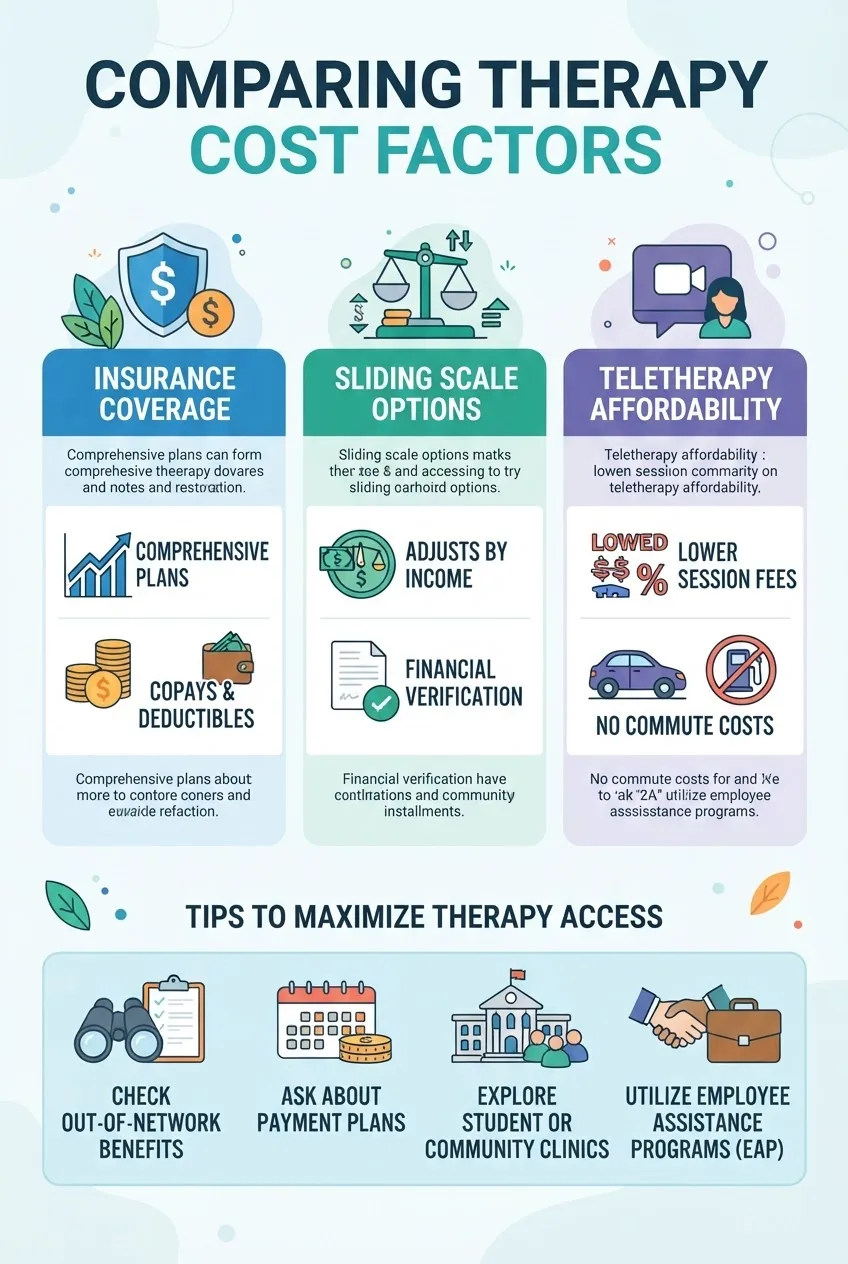
Answer: Access and affordability depend on service format, provider network status, sliding scale availability, and insurance policies; compare costs, in-network options, and teletherapy affordability to select sustainable care.
Key factors to check:
- Insurance coverage: in-network vs. out-of-network benefits and prior authorization requirements.
- Sliding scale and community clinic options for reduced fees.
- Teletherapy cost differentials and low-cost online platforms.
According to a 2024 industry report on behavioral health access, teletherapy adoption improved access for rural and underserved populations but insurance parity and state regulations still create variability in coverage (source type: 2024 industry report).
| Factor | Typical Range | Notes |
|---|---|---|
| In-network therapy | $0–$40 co-pay or coinsurance | Requires verifcation of codes and session limits; some plans require pre-authorization. |
| Out-of-network / private pay | $80–$250 per session | Reimbursable in some plans with superbill; sliding-scale may be available. |
| Sliding scale / trainees | $20–$75 per session | Often offered by nonprofits, training clinics; income verification common. |
| Teletherapy platforms | Subscription $40–$120/month or per-session $50–$150 | Some platforms include messaging and app tools; check confidentiality and licensing across state lines. |
Tips to maximize access:
- Contact insurance with provider NPI and CPT codes to confirm in-network coverage and session limits.
- Ask clinics about sliding-scale counseling near me options or trainee clinics with reduced fees; see this resource:
- Use teletherapy for geographic flexibility but verify state licensure and secure-platform policies.
Sliding Scale Counseling Near Me
External guidance on insurance and resource navigation is available from SAMHSA for community support and coverage resources:
Substance Abuse and Mental Health Services Administration (SAMHSA) — for support resource directories and guidance on funding and access.
Transition: Clear access and cost expectations help you prepare for what actually happens inside sessions—covered in the next section about setting expectations and session structure.
Setting Expectations: What to Expect During Therapeutic Sessions and Support Process
Answer: Expect an initial assessment, goal setting, regular sessions with agreed structure, progress tracking, confidentiality protections, and periodic reviews; the process is collaborative, and outcomes vary by engagement and alignment of services with goals.
-
What happens at the first session?
Answer: The first session typically includes intake, clinical history, risk screening, and collaborative goal-setting; clinicians explain confidentiality, session logistics, and outcome measures.
Clinicians often use structured intake forms and standardized measures (PHQ-9, GAD-7) to create a baseline and inform the initial treatment plan. For a clear client-oriented explanation of the therapy process, see this guide:
-
What is a typical session structure?
Answer: Typical sessions run 45–60 minutes and include check-in, agenda-setting, focused work on goals, and a summary with between-session tasks.
Example structure:
- 5–10 minutes: symptom check and quick mood rating.
- 5 minutes: set agenda and prioritize focus.
- 30–40 minutes: core therapeutic work (skill practice, processing, or problem-solving).
- 5–10 minutes: summarize progress and assign homework or coping strategies.
-
How is progress tracked?
Answer: Progress is tracked using standardized symptom measures, goal checklists, session notes, and periodic formal reviews—clients and therapists use these data to adjust plans.
Practical step: ask your therapist at intake which measures they use and how often (commonly every 4–12 sessions). Keep personal logs to compare self-reported change with clinical measures.
-
What about confidentiality and security?
Answer: Therapists explain confidentiality limits (duty to warn, mandated reporting, court orders) and obtain consent for records sharing; teletherapy platforms should meet HIPAA or equivalent security standards.
Caveat: If a therapist is not HIPAA-covered (e.g., some private platforms), ask about encryption, data handling, and practitioner licensure. If concerned, request in-person sessions or a therapist using secure clinical platforms.
-
How long does therapy typically last?
Answer: Duration ranges from brief (6–12 sessions) to long-term (months to years) depending on goals, severity, and client preference; periodic reassessment guides continuation or step-down.
Guideline example: short-term skills-focused work may conclude after 8–12 sessions, while complex trauma or personality-related concerns often need longer-term, collaborative planning.
-
What if therapy doesn’t seem to help?
Answer: If progress stalls, discuss concerns openly with your therapist; consider adjusting modality, increasing session frequency, seeking a second opinion, or changing therapists for better fit.
Practical steps: request a progress review, ask about different therapeutic approaches (e.g., group vs. individual), or seek consultation from another clinician to evaluate treatment alignment.
-
How are crises handled?
Answer: Clinicians develop crisis plans during intake; emergency contact info, local crisis lines, and protocols for after-hours crises are clarified and provided in writing.
If immediate danger exists, contact emergency services; for non-urgent but concerning escalation, use your therapist’s crisis plan or local crisis resources recommended by SAMHSA.
-
Client-therapist relationship and boundaries
Answer: A therapeutic relationship rests on trust, professional boundaries, and mutual agreement about goals and session logistics; clear boundaries support safety and outcome reliability.
Expect professional limits on contact outside sessions, confidentiality practices, and transparent fee policies. If boundaries are unclear or uncomfortable, address them directly with your clinician or consider reporting to licensing boards for serious concerns.
Transition: The sections above give a practical map—now a concise reminder of key takeaways and next steps.
Final summary and next steps: Therapeutic service options span individualized counseling, groups, family systems, teletherapy, and specialty programs; choose by aligning therapy goals, severity, delivery preferences, and affordability. Integrate support systems and holistic strategies for better therapy health, verify access and insurance, and set clear expectations for sessions and progress tracking. For help starting, look up local options or contact a licensed clinician to schedule an initial assessment.
Call to action: If you’re ready to explore options, start by clarifying your goals and checking availability for a brief consult with a licensed provider or community clinic to create a practical plan tailored to your needs.