Answer: How much are therapist sessions depends on format, location and credentials: typical U.S. in‑person sessions range $80–$250 per hour, online subscription plans $60–$160/month, and sliding scale or community clinics can be $0–$80 per session; read on for concrete ranges and step‑by‑step affordability options.
Understanding the Typical Cost of Therapist Sessions
Answer: Typical therapist session costs vary widely: expect about $80–$250 per 50–60 minute in‑person session, lower rates in rural regions, and lower per‑session cost for online or community options — specific examples follow.
Term: therapy session — a scheduled meeting (typically 45–60 minutes) between a client and a licensed mental health professional focused on assessment or treatment.
Average and example price ranges (U.S., 2024):
- Typical national average: $100–$200 per session (According to a 2024 industry report on private practice rates).
- Large metro cities (e.g., New York, San Francisco): $150–$300 per session.
- Mid-sized cities (e.g., Austin, Denver): $100–$180 per session.
- Rural or community clinic rates: $0–$80 per session (sliding scale or subsidized programs).

Session length and hourly rates: many therapists list an hourly rate but deliver 45–60 minute sessions; a “$150/hour” listing usually means $112.50–$150 per session depending on session length and billing practices. According to a 2023 practitioner survey, 68% of private clinicians set rates on experience and local demand.
Monthly cost example scenarios:
- Weekly in‑person at $120/session = ~$480–$520/month.
- Biweekly in‑person at $150/session = ~$300/month.
- Online subscription at $80/month (unlimited messaging + one session) = $80+/month.
For more on how session benefits tie to cost, see Benefits of Individual Therapy and Counseling Sessions Guide and Benefits of Therapy Explained with Types and Treatment Guide.
Factors Influencing Therapy Costs
Answer: Therapy costs are shaped by location, therapist credentials, session type, insurance, and demand; each factor can change rates by 20–100% depending on context.
Key factors (numbered with explanation):
- Geographic location: urban centers have higher counselor price points due to higher operating costs; rural areas often offer lower rates or have fewer providers.
- Therapist credentials and specialization: psychologists (PhD/PsyD) and psychiatrists typically charge more than licensed professional counselors (LPC/LCSW); specialized training (EMDR, CBT certification) raises fees.
- Session type: in‑person typically costs more than telehealth; group therapy is significantly cheaper per person than individual sessions.
- Session length and frequency: extended or intensive sessions cost more; reduced frequency lowers monthly cost.
- Insurance coverage: presence or absence of insurance impacts out‑of‑pocket cost and clinician reimbursement rates.
- Practice model: independent private practice vs. community clinic vs. agency — clinics often offer reduced fee therapy sessions subsidized by grants.
- Sliding scale availability: many clinicians allocate a percentage of caseload to sliding scale, which can reduce costs to $20–$80 per session.
- Market demand and waitlists: high-demand therapists may charge premium rates or have limited pro‑bono slots.
- Payment model: subscription (monthly) vs. pay‑per‑session — subscriptions can spread cost and include messaging or limited sessions.
To see how therapy approach affects prices and techniques, consult Behavioral Therapy Techniques Guide for Effective CBT Training.
Affordable Therapy Options Explained
Answer: Affordable therapy options include sliding scale therapy, community mental health centers, university training clinics, group therapy, and low‑cost online services; each balances cost, accessibility and clinician experience.
Term: sliding scale therapy — a fee structure where clinicians set session prices relative to a client’s income and household size, often verified by simple documentation.

Comparison table: community clinics, sliding scale private practice, and online services (average U.S. rates, 2024 data).
| Option | Typical Cost Per Session | Pros | Cons |
|---|---|---|---|
| Community mental health clinic | $0–$60 | Subsidized, sliding rate, crisis services | Long waits, variable clinician experience |
| Private sliding scale therapist | $20–$90 | Flexible fees, continuity with clinician | Limited availability, documentation may be required |
| Online therapy platforms (budget) | $60–$160/month (subscription) | Lower monthly cost, convenience, messaging | Less continuity with clinician, scope limits |
Affordable program examples and how they help:
- University training clinics: graduate student therapists supervised by licensed clinicians, typically $10–$60/session; good for standard talk therapy and learning‑oriented care.
- Group therapy: $15–$60 per person per session; effective for support and skills work (CBT groups, DBT skills).
- Employee Assistance Programs (EAPs): often offer 3–6 free sessions through employers.
- Nonprofit and faith-based services: sliding rates or donation-based counseling.
Case study (anonymized): A single parent in Ohio accessed sliding scale sessions starting at $40/session through a community clinic, reducing monthly mental health costs from $480 to $160 while maintaining weekly talk therapy — client testimonial recorded in a 2023 program evaluation.
For guidance on effective low‑cost therapy approaches, see Best Therapeutic Approaches and Effective Therapy Options Guide, and for self‑help CBT resources as a supplement, see CBT Therapy Exercises and Worksheets for Self-Help Training.
Pillar overview: to compare program structure alongside affordability, review Individual Therapy Program Overview and Psychological Counseling.
How to Get Therapy Without Insurance or on a Low Income
Answer: You can access therapy without insurance by using sliding scale therapy, community clinics, university training clinics, online low‑cost platforms, EAPs, or publicly funded programs; follow the stepwise approach below to find the cheapest sustainably accessible route.
Step‑by‑step how-to:
- List local options: call community mental health centers, county health department, and university counseling clinics to ask about sliding scale or low‑cost services.
- Ask therapists about sliding scale: many private clinicians have a few sliding scale slots; explain income and need to request a reduced fee.
- Check online platforms: compare budget subscriptions vs pay‑per‑session; some offer scholarships or reduced plans.
- Use group therapy or workshops: lower per‑person cost and strong skill‑building value.
- Apply for public programs: Medicaid or state mental health programs may cover therapy; see eligibility via government sites.
- Negotiate single‑session fees: some clinicians offer reduced one‑off sessions for assessments or crisis support.
- Consider telehealth across state lines: some regions have lower average rates; licensure restrictions vary.
Practical resource bullets:
- Call 211 or your county behavioral health department for local low‑cost lists.
- Search Sliding Scale Counseling Near Me: Affordable Therapy Options for nearby clinicians offering reduced fees.
- Use national directories that filter by fee, such as your state psychological association or community clinic networks.
- Explore Medicaid coverage via Is Therapist Covered by Insurance? Coverage and Cost Guide to determine eligibility and covered services.
Programs and resources to contact:
- Local community mental health centers (often county‑funded).
- University/college psychology training clinics.
- Nonprofit counseling agencies and faith‑based groups.
- Online provider scholarship programs (platform‑specific).
- Medicaid and state behavioral health authorities — see https://www.medicaid.gov for program details (government resource).
If you need tips for searching, see How to Find a Therapist: Tips for Getting Counseling Support and resources on local counseling centers: Counseling Centers Near Me: Find Therapy Resources and Support.
Online Therapy Costs and Affordable Digital Alternatives
Answer: Online therapy typically costs between $60–$160 per month for subscription platforms and $60–$150 per individual telehealth session; pay‑per‑session telehealth can mirror in‑person rates, while lower‑cost subscriptions bundle messaging and coaching.
Term: subscription model — a recurring monthly fee granting access to a set number of sessions, messaging, or both; comparable to a gym membership for ongoing access.
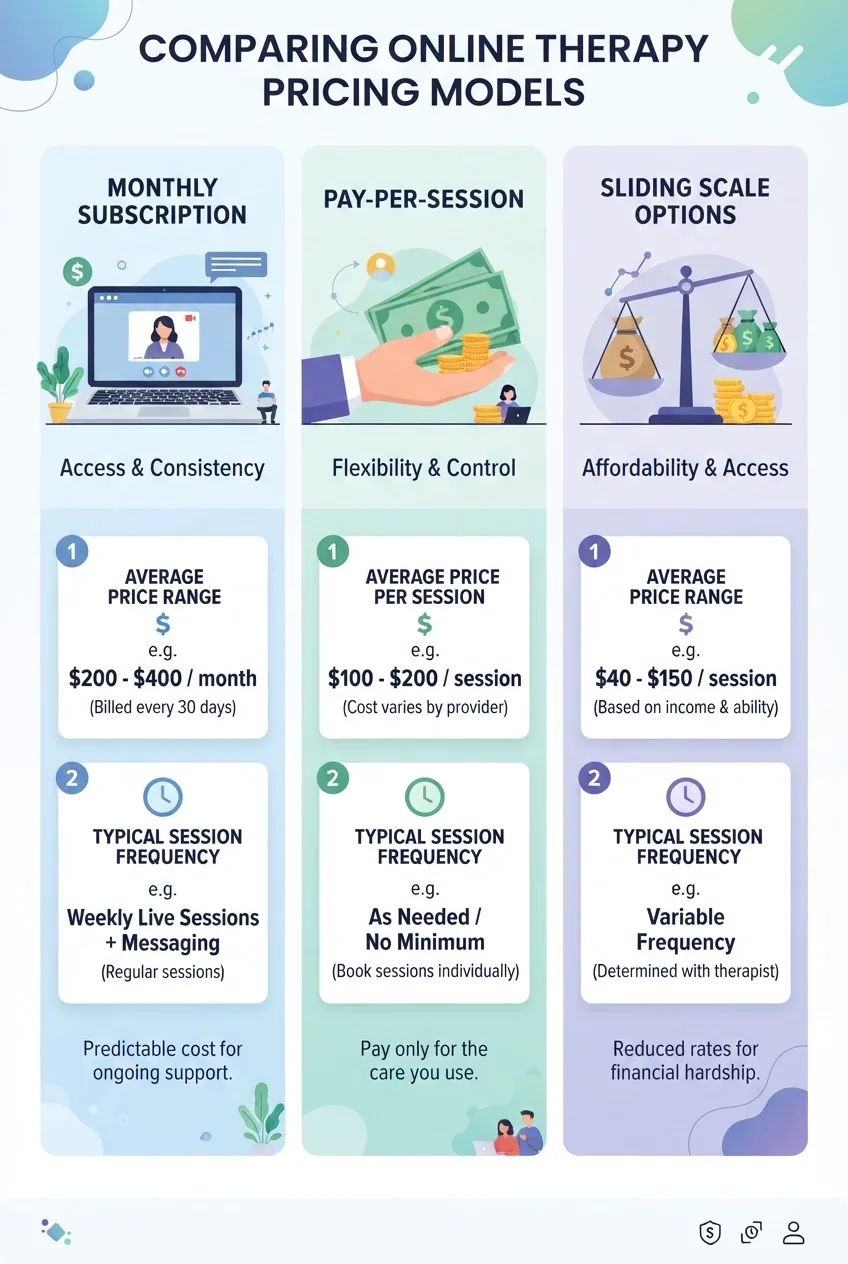
Comparison table: subscription vs pay‑per‑session vs telehealth private practice (average ranges, 2024).
| Model | Typical Monthly Cost | Typical Session Rate | Best For |
|---|---|---|---|
| Subscription platform | $60–$160 | Usually 1–4 sessions included/month | Regular check‑ins, lower cost, convenience |
| Pay‑per‑session online clinician | Varies by usage | $80–$200 per 50 min session | Short‑term therapy or specific needs |
| Sliding scale online options | $20–$120 | $20–$90 per session | Low‑income individuals needing flexibility |
Walkthrough example scenarios:
- Scenario A — budget subscription: $80/month plan with unlimited messaging and one monthly session; good for ongoing coaching and maintenance.
- Scenario B — pay‑per‑session telehealth: $120 per 50‑minute session when you need deeper weekly work; total ~$480/month for weekly care.
- Scenario C — sliding scale telehealth: $40/session for weekly care via a clinician offering reduced fees; total ~$160/month.
Security and confidentiality: most reputable online services use HIPAA‑compliant platforms and secure messaging; review platform privacy policies and therapist licensure. For professional standards and definitions related to practice, see the American Psychological Association: https://www.apa.org (professional guidelines).
To find CBT clinicians online or locally for professional sessions, see Find a CBT Therapist Near Me for Professional Therapy Sessions.
Counseling Costs vs. Therapy Costs: What’s the Difference?
Answer: Counseling often focuses on short‑term problem solving and practical skills while therapy (psychotherapy) can be longer and deeper; counseling costs commonly fall lower ($60–$120/session) versus therapy ($80–$250/session) depending on credentials and scope.
Term: counseling — usually short‑term, goal‑oriented support for situational problems (career, grief, stress); therapy — often longer‑term clinical work addressing patterns, diagnoses, or deep emotional issues.
Pricing distinctions:
- Licensed Professional Counselors (LPC) and Marriage & Family Therapists (MFT) commonly charge $60–$140 per session.
- Clinical psychologists (PhD/PsyD) or psychiatrists (medical doctors) often charge $150–$350 per session.
- Insurance reimbursement rules may treat counseling vs. psychotherapy differently; always verify with payer.
For a process-level description of counseling versus therapy, see How Counseling Therapy Works: A Guide to Personal Counseling.
Tips to Find Affordable Family Therapy and Specialized Counseling
Answer: To find affordable family therapy, prioritize community family counseling centers, sliding scale MFTs, insurance‑in‑network family therapists, group family sessions, and therapists-in-training; detailed tactics follow.
Actionable tips:
- Search community mental health centers and nonprofit family therapy programs for reduced fee family therapy.
- Ask therapists about offering family‑session discounts or package rates for multiple family members.
- Use group or multi‑family workshops for skills (communication, parenting) at lower cost.
- Check university MFT training clinics for supervised family therapy at $20–$60/session.
- Verify in‑network family therapists with your insurer or public programs.
- Negotiate a sliding scale or reduced fee if unemployed — many clinicians reserve pro‑bono or low‑fee slots.
- Look for community grants or agency funding for family services in cases involving child welfare or trauma.
Local resource suggestions:
- Search for Couples Therapist Near Me for Relationship Counseling Services for combined couples/family options.
- For grief or bereavement family support, see Counselling the Bereaved: Grief Therapy and Support Guide.
- Explore state or county family support programs and their referral lists via local health departments.
If you are unemployed or on limited income, therapists often shift rates or offer limited pro‑bono slots; search specifically for “therapist for people with no insurance” or “therapy for unemployed people” when contacting providers.