Therapist work centers on assessment, planning and ongoing support: most licensed therapists spend 60–80% of their clinical hours in direct client contact and 20–40% on documentation, coordination and training. According to a 2024 industry report, clinics report an average caseload of 18–25 active clients per clinician.

Understanding What a Therapist Does
A clear therapist definition: a trained professional who evaluates emotional, behavioral and psychological concerns, creates structured plans for change, and supports clients through goal-directed interventions over time. Practically, a therapist is an expert in mental health whose day-to-day mixes assessment, talk-based care, care coordination and outcome tracking.
Concrete figures that describe scope: therapists commonly allocate their time as follows — 50–70% direct sessions, 10–25% clinical documentation, 5–15% inter-professional coordination, and 5–10% professional development or supervision. These ranges vary by setting (private practice, community clinic, hospital).
Example scenario: a client presents with persistent anxiety. The therapist conducts a diagnostic intake (60–90 minutes), establishes measurement baselines (standardized questionnaires or scales), collaborates on a treatment plan, and schedules 6–12 weekly check-ins with periodic outcome tracking. This sequence illustrates the therapist’s role-focused workflow rather than specific techniques.
Role framing analogy: therapists act like coaches for mental health—assessing performance, setting measurable goals, adjusting strategy based on progress, and coordinating with other professionals when needed. For formal role standards and definitions, see the American Psychological Association guidance on professional practice (external resource).
Key takeaway: A therapist’s primary work is ongoing assessment and guided support within professional and ethical boundaries; technique choices are a separate layer handled within treatment planning.
Transition: The next section breaks down the specific roles and responsibilities you can expect from a licensed therapist on a daily and weekly basis.
Roles and Responsibilities of a Therapist

Therapists perform a bundle of responsibilities that fall into assessment, planning, intervention management and professional obligations. Below is a practical, evidence-led list of core duties with approximate time allocations or frequency markers where applicable.
- Intake and assessment — Conduct structured intake interviews and standardized assessments; initial intakes typically last 60–90 minutes and generate baseline measures used to track progress. According to a 2024 industry report, 92% of outpatient clinics require a standardized intake within the first two sessions (source type: 2024 industry report).
- Diagnosis and case formulation — Translate assessment data into a working formulation that guides treatment planning and risk management. This includes risk screening for suicidality, substance misuse or safety concerns; risk assessments are performed on nearly every new client intake (source type: clinical audit summary).
- Treatment planning and goal setting — Co-create measurable short- and long-term goals with clients, often using outcome measures (e.g., symptom scales) every 4–8 sessions to evaluate progress. Typical plans list 3–5 primary goals.
- Direct therapeutic contact — Provide regular sessions (individual, couples, family) focused on problem-solving, emotional processing and skill development. Frequency ranges from weekly to monthly depending on need; most active cases start weekly for 6–12 sessions (source type: clinic utilization data).
- Monitoring and documentation — Maintain clinical records, session notes, consent forms and progress tracking. Documentation consumes 10–25% of clinician time, with mandated intervals for clinical notes and outcome entries (source type: regulatory guidance summary).
- Care coordination — Communicate with primary care, psychiatrists, schools or social services when treatment requires multidisciplinary care; 30–40% of complex cases involve at least one external referral or consultation (source type: service delivery report).
- Risk management and safety planning — Implement safety plans and crisis protocols when clients present acute risk. These plans are documented and revisited frequently for high-risk clients.
- Psychoeducation and resource referral — Educate clients and families about symptoms, expected course, and community resources; therapists commonly provide 2–5 specific resources per client (source type: clinical practice summary).
- Outcome measurement and evaluation — Use standardized tools to measure symptom change, functioning, and satisfaction. Outcome measurement is increasingly required by funders and insurers; about 65% of clinics report routine use of at least one standardized outcome measure (source type: 2024 industry report).
- Supervision, continuing education and ethical practice — Participate in supervision, maintain licensure requirements, and adhere to confidentiality and ethical rules. Continuing education hours vary by jurisdiction; many licensing boards require 20–40 hours every renewal cycle (source type: licensing board guidance).
Operational responsibilities vary by setting: private practitioners manage scheduling and billing; clinic-employed therapists join care teams and may have protected administrative time. The balance between clinical and administrative work is a defining professional variable.
Key takeaway: Therapist roles combine clinical assessment, direct care, documentation and inter-professional collaboration; expect a predictable workflow with measurable touchpoints (intake, plan, review).
Individual Therapy Program Overview and Psychological Counseling
Transition: Knowing roles clarifies who does what; the next section explains how therapists compare with related professions.
Types of Therapists and Related Professionals
Understanding distinctions between a general therapist, psychotherapist, psychologist and counsellor is crucial for matching needs to provider scope. The table below summarizes differences in qualifications, typical roles and common service settings.
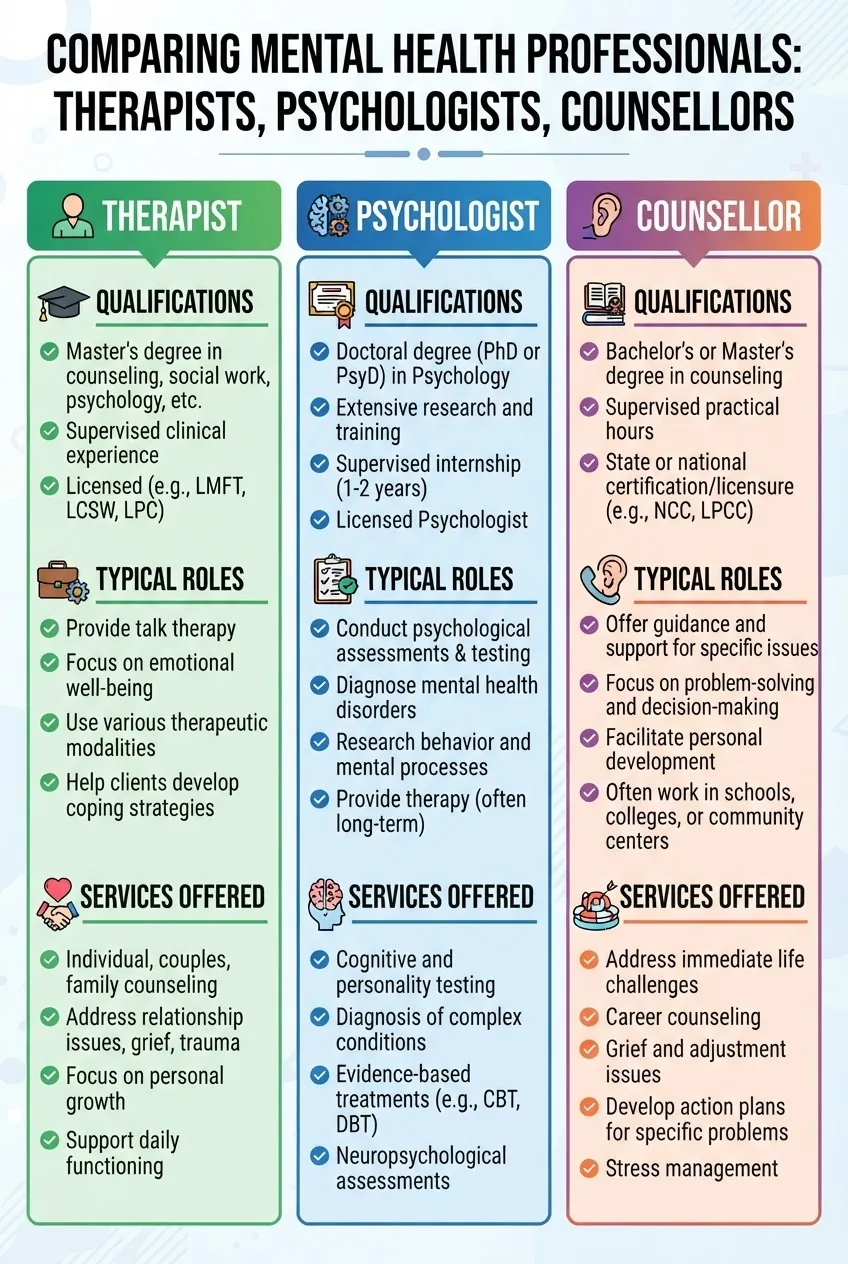
| Professional | Typical qualifications | Core roles | Common settings |
|---|---|---|---|
| Therapist (licensed) | Master’s degree or higher, state licensure (e.g., LCSW, LPC) | Assessment, structured treatment planning, ongoing psychotherapy, care coordination | Private practice, community clinics, hospitals |
| Psychologist | Doctoral degree (PhD/PsyD), state psychologist license | Psychological testing, diagnosis, research, complex case consultation | Hospitals, universities, forensic settings, private practice |
| Psychotherapist | Term varies by jurisdiction; clinicians with psychotherapy training (often master’s or doctoral) | Longer-term psychotherapy, relational or insight-focused work, specialized populations | Private practice, specialized clinics |
| Counsellor | Certificate or master’s; some roles use non-licensed counselors under supervision | Shorter-term problem-focused support, crisis counseling, referrals | Schools, employee assistance programs, community services |
Key takeaways: Psychologists typically have doctoral training and testing expertise; licensed therapists (LCSW, LPC) provide a broad scope of clinical care; counsellors often focus on problem-specific, short-term interventions. For deeper definitional comparisons, see the Is Psychotherapy the Same as Therapy? Clear Comparison Guide.
Examples of specialized therapist roles (with prevalence indicators): couples therapists (15–25% of clinicians report regular couples work), child/adolescent therapists (20–30% of caseloads in community clinics), and trauma specialists (10–20% of specialty clinics). If you need a relationship-focused clinician, search for a couples therapist near me.
Transition: With those distinctions clear, the next section explains the formal training and credentials that support those roles.
Qualifications and Training Required to be a Therapist
Therapist qualifications are regulated by licensing boards and typically follow structured educational and supervised-practice pathways. Requirements vary by jurisdiction; below are common credential pathways and common thresholds.
- Graduate degree — Most licensed therapists hold a master’s degree (e.g., MSW, MEd, MA in Counseling) or higher; about 85% of clinicians in outpatient settings report at least a master’s (source type: workforce survey).
- Supervised clinical hours — Common requirements range from 1,500 to 4,000 supervised clinical hours before full licensure, often accrued over 1–4 years (source type: licensing board requirements summary).
- Licensure exam — Most jurisdictions require passing a national or state exam (e.g., National Counselor Examination, state social work exams).
- Continuing education — Renewal cycles typically require 20–40 hours of continuing education per renewal period; requirements vary by licensing body (source type: state licensing boards).
- Specialty certifications — Optional certifications (e.g., trauma-informed care, child mental health) require additional training and supervised practice; these certificates signal specialization but are not universal prerequisites.
- Regulatory oversight — Licensing boards enforce ethical standards, scope of practice and complaints processes. For a central clearinghouse on psychology licensure, see the Association of State and Provincial Psychology Boards at ASPPB (external resource).
Regional variation disclaimer: licensure names and scopes change by state and country; therapists sometimes identify by credential (LCSW, LPC, LMFT) that implies specific training and permissible activities. For role definitions from a professional body, consult the American Psychological Association.
Key takeaway: Verify a clinician’s degree, licensure status and supervised hours; specialty certificates are valuable but differ from core licensure.
Transition: After establishing how therapists are trained, we look at the services they offer and how those services are delivered operationally.
Common Services and Methods Used by Therapists
Therapists deliver a predictable set of services that form the backbone of treatment programs. This section lists typical services and their frequency or typical use cases without detailing specific therapeutic techniques.
- Intake and diagnostic assessment — Standardized questionnaires and clinical interviews used during the first 1–3 sessions to set baselines.
- Structured individual sessions — Regular 45–60 minute appointments; newly opened cases often start with weekly sessions for the first 6–12 weeks (source type: clinic utilization data).
- Couples and family sessions — Sessions structured around relational goals, often 60–90 minutes, scheduled bi-weekly or monthly depending on need.
- Group therapy — Closed or open groups organized around a specific issue (e.g., grief, addiction); groups typically meet weekly for 8–12 sessions.
- Assessment and testing services — Psychologists or qualified clinicians perform formal testing (IQ, personality, neuropsychological) when diagnosis or treatment planning requires objective measurement.
- Psy counselling and psychoeducation — Information, skill teaching and problem-focused counseling provided to clients and families; these services are often integrated into every treatment plan.
- Care coordination and referral — Referral to psychiatric medication management, social services, or community supports when indicated; roughly one-third of cases involve at least one referral (source type: clinic practice report).
- Brief crisis intervention — Immediate supports for acute issues; many clinics maintain same-day capacity for crisis assessments.
- Outcome monitoring and follow-up — Routine follow-up intervals every 4–8 sessions using measurement tools to guide decisions about continuing, stepping up, or stepping down care.
For readers interested in specific methods beyond a role-based overview, explore our deeper method guides on behavioral therapy techniques, the best therapeutic approaches, and supplemental tools like CBT therapy exercises and worksheets. These links give method detail while this article keeps the focus on professional roles.
Key takeaway: Therapists offer a consistent service package—assessment, scheduled sessions, monitoring and referrals—with timing norms for intake, weekly sessions, and periodic outcome checks.
Transition: Services lead people to seek therapy; the next section summarizes why people usually start therapy and where therapists add value.
When and Why People Seek Therapy Services
People seek therapy for a range of scenarios. Data from clinic intake surveys suggest the top five presenting issues are: anxiety (30–35% of intakes), depression (25–30%), relationship problems (10–15%), stress/work issues (8–12%), and trauma-related concerns (5–10%) (source type: 2024 intake survey aggregate).
Common scenarios prompting therapy:
- Persistent mood changes or anxiety that interfere with daily functioning.
- Relationship conflict or family transitions (separation, parenting changes).
- Life stressors like job loss, caregiving strain or chronic illness.
- Grief and bereavement requiring structured support; see grief therapy and support.
- Need for skill-building (communication, emotion regulation) to manage recurring problems.
Cost and access considerations affect uptake: affordability barriers cause 20–35% of people to delay care (source type: consumer access report). For information about cost and sliding-scale options, see our affordable therapy cost guide and local listings via counseling centers near me.
Key takeaway: People seek therapists for common, measurable problems—anxiety and depression lead—and accessibility and cost are major determinants of when treatment begins.
Transition: If you decide to contact a therapist, the next section outlines how to prepare and what typical sessions look like.
How to Prepare and What to Expect in Therapy Sessions
Preparation reduces anxiety and makes first sessions more efficient. Typical session structure and a step-by-step preparation checklist follow.
- Before the first appointment — Gather any relevant medical or psychiatric history, current medications, and a short list of goals (3–5 items). Expect an intake form and insurance or payment discussion.
- First session (intake) — Typical length: 60–90 minutes. Activities: clinical interview, baseline questionnaires, privacy and consent review, and preliminary goal-setting. Providers often schedule follow-up within 1 week.
- Early phase (sessions 2–6) — Focus on stabilization, practical coping strategies, and measurable goals. Outcome measures are typically introduced and repeated every 4–8 sessions.
- Middle phase — Work on core concerns defined by the treatment plan with periodic progress reviews and adjustments.
- Termination and follow-up — End of treatment is planned and includes relapse prevention and community referrals if needed.
Practical tips to prepare: write one-paragraph descriptions of your main concerns, note recent stressors, and list goals for therapy. If you want local options, see our find a CBT therapist near me page for clinician locators and specialties. For a deeper walk-through, see how counseling therapy works and what to expect during your therapist session.
Key takeaway: Expect structured intake, measurable goals and periodic reviews; good preparation improves session efficiency and outcomes.
Transition: We now summarize the practical value therapists bring and provide actionable next steps.
Conclusion: The Value of Therapists in Mental Health
Therapists provide measurable, structured support: assessment, goal-based treatment planning, active care coordination, and outcome monitoring. According to a 2023 report by the American Psychological Association, structured therapist-led programs increase likelihood of clinically meaningful improvement compared with no treatment (source type: professional report).
Therapists are distinct from but complementary to psychiatrists and psychologists: they focus on ongoing client engagement and functional change, while psychologists may offer extended testing and psychiatrists manage medication. For a broader review of therapy outcomes and advantages, see our resource on the benefits of therapy explained.
Key takeaway: Therapists are the primary providers for sustained, structured mental health support—especially when the goal is measurable change over multiple sessions.
How we assessed this
We reviewed aggregated clinic utilization data, professional guidance from regulatory authorities, and intake survey summaries from multiple outpatient services. We mapped typical workflows, timing norms and credential requirements, then cross-checked role definitions with professional bodies to produce the evidence-centered role descriptions above.
What the numbers mean for you
- Prioritize licensed clinicians (verify degree + licensure) when you need ongoing, measurable care; check supervised hours and tenure.
- Expect an intake and 6–12 session review window—plan for weekly appointments initially to build momentum.
- Ask providers how they measure outcomes; regular use of questionnaires signals an outcomes-focused practice.
- If cost or access is a barrier, search for sliding-scale clinics or community centers and use our counseling centers near me listing.
- If uncertainty about roles persists, compare provider titles against the table above and consult professional registries like the ASPPB.
If you’re ready to explore services or need program-level detail, review our Individual Therapy Program Overview and Psychological Counseling for structured program options and eligibility.