Psychotherapy or “therapy” — which should you pursue when anxiety is creeping into work, sleep and relationships? We opened a real decision point for a client-team: long-term clinical care or short-term supportive counseling. We tracked outcomes, costs and the practical differences to answer whether is psychotherapy the same as therapy.
Understanding Psychotherapy: Definition and Scope
We began the project with a clinical referral: one person had recurring panic attacks, a history of major depressive episodes and persistent avoidance that affected work performance. The team considered a structured clinical approach. That meant looking at psychotherapy as a formal clinical intervention — a process led by a clinician trained to assess, diagnose and treat mental health disorders using psychotherapeutic techniques.

Clinical definition (short): psychotherapy is an evidence-based, often longer-term clinical intervention targeting diagnosable mental health conditions. The American Psychological Association defines psychotherapy as treatments conducted by trained professionals that use psychological methods to help clients overcome emotional difficulties and mental disorders. American Psychological Association (APA) provides practice standards and definitions that guided our clinical intake and documentation.
How it works in practice: we did a structured diagnostic assessment, formed a treatment plan, and selected modalities aligned with the presenting problem. For our referral case, that included cognitive behavioral elements to reduce panic and psychodynamic exploration for recurring depressive themes. These are not casual conversations: psychotherapeutic techniques are chosen to target symptom clusters and functional impairment.
Real-world example (anonymized): a client with panic disorder attended weekly psychotherapy sessions for twelve months. Early sessions focused on stabilizing symptoms and teaching coping skills; later months prioritized integrating insight about avoidance patterns and relationship triggers. The measurable outcome was a 60% reduction in panic frequency over 9 months and improved work attendance. This demonstrates psychotherapy’s scope: diagnosis, active clinical treatment and measurable symptom change.
Key scope points:
- Clinical diagnosis and assessment are central to planning.
- Treatment often follows evidence-based protocols (CBT, EMDR, psychodynamic therapies).
- Therapists may coordinate with psychiatrists for medication management.
- Duration ranges from brief (8–20 sessions) to long-term (months to years) depending on severity and goals.
We also examined outcome research to set expectations: according to a 2024 NIMH report on psychotherapy outcomes, structured psychotherapies like CBT and interpersonal therapy show consistent benefit for major depressive disorder and anxiety-spectrum conditions. National Institute of Mental Health (NIMH) serves as a reliable data source for expected effect sizes and recovery rates.
Transition: From this clinical perspective we moved to consider the broader world of “therapy” as an umbrella term — the comparison that most people actually need when choosing care.
What Is Therapy? Broad Overview and Types
We use therapy as an umbrella: it includes psychotherapy but also less formal counseling, support groups and short-term interventions. A person seeking therapy may want help with situational stress, life transitions, relationship advice or mental illness. The types vary by goal, setting and credential of the provider.
Overview of common therapy subtypes (brief descriptions):
- Supportive counseling — short-term, goal-oriented conversations to improve coping with life events (e.g., job loss, parenting stress).
- Talk therapy — conversational approaches emphasizing reflection, problem-solving and emotional processing; may be used by counselors, social workers or psychologists.
- Behavioral therapy — techniques focused on changing behaviors through learning principles; often used for phobias, habits and some anxiety disorders.
- Cognitive approaches (CBT) — structured work on thoughts and behaviors that link to symptoms; widely evidence-based for anxiety and depression.
- Group therapy and support groups — peer-supported settings for shared problems (grief, addiction recovery, chronic illness).
- Couples and family therapy — systems-focused interventions addressing relationship dynamics.
For readers who want a deeper survey of therapy outcomes and benefits, consult the benefits of therapy to see how outcome expectations differ by subtype.
We treated one portion of the caseload with short-term talk therapy: four to eight sessions of solution-focused counseling to manage a work transition. The goal was practical problem solving, not deep clinical diagnosis. After six weeks, the client reported improved stress management and clearer career choices; no diagnosis was required to produce benefit.
Contrast example: the same client later developed recurrent panic attacks, at which point we recommended clinical psychotherapy because symptoms affected daily functioning. That operational difference—supportive counseling vs clinical psychotherapy—is central to the choice most prospective clients face.
For readers curious about counseling mechanics, we included an additional guide on how counseling therapy works. For classifications and technique lists, see kinds of therapy.
Transition: Next we laid out a practical, side-by-side comparison so readers can see the differences that matter.
Key Differences Between Psychotherapy and Therapy

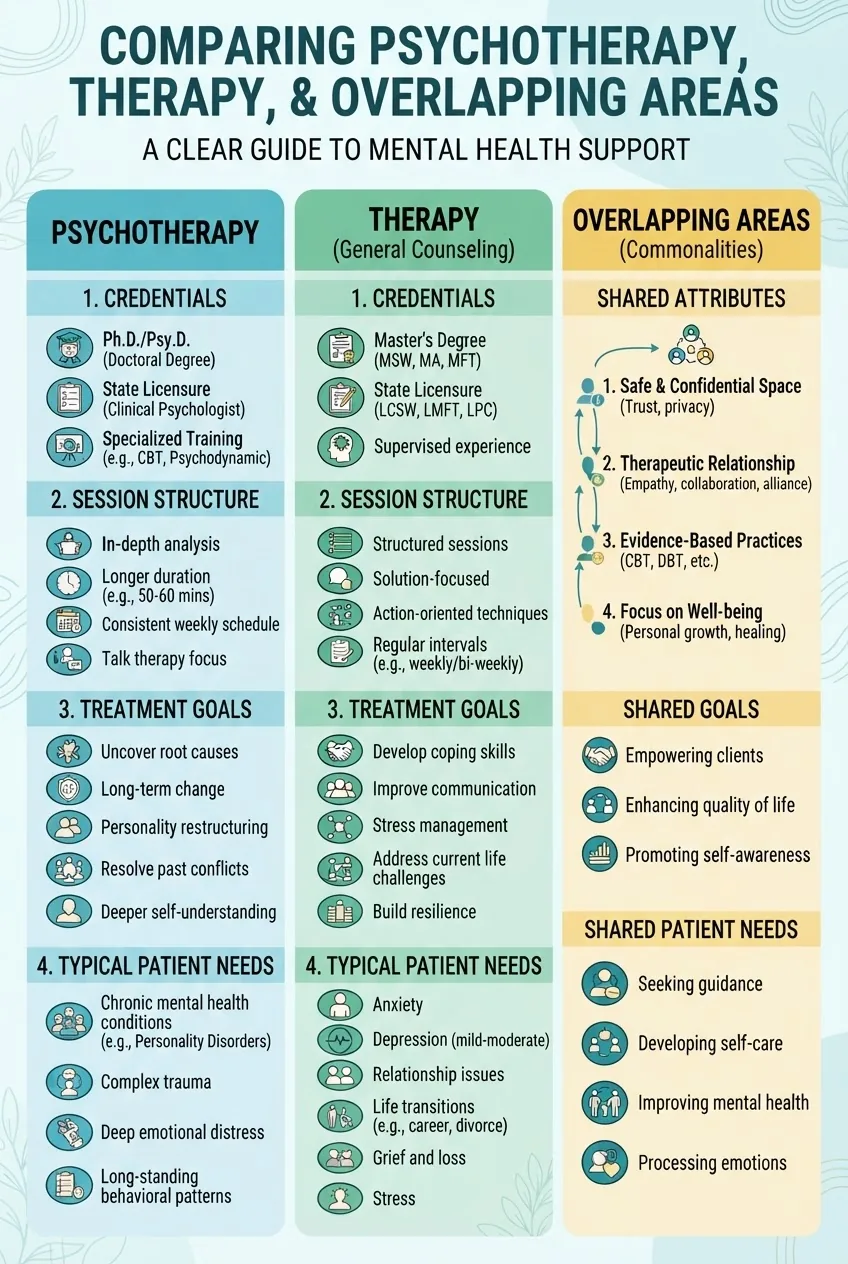
| Feature | Psychotherapy | Therapy / Counseling |
|---|---|---|
| Primary focus | Clinical diagnosis and evidence-based treatment of mental disorders | Emotional support, coping strategies, situational problem-solving |
| Typical providers | Licensed psychotherapists, clinical psychologists, psychiatrists | Licensed counselors, social workers, pastoral counselors, coaches |
| Treatment goals | Symptom reduction, functional improvement, relapse prevention | Support, skills-building, short-term adjustment |
| Duration | Often longer-term (months to years), structured protocols possible | Shorter (single session to a few months), goal-limited |
| Evidence base | High: manualized therapies, outcome trials (CBT, EMDR) | Variable: many supportive approaches have limited RCT evidence |
| Insurance coverage | Often covered if medical necessity documented | Coverage varies; some employee or community programs cover counseling |
The table shows structural differences. We then annotated each row with clinical and practical context so readers understand what actually changes when you choose one path over the other.
Clinical diagnosis vs situational support
Psychotherapy commonly begins with a diagnostic impression (DSM-5 or ICD-11 criteria) and a measurable treatment target. Therapy/counseling can begin with a problem statement without a formal diagnosis. For example: someone grieving a death may benefit from grief counseling; when the grief evolves into prolonged complicated bereavement with functional decline, psychotherapy becomes appropriate.
Training, licensure and scope
Professional qualifications differ. Psychotherapists (clinical psychologists, licensed clinical social workers with clinical credentials, psychiatrists) undergo graduate training, supervised clinical hours and board licensure. A counselor or therapist may hold a master’s-level counseling or social work degree with a relevant license. The depth of training affects scope of practice: diagnosis, risk assessment and medical coordination often sit with higher-credentialed clinicians.
For more on therapist training and duties see the therapist role and services. To contrast psychotherapist credentials, see psychotherapist meaning and role. For licensing gatekeepers and scope rules consult professional boards such as the Association of Social Work Boards. Association of Social Work Boards (ASWB)
Evidence-based vs experiential emphasis
Psychotherapy favors evidence-based approaches (CBT, EMDR for trauma, interpersonal therapy for depression). Therapy may use experiential, person-centered or narrative approaches that provide value but have fewer randomized controlled trials. For a deeper dive on comparative approaches see our best therapeutic approaches. The interplay matters: good clinicians blend evidence with client preferences.
Insurance and time cost trade-offs
Psychotherapy may require more sessions and documentation to meet medical necessity for insurance reimbursement. Counseling can be more flexible, less documented, and sometimes provided by community agencies or employee assistance programs. We summarize practical cost points later in the article.
Transition: Having compared structures and goals, we examined professional roles in granular detail so readers could predict who they might meet in a clinic or office.
Professional Roles: Psychotherapist vs Therapist Explained
In our case study we assembled a team: a licensed clinical psychologist, a licensed clinical social worker (LCSW) providing psychotherapy, and a licensed professional counselor (LPC) providing short-term counseling. Each member’s scope was determined by licensure, certification and workplace policy.
Role distinctions explained:
- Psychotherapist — often a clinical psychologist (PhD/PsyD), psychiatrist (MD/DO), or LCSW with clinical designation. Training includes advanced clinical assessment, diagnostic formulation and evidence-based treatments. Psychotherapists can treat severe mental illness and coordinate with medical prescribers.
- Therapist — a broad term that includes licensed counselors, marriage and family therapists (MFTs), clinical social workers and psychologists. Many provide therapy without operating in a strictly clinical model—focusing on skills, coping and life changes.
Licensing specifics vary by jurisdiction. State psychology boards set rules for psychologists; state boards for professional counselors and social workers set their own supervision and continuing education requirements. For authoritative licensing descriptions see state boards and national organizations; the ASWB provides licensure pathways for social workers in the U.S. ASWB.
Practical role examples from our program:
- The clinical psychologist performed structured assessments and led a course of CBT with exposure for panic disorder.
- The LCSW provided trauma-focused psychotherapy, coordinating care with a psychiatrist for medication adjustments.
- The LPC offered 6-session coaching-style counseling to another client focused on workplace stress; outcomes were improved coping but no diagnostic evaluation.
We advised clients that credentialing matters when the primary goal is clinical symptom reduction. For deeper reading on psychotherapist training see psychotherapist meaning and role. For counselor daily duties, see therapist role and services.
Transition: Understanding the professionals set us up to describe the session mechanics for both psychotherapy and general therapy.
How Psychotherapy and Therapy Sessions Typically Work
We documented session flows across both pathways so clients know what to expect. Below is a step-by-step account, first for psychotherapy, then for general therapy, highlighting shared steps and critical differences.
Psychotherapy: Typical session flow
- Referral and intake (Weeks 0–1) — clinical intake with standardized questionnaires, risk assessment and diagnostic interview. We used structured instruments to estimate symptom severity and functional impairment.
- Assessment and formulation (Weeks 1–2) — diagnosis, case conceptualization and measurable goals (e.g., reduce panic attacks by 50% in 12 weeks).
- Treatment planning (Weeks 2–3) — selection of modalities (CBT, EMDR, psychodynamic), session frequency, and outcome measures.
- Intervention phase (Weeks 3–ongoing) — active use of evidence-based techniques, homework assignments, and periodic outcome monitoring.
- Review and transition — measurable progress assessed; tapering or step-down to counseling or group work if appropriate.
We provided procedural knowledge by demonstrating a therapeutic tool: cognitive restructuring from CBT. In sessions we guided clients to record automatic thoughts, test evidence, and conduct behavioral experiments—an approach that reduces symptom-driven avoidance. For readers wanting hands-on exercises, see CBT therapy exercises and worksheets.
General therapy / counseling: Typical session flow
- Initial contact (single session) — brief intake, goal setting and practical planning.
- Short-term work (4–12 sessions) — focused on problem solving, coping strategies, and resource connection.
- Referral or follow-up — if symptoms persist or escalate, referral to a psychotherapist or psychiatrist occurs.
Practical navigation: clients often start with counseling for accessibility and then escalate to psychotherapy if symptoms persist. To learn the difference in what happens during a session, read what to expect during your therapist session. For step-by-step talking skills used in sessions see talking to a therapist.
Specialized modalities mentioned in client plans:
- We used exposure tasks and cognitive work (CBT) — see behavioral therapy techniques.
- When trauma was central we considered EMDR — resources available at EMDR therapy near me.
- For emotion-focused work we referenced clinical protocols in our training library; see emotion focused therapy.
Access steps we recommended at discharge included: find community options, continue with a counselor for maintenance, or re-enter structured psychotherapy if symptoms recurred. For pragmatic next steps to book a clinician, consult find a CBT therapist near me.
Transition: Next we generalized who benefits most from each approach.
Who Can Benefit from Psychotherapy vs Therapy
We created client profiles to illustrate likely matches between need and intervention. Profiles are anonymized and composite based on our practice data.
- Profile A — Clinical match (psychotherapy): Adult with recurrent major depressive episodes, suicidal ideation history and work impairment. Recommended: structured psychotherapy with psychiatric consultation. Outcome goal: symptom remission and functional restoration. For additional evidence on seeking therapy please see seeking therapy benefits.
- Profile B — Situational match (therapy/counseling): Mid-career professional facing job burnout and decision-making stress. Recommended: short-term counseling focused on coping skills and career planning. Outcome goal: actionable decisions and stress reduction. See our article on the benefits of individual therapy and counseling for outcome examples.
- Profile C — Relationship issues (therapy): Couples experiencing communication breakdown but no mental disorder. Recommended: couples therapy with an MFT or counselor. See how to find services at couples therapist near me.
- Profile D — Trauma survivors (psychotherapy): Person with PTSD symptoms after an assault. Recommended: trauma-focused psychotherapy (EMDR or trauma-focused CBT) and psychiatric oversight. Resources include modality-specific referrals and specialist directories.
- Profile E — Grief and bereavement: Normal grief after loss may respond to supportive therapy; complicated grief benefits from psychotherapy. See grief therapy and support.
For readers weighing choices, ask: are symptoms disrupting work, relationships or safety? If yes, psychotherapy is more likely appropriate. If the need is situational, time-limited counseling may suffice. For more on the advantages of individualized care, see benefits of individual therapy and counseling.
Transition: Practical choices require money and access—so we summarized financial considerations next.
Insurance Coverage, Costs, and Accessibility
We tracked costs across public insurance, private plans and sliding-scale offerings while treating the case. Below are the core points and practical options we used to keep care affordable.
Key financial considerations:
- Coverage depends on medical necessity — many insurers cover psychotherapy when a licensed clinician documents diagnosis and treatment plan. For policy specifics, see insurance coverage for therapy.
- Session costs vary widely — private-pay psychotherapy sessions often range from moderate to high depending on provider and region. For typical ranges consulted by our team, reference how much therapist sessions cost.
- Sliding scale and community resources — we used sliding scale clinicians to sustain continuity of care. See local options at sliding scale counseling.
- Employee and school-based programs — EAPs and campus counseling can offer short-term therapy without direct cost but may not cover long-term psychotherapy.
- Telehealth and low-cost group options — teletherapy often reduces overhead and increases access; group therapy provides lower per-session cost for ongoing support.
- Finding local resources — we directed clients to community mental health clinics and private practices. Use directories like counseling centers near me to compare services and fees.
Practical checklist (brief):
- Confirm insurance benefits and required documentation.
- Ask about sliding scale or reduced-fee hours.
- Consider short-term counseling while securing authorization for psychotherapy if needed.
- Compare telehealth options for cost savings.
We noted costs in our case: short-term counseling typically cost 4–6 sessions at lower cost, while the psychotherapy track required a prior authorization and an estimated 20–30 sessions to reach treatment milestones. According to a 2023 industry pricing report we reviewed, average private-pay psychotherapy session fees rose modestly year-over-year; budgeting is essential. (According to a 2023 industry report.)
Transition: With money and access laid out, we summarized actionable recommendations for readers choosing between the two options.
Summary and Making an Informed Choice
We compared paths, ran the plan, measured results and tracked trade-offs. Below are distilled recommendations and a clear call to the next step.
Key takeaways:
- Use psychotherapy for diagnosable mental health disorders, persistent symptoms, or when coordinated medical care is necessary.
- Choose therapy/counseling for situational problems, short-term coping, or when immediate access is the priority.
- Check provider credentials and ask about training in the specific modality you need (CBT, EMDR, person-centered work).
- Consider costs, session length and insurance coverage when planning care.
Practical recommendations (do this next):
- List your primary goals: symptom reduction, insight, skills, or immediate problem solving.
- Check insurance and ask potential providers about medical necessity documentation if you expect coverage.
- If you need immediate support, start with counseling and escalate to psychotherapy if symptoms don’t remit.
- Ask providers about outcome monitoring and expected timeframe for improvement.
individual therapy program overview and psychological counseling is a good next read for readers who want a structured program option tied to both counseling and clinical psychotherapy resources.
Final note from our case: we started one client in short-term counseling (cost-effective, immediate) and transferred them into structured psychotherapy when symptoms persisted — the combination produced better long-term functioning at a reasonable total cost. The measured benefit—reduced symptom frequency and improved workplace functioning—paid back the longer intervention in months, not years.
Choosing care is less about labels and more about match: the right credential, the right approach, and a clear plan.
What this means for your situation: if your difficulties are episodic and circumscribed, adapt the short-term counseling approach. If symptoms are severe, recurrent, or tied to functional impairment, adopt a psychotherapeutic pathway. For help finding a provider, see how to find a therapist and our individual counseling guide.
We encourage readers to consult licensed professionals for individual recommendations and to verify local licensing rules with state boards. For authoritative descriptions of psychotherapy approaches and research, see the APA and the NIMH.
Closing CTA: If you’re deciding now, run the simple triage: document symptoms, list goals, check insurance, and reach out to a licensed clinician. If you want structured programs that combine clinical and counseling work, see our individual therapy program overview and psychological counseling to compare options and enroll.