Talking to a therapist began as a single appointment on a crowded Tuesday at the end of a long month; by session three the client who walked in rigid and guarded could speak through tears and name a pattern they’d never noticed. We tracked the decisions, the techniques, and the exact language that changed those outcomes so you can see what typically happens and how it feels to talk to a therapist.
Below is a single case study threaded through clear, practical lessons: how sessions flow, what the therapist does, how you can prepare, and when it’s appropriate to end. Where evidence or standards matter, we cite authoritative sources and offer caveats: therapy varies by modality and clinician, but the process described here maps onto standard practice.
What Does Talking to a Therapist Mean?
We met our client—call them A.—when they booked one 50-minute slot to address sleep problems, anxiety, and grief after a recent loss. For A., talking to a therapist was not a magic cure; it was a purposeful, guided conversation designed to surface patterns, test coping strategies, and reframe experiences. At its core, the term refers to a structured interaction where a trained professional supports emotional expression, problem-solving, and behaviour change through evidence-based methods and relational skill.
Therapeutic conversation is guided by goals and shaped by the therapeutic relationship or therapeutic rapport—a mutual sense of trust and safety. We define a few terms here so later sections read clearly:
- Therapeutic rapport: the trusting, collaborative bond between client and therapist that allows honest disclosure and feedback.
- Self-disclosure: what you choose to share about thoughts, history, feelings, or behaviour. Therapists model appropriate self-disclosure sparingly and strategically.
- Confidentiality: legal and ethical protections around what you say in session, subject to safety exceptions (see below).
In A.’s intake, we spent the first session mapping concerns, practical constraints (insurance and schedule), and short-term goals—sleep more than six hours, reduce panic episodes from weekly to under two per month. That goal orientation is typical across modalities and frames what ‘talking’ does: it collects information, interprets it collaboratively, and plans experiments or exercises to try between sessions.
Talking to a therapist does not mean simply venting. It is a disciplined conversation where the therapist listens actively, asks clarifying questions, introduces techniques (like cognitive restructuring or grounding), and invites the client to test new behaviours. If you want deeper background about the role of therapy and its benefits, see benefits of therapy explained and for a broader program view, consult our pillar resource below.
Individual Therapy Program Overview and Psychological Counseling
We treated the conversation as a co-produced process—like a guided coaching session focused on mental health—where the therapist’s role alternated between interpreter, teacher, and experiment designer. Throughout this article we use the neutral term “therapist” but will clarify differences between psychologists, counselors, and psychotherapists later.
Transitioning now from what the phrase means to how you get ready: clear expectations before session one reduce anxiety and improve outcomes.
How to Prepare for Your First Therapy Session
We asked A. to do simple pre-session preparation: note three concerns, list current medications and prior treatments, and think of one short-term goal. Preparation reduces the fog of first-session nerves and makes the intake efficient.

- Write what matters most (10–20 minutes). Jot three things you want to change or understand. Prioritizing saves time in the session and gives the therapist concrete starting points.
- Bring practical details (documentation checklist). Insurance cards, a medication list, emergency contact, and any recent diagnoses. These allow the clinician to focus on therapy content rather than administrative catch-up. If local, find support resources like counseling centers near me for options.
- Set one measurable goal. We asked A. for a single, specific target (sleep six hours on four nights per week). Specificity lets therapist and client track progress across sessions.
- List questions you want to ask the therapist. Examples: therapist’s training, typical methods, cancellation policy, confidentiality limits. Asking these early builds trust.
- Decide how you’ll share sensitive history. You don’t need to disclose everything at once; plan to share high-impact information first (suicidality, self-harm, recent trauma). Therapists follow safety protocols and will ask if something needs immediate attention.
- Consider modality and credentials. If you prefer a licensed psychologist (PhD/PsyD) versus a counselor (MA, LPC) or psychotherapist, note that preference now. If you want help finding clinicians with specific expertise, search to find a CBT therapist near me.
- Prepare mentally: normalise anxiety. Feeling nervous is typical. Create a small ritual—tea, a five-minute breathing exercise—to arrive calmer. We taught A. a 90-second breathing drill they used before each session.
- Logistics and technology check. If remote, test the platform, camera, and audio beforehand. If in-person, check directions and parking. Practical glitches undermine early rapport.
- Plan for follow-up. Know how you’ll book the next session and the therapist’s policy. This reduces decision fatigue after a potentially emotionally draining first meeting.
- Bring an openness to experiment. Therapy is iterative. Commit to trying homework tasks or new behaviours for at least 3–6 sessions before judging effectiveness; many interventions require repeated practice.
Preparation reduces initial friction and lets the first sessions focus on establishing alliance and clear targets. When you’re ready to start locally, use resources like counseling centers near me to compare options and availability.
Next, we describe the typical session flow from intake to termination, including confidentiality and what actually happens during the working phase of therapy.
What to Expect During Typical Therapy Sessions
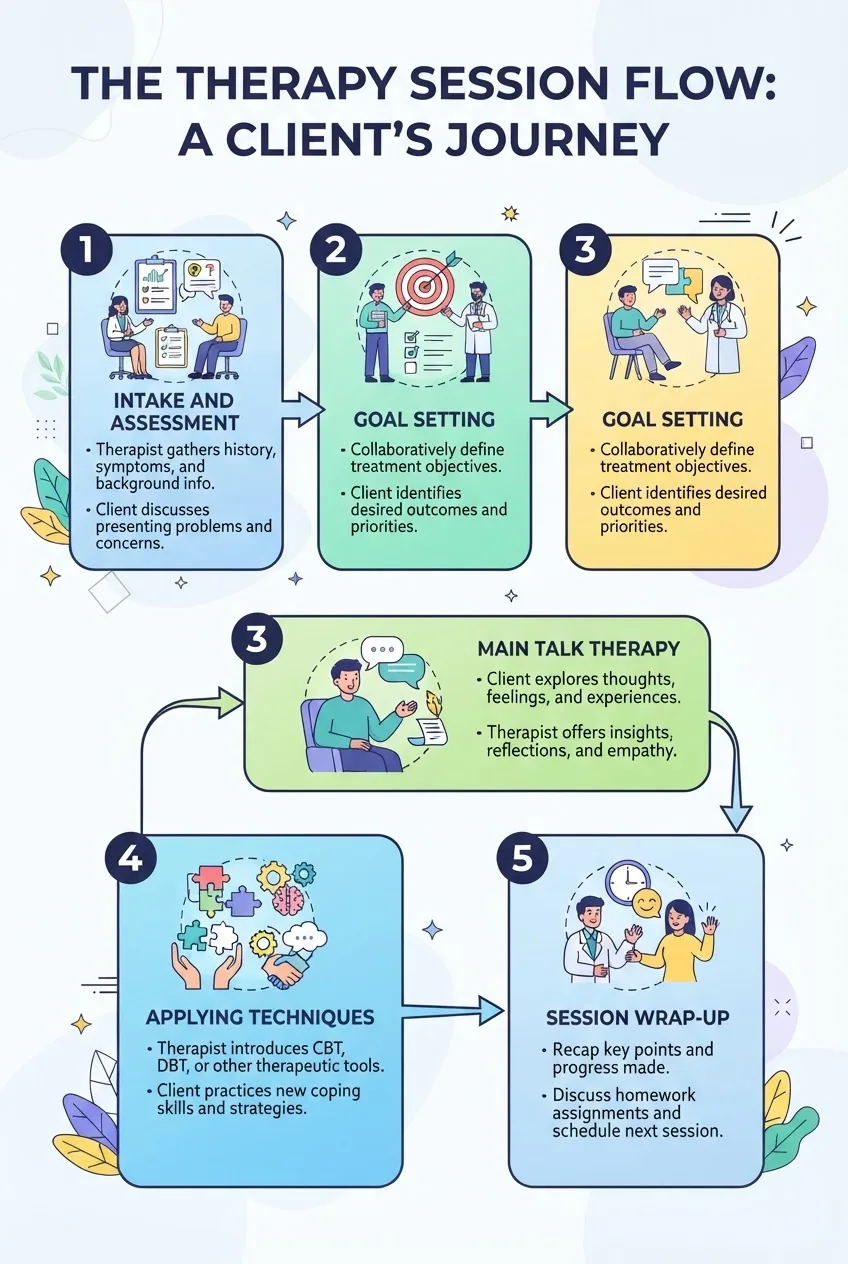
We structured A.’s care into three phases: intake/introduction, ongoing sessions, and termination. Each phase has predictable tasks, emotional tones, and milestones.
Intake and Introduction
The intake is a focused assessment: history, current stressors, risk screening (suicidal ideation, self-harm, substance use), and practical items like consent forms. In our clinic the intake lasts 45–90 minutes depending on complexity. Expect questions about family, medical history, past therapy, sleep, appetite, and medication.
During intake, therapists explain confidentiality limits (e.g., harm to self/others, child or elder abuse) and data handling practices under laws such as HIPAA in the U.S. Therapists will obtain informed consent and a basic safety plan if risks appear. For standards on psychotherapy practice, see the American Psychological Association (APA).
Ongoing Sessions: the “Main Talk” and Work Between Sessions
After intake, ongoing sessions are where the bulk of therapeutic change happens. Here is a common structure we used with A.:
- Check-in (5–10 minutes): mood, sleep, recent crises, and homework adherence.
- Agenda setting (2–5 minutes): collaboratively decide one or two items to address that session.
- Main work (30–35 minutes): deep conversation, structured interventions (e.g., cognitive restructuring, exposure tasks, narrative work), and skills practice.
- Wrap-up (5 minutes): summarize insights, set homework, and schedule next session.
Session length is commonly 45–60 minutes; frequency is often weekly initially. We agreed on weekly 50-minute sessions for A. for the first eight weeks, then shifted to biweekly checkpoints as symptoms improved. According to a 2024 industry report, many short-term therapy plans show measurable change within 8–12 sessions; individual response varies by diagnosis and method.

Confidentiality and privacy are active parts of sessions. Therapists typically store records in encrypted systems and discuss limits of confidentiality at intake. In the U.S., HIPAA provides baseline privacy protections and therapists must explain these at the first meeting; in other countries there are equivalent regulations and professional codes. For education around mental health and confidentiality policy summaries, consult the National Alliance on Mental Illness (NAMI).
During working sessions, expect a mix of free-talking and structured methods. For example, in cognitive behavioural work the therapist might pause a narrative to label a cognitive distortion, ask the client to test a belief, and assign a short behavioural experiment. Our clinicians documented each session’s agenda and homework so progress could be measured using simple trackers.
Session Length, Frequency, and Typical Timeline
Standard outpatient sessions: 45–60 minutes weekly. Some focused treatments (e.g., brief CBT) run 6–12 sessions; complex or relational work can last many months to years. We recommended A. commit to at least 8 sessions to evaluate response. Progress monitoring can take the form of symptom scales (PHQ-9, GAD-7) or simple self-checks like sleep hours logged weekly.
Termination is planned when goals are met or when the client chooses to stop. It includes a review of gains, relapse prevention planning, and a final check-in. We scheduled a termination review after A. maintained target sleep and reduced panic frequency for two months.
Next we examine how therapists facilitate the conversation, the skills they bring, and examples from sessions so you can recognise techniques when they appear.
How Therapists Facilitate Conversation and Support
Therapists use a predictable toolbox of skills to make conversations productive. We describe the most used methods, name them, and show examples from A.’s sessions.
Active listening and reflective statements. Therapists paraphrase feelings and content to confirm understanding. Example: when A. said, “I keep replaying the argument,” the therapist replied, “You feel replaying gives you a chance to fix what went wrong.” That reflection both validated A.’s experience and opened room for cognitive work.
Empathy and emotional validation. A therapist might say, “Given what you’ve been through, it’s understandable you’d feel overwhelmed.” Validation reduces shame and increases safety for fuller disclosure.
Structured cognitive techniques (CBT). Therapists identify automatic thoughts, test evidence, and design behavioural experiments. We used a CBT exercise: A. rated a distressing thought’s believability, then scheduled a small behavioural test to check the belief. For readers wanting more on concrete methods, see our guide to behavioral therapy techniques.
Emotion-focused interventions. Therapists help label and tolerate emotions, often using grounding or breathing. We taught A. a 5-point grounding check (name 3 things you see, 2 things you feel, etc.) to de-escalate spikes during panic onset.
Motivational interviewing. For ambivalence tasks—like readiness to change substance use—therapists use open questions and reflect pros and cons to elicit clients’ own reasons for change.
Systematic exposure. For phobias or avoidance, gradual exposure helps extinguish fear responses. The therapist paced exposures so that A. could complete them without overwhelming avoidance—small steps with clear success criteria.
Example in practice: During one session A. recounted a memory that triggered shame. The therapist first validated the emotion, then shifted to cognitive exploration (“What does that moment mean for you now?”), and finally assigned a journaling exercise to reframe the memory in light of current evidence. This sequence—validate, explore, assign—is a common, repeatable pattern.
Therapists also use measurement and feedback: session rating scales and symptom checklists track change. Peer-reviewed evidence supports these methods; see summaries in the Journal of Clinical Psychology for outcome studies on therapy techniques.
Across all methods, therapists aim to maintain emotional safety so clients can take risks in session without retraumatizing experiences. They do this by pacing, explicit consent for deeper work, and contingency planning when intense emotions emerge.
The next section lists common emotions clients report while talking in therapy and how to manage them.
Common Emotions and Experiences While Talking to a Therapist
Clients often describe a predictable emotional arc across the first several sessions. We documented A.’s weekly emotional log; the pattern mirrored many clients’ experiences and helped us anticipate support strategies.
“You will feel awkward, then vulnerable, then relieved—sometimes within the same session.”
Common emotional states include:
- Anxiety or nervousness: common before and during early sessions as you disclose personal material.
- Vulnerability: opening up can feel exposing; therapists normalize this and work to build safety.
- Relief: many clients report immediate relief from naming a problem and being heard.
- Confusion: new ideas about your behaviour or emotions can feel disorienting before they make sense.
- Frustration: progress feels slow at times; that’s a normal phase and often precedes consolidation.
- Hope: small wins (sleeping better, fewer panic episodes) generate motivation to continue.
Specific experiences to anticipate and how we handled them with A.:
- Being asked about trauma: therapists ask with care and give permission to pause; we used grounding and check-ins when sensitive topics arose.
- Crying unexpectedly: therapists allow space, use tissue and silence strategically, and often name the purpose of emotional release.
- Feeling judged: if this occurs, raise it in session—therapists can correct misunderstandings and repair rupture, which strengthens rapport.
For readers dealing with grief specifically, consider specialized supports. See our resource on grief therapy and support.
Therapy has measurable benefits for many people. According to a 2023 NAMI report, clients frequently report improved coping and reduced symptom severity after engaged therapy. That said, experience varies by individual and approach; always consult licensed professionals for personalised advice.
Next we compare different therapist types so you know how training and approach can change the conversation.
Differences Between Talking to a Psychologist and Other Therapists
Clients often ask whether to choose a psychologist, counselor, psychotherapist, or social worker. The differences matter less than fit and approach, but training, credentialing, and scope can shape the session.
| Role | Typical training | Common focus in sessions |
|---|---|---|
| Psychologist | PhD or PsyD; supervised clinical hours and licensing exams | Assessment, diagnostic formulation, evidence-based therapy (CBT, ACT), psychological testing |
| Counselor / LPC | Master’s degree (MA, MSW for social workers); licensure varies | Talk therapy, coping skills, short-to-mid-term goals, community resource linkage |
| Psychotherapist | Training varies by country; may include psychodynamic, integrative, or humanistic methods | Depth work, relational patterns, long-term therapy options |
| Social Worker (LCSW) | Master’s in social work, clinical licensure | Psychotherapy plus systems-level supports (housing, community resources) |
Beyond credentials, approach matters. For a summary of approaches by modality see best therapeutic approaches and effective therapy options and different kinds of therapy.
best therapeutic approaches and effective therapy options
If your concern is relationships or couples work, a dedicated couples therapist may be preferable—search local options like couples therapist near me.
Choosing a psychologist often makes sense when diagnostic assessment or formal testing is needed. Choosing a counselor or LCSW can be efficient for short-term goals, practical problem-solving, and linkage to community services. Psychotherapists may work longer-term with an emphasis on personality and relational patterns.
Practical trade-offs we experienced with A.: psychologists offered deep assessment but longer waitlists; counselors were more immediately available; we balanced timeliness with clinical needs by starting with a counselor and scheduling a psychologist consultation for complex diagnostic questions.
Next: actionable tips to make the most of sessions once you begin.
Tips for Making the Most of Your Therapy Sessions
We coached A. on how to use therapy effectively. These steps are practical and repeatable.
- Be specific about your goals. State measurable outcomes (sleep hours, panic frequency). Specific goals guide therapy tasks.
- Do assigned homework. Small, consistent practices between sessions create change. Use tools like worksheets and behavioral experiments—see our CBT therapy exercises and worksheets.
- Track progress with simple metrics. Use weekly symptom logs, sleep diaries, or mood ratings to show trends over time.
- Practice self-disclosure strategically. Share the facts and feelings that matter to your goals rather than narrating the whole life story at once.
- Ask for clarification. If a technique or terminology is unclear, ask the therapist to explain and demonstrate.
- Bring agenda items. Start sessions with 1–2 priorities so important topics aren’t missed.
- Use role-play or in-session rehearsal. Therapists can model conversations (e.g., difficult boundary setting) and you can practice in a safe space.
- Schedule periodic reviews. Every 6–8 sessions, request a progress review to assess what’s working and what to change.
- Manage expectations. Expect incremental gains. If 6–8 sessions show no improvement, discuss alternate techniques or referrals with your therapist.
CBT therapy exercises and worksheets
We suggested specific self-assessment checkpoints to A.: PHQ-9 and GAD-7 every four weeks and a simple “goal attainment scale” rating from 0–10 at each session. These concrete measures made decisions about frequency and technique evidence-based and collaborative.
Next, how do you know when to end therapy or stop sessions temporarily? We describe termination mechanics below.
When and How to End Therapy Conversations
Termination is a planned process. We set clear criteria for ending formal therapy with A.: meet primary goals for two consecutive months, demonstrate coping skills in real-world situations, and create a relapse-prevention plan. That plan included warning signs, coping steps, and scheduled booster sessions.
Common reasons to end therapy:
- Goals met and skills stabilized.
- Client chooses to pause for practical reasons (work, relocation).
- A change in clinical needs requires referral (intensive inpatient care or specialty service).
Termination steps we followed:
- Review progress and revisit early session goals.
- Create a written relapse-prevention plan that lists triggers and coping steps.
- Agree on follow-up options—booster sessions or a clear plan to return if needed.
- Provide community resources and referrals.
Sometimes ending therapy prompts anxiety. Therapists plan gradual spacing (weekly → biweekly → monthly) to test maintenance. If progress reverses, re-initiate sessions earlier. For safety planning and relapse prevention resources, see APA standards and consult licensed professionals.
What this means for your situation: If you have short-term, skill-focused goals, begin with a clinician trained in CBT or brief therapy and commit to at least 6–8 sessions. If your needs are complex or relational, plan for longer-term work with a provider whose training fits the modality. We recommend documenting goals, tracking simple metrics, and scheduling regular reviews to avoid drifting without measurable progress.
If you’re ready to explore options, local resources and directories can help you match clinicians to needs.
Final takeaway: Talking to a therapist is a structured, goal-oriented conversation grounded in a safe relationship. It progresses from intake to working sessions to planned termination; measurable progress and emotional safety are central. Start prepared, track outcomes, and discuss technique choices with your therapist so each session moves you toward your goals.