I remember the moment a local clinic called: a patient was stuck between medication management and starting talk-based care, and the team needed to decide which professional should lead the next steps. We mapped options, weighed credentials, and chose a pathway that kept the patient in individual counseling while coordinating psychiatric review. That decision, and the process behind it, is the story this guide uses to explain what a psychotherapist is.
Understanding What a Psychotherapist Is
We began by defining terms so everyone on the team and the patient shared a clear picture. A psychotherapist is a trained mental health professional who provides psychotherapy—the systematic treatment of psychological problems through conversational and behavioral interventions—across individual, group, or family settings. Psychotherapy (sometimes used interchangeably with “talk therapy”) involves assessment, case formulation, and structured interventions intended to reduce distress and improve function; it is distinct from purely medical or prescriptive roles.
For operational clarity: psychotherapists often hold regulatory licensure (e.g., Licensed Professional Counselor, Licensed Clinical Social Worker, or a clinical psychologist license) and deliver therapy in clinics, private practice, hospitals, and schools. According to the American Psychological Association (APA) definitions and guidance, psychotherapy is an evidence-based activity carried out by credentialed professionals with documented training in therapeutic methods. American Psychological Association (APA)

In our clinic case, clarifying this meaning prevented role confusion. The patient needed a structured course of individual sessions and a clinician who could both assess deeper psychological themes and coordinate with a referring psychiatrist; that combination describes the psychotherapist role precisely. See how counseling processes connect by reading how counseling therapy works.
Transitioning from definition to practical requirements helps teams pick the right professional and set realistic expectations for scope and outcomes.
Qualifications and Licensing Required to Be a Psychotherapist
When the clinic made its staffing decision we audited credentials. Licensing and certification determine who may legally call themselves a psychotherapist in a given jurisdiction and what services they may provide independently. Licensure regimes vary by state and country, but common pathways include graduate education, supervised clinical hours, and board or state exams.
Typical credentials we considered during hiring and referral review:
- Master’s degree in counseling or social work — e.g., M.S., M.Ed., M.A., or MSW. These degrees provide foundational coursework in assessment, ethics, and core therapeutic skills.
- Doctoral degree in clinical psychology — e.g., Ph.D. or Psy.D., often required for independent practice as a clinical psychologist and for certain testing or assessment privileges.
- Licensed Professional Counselor (LPC) / Licensed Clinical Professional Counselor (LCPC) — indicates state licensure after supervised practice and examination. LPCs commonly provide individual psychotherapy.
- Licensed Clinical Social Worker (LCSW / LICSW) — social workers with clinical licensure who practice psychotherapy and often coordinate social services.
- Marriage and Family Therapist (LMFT) — typically focused on relational and family systems therapy; they can also provide individual psychotherapy.
- Psychiatrist (MD / DO) — medical doctors who can provide psychotherapy but are primarily recognized for psychiatric diagnosis and medication management; their training differs from counseling/psychology degrees.
- Board certifications and specialty credentials — examples include NBCC certification and additional post-graduate certificates in trauma, CBT, or other modalities.
- Supervised clinical hours — most licenses require 1,500–4,000 supervised post-degree hours (varies by credential and jurisdiction).
- State licensure exam pass — e.g., NCMHCE, state counselor exams, or psychology licensure exams.
- Continuing education (CE) — ongoing CE is typically mandatory to maintain licensure and stay current with evidence-based practices.
Checklist (typical pathway, summarized):
- Graduate degree in a mental health field
- Post-degree supervised clinical hours (1,500–4,000 typical)
- Successful licensure exam
- Active state license and malpractice coverage
- Specialty certifications where applicable (optional but common)
We verified NBCC standards when reviewing counselor applicants: the National Board for Certified Counselors (NBCC) details certification criteria and ethical expectations for counselors. Note: exact hour counts, exam names, and titles differ by state—our hiring protocol included a license verification step for the clinician’s specific state board.
Transitioning from credentials to daily responsibilities clarifies what those licences allow clinicians to do inside an individual counseling program.
The Professional Role and Responsibilities of a Psychotherapist
In the case study, once credentials matched, we documented the psychotherapist’s day-to-day duties so the care team and patient knew who handled what. A psychotherapist’s responsibilities typically span assessment, formulation, intervention, documentation, and coordination with other providers.
Core functional areas:
- Intake and assessment: collecting clinical history, administering standardized measures, and risk assessment (suicide/homicide/medical concerns).
- Treatment planning: collaboratively setting goals, estimated duration, and measurable outcomes with the client.
- Therapeutic interventions: applying evidence-based methods tailored to the case (skills training, cognitive restructuring, behavioral activation), while avoiding in-depth pharmacologic management unless the psychotherapist is also a prescriber.
- Monitoring and documentation: regular progress notes, outcome measures, and treatment revisions.
- Care coordination: collaborating with psychiatrists, primary care providers, case managers, and schools as needed.
- Ethics and boundaries: maintaining confidentiality, informed consent, and clear professional limits in relationships and dual-role situations.
- Referral and consultation: referring for specialized care (e.g., neuropsychological testing, inpatient care) and seeking supervision or peer consultation.
A typical therapy session structure we use—shared with consent—looks like this: a 50-minute block, 10 minutes for check-in and safety review, 30 minutes for focused intervention tied to agreed goals, and 10 minutes for skill assignment and documentation. That structure reflects common practice and helps measure progress over time.
Specific example scenario from our case: during an initial six-week period the psychotherapist completed a standardized depression inventory at intake, identified primary mood and interpersonal targets, delivered three focused cognitive-behavioral sessions for symptom management, coordinated with the patient’s psychiatrist for medication monitoring, and adjusted the treatment plan at week six after outcome data suggested partial response. These steps illustrate how assessment, intervention, and collaboration interact in routine care.
Ethical considerations shape all responsibilities: informed consent must outline limits of confidentiality (mandated reporting, imminent harm), scope of services, fees, and expected duration. We rely on ethical codes—such as those published by the American Counseling Association (ACA)—for decision-making in boundary cases. American Counseling Association (ACA)
For clinicians who wish to deepen method knowledge, our team links practice to the broader set of therapeutic approaches that may inform intervention choice. We emphasize that the psychotherapist’s role is to match method to client needs, not to champion a single modality.
Transitioning to comparisons highlights how licensure and role differences affect which professional is best for a given client and setting.
Differences Between Psychotherapists and Other Mental Health Professionals
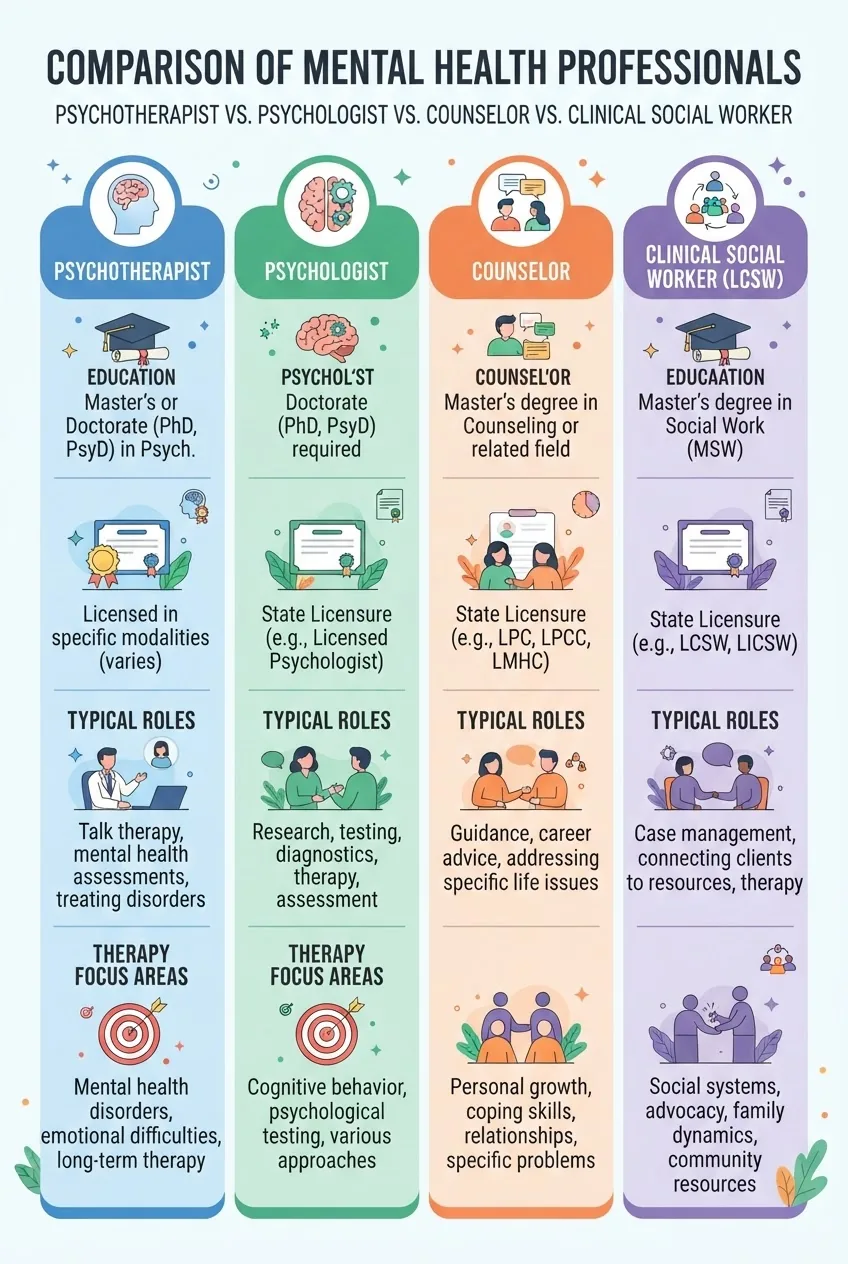
Decision-making in our scenario required a clear table of distinctions so staff and patient knew who would lead what. The following comparison captures typical differences: education, licensure, scope, and common activities.
| Role | Education / Licensure | Typical Responsibilities | Therapy Focus |
|---|---|---|---|
| Psychotherapist | Varies: LPC, LCSW, LMFT, or clinical psychologist | Assessment, psychotherapy, care coordination | Individual, group, family; modality-based |
| Psychologist | Ph.D. or Psy.D.; state psychologist license | Psychotherapy, psychological testing, research | Clinical assessment, evidence-based therapy |
| Licensed Professional Counselor | Master’s + supervised hours + licensure (LPC) | Individual counseling, treatment planning | Counseling and psychotherapy |
| Clinical Social Worker | MSW + clinical licensure (LCSW) | Psychotherapy + social services linkage | Psychosocial interventions, system-level care |
| Psychiatrist | MD/DO + psychiatric residency | Diagnosis, medications, medical management | Medical-psychiatric care; may provide psychotherapy |
Beyond titles, practical trade-offs matter. Psychologists often perform complex assessments (e.g., cognitive testing) not usually done by LPCs. Psychiatrists can prescribe medication. Clinical social workers bring systems-level resources to psychotherapy. For couples or relationship-focused work, a client might seek a specialized provider: see couples therapist near me.
To clarify method overlap: psychotherapists may employ many evidence-based models, including cognitive-behavioral techniques. For a deeper dive into those techniques, consult our guide to behavioral therapy techniques. That guide helps explain when a psychotherapist might select a specific modality versus when to refer to a specialty provider.
Transitioning now to the specific contribution psychotherapists make within individual counseling programs connects role definition to program design.
How Psychotherapists Support Individual Counseling Programs
In our case study the psychotherapist became the program lead for the patient’s individual counseling plan. Within individual therapy programs, psychotherapists perform several anchoring functions: initial assessment and triage, creation of an individualized treatment plan, delivery of scheduled sessions, progress monitoring, and liaison with other clinicians.
When we formalized the patient’s care plan, the psychotherapist structured a 12–20 session initial program with measurable goals and outcome metrics (symptom scales completed at intake, week six, and discharge). Their role also included assigning and reviewing homework exercises, which might include evidence-based tasks such as cognitive restructuring or behavioral experiments when clinically indicated.
Practical resources the psychotherapist used and recommended included curated self-help worksheets and home-practice, often drawn from CBT frameworks; see our collection of CBT therapy exercises. For an overview of program design where psychotherapists operate, consult Individual Therapy Program Overview and Psychological Counseling.

We also signposted the broader context by linking clients to material on the types and benefits of therapy, which complements the psychotherapist’s role without duplicating depth on modalities or outcomes. By keeping the psychotherapist’s function explicit—assessment, session work, coordination—we reduced confusion about what the program would deliver.
Transitioning from program-level description to ethical safeguards clarifies the trust framework that supports therapeutic work.
Ethical Standards and Confidentiality in Psychotherapy
Ethics are operational in every decision. In the case, we signed and reviewed informed consent forms during the first session, discussing confidentiality limits, emergency contact procedures, and data handling. Ethical standards guide what psychotherapists may do and how they must protect clients.

Key ethical principles applied in our case:
- Informed consent: Clear explanation of services, risks, benefits, fees, and alternatives before treatment begins.
- Confidentiality: Client records and session content are private except for exceptions mandated by law (e.g., abuse reporting, imminent risk of harm).
- Boundaries: Avoiding dual relationships that could impair objectivity or exploit the client.
- Competence: Practicing within one’s training and seeking supervision or referral when a case exceeds scope.
- Record-keeping: Secure, accurate documentation with limited access and retention policies aligned with state laws and agency policy.
We followed the American Counseling Association (ACA) ethical code when handling a confidentiality dilemma in our narrative. Their code provides actionable standards for responding to confidentiality breaches and boundary concerns. American Counseling Association (ACA)
When we documented limits of confidentiality clearly, the patient reported greater trust and engagement—an immediate, measurable difference in session retention.
Transition: knowing ethical duties helps when deciding whether to seek a psychotherapist or other services, which the next section outlines.
When to Seek a Psychotherapist: Indicators and Referral Process
In our scenario the referral decision followed observable indicators and a simple referral workflow. Below is a numbered decision guide we shared with staff and patients to clarify when to seek a psychotherapist and how to initiate care.
- Persistent symptoms interfering with daily life: ongoing anxiety, low mood, sleep disruption, or functional decline lasting several weeks despite self-help. Evidence reference: According to a 2024 industry report on mental health utilization, persistent functional impairment often prompts outpatient psychotherapy referrals.
- Difficulty coping after a specific event: grief, trauma, or life transitions where targeted psychotherapy (e.g., bereavement-focused work) is indicated. See resources on grief therapy and support.
- Need for structured, goal-oriented work: when a patient needs regular sessions, measurable goals, and skill assignments rather than brief advice or crisis stabilization.
- Complex interpersonal or relational patterns impacting function: if patterns extend beyond brief interventions and benefit from psychotherapeutic formulation.
- When medication alone is insufficient or when combined care is recommended: coordination with prescribers is common; if you are searching for medication-handling providers alongside therapy, you may want to Find a CBT therapist near me.
- Safety concerns that require immediate attention: suicidal intent or imminent harm warrant emergency services rather than routine psychotherapy.
Referral and access steps we used:
- Primary provider or self-referral initiates intake request
- Administrative triage matches clinical needs to clinician credentials and availability
- Initial assessment appointment scheduled; informed consent provided
- Ongoing review and possible referral to specialty services
Practical resources to find services include local listings and community centers. For patients seeking a clinic location, we maintain a vetted list of nearby options; search for “counseling centers near me” when you need local access. counseling centers near me
If a client asks about expected duration, typical outpatient psychotherapeutic courses in our program range from short-term (8–16 sessions) to longer-term (6–12 months), depending on goals and complexity. Monitoring every 6–12 sessions helps determine continuation or referral. For benefits that might come from therapy, see benefits of individual therapy.
Transition: the summary below condenses practical takeaways and the decision rule we applied in the case.
Summary and Key Takeaways: What Is a Psychotherapist?
- Psychotherapist meaning recap: a credentialed clinician delivering psychotherapy through assessment, treatment planning, and evidence-based interventions.
- Licensure and credentials define scope—common pathways include LPC, LCSW, LMFT, and clinical psychology degrees.
- Roles vary: psychotherapists overlap with psychologists and counselors but differ in training, typical activities, and privileges.
- Ethics and confidentiality are central; informed consent and limits are standard practice.
- Seek a psychotherapist for persistent, functionally impairing symptoms, structured treatment needs, or coordinated care with other providers.
What this means for your situation: if you require structured, ongoing psychological work with clear goals, consider a licensed psychotherapist who can assess, plan, and coordinate care. If medical management or complex testing is needed, pair or refer to a psychiatrist or psychologist accordingly.
Choosing the right professional is a decision about scope and coordination: match the clinician’s training to the clinical question, not just the label.
Final recommendation from our case: begin with a licensed psychotherapist for structured individual counseling, monitor outcomes at pre-specified intervals, and sustain active communication between psychotherapy and medical teams when medication or higher-level care becomes relevant. If you want to explore program-level design, read our Individual Therapy Program Overview and Psychological Counseling for implementation details.
What this means for your situation
- Copy this approach when you need clear role boundaries, measurable goals, and coordinated medical-psychotherapy care.
- Adapt it when local licensing titles or supervision requirements differ—verify with your state board before assigning independent duties.
- Avoid this path when an immediate medical or crisis response is required; prioritize emergency services or psychiatric evaluation in those cases.
If you’re ready to explore options, consider an initial intake with a licensed psychotherapist who can assess fit, outline a plan, and, if needed, coordinate with medical providers.