By the end of this hands-on guide you will have a clear, usable definition of therapy behavioral therapy, be able to describe its main psychological foundations, perform a basic behavioral assessment, and outline a 6–12 session treatment plan. Estimated time: 60–120 minutes to read and plan; skill level: beginner to competent practitioner preparing to apply behavioral principles in a clinical or coaching setting.
Before you start
- A note-taking device and secure client record template (paper or EMR) for intake notes and baseline scales.
- Standardized assessment forms: GAD-7, PHQ-9, a simple A-B-C behavior log template, and consent for treatment (one each).
- Quiet space for 50–60 minute sessions and access to safe, graded exposure materials if planning exposure work.
- Familiarity with basic conditioning language (classical vs. operant) and reinforcement concepts—no advanced training required.
- Access to supervision or a licensed clinician if practicing beyond your credential scope.
-
What Is Behavioral Therapy? Definition and Psychological Foundations
Begin by defining what you will deliver to a client and how you will explain it in plain language. Broadly, behavioral psychotherapy definition frames therapeutic change as change in observable behavior and the environmental factors that shape it. Behavioral therapy—also called behavior therapy or behaviour therapy in some literatures—focuses on measurable actions, learning history, and current contingencies rather than lengthy exploration of unconscious drives.
Historically, behavioral therapy grew from early 20th-century learning theories. Psychologists like John B. Watson and later B.F. Skinner grounded practice in experimental learning: responding to stimuli, forming associations, and adjusting behavior through consequences. Over time, clinical approaches adapted laboratory learning principles to human problems, resulting in interventions for phobias, anxiety, compulsive behaviors, and more.
A contemporary, clinician-facing definition: behavioral therapy is an evidence-based collection of techniques and assessment methods that identify maladaptive stimulus–response patterns and alter them using controlled exposure, reinforcement strategies, and behavioral rehearsal. For clinicians looking for program context, see Individual Therapy Program Overview and Psychological Counseling.
Practically, you will present this definition to clients as: “We will identify the patterns that keep a problem active, test small behavior changes, and build new routines that produce better results.” This framing connects lab-based theory to everyday goals and reinforces measurable outcomes.
Clinical definitions and practice expectations align with professional standards. The American Psychological Association provides practice guidelines and definitions that shape licensing and ethical practice; clinicians often reference APA statements for scope and standards. For APA resources, see American Psychological Association (APA).
Transition: having established what behavioral therapy is and its roots, we now examine the psychological theories that clinicians use to design treatment.
-
Core Principles and Psychological Theories Behind Behavioral Therapy
This section outlines the main learning theories you will use when planning and explaining treatment. Keep language concrete and use everyday analogies: learning by association (like Pavlov’s dog) and learning by consequence (like training a pet).
Classical conditioning (learning by association)
Classical conditioning explains how neutral cues become linked with automatic responses. In clinical work, a neutral situation (e.g., riding an elevator) can acquire anxiety if it has been repeatedly paired with panic. The model: unconditioned stimulus → unconditioned response; neutral stimulus paired with unconditioned stimulus → conditioned stimulus → conditioned response. Use simple exposure to break the association.
Operant conditioning (learning by consequence)
Operant conditioning—central to behavioral treatment—describes how behaviors increase or decrease depending on their consequences. Reinforcement (positive or negative) increases behavior; punishment decreases it. Example: if checking one’s phone reduces anxiety (negative reinforcement), checking will become more frequent. When planning interventions, you will map contingencies and adjust reinforcement schedules.
Reinforcement and punishment: practical examples
Use simple, observable examples: reward a child for completing homework (positive reinforcement); remove an unpleasant task after a behavior to encourage it (negative reinforcement); logically impose a brief consequence for unsafe behavior (punishment, used carefully). Always pair these plans with ethical consent and clear boundaries.
Stimulus-response and psychological behaviorism
Psychological behaviorism emphasizes measurable stimulus–response sequences and environmental control of behavior. In practice you will conduct a functional analysis: identify antecedents (A), behaviors (B), and consequences (C). This A-B-C approach is used in both simple behavior plans and complex formulations for clinicians working with severe behavior problems.
For theoretical depth and methodology we often consult peer-reviewed literature. See applied research summaries in journals like the Journal of Behavior Therapy and Experimental Psychiatry for experimental foundations and clinical trials: Journal of Behaviour Therapy and Experimental Psychiatry.
Transition: with the theories clear, next we define who delivers behavioral therapy and what qualifications they should have.
-
Role and Qualifications of a Behavior Therapist
When referring clients or hiring staff, be explicit about role boundaries. A behavior therapist (first mention) commonly holds credentials such as a licensed psychologist, licensed clinical social worker, licensed professional counselor, or board-certified behavior analyst, depending on the setting and population.

Typical responsibilities include conducting behavioral assessments, creating measurable treatment plans, delivering interventions (exposure, reinforcement programs), monitoring progress with validated measures, and coordinating with other professionals (psychiatrists, schools, case managers).
Core qualifications and credentials (common):
- Master’s or doctoral degree in psychology, counseling, social work, or applied behavior analysis.
- State license (e.g., Psy.D./Ph.D., LCSW, LPC) or Board Certification (BCBA) where applicable.
- Training in evidence-based behavioral methods and ongoing clinical supervision for early-career practitioners.
- Familiarity with assessment tools (GAD-7, PHQ-9, functional behavior assessment) and basic measurement practice.
- Adherence to APA ethical standards and local practice regulations; consult APA guidelines as needed: American Psychological Association (APA).
Settings where behavior therapists work: outpatient clinics, schools, inpatient units, community mental health centers, private practice, and specialized behavior programs. Roles vary by setting—from brief problem-focused treatment to intensive behavior support plans in educational settings.
Practical referral anchors: If you need to locate clinicians specializing in behavioral or CBT approaches, consider searching for a local specialist— find a CBT therapist—or check community clinics— counseling centers near me.
Transition: understanding who delivers behavioral therapy helps decide what techniques are appropriate—next we list the common ones you will use.
-
Common Behavioral Therapy Treatment Techniques
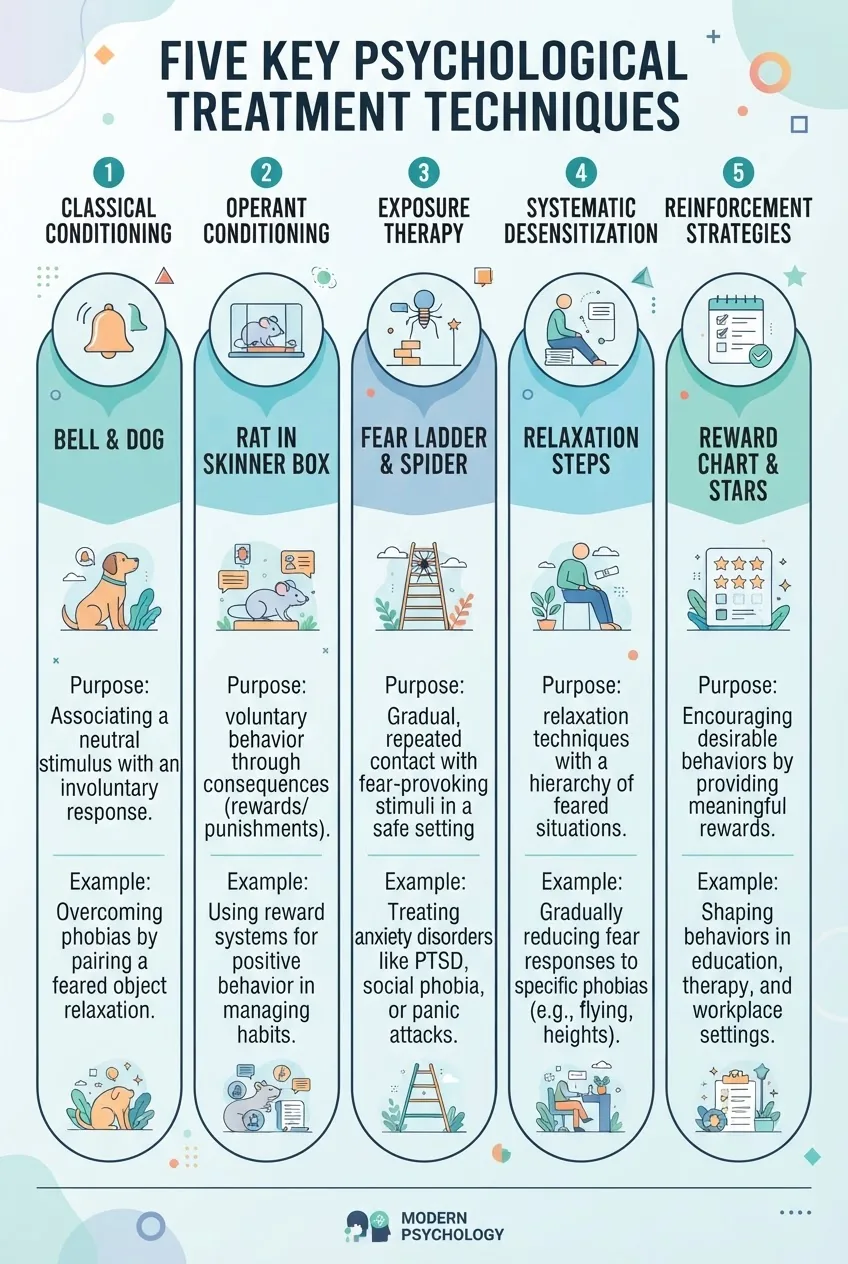
This section maps the essential, practitioner-ready techniques. For deeper training and CBT integration, see our behavioral therapy techniques guide.
- Exposure therapy: Use graded, repeated contact with feared stimuli to extinguish conditioned fear. Typical use case: specific phobias and social anxiety. Practical plan: 8–12 weekly sessions, start with 10–20 minute in-session exposures, assign 10–30 minutes daily homework exposures, and track Subjective Units of Distress (SUDS) before/after each exposure.
- Systematic desensitization: Combine relaxation (deep breathing or progressive muscle relaxation) with a fear hierarchy. Use for clients who need a scaffolded approach: create a 12–20 item hierarchy, practice relaxation for 5–10 minutes, then pair relaxation with gradually more challenging items in 20–40 minute sessions across 6–10 sessions.
- Operant reinforcement strategies (behavior modification): Apply positive reinforcement schedules to increase adaptive behaviors and reduce target maladaptive behaviors. Design specifics: choose a concrete reinforcer (praise, token, privilege), set fixed-ratio or variable-ratio schedules depending on speed of change desired, and measure frequency daily. Often used for skill-building, child behavior, and substance-use aftercare.
- Functional Behavioral Assessment (FBA) and behavior plans: Conduct A-B-C analyses, direct observation for 1–2 weeks, create a hypothesis about function (attention, escape, sensory). Implementation: select replacement behavior, teach it across 3–6 sessions, apply reinforcers immediately and consistently for 2–4 weeks while collecting weekly frequency charts.
- Modeling and behavioral rehearsal: Demonstrate desired behavior and let the client practice in-session with feedback. Typical use: social skills training, assertiveness, parenting programs. Structure: 10–15 minute modeling, 20–30 minute role-play with coaching, assign real-world practice between sessions.
- Contingency management: Use clear consequences for substance use or adherence behaviors (e.g., vouchers for negative urine screens). Design requirement: objective measurement (e.g., urine screens twice weekly), transparent reinforcement schedule, and documented outcomes. Effective in addiction and adherence contexts.
- Habit reversal and response prevention: For tics, trichotillomania, or compulsive behaviors teach competing response and prevent the problematic action. Practical timeline: baseline monitoring for 1–2 weeks, skill training across 3–6 sessions, daily practice with logging.
- Behavioral activation: Structured scheduling of positively reinforcing activities to address depression. Use activity logs, plan 3–5 pleasurable/meaningful activities per week, rate pleasure/mastery 0–10, and review progress weekly across 6–12 sessions.
- Exposure with response prevention (ERP): Standard for OCD—expose to obsessional triggers and prevent compulsive response. Typical program: 12–20 sessions, daily homework exposures, clear hierarchy, and frequent monitoring of ritual frequency and distress.
- Skills training within CBT frameworks: Although CBT includes cognitive elements, many behavioral techniques (role-play, exposure, activation) are used in CBT. For exercises and worksheets to support home practice, see CBT therapy exercises and worksheets.
Transition: after selecting techniques you must match them to specific conditions—next section covers common clinical applications and case examples.
-
Conditions and Issues Treated with Behavioral Therapy
Behavioral therapy applies across a wide range of conditions where behaviors, learning histories, or avoidance maintain distress. Common indications include anxiety disorders, phobias, obsessive–compulsive disorder (OCD), trauma-related avoidance (PTSD), addiction (as part of contingency management), and disruptive behavior problems in children.
According to a 2024 NIMH report, exposure-based and behavioral treatments remain first-line, evidence-supported options for specific phobias, panic disorder, and OCD when delivered by trained clinicians; consult National Institute of Mental Health (NIMH) resources for prevalence and treatment guidance. (Source type: governmental health report, 2024.)
Case example (composite)
“Alex,” a 28-year-old experiencing social anxiety, reported avoidance of group meetings and frequent heart-racing when speaking. Intake used the GAD-7 (score 13), an A-B-C behavior log for one week, and a 60-minute intake. Treatment plan: 10 weekly sessions combining graded in vivo exposure (start with 5-minute phone calls, progress to 10-minute group interactions), behavioral rehearsal, and daily 15–20 minute homework practice. After 8 weeks Alex reported reduced avoidance and a GAD-7 of 6.
For discussion of complementary benefits beyond behavior change, such as therapeutic alliance and broader well-being, see our guide on benefits of individual therapy.
Transition: now compare behavioral therapy with other modalities so you can position it in a treatment plan.
-
How Behavioral Therapy Differs from Other Therapies
Clinicians must explain differences to clients concisely. Behavioral therapy distinguishes itself by emphasis on observable behavior and measurable change. Cognitive-behavioral therapy (CBT) integrates cognitive restructuring with behavioral techniques; behavioral therapy focuses more narrowly on learning principles and behavior change.
Feature Behavioral Therapy Other Therapies (CBT, Psychodynamic, Person-Centered) Primary target Observable behaviors, learning contingencies Thoughts/emotions (CBT), unconscious processes (psychodynamic), client-led exploration (person-centered) Typical methods Exposure, reinforcement, habit reversal Cognitive restructuring, insight work, empathy-based support Session focus Behavioral experiments, skills practice Narrative exploration, emotional processing Evidence base Strong for phobias, OCD, certain addictions CBT strong for depression/anxiety; psychodynamic evidence mixed For a broader comparison of therapy types and benefits across modalities, see resources summarizing the benefits of therapy and the best therapeutic approaches. To compare with an overview of different modalities, consult different kinds of therapy.
Transition: after choosing an approach, clients often ask what happens in sessions—read on for a stepwise session flow.
-
What to Expect During Behavioral Therapy Sessions
This step-by-step section gives exact timings, activities, and how to document progress. It assumes weekly 50–60 minute sessions unless an intensive program is specified.
- Pre-session intake and baseline measures (60 minutes): Complete consent, collect GAD-7 and PHQ-9, conduct a 15–20 minute clinical interview, and begin an A-B-C behavior log. Document baseline frequency and severity (e.g., avoidance episodes per week).
- Session 1: Assessment and formulation (50–60 minutes): Build a collaborative A-B-C analysis, establish 1–3 measurable goals, and agree on homework (daily 5–15 minute behavior logs). Set treatment length expectation (6–12 sessions for focused problems; up to 16–20 for complex or comorbid cases).
- Session 2: Psychoeducation and hierarchy building (50 minutes): Teach classical vs. operant basics in plain language, co-create a fear/anxiety hierarchy with 8–12 graded items (ranked SUDS 0–100), and introduce self-monitoring tools to use for daily homework.
- Sessions 3–10: Intervention phase (45–60 minutes each): Implement exposure or behavioral activation, conduct in-session exposures for 15–30 minutes, conduct behavioral rehearsal or skills training for 15–25 minutes, and assign 10–30 minutes of daily homework. Monitor SUDS and record frequencies weekly. Reassess using GAD-7/PHQ-9 every 4 sessions.
- Mid-treatment review (after session 6): Measure progress against baseline: aim for a 30–50% reduction in target behavior frequency or a clinically meaningful score drop on standardized scales (e.g., GAD-7 reduction of 5 points). If progress <20% by session 6, adjust plan or consult supervisor.
- Final sessions and relapse prevention (final 2–3 sessions): Consolidate gains, create a written relapse-prevention plan with triggers and response options, and schedule a 1-month follow-up check-in. Provide booster session options at 1–3 months.
Practical documentation: keep weekly behavior logs, SUDS charts per exposure, and session notes specifying interventions, duration, and homework compliance. For a primer on how counseling sessions operate in a personal therapy context, see how counseling therapy works.
Transition: before you implement, learn from common mistakes clinicians make when starting behavioral work.
Common mistakes and how to avoid them
I have seen clinicians rush into exposure without a clear hierarchy; the result was drop-out. To avoid this, always spend a full session on assessment and hierarchy construction, set realistic initial exposure targets (5–10 minutes), and secure client agreement to homework. I also observed overuse of punishment-like consequences in parenting programs—replace punitive responses with immediate reinforcement and documented behaviour contracts instead.
Checklist: Verify your behavioral therapy plan
- Intake completed with consent, GAD-7/PHQ-9, and A-B-C behavior log.
- Clear, measurable treatment goals (1–3 targets with baseline metrics).
- Selected technique(s) mapped to goals (exposure, reinforcement, activation, etc.).
- Hierarchy or behavior plan written with SUDS or frequency targets and homework assigned.
- Progress monitoring schedule and contingency for limited progress (supervision plan).
- Relapse prevention plan with follow-up and optional booster sessions.
When to call in a professional
Refer to or consult a licensed clinician when a client poses safety risks (suicidality, self-harm), demonstrates severe comorbidity (psychosis, uncontrolled bipolar disorder), or when specialized credentialing is required (e.g., BCBA for intensive ABA in autism). If progress is minimal after 6–8 sessions, request consultation or consider combined treatments (pharmacotherapy plus behavioral therapy).