By the end of this hands-on guide you’ll have a step-by-step plan to find, evaluate, schedule, and prepare for secure online child therapy for your teen in Texas—this work typically takes 2–4 hours of focused searching and basic internet skills.
Start here to locate counselors for teenagers near me who offer teletherapy options in Texas, confirm licensure, compare platforms, and set up the first session with confidence.
Before you start
- Gather the teen’s insurance card (if any) and the parent/guardian’s contact details.
- Have a short list of 3–5 concerns or goals for therapy (e.g., sleep issues, school stress, mood changes).
- Prepare a laptop or tablet with a webcam, headphones, and a stable internet connection (minimum 10 Mbps recommended).
- Set aside 60 minutes for the initial intake plus 30 minutes of research time per therapist candidate.
- Enable a private, quiet room in the home for sessions where the teen can close the door.
Transition: The sections below break the process into clear actions you can follow. Each H2 contains a short explanation plus numbered practical steps to implement immediately.
Overview of Online Child Therapy in Texas
Online child therapy in Texas refers to mental health services for children and adolescents delivered through video or secure messaging platforms. Telehealth for children can include evaluation, individual therapy, family sessions, and group work, with clinicians licensed in Texas providing care across the state when permitted by state rules.

Access has expanded: according to a 2024 Texas Health and Human Services report, telehealth visits for youth behavioral health increased by double-digits since 2020 (state health data, 2024). The American Psychological Association’s telehealth guidance frames online therapy as clinically effective for many adolescent concerns when privacy, engagement, and licensure are correctly handled (APA guidance, 2022).
Why Texas-specific? Texas licensing and regulations determine whether a counselor can offer services across city or county lines, what parental consent is required, and the documentation needed for insurers. Platforms commonly used include secure telehealth apps and general video tools—Zoom (with healthcare/HIPAA settings), doxy.me, SimplePractice, and other dedicated telehealth portals that support encrypted sessions and note-taking.
- Know the scope: Teletherapy can include assessment, skill-based therapies (CBT), family check-ins, and crisis triage. Identify whether you need long-term weekly therapy (50–60 minutes) or short-term skill coaching (30–45 minutes).
- Confirm licensure requirements: Therapists must be licensed in Texas (LPC, LPC-S, LCSW, LMFT, PsyD/PhD). Confirm license type and supervise status before booking.
- Choose secure platforms: Seek providers offering HIPAA-compliant platforms (e.g., doxy.me, SimplePractice) or business associate agreements for Zoom for Healthcare settings.
- Understand consent rules: In Texas, minors need parental consent for outpatient therapy in many cases; limited exceptions apply for certain confidential services—verify with the therapist.
Transition: Now that you have a state-specific foundation, the next section walks you through finding actual providers near you who offer online options.
How to Find Counselors for Teenagers Near Me in Texas
Use a combination of local search, directories, and direct clinic sites to find licensed online counselors. Follow this checklist to narrow candidates from broad search results to 2–3 therapists you’ll contact.
- Search with precise keywords: Run searches like “counselors for teenagers near me online Texas”, “teen psychologist near me telehealth”, or “therapists for teenager near me virtual”. Note the clinic name, clinician names, and whether they explicitly list teletherapy.
- Tip: add the teen’s city name to prioritize clinicians who advertise local availability; many Texas clinicians may list multiple counties.
- Use verified directories: Start with professional directories (Psychology Today, TherapyDen, GoodTherapy) and filter for “Telehealth” and “Texas” licensure. Verify clinicians’ licensing status separately on state pages.
- Look for practitioner photos, specialties, session formats (30/45/50–60 minutes), and whether they accept adolescents.
- Check public license verification: Confirm each clinician’s active license online using the Texas licensing board database. Search name + license type (LPC, LCSW, LMFT, PsyD) and record license number and status.
- Example resource: Texas Health and Human Services for local health policy and resources.
- Shortlist based on specialization: Create a shortlist of 4–6 clinicians who explicitly list adolescent expertise, online counseling for teens in Texas, or conditions like mood, social anxiety, or school issues.
- Prefer clinicians experienced with teenage girls if that’s relevant; search “therapist for teenage girl near me” and look for language about gender-responsive care.
- Read reviews and sample content: Review clinician bios and look for practical signals: years in practice, training (CBT, DBT, family systems), and published resources. teen counseling service reviews
- Look for evidence of teletherapy experience explicitly mentioned—this reduces risks around engagement and technology fluency.
- Verify platform & privacy: On clinicians’ intake pages, confirm the telehealth platform used (Zoom for Healthcare, doxy.me, SimplePractice) and whether they provide a HIPAA/consent statement. Ask for a sample intake packet if not posted online.
- Ask: “Do you use an encrypted telehealth portal? Is there a data processing agreement?” Document the answer when you call or email.
- Ask scheduling & fees: Contact the top 2–3 clinicians. Ask exact questions: session length (45 or 50 minutes), cost per session, sliding scale options, insurance accepted, and how cancellations are handled (typically 24–48 hours).
- therapists for teens near me guide can help with typical local pricing benchmarks.
- Set a 20-minute consultation: Book a brief intake or phone consult (often free or $25–$50). Use the consult to verify rapport, telehealth proficiency, crisis plan, and parental involvement rules.
- Checklist for consult: clinician’s Texas license and license number, telehealth platform name, emergency procedures, confidentiality limits for minors, typical therapy cadence (weekly/biweekly).
- Make a final selection and schedule the intake: Choose the therapist who demonstrates explicit adolescent experience, clear telehealth processes, and good rapport during consults. Schedule the first full intake (50–60 minutes).
- Reserve 60–75 minutes for a first session (50–60 minute therapy plus 10–15 minutes for intake paperwork and parent questions).
Transition: With clinicians shortlisted, next compare the kinds of online services available to determine which fits your teen’s needs and family logistics.
Types of Online Counseling Services Available for Teens in Texas
Online counseling for teens in Texas comes in several structured formats. Below is a practical three-column comparison so you can match service type to goals, session length, and typical cost.
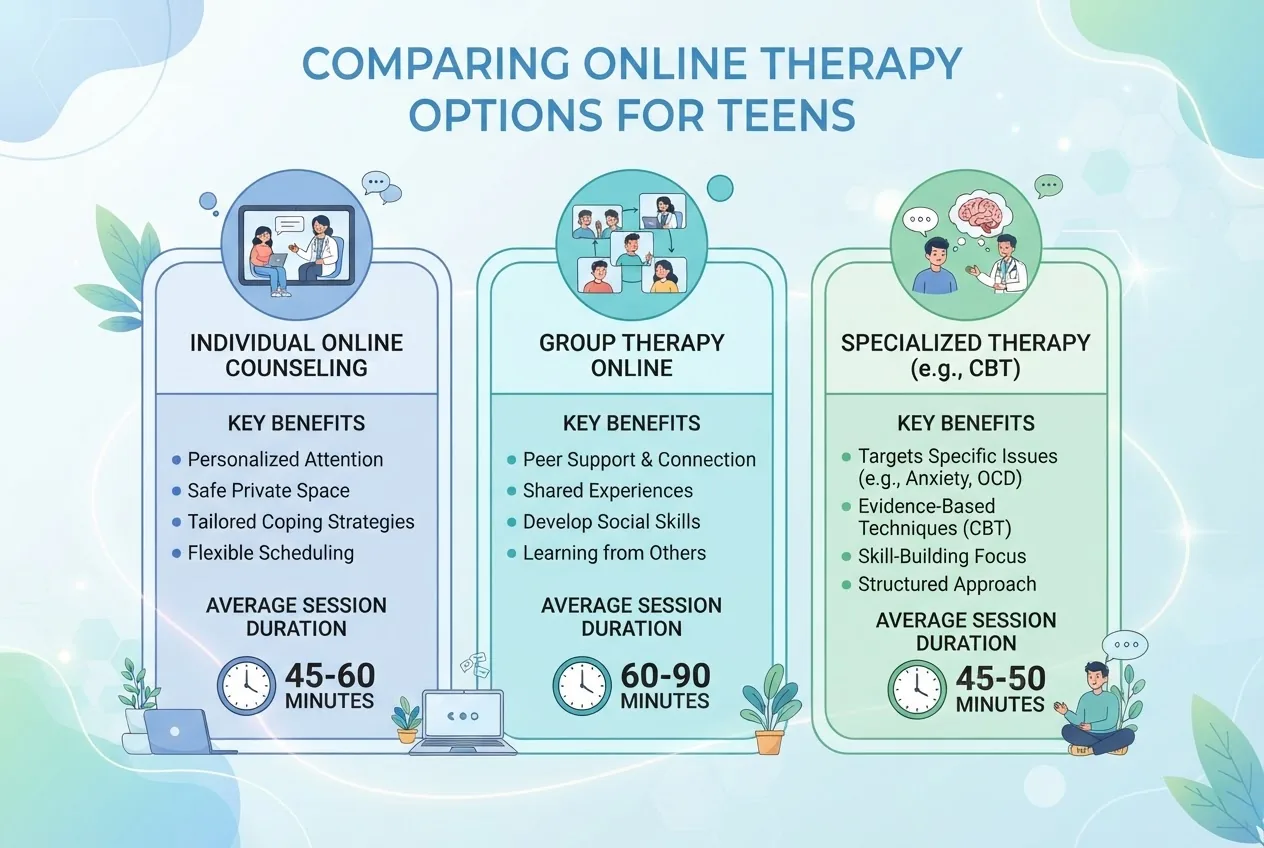
| Service | What it does | Session length & typical price |
|---|---|---|
| Individual online counseling | One-to-one sessions focusing on personalized goals: mood, coping skills, behavior, family dynamics. Modalities commonly used include CBT, ACT, and family therapy when parents join. | 50–60 minutes; $90–$200 per session depending on clinician and insurance. Medicaid often requires provider enrollment (check with insurer; state Medicaid data, 2024). |
| Group therapy online | Peer groups for social skills, anxiety groups, or skill-building groups (DBT skills for teens). Good for social anxiety practice in a controlled virtual setting. | 60–90 minutes; $30–$80 per session or program pricing for 6–12 week cohorts. |
| Specialized therapy (e.g., online CBT) | Structured evidence-based interventions like CBT for teenage depression, exposure therapy for anxiety, family-based interventions for eating concerns. Often includes homework and digital tools. | 45–60 minutes; $100–$220 per session depending on clinical specialization and clinician credentials. |
When searching, specify the service: “online counseling for teens in Texas” or “therapy for teenage depression near me” to surface clinicians with relevant experience. For in-depth treatments specifically for depression, see depression treatment options for teenagers.
Transition: After picking a service model, you’ll want to know exactly what happens in a session and how to set up the tech so you avoid interruptions and privacy issues.
What to Expect During an Online Therapy Session for Children and Teens
Online counseling sessions follow a predictable structure similar to in-person therapy but with telehealth-specific checks. Expect an intake, clinical assessment, safety planning, and therapeutic work with measurable goals.
- Pre-session intake and paperwork (15–30 minutes): You typically complete consent, telehealth consent, HIPAA disclosure, emergency contact information, and a brief intake form. Have a completed list with names, addresses, and emergency contacts.
- Tip: allow 20–30 minutes before the first session for platform login tests and forms.
- Initial assessment (first full session — 50–75 minutes): The clinician will gather developmental history, current symptoms, sleep and school patterns, strengths, and risk questions (suicidality, self-harm). Parents may join some or all of this session depending on the therapist’s model and confidentiality rules.
- Clinicians use structured tools at times (PHQ-A, GAD-7 adapted) to measure baseline symptoms.
- Therapeutic work (ongoing sessions — 45–60 minutes): Most teen sessions are weekly at first. The clinician will set specific measurable goals (e.g., practice two anxiety-management techniques each week, improve school attendance by 20% over eight weeks).
- Expect homework: skill practice, journaling, brief behavioral experiments. The clinician documents progress in notes available to parents as agreed upon in consent forms.
- Privacy and parental involvement: Therapists explain confidentiality boundaries at the start. For teens, clinicians often negotiate private time (10–20 minutes alone) to build trust and then rejoin parents for summary and planning. Clarify what will be shared and when.
- Technology checklist for each session: Use a laptop or tablet on a stable surface; plug in headphones with a built-in mic; test camera and microphone 10 minutes before; ensure the background is neutral and the room is private.
- Backup plan: clinician’s phone number or secure messaging for connection problems; ask for text or phone call fallback if video fails.
- Safety plan and emergency procedures: Clinicians should have the teen’s current location and emergency contact each session. Confirm the therapist’s emergency protocol for Texas residents (they must know where to refer in your county).
Transition: With expectations set, weigh the benefits and challenges of teletherapy to see whether it matches your teen’s learning style and life situation.
Benefits and Challenges of Online Counseling for Teens in Texas
Teletherapy increases access and flexibility but also brings engagement and technology barriers. Below I share real-world scenarios and clinician-derived pros/cons so you can match expectations to your teen’s needs.
Case scenario: A 15-year-old girl in a mid-sized Texas town started weekly online CBT sessions for social anxiety. After two months of 45-minute sessions and guided exposure tasks, she reported 40% reduction in avoidance behaviors and returned to a small school club. This composite case reflects typical timelines for measurable gains.
Benefits:
- Accessibility: removes long travel times in large Texas counties and connects teens to specialized adolescent clinicians statewide.
- Comfort: teens often open up more from their own rooms; clinicians report increased early engagement with shy adolescents (APA telehealth reviews, 2022).
- Continuity: easier to maintain weekly cadence during school breaks, illness, or family relocation.
Challenges:
- Technology friction: poor internet or lack of private space reduces efficacy—aim for 10 Mbps download/upload and a quiet room with a closed door.
- Engagement limits: some teens struggle to sustain attention digitally; clinicians may need to shorten activities to 20–30 minute focused segments.
- Privacy concerns: shared living spaces can interfere with confidential conversations; clinicians will help structure private time and parental checkpoints.
Expert note: “I often split sessions into a 10–15 minute parent check-in and a 35–40 minute teen session,” says a licensed Texas clinician with 8 years of adolescent teletherapy experience. This hybrid preserves confidentiality while keeping parents informed.
Practical recommendation: If your teen shows attention difficulties, negotiate with a clinician for 30–40 minute highly structured sessions plus weekly digital check-ins rather than standard 50–60 minute formats.
Transition: Cost and coverage are frequently deciding factors—next is a clear breakdown of pricing, insurance, and assistance options in Texas.
Cost and Insurance Coverage for Online Child Therapy in Texas
Pricing for online teen counseling varies by clinician credentials, specialization, and whether the provider accepts insurance. Below are concrete cost ranges and reimbursement pathways.
- Private-pay session rates: Typical ranges are $90–$220 per 50–60 minute session. Specialist clinicians (child psychologists, PhD/PsyD) are on the higher end.
- Insurance: Many in-network providers bill major insurers and some telehealth-only plans; ask whether the clinician will submit claims for you or if you must submit superbills.
- Medicaid & CHIP: Medicaid programs in Texas may cover teletherapy when providers are enrolled; confirm provider enrollment and covered CPT codes (state Medicaid guidance, 2024).
- Sliding scale: Many private clinicians offer sliding scale fees based on household income—typical discounts reduce rates by 20–50%.
Practical steps to manage cost:
- Check in-network directories: Call your insurer with clinician names and license numbers to verify coverage and co-payments.
- Ask about superbills: If clinician is out-of-network, request superbills for reimbursement submission (often partial reimbursement).
- Use community resources: Look for university training clinics or community mental health centers that offer low-cost teletherapy in Texas.
- Compare program pricing: For group or program-based services, compare total program cost and session counts (e.g., 8-week CBT group = $240–$640 total).
For local cost details, see kids therapist near me service costs.
Transition: Once you’ve chosen a therapist and arranged logistics, parents play a central role in supporting engagement and follow-through.
How Parents Can Support Teens Accessing Online Therapy
Parental involvement balances support with teen autonomy. Use structured routines, clear boundaries around privacy, and pragmatic follow-through to increase therapy impact.
- Set up a private space: Reserve a quiet room with a closed door, comfortable seating, and headphones. Aim for consistent scheduling—same day/time each week reduces missed sessions.
- Prepare the teen: Spend 10 minutes before each session reviewing goals and any homework. Encourage honest feedback: “Tell the therapist when it’s not working for you.”
- Manage logistics: Ensure the device is charged and software is updated. Test the connection 10 minutes before the session and have the clinician’s phone number ready.
- Balance confidentiality and safety: Agree on private time within sessions (typically 10–20 minutes). Expect the therapist to report safety concerns; know that mandatory reporting laws require clinicians to act if there’s imminent risk.
- Support homework and skills practice: Help the teen schedule 10–20 minutes three times weekly for skill practice (breathing exercises, exposure tasks), without pressing them for immediate results.
- Model follow-through: Keep appointments, respect cancellations rules (usually 24–48 hours notice), and communicate with the clinician as agreed.
Transition: Choosing the right therapist is a final critical skill—use the checklist below to confirm qualifications, fit, and practical suitability.
Choosing the Right Therapist for Your Teenager Near You
Selecting a therapist combines credential checks with soft measures like rapport and cultural fit. Work through this checklist to make a confident choice.
- Verify credentials: Confirm the therapist’s license type and active status in Texas. Psychologists (PhD/PsyD) and licensed professional counselors (LPC/LPC-S) have different training—understand the difference in role and assessment capability.
- Match specialty: Choose clinicians listing adolescent experience and relevant modalities (CBT, DBT, family therapy). therapy with teens techniques and training overview
- Check advanced training: For older teens transitioning to adult care, see clinician training for young adults. psychotherapist training for young adults
- Look for cultural fit: Read bios for language about identity, gender, ethnicity, or religious sensitivity if that matters for your teen’s comfort.
- Assess logistics: Confirm session length, fees, cancellation policy, and platform. Ask for a clear emergency plan and local referral options in Texas.
- Use a short trial: Book 3–4 sessions as a trial period. If engagement or progress is minimal after that, consider another clinician.
For deeper reading on reviews and service insight when evaluating clinicians, consult teen counseling service reviews and therapists for teens near me guide.
Transition: Knowing which therapist to pick is crucial — the final operational step is confirming legal/privacy requirements so sessions remain secure and compliant.
Legal and Privacy Considerations for Online Child Therapy in Texas
Online counseling in Texas must satisfy HIPAA, state licensing, and parental consent rules. Understanding these rules protects confidentiality while ensuring legal compliance.
- Licensing: Therapists offering services in Texas must be licensed by Texas boards (LPC, LCSW, LMFT, PsyD/PhD). Confirm license status through Texas licensing resources and check for any disciplinary history (Texas licensing board search, 2024).
- HIPAA and platform security: Use platforms that support HIPAA compliance or business associate agreements. Request the clinician’s privacy policy and information on how session recordings, if any, are stored and protected.
- Consent for minors: Parental consent is commonly required for outpatient therapy of minors; clinicians will document consent forms. There are narrow exceptions for confidential services like certain reproductive health or substance use services—discuss specifics with the clinician.
- Mandatory reporting: Texas clinicians are mandatory reporters for child abuse and imminent harm; they must act on credible disclosures. Therapists should explain reporting thresholds in intake paperwork.
- Data storage: Confirm how clinical notes, recorded sessions, and messages are stored, who can access them, and retention periods. Prefer clinicians who store notes in encrypted, cloud-based electronic health records with access controls.
For official guidance on licensure and online practice, consult the Texas State Board of Examiners of Professional Counselors and the APA telehealth resources:
Texas State Board of Examiners of Professional Counselors — licensing and scope FAQs.
American Psychological Association telepsychology guidelines — practice standards and informed consent considerations.
Texas Health and Human Services — state public health data and youth behavioral health programs.
Transition: After implementation, be mindful of common mistakes and how to avoid them. I share mistakes I’ve seen and practical fixes below.
Common mistakes and how to avoid them
I’ve seen families make recurring errors when starting teletherapy; here are three I encounter most often, and how I fix them.
- Rushing the license check: I once assumed a clinician’s online profile meant they could legally provide services statewide. I now always verify license status on the Texas board before booking. Verify license number and active status and document it in your notes.
- Ignoring the platform test: I scheduled an intake without testing the video platform; the session was delayed 20 minutes due to audio settings. Test audio/video 10 minutes beforehand and have a phone fallback if the clinician permits it.
- Overlooking privacy in shared homes: A teen’s session was overheard and trust was compromised. We implemented headphones and a “do not disturb” sign, and scheduled sessions when family members were out to preserve confidentiality.
Checklist: Verify before your teen’s first online session
- Clinician’s Texas license number and status checked and recorded.
- Telehealth platform identified and tested (10-minute tech check done).
- Parent consent completed and intake paperwork returned before the session.
- Emergency contact and teen’s physical location documented for each session.
- Clear expectations set for confidentiality, private time in session, and parent updates.
- Insurance coverage verified or sliding scale confirmed; fees documented.
When to call in a professional
If your teen shows active suicidal intent, self-harm behaviors, psychosis, or severe functional decline (not attending school, sudden major weight loss, or aggression), call local emergency services or contact your clinician immediately. For complex medication decisions, consult a child psychiatrist. Use a therapy trial of 6–8 sessions to judge progress; if no measurable improvement, consult another clinician for a second opinion.
Final transition: Use the checklist above before your first session. If you want a guided intake script or a sample parental consent checklist, the resources linked in this guide provide next-level forms and templates.
Conclusion
You now have a complete, actionable pathway: how to find and vet counselors for teenagers near me who provide online child therapy in Texas, which service types to choose, what to expect in sessions, cost and insurance options, parental responsibilities, and legal safeguards. Spend 2–4 focused hours following the checklist and book a 20-minute consult with two clinicians this week.
Ready to start? Gather the teen’s goals, verify two Texas-licensed clinicians, and schedule a consult—then book the first intake session. For deeper reading on therapy approaches and clinician training, review the therapy with teens techniques and training overview resource.