Online family therapy — by the end of this hands-on guide you will be able to identify the best virtual format for your family, compare pricing and therapy packages, book an initial consultation, and run a productive first session. Expect to spend 2–3 hours researching and planning and one 60–90 minute intake session; skill level required: beginner to intermediate.
Before you start
- Device with camera and microphone (laptop recommended) and a smartphone as backup.
- Reliable internet: minimum 25 Mbps download and 5 Mbps upload for multi-person video sessions.
- Private, quiet room with soft lighting and headphones for confidentiality.
- Insurance information, Medicare/Medicaid details if applicable, and payment method (card, HSA/FSA).
- List of goals (3 measurable goals) and a brief family timeline of concerns (1 page).
- Access to a videoconference app account (Zoom, Skype) or willingness to register on a provider portal.
- Consent forms signed electronically (if minors are involved, legal guardian paperwork).
Use the steps in “How to Get Started with Online Family Therapy Today” below to move from planning to an effective first session. Now we begin the deep guide: definitions, benefits, types of services, how to choose a therapist, what to expect in sessions, group and parenting formats, costs and privacy, limitations and starting steps.
What is Online Family Therapy?
Online family therapy (also called virtual family counseling or teletherapy family sessions) is a form of psychotherapy where a licensed family therapist or counselor meets with two or more family members via a secure video or phone connection. Sessions follow the same evidence-based frameworks used in person—systems therapy, structural family therapy, and cognitive behavioral therapy (CBT)—but are adapted for remote communication, screen-sharing for worksheets, and digital homework.
Definition and core components:
- Assessment: Intake interviews to map family roles, communication patterns, and immediate risks (30–90 minutes).
- Treatment plan: Structured goals, session cadence (weekly/biweekly), and planned homework.
- Modality: Individual family member check-ins, whole-family sessions, and parallel individual therapy when needed.
- Technology: Video platforms (Zoom, Skype, or proprietary portals) with secure messaging and document exchange.
How teletherapy adapts family work: remote therapy leverages visual cues from video, uses breakout rooms for private caregiver-child conversations, and sends digital worksheets via secure portals. According to a 2024 industry report, teletherapy family retention rates matched in-person retention when sessions included consistent agendas and measurable tasks.
Therapist insight: “I find that remote sessions increase attendance for busy families; we plan shorter, more frequent check-ins—30 minutes mid-week plus 60-minute family sessions works well,” says an LCSW with 12 years of family practice (anonymized).
Mini case vignette (anonymized): A two-parent household with a teenager used eight weeks of blended teletherapy—three whole-family video sessions plus two caregiver-only coaching calls—and reported improved weekly family check-ins and a 40% reduction in daily conflict per self-report scale.
Transition: Understanding the definition will help you clearly see the advantages; next we’ll outline the specific benefits families report when shifting to virtual options.
Benefits of Online Family Therapy and Counseling

- Convenience and scheduling flexibility — Families can meet from home, reducing commute time by 60–90 minutes per session; weekly or fortnightly scheduling becomes feasible for dual-working parents. See flexible teletherapy appointment options for providers offering evening and weekend slots. flexible teletherapy appointment options
- Accessibility — Reaches rural or mobility-limited families and multigenerational households; for multigenerational support see family therapy options for multigenerational families. family therapy options for multigenerational families
- Higher attendance and continuity — On-demand scheduling and reduced travel often lead to fewer missed sessions; explore on-demand therapy services online when you need flexible access. on-demand therapy services online
- Comfort and reduced stigma — A child or elder is more likely to engage when participating from a familiar environment, improving early engagement and homework adherence.
- Cost-efficiency and package options — Many providers offer therapy packages (e.g., 8-week family packages, caregiver coaching bundles) which lower per-session costs by 10–25%; you can compare package deals against individual session pricing in the Costs section below.
- Specialty options and faith-sensitive support — Families can find therapists who match cultural or spiritual preferences regardless of geography; for faith-oriented families consider faith-based relationship counseling online. faith-based relationship counseling online
- Provider choice and quality — Access telehealth clinicians and programs with family-specialty training and teletherapy experience; see quality telehealth mental health providers to identify accredited services. quality telehealth mental health providers
- Reduced scheduling friction for crisis follow-up — Many platforms offer brief check-ins or same-day touchpoints after a crisis; search same-day services when immediate support is required.
- Data-driven progress tracking — Digital sessions allow secure sharing of standardized outcome measures and progress dashboards, increasing transparency across family members and clinicians.
- Continuity with allied services — Families can coordinate with remote psychiatrists, pediatricians, or school counselors via shared care plans; telepsychiatry can complement family therapy when medication or specialized care is needed.
According to a 2023 AAMFT report, many family therapists report equivalent therapeutic outcomes when teletherapy uses structured interventions and measurable goals. For providers with variable hours, on-demand therapy services online may provide the fastest access for busy families. Transition: next we’ll compare the common service types so you can match format to your family’s needs.
Types of Online Family Therapy Services
Online family services generally fall into three core categories: individual family therapy (whole-family sessions), online group family therapy (teletherapy groups), and parenting counseling online. Below is a comparison to help you select the right format.
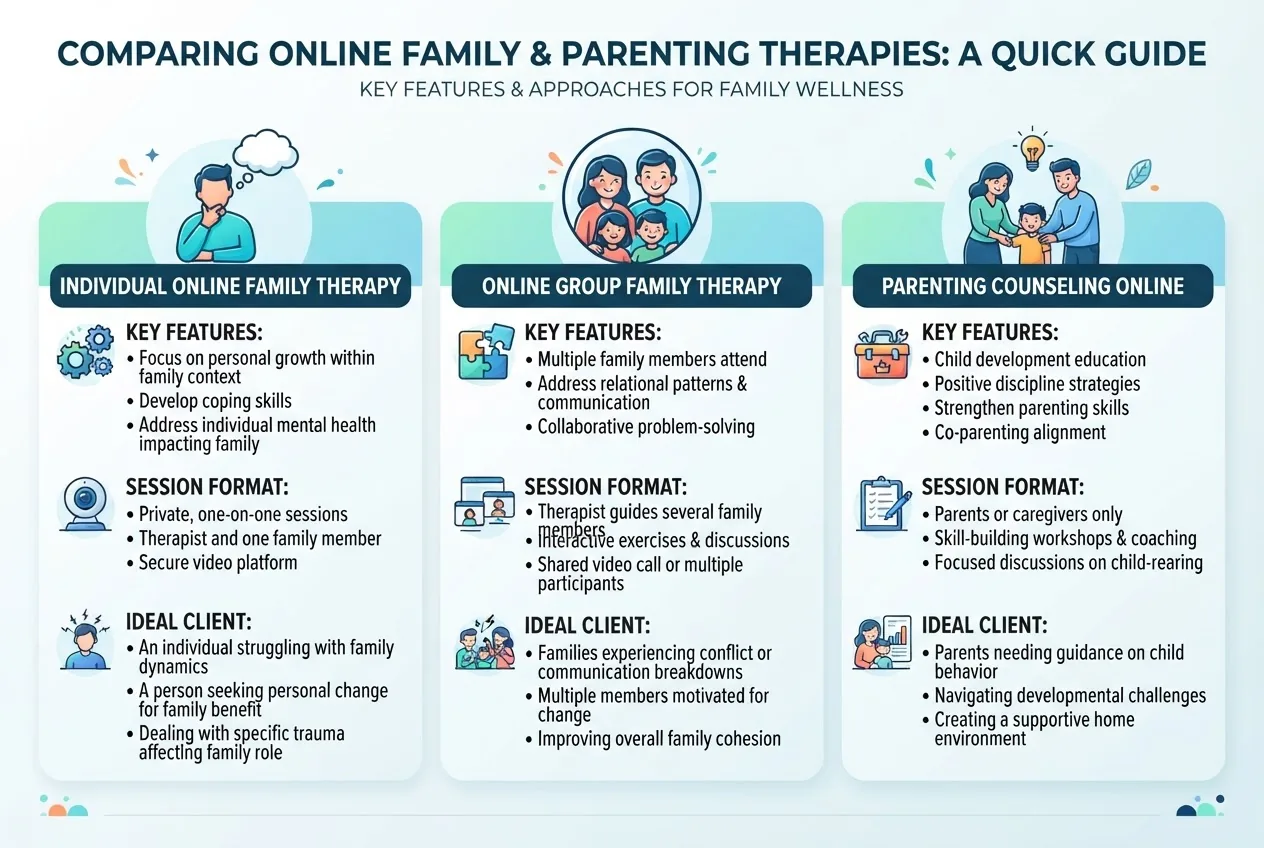
| Service | Features | Ideal use & format |
|---|---|---|
| Individual family therapy (virtual) | One therapist, whole-family or selected members, tailored systemic interventions, private breakout for sensitive topics. | Best for acute relationship conflicts, blended family transitions; 60–90 minute weekly video sessions; homework assigned digitally. |
| Online group family therapy (teletherapy groups) | Multiple families or support groups, psychoeducation, peer feedback, facilitator-led exercises, 6–12 participants max to preserve safety. | Ideal for shared concerns (parenting strategies, communication skills); 90-minute sessions weekly or biweekly; group agreements required. See online group therapy for relationship support. online group therapy for relationship support |
| Parenting counseling online | Parent coaching, behavior management plans for children, co-parenting mediation, brief skill-based sessions and video coaching of interactions. | Used when parenting techniques or child behavior are main issues; 45–60 minute sessions with recorded role-plays and homework. Also see premarital and family counseling virtual options for related pre-family-transition support. premarital and family counseling virtual options |
| Blended packages | Mix of whole-family, caregiver-only, and individual child sessions with set durations (e.g., 8-week family package). | Recommended when families need intensive short-term change; packages often include progress tracking and 1–2 “check-in” calls per month. |
Session formats vary: single-camera whole-family video, split-screen multi-camera, or a therapist using a secure portal with messaging and file upload. Pricing and packages are discussed below—read the Costs section for sample price tables and sliding-scale options.
Transition: now that you know the formats, let’s walk through choosing a therapist and validating credentials.
How to Find and Choose the Right Family Therapist Online
Choosing a therapist requires both clinical match and practical licensing checks. Follow these practical steps to shortlist and verify candidates.
- Clarify your primary goal — Write 1–3 concrete goals (e.g., “reduce daily arguments to two per week” or “establish consistent bedtime routines within 6 weeks”).
- Choose the service format — Pick from whole-family therapy, parent coaching, or teletherapy groups based on the comparison above.
- Search targeted directories and provider websites — Use therapist directories, telehealth platforms, and local licensure boards. For tools to locate providers, review resources for finding online family therapists and counselors. finding online family therapists and counselors
- Verify licensure and experience — Confirm the therapist holds a license in your state for family therapy (LMFT, LCSW, LPC). According to AAMFT standards, licensed Marriage and Family Therapists should disclose licensure and scope; review AAMFT resources for family therapy telehealth. American Association for Marriage and Family Therapy (AAMFT)
- Confirm teletherapy competence — Ask whether the clinician has structured teletherapy training and how they handle emergencies, cross-state licensing, and child protection reporting. Request their telehealth privacy protocol.
- Compare packages and pricing — Request packaged offers (e.g., 8-session family package with 2 caregiver coaching calls). Use the Costs section below to benchmark rates.
- Check clinical approach and fit — Ask about modalities (systems therapy, CBT, trauma-informed care). If CBT is a priority, check for CBT experience: see CBT techniques in online family therapy. CBT techniques in online family therapy
- Trial a short intake call — Book a 15–20 minute intake to evaluate rapport, tech fluency, and safety protocols; many clinicians offer a brief free or low-cost consult.
- Confirm administrative and billing details — Ask whether they accept insurance, Medicare, or Medicaid, and whether they offer sliding scale or package discounts. Search for licensed online family therapists in your area when location-based licensure applies. licensed online family therapists in your area
According to a 2024 industry report and AAMFT guidance, ask explicitly about cross-state practice: many therapists are only licensed in select states and will list telehealth licensure on their profiles.
Transition: after you select a provider, the next section explains exactly what happens in a typical online family therapy session, including tech and communication protocols.
What to Expect in an Online Family Therapy Session
Sessions move through intake, assessment, intervention, and homework—similar to in-person care—while using digital tools for efficiency. Typical lengths: intake 60–90 minutes; follow-up family sessions 60–90 minutes; caregiver coaching 30–60 minutes.
- Pre-session: You’ll receive a secure link or portal invite, intake forms, consent documents, and a short tech-check video to confirm camera/mic settings.
- Intake: Clinician gathers history, safety screening, and establishes confidentiality agreements and emergency contacts (10–20 minutes per person).
- Therapeutic work: Interventions may include role-play, communication exercises, genogram mapping, and CBT-based skill practice. Many clinicians use screen-sharing for worksheets. For targeted CBT work, explore CBT techniques in online family therapy. CBT techniques in online family therapy
- Closure and homework: Therapist assigns digital tasks, schedules the next session, and confirms privacy expectations.
Session checklist (prepare these before log-in):
- Private room with door closed and headphones ready.
- Device fully charged and connected to power.
- Printed or digital copy of family goals and a one-page timeline of concerns.
- Emergency contact list and local crisis numbers (therapist will ask for these).
- Headset with noise cancellation for children or noisy homes.
Platform options: therapy platforms like Skype and Zoom are commonly used; some providers use proprietary HIPAA-compliant portals. therapy platforms like Skype and Zoom and Zoom therapy sessions for families are both common. If anyone in the family experiences social anxiety during video sessions, consider strategies for participation: see managing social anxiety in online therapy for targeted tips. managing social anxiety in online therapy
Transition: group formats operate differently—next we’ll explain how teletherapy groups are structured and how they can help families.
Online Group Family Therapy and Teletherapy Groups Explained
Online group family therapy (teletherapy groups) brings multiple participants or multiple families together for facilitated sessions. Group formats emphasize shared learning, modeling, and normalization—the power of peer feedback can accelerate skill learning when carefully managed.
How groups are structured:
- Size: 6–12 participants or 3–6 families is typical to preserve safety and allow meaningful participation.
- Duration: 90 minutes is common, with a defined agenda and facilitator who enforces confidentiality and turn-taking.
- Facilitation: Co-facilitators or an assistant can monitor chat and private messages to handle side issues without derailing the group.
Illustrative examples:
- Parenting support group: weekly 90-minute sessions for 8 weeks, includes role-play and shared behavior charts.
- Communication skills group for couples with children: 10-week series focused on repair strategies and parenting alignment.
- Teen-family communication circle: smaller groups with a therapist-led check-in and breakout rooms for teen-only processing.
A facilitator’s tip: establish group rules on turn-taking, nonjudgmental language, and a safety plan that includes emergency local resources for every participant. For related group-focused supports, see online group therapy for relationship support.
Transition: now we’ll focus on parenting-specific online counseling formats and how they help modern families.
Parenting Counseling Online: Support for Modern Families
Parenting counseling online blends psychoeducation, live coaching, and behavior interventions tailored to modern family dynamics—blended households, co-parenting across homes, and multigenerational caregiving. Sessions can include live observation, where a parent records or streams a routine (e.g., bedtime) for therapist review.
Case vignette: A single parent used a 6-session parenting package—four coaching sessions and two live video observations. Within six weeks, consistent routines reduced bedtime resistance from 45 to 12 minutes on average and improved morning transitions.
Common techniques used:
- Video coaching: therapist observes a live interaction and offers micro-feedback during a private coach call.
- Behavior contracts: digital forms with measurable targets (e.g., “3 positive interactions daily for 14 days”).
- Co-parent mediation online: structured sessions to align parenting plans and communication protocols.
Video modalities are particularly helpful for parenting work; for tools and platforms, review video therapy for parenting and family issues.
Transition: having covered formats and parenting supports, next we’ll provide detailed guidance on costs, packages, and insurance.
Costs, Insurance, and Therapy Packages for Online Family Counseling
Online family therapy pricing varies widely by provider type, licensure, and region. Packages reduce per-session cost and improve commitment. Below are practical pricing examples and payment guidance.
Example price ranges (national estimates):
- Single 60–90 minute family session: $120–$300
- Caregiver coaching (30–60 min): $60–$150
- 8-week family therapy package (6–8 sessions + 2 coaching calls): $700–$2,000
- Group family program (8 sessions): $150–$500 per family
- Sliding scale: 20–50% reductions based on income, offered by many community clinicians
Sample pricing table (illustrative only):
| Service | Typical price | Notes |
|---|---|---|
| 60–90 min family session | $120–$300 | Higher where clinicians are specialized or hold advanced credentials. |
| 8-week family package | $700–$2,000 | Often includes measurement tools and two coaching calls. |
| Group family program (per family) | $150–$500 | Cost-effective for skills training and peer support. |
Insurance and payment options:
- Many private insurers cover teletherapy when delivered by a licensed provider—verify network participation and whether family sessions are reimbursable.
- Medicare acceptance for family therapy is limited; search for online family therapists that accept Medicare when older adults are involved. online family therapists that accept Medicare
- Medicaid coverage varies by state; check with local plans for telehealth family therapy benefits and search insurance-covered online therapy options. insurance-covered online therapy options
- Packages are frequently paid with credit card, HSA/FSA, or provider payment plans; ask about refunds and session rollover policies.
- For cost-sensitive families, review free online therapy options for families as supplemental resources and community programs. free online therapy options for families
Practical tip: ask providers for an itemized sample invoice and a written package agreement listing number of sessions, length, and cancellation policy. Transition: we now cover privacy and regulatory quality standards that protect your family online.
Privacy, Security, and Quality Standards in Online Family Therapy
Privacy and security are central to online family therapy. Families should confirm that the platform and clinician follow recognized standards and protective measures.
- HIPAA and telehealth compliance: Confirm a provider uses HIPAA-compliant platforms, secure portals, and encrypted video. For regulations and guidance about telehealth privacy consult official HIPAA resources. HIPAA telehealth guidance
- Encryption and storage: Ask whether sessions are recorded and how recordings are stored, encrypted, and for how long.
- Licensure verification: Therapists should provide license numbers and the state issuing the license; verify through state licensing boards and AAMFT resources. AAMFT
- Security checklist:
- Unique meeting links with passwords and waiting rooms enabled.
- Encrypted messaging for homework and documents.
- Clear informed consent specifying telehealth limits and emergency protocols.
- Qualified providers: Make sure your clinician is part of recognized mental health services and that you’re comfortable verifying credentials with licensed teletherapy providers and mental health services. licensed teletherapy providers and mental health services
Transition: there are real challenges to virtual family therapy—read the next section to learn limitations and practical workarounds.
Challenges and Limitations of Family Therapy Virtual Options
Virtual family therapy works well in many cases but has key limitations that families should consider and plan for.
- Technical difficulties: Unstable connections, audio/video lag, and device failures can interrupt the flow. Troubleshooting tips: have a backup device, use wired Ethernet when possible, and set a 5-minute tech-check before session start.
- Engagement and screen fatigue: Younger children may struggle with sustained screen attention. Use shorter interactive segments (10–15 minutes) with breaks and in-session activities.
- Complex trauma and safety concerns: High-risk trauma or active safety risks may require in-person assessment or coordination with local crisis services. For trauma-specific online care, review handling trauma in online family therapy and consider trauma-specialist referrals. handling trauma in online family therapy
- Legal and cross-state licensure barriers: Therapists may not be licensed in the state where all family members live; expect delays in scheduling or referrals.
- Emergency response limits: Therapists cannot provide emergency medical interventions remotely; families must give local emergency contacts and plans. Recent analyses suggest pairing family therapy with online treatment for anxiety and depression alongside family therapy when individual symptoms require medication or specialized care. online treatment for anxiety and depression alongside family therapy
Troubleshooting quick guide:
- If video lags: switch to audio-only or continue with shared PDF worksheets via the portal.
- If a participant disconnects: therapist pauses and uses a 5-minute reconnection buffer; if reconnection fails, continue the session with available members and schedule a short follow-up.
- If safety concerns arise: therapist enacts the pre-agreed safety plan and contacts local emergency services if necessary.
Transition: with challenges in view, here are step-by-step instructions to start your first online family therapy engagement today.
How to Get Started with Online Family Therapy Today
This section is the practical core: follow the numbered steps below to go from decision to your first effective session. Plan 2–3 hours of preparation and a 60–90 minute initial meeting.
- Define measurable family goals (Action: write goals) — Spend 15–30 minutes drafting 1–3 measurable objectives (e.g., “Reduce nightly conflicts to two or fewer per week within 6 weeks”). Put each goal in a shared document and assign one family member as the session-timekeeper.
- Decide the service format (Action: select format) — Choose whole-family sessions for systemic issues, parenting counseling online for child behavior, or teletherapy groups for peer learning. Refer to the Types table to match needs and timelines (e.g., 8-week packages for skill acquisition).
- Shortlist 3 providers (Action: search & list) — Use directories and the Therapist Websites Guide to compile three clinicians or clinics with family experience. finding online family therapists and counselors List each clinician’s licensure (LMFT/LCSW), telehealth experience, fees, and whether they accept insurance.
- Verify credentials and telehealth policies (Action: confirm) — Spend 20–30 minutes verifying license numbers, cross-state practice permissions, and malpractice coverage. Consult AAMFT resources if the therapist is an MFT. AAMFT
- Request packages and compare total cost (Action: request quotes) — Ask for an itemized package (sessions, coaching calls, progress measures). Ask about sliding scale, number of included sessions, and rollover policies. Compare per-session cost and the expected total investment for a standard 8-week plan.
- Book a 15–20 minute intake call (Action: schedule) — Use the intake call to test rapport and tech. Bring your measurable goals, schedule constraints, and emergency contact details. If immediate support is needed, inquire about same-day online family therapy sessions. same-day online family therapy sessions
- Complete paperwork and tech checks (Action: sign & test) — Fill intake forms, consent, and privacy agreements. Perform a 5–10 minute camera/mic check with your therapist before the scheduled intake to avoid delays. Familiarize everyone with features like mute, chat, and screen-share.
- Prepare the physical environment (Action: set up) — Block the session time, arrange seating so faces are visible together, eliminate background distractions (TV off), and ensure at least 30 minutes of uninterrupted time after the session for family debrief.
- Run the first session (Action: engage) — Start with a brief goals review (5 minutes), complete the assessment, set 2–3 short-term tasks, and confirm the next appointment. Expect the therapist to collect safety information and to co-create a written plan.
- Implement homework and measure progress (Action: track) — Use shared digital tools to record daily wins and conflicts. Reassess progress at week 4 with a simple scale (0–10) for each goal and adjust the plan if progress is <30% toward target after four sessions.
Practitioner note: pair family sessions with individual teletherapy when a family member has high symptom severity (depression, PTSD); integrated care yields better outcomes according to recent meta-analyses. Recent peer-reviewed study
Common mistakes and how to avoid them
I’ve observed these recurring mistakes in practice: first, families sometimes skip the goals step—without measurable goals sessions drift. I now always start with a 15-minute goals workshop. Second, providers delay tech checks and we lose 10–20 minutes—so I require a 5–10 minute pre-session test. Third, parents expect immediate behavior overhaul; I set realistic short-term benchmarks (10–20% improvement per two sessions).
Checklist before your first session
- Goals document shared with therapist (1–3 goals)
- Intake forms and consent signed
- Device tested and internet speed >=25 Mbps
- Private room reserved for 60–90 minutes
- Emergency contact and local crisis numbers provided
- Payment method and package agreement confirmed
When to call in a professional
If your family experiences active safety risks (suicidal intent, self-harm, or immediate danger), contact local emergency services immediately. Call a specialized trauma therapist if suspected PTSD or repeated abuse is present. If progress stalls after 6–8 sessions (less than 25% improvement), seek a clinical review with a supervisor or a trauma specialist.
Summary and next step: With goals written and a shortlist of providers, use the intake call to test rapport and tech—book within 48–72 hours to maintain momentum. For all families, document one measurable goal and one scheduled session within the week.
Conclusion
Online family therapy and counseling offers flexible, accessible pathways to improved family communication, parenting skills, and conflict resolution. You should now be able to compare formats, verify provider credentials, evaluate packages, prepare your space and technology, and run a focused intake session. If you’d like help selecting a package or booking a consultation, contact a licensed provider through your preferred directory and begin with a 15–20 minute intake call this week.