Online CBT is cognitive behavioral therapy delivered via secure digital channels—video, phone, or structured apps—using evidence-based techniques such as cognitive restructuring and behavioral activation to treat anxiety, depression, PTSD and related conditions with licensed clinicians, structured homework, and measurable outcomes while maintaining privacy protections.
What is Online CBT? An Overview
Answer: Online CBT is the remote delivery of Cognitive Behavioral Therapy (CBT) using video calls, phone, secure messaging or guided apps to apply CBT techniques—like cognitive restructuring and behavioral activation—through structured sessions, homework, and progress tracking so clients can access evidence-based care outside a clinic.
Cognitive Behavioral Therapy (CBT): a structured, evidence-based psychotherapy that identifies and changes unhelpful thoughts and behaviors to reduce emotional distress and improve functioning.

Online CBT (also written as “cognitive behavioral therapy online” or “cognitive behavioral therapy cbt online”) maps the same core CBT elements to digital formats. Typical delivery modes include:
- Live video sessions that mirror in-person therapy in structure and duration.
- Phone sessions for audio-only therapy when video is impractical.
- Guided self-help apps or web programs with automated lessons and therapist check-ins.
- Secure messaging for brief check-ins or homework review between sessions.
Online CBT keeps the core CBT workflow: assessment, collaboratively set goals, teach skills (e.g., cognitive restructuring), practice behavioral experiments, assign homework, and measure progress with standardized measures (PHQ-9, GAD-7, etc.). Accessibility features—closed captions, adjustable text, and asynchronous modules—expand reach to users with different needs.
How Does Cognitive Behavioral Therapy Online Treatment Work?
Answer: Online CBT works by delivering structured CBT protocols through scheduled remote sessions plus digital homework, using techniques like cognitive restructuring, behavioral activation and exposure exercises adapted for video or app formats, with regular outcome measurement and therapist feedback to guide progress.
Cognitive restructuring: a CBT technique that identifies and challenges distorted thoughts and replaces them with balanced alternatives.
Below is a step-by-step breakdown of a typical online CBT treatment pathway and the technology and clinical tasks involved.
-
Intake and assessment (Session 0–1):
Clients complete online intake forms and standardized measures (PHQ-9 for depression, GAD-7 for anxiety). The therapist conducts a diagnostic interview via video or phone and sets specific treatment goals and expected session frequency.
-
Treatment planning and orientation (Session 1):
Therapist explains CBT model, outlines homework expectations, teaches the therapy platform, and reviews privacy, emergency procedures, and technology troubleshooting.
-
Core CBT skill sessions (Sessions 2–8+):
Therapist introduces skills such as:
- Behavioral activation: scheduling rewarding activities to counteract withdrawal in depression.
- Cognitive restructuring: identifying automatic thoughts, evaluating evidence, and developing balanced statements.
- Exposure therapy: gradual, repeated contact with feared stimuli to reduce avoidance (see definition below).
- Problem-solving and relapse prevention: planning for setbacks and strengthening coping strategies.
Exposure therapy: a behavioral CBT technique that systematically and safely confronts feared situations or memories until anxiety decreases.
-
Homework and digital tools (between sessions):
Patients complete online worksheets, log exposures, and record thought records in apps or secure portals; therapists review these between sessions and adjust the plan accordingly.
-
Monitoring and measurement:
Progress is tracked using standardized scales and session-by-session outcome tracking to determine when to intensify, adapt, or discharge treatment.
-
Termination and maintenance:
Therapist and client co-create a relapse prevention plan and may schedule booster sessions or transition to self-guided programs.
Technology walkthrough — common steps a patient experiences:
- Scheduling: secure portal or platform calendar sends automated confirmations and links.
- Pre-session check: client receives a brief technology check checklist (camera, mic, bandwidth) and completes outcome measures online.
- Session connection: clicking a secure link opens an encrypted video session (platforms use end-to-end or TLS encryption).
- Between-session access: therapist assigns worksheets and sends messages through HIPAA-compliant messaging features or app notifications.
Hypothetical client journey (case example):
Sara, age 29, with social anxiety, completes an online intake and begins 12 weekly video CBT sessions. Week 1 establishes goals and teaches cognitive restructuring. Weeks 2–6 mix behavioral experiments (planned public interactions) with thought records entered into the therapist’s portal. By week 8 her GAD-7 drops from 15 to 7; exposures continue with reduced frequency, and a relapse-prevention plan is finalized at week 12.
Clinical adaptations for remote delivery include explicit coaching in home-based exposures, using screen-shared worksheets, and leveraging built-in app reminders to boost homework adherence. Licensed therapists follow regional telehealth laws and scope-of-practice rules when deciding if remote care is appropriate.
Conditions Effectively Treated with Online CBT
Answer: Online CBT effectively treats a broad range of conditions—most robustly anxiety disorders, depression, PTSD, insomnia, OCD and phobias—using well-established CBT protocols adapted for remote delivery and supported by multiple clinical trials and meta-analyses.
Common conditions suited for online CBT include:
-
Anxiety disorders:
Generalized anxiety disorder (GAD), panic disorder, and social anxiety respond well to online CBT protocols involving cognitive restructuring, interoceptive exposure, and social exposures. See the online anxiety medication and treatment options for medication-combination contexts.
-
Depression:
Behavioral activation delivered online consistently reduces depressive symptoms; CBT protocols adapted for web modules also show strong effects when paired with therapist support.
-
Post-traumatic stress disorder (PTSD):
Trauma-focused CBT and prolonged exposure can be delivered online with careful risk assessment and safety planning; some clinicians require occasional in-person contacts for severe cases.
-
Obsessive-compulsive disorder (OCD) and phobias:
ERP (exposure and response prevention) and exposure-based CBT translate well to remote coaching and app-guided exposure hierarchies.
-
Insomnia and behavioral sleep problems:
Online CBT for insomnia (CBT-I) is an evidence-based, scalable treatment often delivered as guided digital programs with clinician oversight.
-
Stress and mild-to-moderate adjustment disorders:
Skills-based CBT online—problem-solving, relaxation training, and activity scheduling—reduce symptom burden effectively.
-
Social anxiety (special focus):
See the online social anxiety therapy guide for focused protocols and practice techniques.
Limits: severe suicidality, active psychosis, unstable medical conditions, or immediate safety risks may require in-person care or coordination with local emergency services. Clinicians screen for these during intake and maintain emergency contact procedures.
Benefits and Limitations of Online CBT Compared to In-Person Therapy
Answer: Online CBT offers greater convenience, accessibility and scalability with comparable effectiveness for many conditions, but it can be limited by technology issues, reduced nonverbal cues, and suitability concerns for high-risk cases.
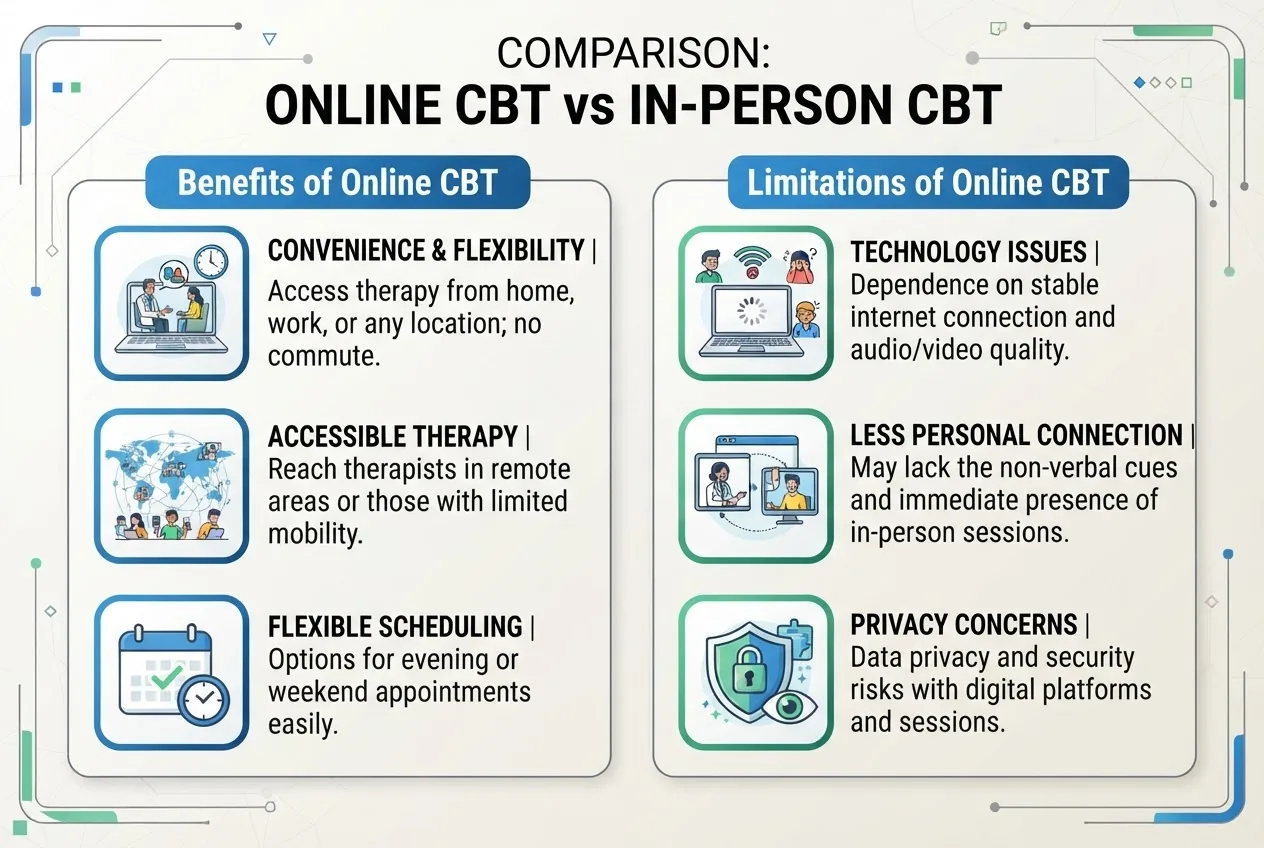
| Benefits of Online CBT | Limitations of Online CBT |
|---|---|
| Convenience—attend from home, reducing travel time and missed work | Requires reliable internet and a private space; connectivity problems may disrupt sessions |
| Increased accessibility for rural or mobility-limited clients | Reduced access to subtle nonverbal cues and in-person rapport building |
| Flexible scheduling, including evening slots and asynchronous modules | Some protocols (high-risk suicide management, severe psychosis) often require in-person or blended care |
| Potentially lower cost per session or more efficient stepped-care models | Privacy concerns if clients lack secure devices or share living spaces |
Professional and family-focused services overlap with CBT choices. For broader virtual therapy that includes family approaches alongside CBT methods see online family therapy and counseling services with virtual options.
Clinical note: For clients with immediate safety concerns, clinicians should provide or coordinate local emergency resources and consider in-person evaluation rather than solely remote care.
Finding and Choosing an Online CBT Therapist
Answer: Choose a licensed clinician experienced in CBT and telehealth by verifying credentials, reviewing treatment approach and outcome tracking, checking platform security, confirming insurance coverage, and using trial sessions to assess fit and communication style.
Checklist for selecting an online CBT therapist:
- Verify state/licensure and credentials (licensed psychologist, LCSW, LPC, LMFT as applicable).
- Confirm specific CBT training or certification (e.g., ABCT membership or CBT certifications).
- Ask about telehealth experience and protocols for crisis management and emergency contacts.
- Request sample treatment plans and typical session structure.
- Confirm platform security (HIPAA-compliant portal or encrypted video) and privacy policies.
- Assess therapist fit via a brief intake or consultation session.
- Check measurable outcomes used (PHQ-9, GAD-7) and frequency of progress reviews.
For faith-based or values-aligned CBT approaches, consider resources such as the Christian relationship counseling online guide when you want clinical CBT integrated with spiritual perspectives.
You can also use the therapist websites guide for finding online mental health support to compare provider bios, specialties, and client reviews.
Common Online CBT Platforms and Tools
Answer: Common tools for online CBT include secure teletherapy platforms for video sessions, mobile and web CBT apps for guided modules and homework, secure messaging portals for between-session contact, and digital assessment tools for outcome tracking.
- Teletherapy platforms (video + portal): Platforms that provide encrypted video, scheduling, and integrated notes; typically used for live CBT sessions. Pros: full session features and secure documentation. Cons: subscription costs and learning curves.
- Standalone CBT apps: Modular programs for skills training (e.g., thought records, behavioral activation). Pros: scalable and convenient for homework. Cons: variable clinician integration and quality.
- Secure messaging portals: Asynchronous check-ins and worksheet submission. Pros: quick contact and adherence monitoring. Cons: limits real-time therapeutic nuance.
- Digital worksheets and assessment tools: PHQ-9, GAD-7, session rating scales integrated into client portals. Pros: objective tracking. Cons: relies on client completion.
- On-demand options: For flexible scheduling consider on demand therapy services online.
When evaluating tools, prioritize HIPAA-compliant vendors, transparent data policies, integration with clinical workflows, and the ability to export or archive clinical notes securely for continuity of care.
Cost, Insurance, and Accessibility Considerations for Online CBT
Answer: Online CBT costs vary widely—from free guided modules to private-pay clinician sessions—while insurance coverage depends on the insurer, license type, and whether the therapist is in-network; sliding scales and public programs can improve affordability.
Key financial and access points:
- Session fees: private clinician video sessions commonly range by region and clinician experience; many practices publish fees per session.
- Insurance: some insurers reimburse teletherapy when therapists are in-network; Medicare and Medicaid rules vary by state and provider type—verify coverage before starting care. For broader telehealth psychiatric options see online psychiatrist and teletherapy mental health services.
- Low-cost alternatives: see curated lists of free or low-cost programs and crisis lines; for more on that see free therapy online options for mental health support.
- Sliding scale: many independent clinicians offer reduced rates based on income.
- Employer EAPs and university counseling centers: often include telehealth or referral pathways.
- Accessibility accommodations: request captioning, screen-reader compatible materials, or asynchronous options when needed.
Practical steps before enrolling: confirm whether your insurer covers telehealth, ask the provider for a superbill if out-of-network reimbursement is possible, and request written cost estimates for expected number of sessions.
Privacy and Security in Online CBT: What to Know
Answer: Patient privacy in online CBT is secured by using HIPAA-compliant platforms with encryption, informed consent for telehealth, secure data storage, clinician confidentiality obligations, and awareness of state telehealth regulations and mandatory reporting laws.
HIPAA: the U.S. Health Insurance Portability and Accountability Act setting standards for protecting sensitive patient health information transmitted electronically.
Privacy and security best practices:
- Confirm the platform is HIPAA-compliant and uses end-to-end encryption or TLS for video sessions.
- Read the provider’s privacy policy and ask whether data is stored on third-party servers and how long it is retained.
- Use strong passwords and update devices, or use a dedicated device for sessions where possible.
- Ensure a private physical space during sessions to maintain confidentiality.
- Understand reporting exceptions: providers must report imminent harm to self/others and child or elder abuse per law.
Regulatory note: telehealth laws differ by jurisdiction—clinicians typically must be licensed where the client is located during care. For regulatory guidance and professional standards see the American Psychological Association telehealth resources at https://www.apa.org/practice/guidelines/telepsychology.
Supplementary Resources for Online CBT Patients
Answer: Supplementary resources for online CBT include therapist-provided worksheets, validated mobile apps, guided online CBT programs, peer or clinician-led online group sessions, and curated reading and audio resources to support homework and skills practice.
- CBT worksheets: thought records, activity scheduling, exposure hierarchies typically provided as fillable PDFs in portals.
- Guided CBT apps: evidence-based apps for anxiety, depression, and insomnia that pair with therapist support.
- Online group options: structured group CBT programs and support groups; for relationship-focused group options see online group therapy for relationship issues.
- Books and workbooks: CBT workbooks that align with therapist homework.
- Community resources: crisis lines and local mental health services for emergencies.
Many therapists incorporate digital homework into treatment plans to increase skill generalization between sessions; ask your clinician which specific resources they recommend and how they integrate them into outcomes tracking.
Research and Effectiveness of Online Cognitive Behavioral Therapy
Answer: Research shows online CBT is effective for many common mental health conditions, with meta-analyses and randomized controlled trials reporting effect sizes comparable to face-to-face CBT for anxiety and depression when therapist support is included.
Key findings at a glance:
- According to a 2023 meta-analysis published in peer-reviewed journals, guided internet-delivered CBT showed moderate-to-large effects for depression and anxiety when clinician support was provided (source type: peer-reviewed meta-analysis).
- According to a 2022 NIH-funded report, telehealth-delivered CBT produced comparable symptom reductions to in-person CBT for many adults with mood and anxiety disorders (source type: government research report).
- Effect modifiers include level of therapist support, treatment adherence, baseline severity, and the match between protocol and condition (source type: peer-reviewed clinical studies indexed on PubMed).
Representative resources for clinicians and patients:
- National Institute of Mental Health summaries and statistics: https://www.nimh.nih.gov (source type: government mental health agency).
- Peer-reviewed literature and meta-analyses available via PubMed: https://pubmed.ncbi.nlm.nih.gov (source type: clinical research database).
- Professional guidance on CBT standards and telepsychology from the APA: https://www.apa.org/practice/guidelines/telepsychology (source type: professional association guidance).
Outcome summary table (research highlights):
| Condition | Online CBT Evidence |
|---|---|
| Anxiety disorders | Consistent moderate-to-large effects in RCTs and meta-analyses (peer-reviewed studies, 2015–2023). |
| Depression | Effective, particularly when therapist-guided; unguided programs show smaller but positive effects (peer-reviewed meta-analyses, 2018–2023). |
| PTSD | Promising results with trauma-focused CBT online when safety planning is robust (clinical trials, 2016–2022). |
Interpretation: Online CBT is an evidence-based option for many patients, especially when programs include therapist support, rigorous assessment, and clear safety protocols. Individual results vary—clinicians and clients should review research summaries relevant to specific conditions and protocols.
Final considerations and clinical disclaimer: Online CBT is not a universal substitute for in-person care for every case—clients with complex, unstable, or high-risk presentations may require in-person assessment and coordinated services. Always consult a licensed clinician to determine the best modality for your needs.
Conclusion
Online CBT is an accessible, evidence-based approach that replicates core CBT methods through secure digital platforms, offering effective treatment for anxiety, depression, PTSD and related conditions with benefits of convenience and scalability. Evaluate therapist credentials, platform security, and treatment fit, and ask about outcome tracking to ensure quality care. To begin, schedule a consultation with a licensed online CBT provider or explore recommended digital programs.
Call to action: If you’re ready to explore online CBT, contact a licensed provider for an initial assessment or review the resources above to compare platforms and protocols.