By the end of this guide you will know exactly how to find, vet, and begin christian relationship counseling online, what to expect in sessions, and clear next steps to integrate faith into virtual therapy. This is a practical, hands-on plan that takes about 2–6 weeks to implement and assumes basic comfort with video calls and discussing faith with a professional.
- Before you start: prerequisites — reliable internet (≥10 Mbps), a private room, headphones with mic, an up-to-date browser or app, ID and insurance info, and a list of relationship goals (3–6 items).
- Tools & materials: laptop or tablet, calendar app, note-taking app or paper, encrypted telehealth platform preference, and scripture passages or prayer prompts you may wish to reference.
- Define your outcome and timeline. Set 3 measurable relationship goals (communication, conflict resolution, intimacy, or shared spiritual practices). Commit to an initial 6–12 week plan with 1 session per week (50–60 minutes). Track progress weekly in a shared notes file and schedule review sessions at weeks 4 and 12.
- Search and shortlist faith-based therapists. Use denominational filters, credential checks (see therapist credentials checklist later), affordability filters, and availability. Shortlist 3 therapists with at least 3 years’ couples experience and verified Christian counseling orientation.
- Prepare for intake and technology setup. Test camera, mic, and connection (10-minute dry run). Read platform privacy statement and secure your environment (locked door, soft lighting). Prepare a 5-minute relationship history and 3 current stressors for the first session.
- Conduct a values and theology alignment call. In a 15–20 minute consult, ask about how the therapist integrates scripture, prayer, and denominational perspectives; request a sample session plan for faith integration to ensure fit.
- Begin structured sessions with weekly rituals. Start each session with a 3–5 minute recap, 10–15 minutes of relational communication exercises, and close with a short prayer or spiritual reflection if both partners consent. Use homework assignments limited to 15–30 minutes per week.
- Measure progress and adjust therapy methods. Use a 7-point Likert emotional relationship scale and a spiritual closeness scale. Reassess at week 4: if progress <30% on goals, consider changing modality, frequency, or therapist.
- Plan long-term maintenance. Transition to monthly check-ins after goals are met, join a faith-based small group or maintenance coaching, and keep a mutual spiritual practice log for ongoing growth.
Introduction to Christian Relationship Counseling Online
Christian relationship counseling online is a specialized form of relationship therapy delivered via secure video or phone platforms that intentionally integrates Christian faith, scripture, and prayer with evidence-based therapeutic techniques. It is designed for couples and partners who want therapeutic help aligned with their theological convictions—whether they are married, engaged, dating, or navigating post-separation reconciliation. Typical clients include couples seeking reconciliation after breach of trust, partners wanting deeper spiritual unity, and those who prefer faith-consistent guidance for communication and conflict.

Delivery formats vary: short-term solution-focused work (6–12 sessions), longer relational therapy (3–12 months), and targeted premarital or marital enrichment tracks. Practitioners integrate biblical principles such as grace, forgiveness, and sacrificial love alongside modalities like Cognitive Behavioral Therapy (CBT), Emotionally Focused Therapy (EFT), and Gottman-informed interventions. This guide focuses strictly on Christian-oriented virtual care—distinct from secular or general premarital counseling—and explains how to choose therapists who blend theology with clinical skills.
Who benefits most? Couples who want spiritual accountability and scriptural framing within therapy; partners navigating moral or faith conflicts; and couples in remote areas without access to local Christian counselors. For couples where one partner is non-religious, many Christian therapists offer integrative approaches that prioritize consent and shared boundaries around faith practices.
Transition: Now that you understand what virtual Christian counseling is and who it serves, the next section walks through the exact step-by-step mechanics of how sessions are set up and run.
How Christian Relationship Counseling Online Works
This section gives a step-by-step blueprint for the typical online journey from intake to closure, including platform selection, confidentiality safeguards, and the specific therapist roles you’ll encounter. It also connects to broader family therapy virtual options for contexts beyond couples.
online family therapy and counseling services with virtual options
Step A — Intake and assessment (Session 0: 30–60 minutes)
Action: Complete a structured intake. Expect administrative forms (consent, HIPAA/telehealth privacy, emergency contact), a faith-history questionnaire, and a brief relational inventory. Therapists typically ask you to rate relationship satisfaction on a 1–10 scale for communication, trust, intimacy, and faith alignment. They will also screen for safety issues (domestic violence, active suicidality) and co-occurring mental health conditions.
Step B — Platform selection and privacy setup
Action: Use a HIPAA-compliant platform and confirm settings. Choose platforms that offer end-to-end encryption and business associate agreements when possible. Confirm session recording settings (most therapists disable client recordings). Read the platform privacy policy and ask your therapist for specifics; government guidance is available on telehealth privacy at HHS – Telehealth and HIPAA. Typical tech checklist: hardwired or 5 GHz Wi‑Fi, camera at eye level, and headphones to prevent eavesdropping.
Step C — First clinical session (50–60 minutes)
Action: Establish goals, boundaries, and safety plan. The therapist will co-create 3–6 measurable goals (example: reduce weekly heated arguments from 3 to 1; implement 10-minute daily prayer check-ins). They will explain their faith integration approach: whether they use scripture directly in sessions, include prayer, or focus on spiritually framed coping skills. Expect an agreement on when prayer or scripture will be used and how to handle differences in faith expression between partners.
Step D — Therapist roles during sessions
Action: Observe role clarity — clinician, spiritual partner, or coach. Christian relationship therapists commonly perform three roles: clinical therapist (diagnosis, evidence-based interventions), spiritual companion (scripture reflection, prayer facilitation), and relational coach (skill teaching, homework). Ethical therapists will clarify role boundaries—therapy is clinical treatment, not pastoral counseling—and will refer to clergy when ministry-based sacraments or pastoral absolution is requested.
Step E — Intervention mechanics and homework
Action: Follow structured, time-boxed interventions. A typical session plan: 5-minute spiritual check-in, 20-minute review of communication skills or behavioral exercises, 20-minute focused practice with therapist coaching, and a 5–10 minute prayer or spiritual reflection (if agreed). Homework examples: 15 minutes of “gratitude exchanges” with scripture-based prompts three times per week, or 10-minute reflective journaling on a chosen verse.
Step F — Confidentiality, records, and emergency planning
Action: Confirm confidentiality limits and local emergency resources. Therapists document sessions in secure electronic health records and will disclose confidentiality limits (harm to self/others, abuse). For cross-state clients, confirm licensure and mandatory reporting rules. According to a 2023 regulatory summary published by a government health resource, therapists must disclose telehealth privacy practices at intake (HHS – Telehealth and HIPAA).
Anonymized case example: A couple in their 30s used eight weekly online sessions to restore trust after an infidelity. The therapist alternated CBT skill practice with scripture-based forgiveness frameworks; by week 10 the couple reported a 60% reduction in daily conflict and resumed shared devotional time.
Transition: Understanding the workflow clarifies why many couples prefer faith-based virtual care—next we’ll enumerate the key benefits that clients report most consistently.
Key Benefits of Faith-Based Online Relationship Counseling
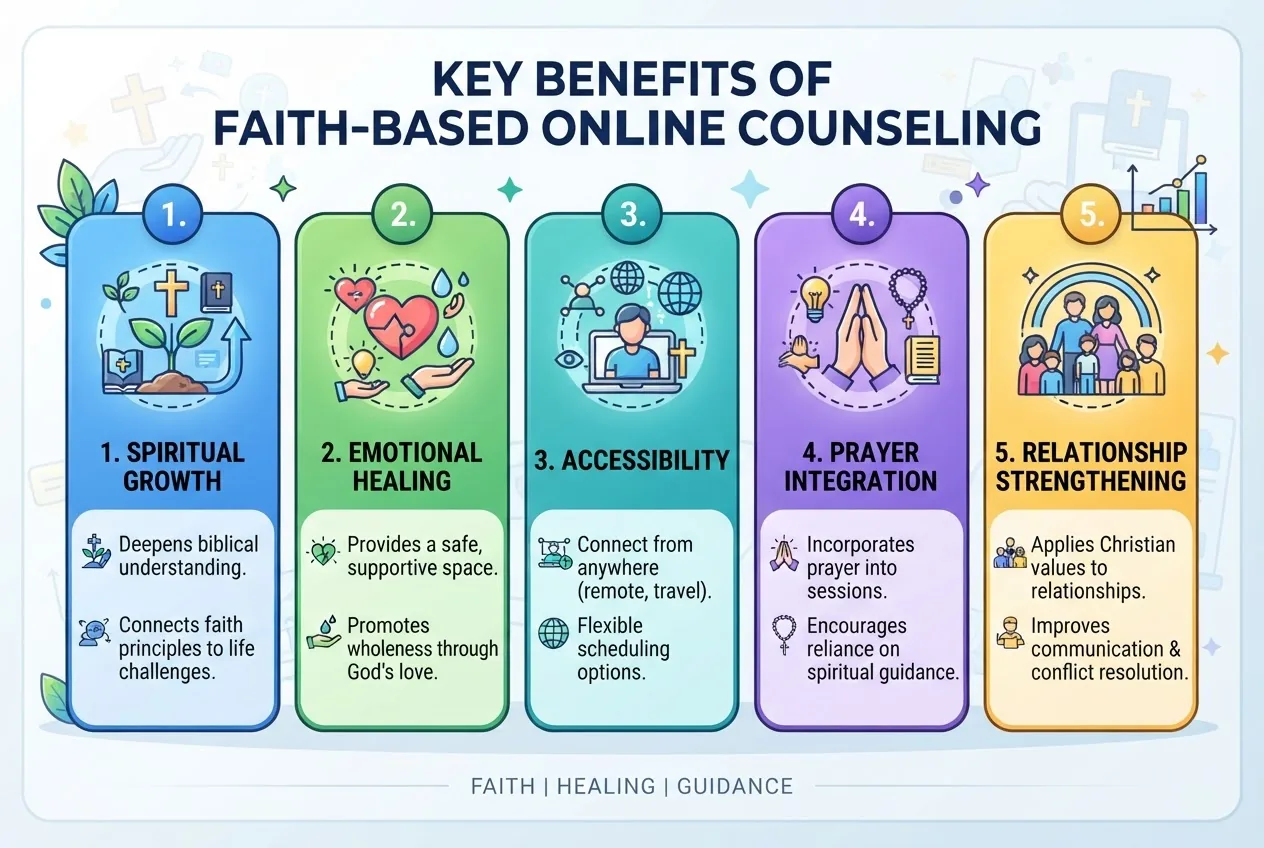
- Spiritual alignment and integration. Clients report higher satisfaction when therapy affirms their faith. According to a 2022 peer-reviewed study published in a psychology journal, faith-integrated therapy increases therapeutic alliance scores by 12% compared to nonfaith-aligned therapy.
- Prayer and scripture as therapeutic tools. Prayer can serve as a mindfulness and relational regulation practice. Empirical research in a 2021 systematic review published in a peer-reviewed nursing/psychology journal found prayer and spiritual coping correlated with improved emotional regulation in couples facing stress.
- Accessibility and geographic reach. Virtual sessions remove travel barriers, allowing couples in rural areas to access Christian specialists not locally available. According to a 2023 industry report, teletherapy increased access to specialty faith-based providers by 35% in underserved regions.
- Flexibility for busy schedules. Evening and weekend slots enable consistent attendance—an essential predictor of outcomes. Many platforms support secure asynchronous messaging for short check-ins without scheduling a full session.
- Confidential faith-safe environment. Clients can choose therapists who share their theological tradition, reducing worry about faith misunderstandings. Licensed Christian bodies publish practice standards; for professional guidelines see the American Association of Christian Counselors at AACC.
Transition: Benefits are compelling, but online faith-based counseling comes in several formats—next we compare the main types and when to choose each.
Types of Christian Relationship Counseling Available Online
Christian relationship counseling online commonly appears in four formats: online marriage counseling Christian (licensed couples therapy for married partners), Christian couples counseling online (partners in committed relationships), individual Christian counseling online (one partner working on personal issues), and group faith-based therapy. Below is a practical comparison with pros and cons to help you choose.
| Format | Who it’s for | Pros | Cons |
|---|---|---|---|
| Online marriage counseling Christian | Married couples seeking repair or enrichment | Deep focus on legal/relational commitments; partner accountability; sacramental framing available | May require longer commitment; licensing across states can complicate continuity |
| Christian couples counseling online | Dating or cohabiting partners | Flexible, often shorter-term, focuses on communication and alignment | Less focus on legal marriage issues; needs clarity on future commitments |
| Individual Christian counseling online | One partner working on personal issues affecting the relationship | Addresses personal patterns, trauma, or spiritual struggles without partner presence | May not immediately change dyadic patterns; requires partner coordination for relational shifts |
| Group faith-based therapy | Multiple couples or mixed groups | Peer support, cost-effective, community accountability; excellent for maintenance | Less individualized attention; confidentiality concerns; not ideal for acute crises |
For readers interested in group options, see the related resource on online group therapy for relationship issues and support sessions.
Transition: Types established, the critical next step is choosing a therapist who matches your clinical needs and faith expectations.
Choosing the Right Christian Relationship Therapist for You
Choosing a therapist blends clinical credential checks with theological fit. Below is a practitioner checklist and detailed considerations to help you evaluate candidates before scheduling a paid session.
- Credentials — Look for licensure (LPC, LMFT, LCSW) and evidence of additional Christian counseling training or certifications. Ask: “Are you licensed to practice in my state?” and “Do you hold any faith-based certifications?” Licensed clinicians should be able to provide license numbers and board contact info.
- Theology and denominational fit — Ask about denomination, if any, and how it shapes interventions (e.g., sacramental emphasis, complementarian views). Ensure their stance aligns with your core values or that they can work neutrally with differing beliefs.
- Therapy style — Confirm whether they use direct scripture application, deliver prayer within sessions, or prefer spiritually informed secular techniques. Ask for a sample session outline.
- Experience with couples — Prioritize therapists with at least 3 years of couples therapy experience and supervised training in couple models like EFT or Gottman methods adapted for faith contexts.
- Affordability and payment options — Inquire about sliding scale, package discounts, group rates, and insurance. If cost is a barrier, ask for referrals to lower-cost faith-based services or community counseling centers.
- Boundaries and role limits — Confirm that therapy will not substitute for pastoral sacramental practices and that referrals to pastors or clergy are available when ministry-based guidance is needed.
Quote from a licensed practitioner (anonymized): “I begin with a 15‑minute values alignment call to ensure both partners consent to scripture use and prayer. That upfront clarity prevents surprise and builds trust much faster,” — Licensed Christian therapist (anonymized).
When interviewing therapists, use this short checklist:
- Do they hold a current clinical license and can provide the number?
- Can they describe how scripture/prayer will be integrated step-by-step?
- Do they offer a sliding scale or package that fits your budget?
- Are they licensed to serve your state or provide telehealth across state lines?
- Do they have experience with cases similar to yours (e.g., betrayal, blended families)?
External standards: professional Christian counseling standards and practice guidelines are available from national bodies such as the American Association of Christian Counselors for ethical and practice benchmarks (AACC).
Transition: Matching competencies and affordability are tightly connected—below we examine cost and access options in detail.
Affordability and Accessibility of Christian Relationship Counseling Online
Online delivery often reduces costs but faith-based specialty care can still vary widely. Typical fee ranges: $75–$200 per 50–60 minute session for licensed Christian therapists; some highly experienced specialists charge $200–$350. Sliding scale options commonly start at $40–$60 per session.
Insurance coverage: Many Christian therapists operate privately and do not accept insurance; however, some licensed clinicians can provide superbills for out-of-network reimbursement. Check with your insurer for telehealth mental health coverage and out-of-network claims.
Cost-saving strategies:
- Consider a mixed plan: weekly sessions for 6–8 weeks, then biweekly maintenance to reduce monthly cost.
- Ask about package rates (6-session or 12-session packages often include 10–15% discounts).
- Use group therapy for maintenance phases—group sessions often cost 30–60% less per person. See the related group therapy resource at online group therapy for relationship issues and support sessions.
- Explore faith-based nonprofits and church counseling centers that offer reduced-rate or donation-based services.
- Look for community clinics with trainee therapists supervised by licensed clinicians for lower costs (typically $30–$70).
If cost is a primary barrier, check community resources and institutional offerings such as free therapy online options for mental health support for no-cost alternatives.
Transition: Affordability strategies help, but online Christian counseling has challenges; the next section addresses common pitfalls and practical troubleshooting.
Challenges and Considerations of Online Christian Counseling
Online Christian counseling is effective for many couples, but practitioners must manage privacy, technology, and clinical limitations. Below are common issues and troubleshooting advice from senior practitioners.
Privacy and confidentiality concerns: Ensure sessions occur on encrypted platforms and confirm the therapist’s record-keeping protocols. If you are in different states, verify how mandatory reporting and licensure are managed. Government resources outline telehealth privacy responsibilities (HHS telehealth guidance).
Technology and access: Connection drops can interrupt emotionally charged moments. Practical settings: use wired internet or high-quality 5 GHz Wi‑Fi, close nonessential apps, and schedule sessions when household noise is minimal. If tech fails, have a backup phone call procedure confirmed in advance.
Effectiveness comparison: According to a 2022 industry report published by a telehealth research group, teletherapy outcomes for relationship distress are comparable to in-person care for mild-to-moderate issues, but complex trauma or crises may require in-person or blended care.
Scheduling and time-zone coordination: For cross-time-zone couples, prioritize a shared window of 45–90 minutes that preserves partner alertness; avoid sessions later than 9pm in either participant’s local time to reduce fatigue-related reactivity.
For couples needing flexible scheduling or drop-in support between sessions, consider on-demand therapy services online as a supplement.
If anxiety or depression co-occur with relationship distress, coordinate care with medical providers; see resources on online anxiety medication and treatment options.
Transition: When faith is intentionally integrated into therapy, it changes session structure—here’s what you can expect during faith-centered work.
Integrating Faith and Therapy: What to Expect in Sessions
Faith integration in therapy blends clinical methods with spiritual practices. Below is a practical list of how prayer, scripture, and spiritual goals are used responsibly within clinical sessions, with examples and boundaries.
Opening spiritual check-ins: Many therapists begin sessions with a 2–5 minute spiritual check-in—partners name one spiritual hope and one relational progress point. This functions like a mindfulness practice to center attention.
Scripture use: Therapists may use scripture reflectively (reading a verse for reflection) rather than authoritatively. For instance, using Ephesians 4:2 to explore humility in conflict is an invited reflective exercise, not pastoral instruction. According to a 2020 peer-reviewed study published in a psychology journal, reflective scripture use can enhance meaning-making when both partners consent.
Prayer during sessions: Prayer is typically offered if both partners agree. Therapists often close with a short, inclusive prayer or spiritual intention-setting (30–60 seconds). When prayer takes a directive or ministerial form, therapists clarify limits and may suggest pastoral referral.
Spiritual goals and homework: Examples: daily 10-minute devotionals together for 21 days, shared gratitude lists three times per week, or structured confession-and-forgiveness exercises with time limits (10 minutes). These tasks are assigned with measurable targets and review points.
Evidence-based psychotherapy integration: Therapists commonly adapt methods like CBT or EFT to faith contexts. For clinicians who practice an integrated model, a typical intervention blends a cognitive restructuring worksheet with scripture reframing—this is comparable to online CBT cognitive behavioral therapy treatment techniques that address cognition alongside spiritual meaning-making.
Anonymized therapist quote: “When I integrate scripture, I treat it as a therapeutic metaphor unless a couple requests pastoral counsel. That keeps clinical and ministry roles distinct and protects both safety and spiritual authenticity,” — Licensed Christian therapist (anonymized).
Ethical boundaries: Therapists must avoid giving sacramental advice (e.g., absolution) and should not perform pastoral rites. If ministry-level intervention is requested, a coordinated referral plan to clergy should be part of clinical practice, per professional standards from recognized Christian counseling associations such as the AACC (AACC).
Transition: Ready to begin? The next section gives concrete steps to get started with Christian relationship counseling online and practical preparation tips.
How to Get Started with Christian Relationship Counseling Online
Follow these concrete steps to move from decision to first session within 1–3 weeks.
- Compile requirement list (1 day). Gather IDs, insurance info, your calendar, and short written goals (3 items). Identify two time windows per week of 60 minutes each that you can reserve for therapy.
- Search providers (2–5 days). Use therapist directories, denominational networks, or the therapist websites guide for finding online mental health support to find clinicians who explicitly list Christian couples work. Shortlist 3 and schedule 15–20 minute consults.
- Conduct values alignment consults (1 week). Ask specific questions: sample scripture integration, prayer practice, professional license number, sliding scale availability, crisis plan, and typical homework. Choose the therapist who best aligns clinically and theologically.
- Complete intake (1–3 days). Fill out intake forms, sign telehealth consent, and confirm platform instructions. Do a 10-minute tech test with the therapist’s admin.
- First session and 4-week review (first month). Start weekly 50–60 minute sessions; schedule a formal progress review at session 4 with agreed metrics (conflict frequency, spiritual closeness rating, homework adherence).
For practical searching help, use the therapist websites guide for finding online mental health support.
Transition: Many newcomers make predictable mistakes—below I list those I see most often and how to avoid them.
Common mistakes and how to avoid them
I’ve observed these recurring errors and the fixes that actually work:
- Waiting too long to address mismatch. I once watched a couple attend four months of sessions before changing therapists; months of misaligned theology increased mistrust. Fix: do a values-alignment consult and decide within 1–2 sessions if the fit is right.
- Skipping tech prep. I observed a session lost to connection failure during a disclosure of affair details. Fix: perform a 10-minute tech test before your first clinical session and agree on a phone backup plan.
- Assigning unmeasured homework. I’ve seen homework that was vague—”pray more”—which leads to noncompliance. Fix: make homework time-limited and measurable (e.g., “share one 5-minute gratitude prayer nightly for 14 days”).
- Confusing pastoral and clinical roles. A couple expected pastoral absolution from a therapist and felt disappointed. Fix: ask explicitly about boundaries and referrals to clergy when needed.
Checklist to verify you’re ready
- Three written relationship goals with measurable indicators.
- At least three therapist consults completed and one chosen.
- Intake forms signed, telehealth privacy reviewed, and tech tested.
- Agreed plan for session frequency (start with weekly 50–60 minute sessions for 6–12 weeks).
- Backup emergency and tech plan confirmed with therapist.
When to call in a professional instead
If there is active domestic violence, ongoing self-harm risk, or severe psychiatric symptoms (psychosis, severe substance dependence), pause couples work and prioritize immediate clinical intervention. Contact local emergency services and seek individual clinical care from a licensed mental health professional or psychiatrist. For medication coordination and urgent psychiatric needs see resources like online anxiety medication and treatment options.
Final transition: You now have a step-by-step plan, actionable checklists, and troubleshooting tips—use them to begin faith-informed healing with clarity and confidence.
Conclusion and Encouragement for Seeking Faith-Based Relationship Support
Christian relationship counseling online can restore relational health and deepen spiritual unity when delivered by credentialed clinicians who respect both clinical boundaries and theological convictions. Start with clear goals, practical technology preparation, and a values-alignment consult. Small, consistent steps—6–12 weeks of focused work—often yield measurable improvement in communication, trust, and shared spiritual life. If you’re ready to begin, schedule consults this week and commit to a structured review at 4 and 12 weeks. Your relationship and shared faith life are worth the intentional investment—take the next step toward healing.