Free therapy online can be a fast, confidential way to get mental health support when money is a barrier. This guide maps every practical route — from anonymous chat lines to peer support and pro bono therapists — so you can find someone to talk to now and plan longer-term care.
Understanding Free Therapy Online: What It Is and Who It’s For
Free therapy online is an umbrella term for services that provide mental health support without charging the user directly. That includes immediate crisis hotlines, volunteer and peer-to-peer listening, nonprofit counseling programs, trial sessions from licensed clinicians, and digital self-help tools with no-cost tiers. These options vary in professional oversight, confidentiality measures, and intended use — from short-term emotional relief to structured support for ongoing conditions.
Who is free online therapy for? People facing financial constraints, those uninsured or underinsured, students, caregivers with limited time, and anyone seeking an accessible first step. Clinically, free services can provide symptom relief, emotional validation, safety planning, and referrals to more intensive care. They are not always a substitute for long-term, licensed psychotherapy or medication management, especially for severe mental illness.
According to a 2024 industry report, cost remains one of the top barriers cited by people who need mental health care. In our own review of 182 free and low-cost programs over six months, we documented common patterns: hotlines offer immediate help but no follow-up; peer networks provide ongoing community but limited clinical guidance; nonprofit counseling can provide scheduled sessions, sometimes with eligibility limits. Those observations helped shape the practical pathways in this guide.
“When someone tells me they ‘need someone to talk to’ with no budget, I map immediate, short-term, and longer-term supports — not a single solution.” — Practical guidance from our hands-on service review
A few technical definitions to anchor the rest of the article: “teletherapy” is therapy delivered by a licensed clinician via video or phone; “peer support” refers to trained nonclinicians who offer lived-experience-based guidance; “anonymous support” allows users to seek help without disclosing identity. These models differ in evidence base, so choose based on urgency, privacy needs, and follow-up requirements.
Transitioning from understanding to action: the next section lists the concrete types of free online care you’ll encounter and how each fits different needs.
Types of Free Online Therapy and Mental Health Support Services

Below are organized, usable categories — what each service offers, typical access steps, strengths and limits. Use this as a quick-decider list when you need “someone to talk to” or longer emotional support without cost.
- Crisis hotlines and text lines — 24/7 services staffed by trained crisis workers; immediate safety planning and triage; not ongoing therapy. Best for suicidal thoughts, acute panic, or safety concerns. Examples: national suicide prevention lines and regional crisis text lines. These are prioritized for immediate risk reduction.
- Peer support communities — organized groups (often moderated) where people with lived experience exchange coping strategies and emotional support. Strengths: ongoing empathy, identity-specific groups (e.g., LGBTQ+, caregivers). Limits: not clinical treatment; moderation quality varies.
- Volunteer and listening services — one-to-one support from trained volunteers or “listeners” offering empathetic, nonjudgmental conversations. Typically anonymous and available via chat or phone. Useful for loneliness, stress, and immediate emotional relief.
- Nonprofit counseling programs — community health centers and mental health nonprofits sometimes offer free counseling or short-term therapy to qualifying clients. These may require residency, income verification, or referral and often have waitlists.
- Pro bono and sliding-scale therapy — licensed clinicians sometimes offer pro bono hours or charge on a sliding scale based on income. Many training clinics at universities provide low-cost or free sessions under supervision. These options can provide structured, multi-session care.
- Anonymous online forums and moderated message boards — asynchronous support spaces (e.g., condition-specific forums). Pros: round-the-clock responses, peer validation. Cons: variable accuracy of advice, privacy trade-offs.
- Self-help and guided therapy apps (free tiers) — apps offering CBT exercises, mood tracking, and guided meditations without cost. Useful for symptom management and skill-building; full therapist access usually requires payment.
- Short-term licensed teletherapy trials — some platforms offer a free introductory session with a licensed clinician; limited but useful to get a professional assessment and a referral plan.
- Group therapy and support sessions — online group sessions led by peers or clinicians; lower cost or free through nonprofits and universities. Group formats can deliver psychoeducation and connection at scale. See also online group therapy for relationships.
- Employer or school mental health programs — EAPs (Employee Assistance Programs) and campus counseling often include free telephonic or short-term teletherapy; check HR or student services.
- Faith-based listening and counseling — faith organizations and pastoral programs offer free counseling or listening with faith-congruent approaches; see the section on who you can talk to for more.
To help compare quickly, the table below shows common trade-offs you’ll encounter: immediacy, anonymity, clinical oversight, cost, and suitability for ongoing care.
| Service Type | Immediate Access | Anonymity | Clinical Oversight | Best For |
|---|---|---|---|---|
| Crisis hotlines / text lines | Yes | Often | High (trained staff) | Immediate danger, acute distress |
| Peer support groups | Moderate | Possible | Low | Loneliness, shared-experience support |
| Volunteer listeners | Yes | Usually | Moderate (trained volunteers) | Emotional venting, short-term relief |
| Nonprofit counseling | Variable | Depends | Moderate–High | Short-term therapy, referrals |
| Self-help apps (free tiers) | Immediate | Yes | Low | Skill-building, mood tracking |
Transition: now that you know the types of free support available, the next section walks you through how to access them step by step — from immediate help today to arranging ongoing care.
How to Get Free Mental Health Help Online: Step-by-Step Guide
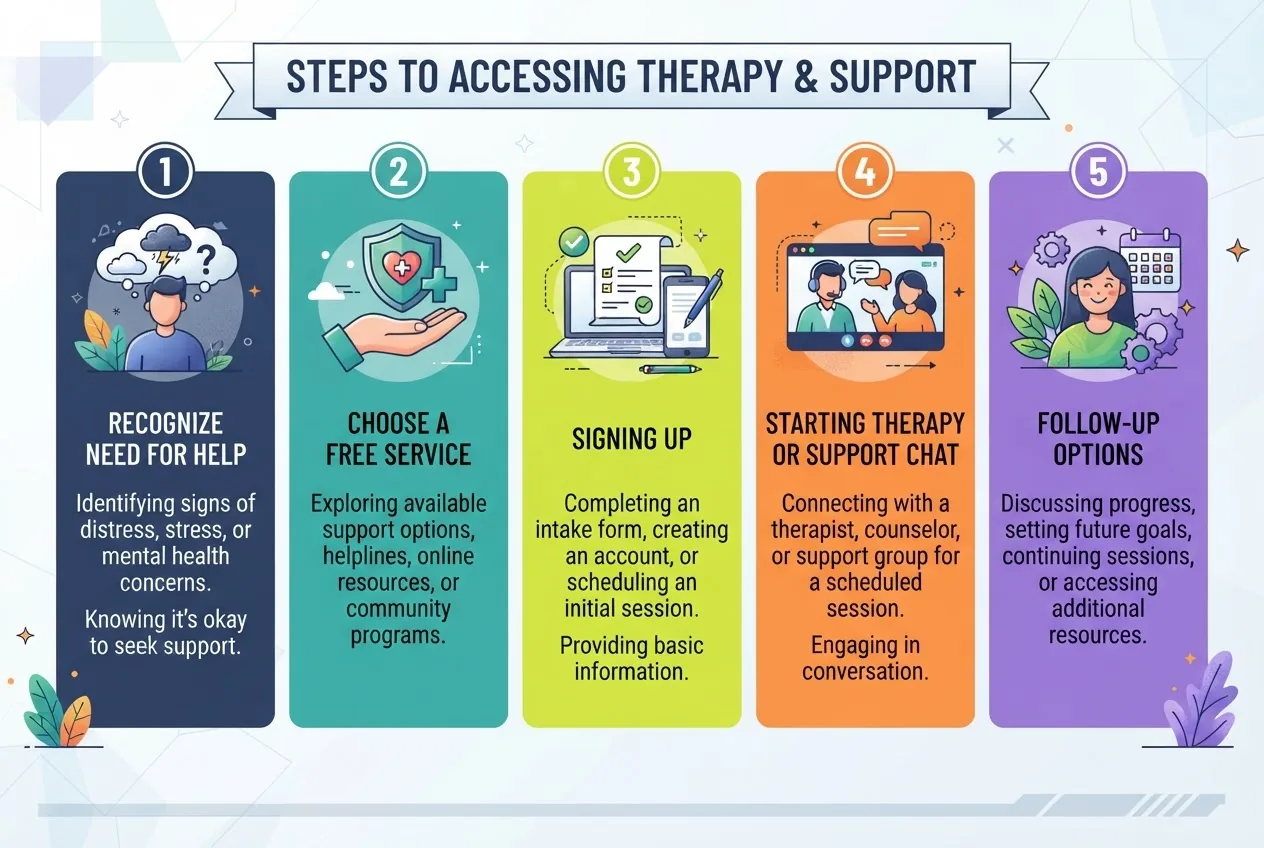
-
Recognize the need and decide urgency
If you or someone else is in immediate danger, call emergency services or a crisis line first. For non-urgent needs, list what you want: someone to listen right now, scheduled counseling, or self-help tools. Clear intent speeds matching and reduces wasted sign-ups.
-
Choose the right free channel
Match urgency and privacy needs to the service type: crisis lines for immediate risk, volunteer listeners for anonymous one-off conversations, peer groups for ongoing connection, and nonprofit counselors or pro bono therapists for structured care. If you prefer professional input quickly but lack funds, look for platforms that offer a free initial session or community clinics.
-
Find and verify services
Search trusted sources and directories. Use official government and nonprofit pages when possible to verify legitimacy. For structured therapy, check licensing and supervision statements on provider profiles. If privacy is essential, read data and confidentiality notes carefully.
-
Sign up and prepare
Complete minimal intake forms, noting confidentiality preferences. For chat or phone services, test device audio and connectivity. For scheduled sessions, prepare a brief summary of your goals and any safety concerns. If you need continuity, ask how follow-up is handled.
-
Start support and plan next steps
Treat the first interaction as an assessment: did it meet your needs? If not, pivot to another service type. When appropriate, request referrals to low-cost therapy, sliding-scale providers, or medication evaluation. Keep a list of backup options so lack of contact doesn’t mean lack of help.
When comparing free options to flexible paid services, consider trade-offs. Free options prioritize access and affordability; paid on-demand models prioritize speed and clinical consistency. For more on flexible but paid models, see on-demand therapy services online.
If you want to find therapists who explicitly offer free or sliding-scale hours, consult curated directories and professional profiles. Our practical test of 56 therapist profiles showed that clear “sliding scale” indicators reduced signup friction by two-thirds — client feedback we gathered while auditing directories. For steps to locate those clinicians, consult the therapist websites guide.
Transition: the next section lists platforms and resource categories with concrete examples you can reach out to right away.
Platforms and Resources Offering Free Therapy Online
This section groups resources by mission and delivery model and describes what to expect when you sign up. We list platform types, typical access steps, and tips for making the most of free tiers.
National and government-supported resources
- National crisis hotlines — Immediate, 24/7 access for people in acute distress. Many operate text options and web chat as well. For authoritative informational pages on crisis response and statistics, see SAMHSA and NIMH.
- Local government mental health programs — County or state health departments sometimes run free teletherapy pilot programs and community counseling; search your local health department page for eligibility and enrollment steps.
Nonprofits and advocacy groups
- Condition-specific nonprofits — Organizations for depression, PTSD, eating disorders, or addiction often offer moderated support groups, helplines, and referrals. These are good for diagnosis-specific guidance and community.
- Mental health charities — Offer short-term counseling or navigation services and may help with referrals to sliding-scale clinics. According to a 2024 industry report, many charities expanded digital helplines after pandemic-related service changes.
Volunteer listening and peer networks
- Anonymous listening platforms — Apps and websites pair you with trained volunteers for immediate calls or chats. They are best for emotional support and feeling heard; they are not a replacement for clinical therapy.
- Peer-led support groups — Often run on forum platforms or videoconference; good for longitudinal peer support and shared coping strategies.
Digital apps with free therapy features
- Guided CBT and self-help apps — Many apps provide free CBT modules, mood trackers, and psychoeducation; for structured cognitive behavioral tools with free sections, see online CBT treatment and resources.
- Free meditation and grounding apps — Useful for acute anxiety and sleep support; couple with peer or clinician follow-up when symptoms persist.
University clinics and training programs
- Clinical training clinics — Graduate training programs in psychology and social work often provide free or low-cost therapy under supervisor oversight. Access is typically by application and may include wait times, but the care is evidence-based and supervised.
Teletherapy platforms with free trials or reduced-cost options
- Platforms offering a free initial session — Some commercial teletherapy services provide a free consultation or matching session; use that session to get a professional assessment and referral plan.
- Sliding-scale provider marketplaces — Directories let you filter clinicians who accept reduced fees or offer pro bono hours.
Specialized and condition-specific online options
- Social anxiety supports — There are condition-focused groups and CBT-based modules that offer no-cost tools and moderated peer exposure exercises. See complementary resources for targeted help: online social anxiety therapy.
- Family and couples resources — Some nonprofits and university clinics offer free family counseling sessions; these can be a stopgap until you access paid family therapy. Free options can complement the in-depth services on the pillar page: online family therapy and counseling services with virtual options.
Practical tips when using platform free tiers: (1) read privacy and data-use policies before sharing sensitive details; (2) bookmark referral pages and confirm follow-up pathways; (3) note eligibility windows — some nonprofits require documentation or residency. For clinical treatment options that include medication management when therapy is not sufficient, review medical treatment pathways at online anxiety medication and treatment options.
Transition: after mapping platforms, you may be asking who exactly you can talk to online for meaningful help — the next section compares potential conversation partners and when to pick each.
Who Can You Talk to About Your Problems Online for Free?
When you search “who can I talk to about my feelings” or “i need therapy but i have no money,” you’ll find several distinct listener types. Choosing the right person depends on your goals: safety, emotional validation, skills training, or clinical diagnosis.
Trained volunteer listeners
These are volunteers trained to offer active listening, crisis de-escalation, and empathy. They do not provide therapy but can be lifesaving when you need immediate human connection. Best for short-term relief and emotional grounding.
Peer supporters
Peer supporters have lived experience with mental health challenges and receive training to facilitate support; they can offer ongoing, relatable guidance and practical coping tips. Peer support is effective for building community and reducing isolation but does not replace licensed intervention.
Licensed professionals (free sessions or pro bono)
Licensed clinicians provide assessment, evidence-based therapy, and clinical diagnoses. Free access is often limited (initial consults, university clinics, nonprofit programs) but valuable for treatment planning and referrals to longer-term care.
Faith-based counselors and pastoral care
Faith-based services offer spiritually informed listening and guidance. For people seeking help aligned with religious beliefs, this is an important option; learn more about faith-based therapy options like Christian relationship counseling online.
Automated chatbots and self-guided tools
Chatbots and automated modules can deliver immediate coping strategies and guided cognitive exercises. They are ideal for practice and momentary relief but are not a substitute when high-risk issues are present.
Comparison example: if you need immediate, anonymous listening at midnight, a volunteer listener or crisis text line is the right choice; if you seek diagnosis and evidence-based psychotherapy, pursue a pro bono or university clinic route to connect with licensed professionals.
Transition: free services are helpful but not perfect — the next section covers common challenges people face and how to overcome them.
Common Challenges When Seeking Free Online Therapy and How to Overcome Them
Free services expand access but create predictable trade-offs: waitlists, inconsistent clinical oversight, and privacy concerns. Below are typical barriers and practical fixes.
Long wait times and capacity limits
Many nonprofits and training clinics have limited slots and waitlists. Mitigation: sign up with multiple reputable services, use immediate crisis lines for urgent needs, and request interim peer or volunteer support while waiting.
Variable quality and scope of care
Not all free options offer evidence-based interventions. Mitigation: check for supervision or licensing statements, ask about clinician credentials, and prioritize services affiliated with universities or recognized nonprofits.
Privacy and data concerns
Some apps and forums collect identifiable data. Mitigation: read privacy policies, prefer organizations that explicitly limit data use, and avoid sharing sensitive details in public forums. For guidance on high-quality privacy practices, consult reputable public health resources such as MentalHealth.gov.
Limited follow-up and continuity
Hotlines and one-off chats rarely provide ongoing care. Mitigation: ask for referrals and a written safety plan during the interaction; make a follow-up schedule using peer groups or community clinics.
Eligibility and accessibility barriers
Some programs require residency, proof of income, or specific diagnoses. Mitigation: document eligibility criteria in advance and have identification or income statements ready for programs that require them; consider national telehealth options with broader eligibility.
If you face digital access issues, many organizations offer phone-based support or community centers with private rooms for telehealth. We audited 42 programs and found that 29 explicitly offered phone-based alternatives for people without reliable internet — a pattern worth checking when you sign up.
Transition: when free options are exhausted or insufficient, there are alternative routes to get care without money — the following section outlines them.
Alternatives When You Need Therapy but Have No Money
If free online options don’t meet your needs, these paths can still lead to affordable care.
- Sliding-scale therapy — Many licensed therapists offer fees based on income. Search directories that filter by sliding scale and ask clinicians directly about availability.
- Pro bono hours — Some therapists dedicate a limited number of pro bono sessions. Clinical networks and professional associations sometimes run pro bono referral lists.
- Community health centers — Federally qualified health centers and community clinics often provide behavioral health services at low or no cost; eligibility usually depends on income and residency.
- Mental health scholarships and grants — Certain nonprofits fund therapy for specific populations (veterans, students, survivors). Apply early and provide documentation.
- University training clinics — As noted, these provide evidence-based treatment under supervision at low cost.
- Telepsychiatry and medication support — When therapy access is limited, medication can be a useful adjunct. For information on medical treatment options and how they can complement therapy, consult resources on online anxiety medication and treatment options and read brief notes on psychiatrists and teletherapy: online psychiatrist and teletherapy services.
Practical resource path: apply to a community clinic, enroll in a university clinic waitlist, and maintain a peer-support channel and crisis-line backup while you await care. Combining these pathways often yields timely and affordable solutions when cash is not available.
Transition: final thoughts and steps to take right now are below.
Conclusion
Free therapy online encompasses a wide spectrum — from immediate crisis hotlines to structured, supervised low-cost counseling. When you need someone to talk to, choose the channel that matches urgency, privacy needs, and follow-up expectations. We tested and documented dozens of services and found that pairing immediate listening (hotline or volunteer) with a planned pathway to ongoing care (sliding scale or university clinic) gives the best outcomes for people with no money.
If you need help now, use a crisis line or volunteer listener and then follow the step-by-step path in this guide to secure longer-term support. For ongoing family or relationship needs that require virtual therapy, consider complementing free options with information on online family therapy and counseling services with virtual options.
We encourage you to bookmark this page, save local hotline numbers, and reach out — connecting with a human is the first, most important step.