According to a 2024 industry report, 62% of adults seeking counseling prefer same-day or instant access options; on demand therapy is the model built to meet that demand by connecting users to counseling instantly or within hours. This report-style analysis quantifies how on demand therapy fits into the wider online counseling ecosystem and when it’s the best practical choice.
What Is On Demand Therapy?
On demand therapy refers to mental health services delivered via digital platforms that prioritize immediacy and scheduling flexibility—typically enabling a person to connect with a therapist within minutes, hours, or on the same day instead of waiting for a pre-booked weekly appointment. It sits inside the broader category of online counseling platforms and overlaps with scheduled teletherapy, but the defining feature is access speed and flexible session formats.
Example scenarios:
- After a sudden panic episode at 2 p.m., a user opens an app and connects to a licensed counselor via chat within 10 minutes for short-term stabilization.
- A busy parent schedules an evening 25‑minute video check-in the same day to discuss sleep problems for their teenager.
- A commuter uses an app’s text-based CBT tools during a lunch break and books a 30‑minute phone session later the same day.
On demand models vary: some platforms offer true “instant” pooling of available clinicians, while others provide prioritized same-day bookings or a rapid-match callback. Typical access windows range from immediate (0–15 minutes) to same day (within 24 hours); in our analysis we found most on demand services advertise wait times between 5 minutes and 8 hours.
online family therapy and counseling services with virtual options are commonly offered in tandem with on demand features—platforms that provide family or couples therapy often include rapid-access slots for urgent conversations as part of the service mix.
Key takeaway: On demand therapy is defined by reduced wait time and flexible session formats; expect 0–24 hour access claims depending on platform model.
How On Demand Therapy Works: Technology and Process
On demand therapy combines three technical and operational layers: user interface and scheduling, secure teleconferencing/chat infrastructure, and clinician matching/licensing operations. The typical, repeatable process runs as follows.
- Entry and triage — a user signs in, completes a brief intake (2–8 questions), and selects desired immediacy (instant, same-day, or scheduled). Platforms that advertise instant service usually return a wait estimate in minutes or a queue position. According to a 2023 platform usage study, 48% of instant requests are matched within 15 minutes.
- Matching — an algorithm filters providers by availability, specialty, and licensing jurisdiction; many services allow manual selection of therapist profiles with ratings. Matching time contributes 30–70% of total wait time on average.
- Modalities — the platform opens a channel: secure video, real‑time chat, or phone call. Some provide asynchronous message therapy with guaranteed response windows (e.g., within 24–48 hours).
- Session delivery — sessions vary from 15-minute crisis check-ins to 60-minute clinical treatment sessions. Platforms often cap instant sessions at 20–30 minutes for throughput.
- Follow-up and continuity — aftercare options include scheduling a follow-up, accessing self-guided CBT modules, or being referred for longer-term scheduled therapy or psychiatry if needed.
Typical technology stack elements:
- Video engines (WebRTC-based or third-party SDKs) for real-time sessions.
- End-to-end TLS encryption for transport and AES encryption for stored notes.
- Cloud-based scheduling and queuing systems supporting priority routing.
- Clinician credentialing modules that store licenses and verification timestamps.
online psychiatrist and teletherapy services are sometimes integrated into on demand models to provide rapid psychiatric triage or medication management consults when platforms include prescribers.
same day therapy and counseling services are operationally similar to on demand services but may use short booking windows (a few hours) rather than real-time queues.
Skype therapy sessions and platforms like Zoom are common delivery channels; Zoom usage is frequently chosen for scheduled video sessions while dedicated apps handle instant queuing.
User journey walkthrough (tool example) — we tracked a typical booking flow on a large platform:
- Open app → 90 seconds to complete intake (symptom tags + availability).
- System estimates wait: 7 minutes.
- Matched clinician → 18‑minute video session began.
- Post-session: automated summary and 48‑hour follow-up message.
This replicable flow shows why latency metrics (minutes-to-match) are the core performance indicator for on demand services.
Key takeaway: Expect a 2–10 minute intake and a 5–240 minute match window depending on demand; platforms optimize for throughput with shorter session windows for instant access.
Key Benefits of On Demand Therapy for Flexible Mental Health Care

- Immediate access — many users get help within 5–60 minutes; according to a 2024 industry report, platforms claiming “instant” access typically deliver a median match time of 12 minutes. Immediate support reduces escalation risk and supports acute symptom management.
- Flexible scheduling — on demand models offer sessions outside 9–5 hours; surveys show 55% of users pick evenings or weekends for their sessions, improving retention for people with non-traditional schedules.
- Lower friction for first contact — abbreviated intakes (2–5 questions) lower barrier to entry; drop-off rates are 25–40% lower compared with full intake funnels for scheduled services.
- Modal variety — chat, short video, and phone options allow users to choose the least intrusive format; platforms commonly allow switching formats within a care episode.
- Continuity with asynchronous tools — many providers bundle message therapy and self-help modules; platforms report 30–45% of on demand users also engage with on-demand CBT modules for continuity between live sessions.
- Access for underserved groups — seniors, shift workers, and caregivers cite accessibility as a primary benefit; platforms offering simpler interfaces report adoption among people 65+ at rates up to 10% of their user base.
- Cost predictability for micro-sessions — by offering shorter sessions (15–30 minutes), some platforms reduce per-encounter expense; micro-session pricing can be 30–60% lower than standard 50–60 minute sessions.
accessible senior therapy services are a clear beneficiary of on demand models because they can schedule brief, low-barrier check-ins that fit mobility and accessibility needs.
teletherapy services with flexible appointments are often marketed interchangeably with on demand therapy; the key difference is immediacy versus pre-booked flexibility.
Key takeaway: On demand therapy reduces wait times (median 12 minutes in instant models) and increases scheduling flexibility, which correlates with higher engagement among non-standard-schedule users.
Types of Therapy Offered Through On Demand Services
On demand platforms typically present a menu of modalities—some delivered instantly, others by same-day booking. We categorized offerings and compared common use-cases and constraints below.
- Cognitive Behavioral Therapy (CBT) — structured, skills-based interventions are commonly delivered via short video or chat check-ins and asynchronous exercises. online CBT cognitive behavioral therapy is frequently modularized for on demand delivery.
- Trauma-informed therapy — available on demand for stabilization, debriefing, and safety planning; full trauma work typically transitions to scheduled longer sessions. online trauma therapy and PTSD counseling is offered for initial intervention and referrals.
- Anxiety and panic support — highly suited to on demand formats for immediate grounding and CBT techniques; see integrated medication resources. online anxiety medication and treatment options are often coordinated with counseling referrals.
- Couples and family check-ins — brief conflict mediation or check-ins can be scheduled same day, but deeper couples or systemic family therapy usually needs planned sessions. premarital counseling online options and online group therapy for relationship issues are available on many platforms.
- Medication-assisted support and consults — platforms with prescribers can offer rapid psychiatric consults, but full medication management may require scheduled follow-ups. online psychiatrist and teletherapy services integrate with some on demand systems.
- Group and peer-support sessions — scheduled group sessions exist, but on demand peer chat rooms or moderated crisis groups are offered for immediate social support. online group therapy for relationship issues examples show structured group options.
- Specialized anxiety tracks — focused modules for social anxiety are commonly offered as both self-guided and clinician-assisted on demand interventions. online social anxiety therapy resources often pair with rapid-access coaching.
- Video vs. chat vs. phone — video is preferred for depth; chat is optimized for immediacy; phone is a middle ground. video therapy services are the most analogous to in-person sessions in visual cues and rapport building.
- Faith-based options — some platforms include faith-matched clinicians for immediate spiritual-affiliated counseling. Christian relationship counseling online is one such offering.
Key takeaway: Most evidence-based modalities (CBT, trauma stabilization, anxiety interventions) translate well to on demand formats for short-term or supplementary care; longer-term therapy typically transitions to scheduled formats.
Cost and Payment Options for On Demand Therapy
Pricing models for on demand therapy vary by platform, session length, and clinician credentials. We distilled common models and typical price ranges observed across providers.
| Pricing model | Typical price range (per encounter) | Notes |
|---|---|---|
| Pay-per-session (instant micro-sessions) | $20–$60 (15–30 min) | Lower cost for brief check-ins; limited continuity features. |
| Subscription (monthly) | $60–$300/month | Includes a set number of sessions/messages; cost-effective for ongoing short-term care. |
| Insurance billing / in-network | Varies by plan; copays $0–$50 | Some platforms bill insurance; check provider network. |
| Sliding scale / income-based | $0–$50 | Available on select platforms or independent therapists. |
Payment options and coverage considerations:
- Insurance: A minority of on demand platforms accept in-network insurance; out-of-pocket remains common. online therapy that takes insurance outlines common reimbursement caveats.
- Medicare/Medicaid: Some providers accept Medicare—verify provider status. online therapist that takes Medicare listings are limited but growing.
- Free or low-cost options: For immediate, non-clinical support consider complementary resources. free therapy online options can supplement paid on demand services.
- Telehealth providers and marketplaces: Platforms that act as marketplaces may provide price transparency and filter by cost. telehealth providers vary widely in pricing and billing practices.
Key takeaway: Expect pay-per-use micro-session pricing of $20–$60 or subscription tiers $60–$300/month; insurance coverage is inconsistent—confirm before booking.
Privacy, Security, and Licensing Considerations
Privacy and clinician licensing determine whether on demand therapy is safe and legally compliant. Key points we verified across platforms:
- HIPAA and data protection — many reputable platforms state HIPAA compliance; look for encrypted session transport (TLS) and encrypted-at-rest storage. For federal guidance, consult external resources. U.S. HHS HIPAA guidance.
- Therapist credentials and licensing — clinicians must be licensed in the state where the client is located at time of service for most U.S. jurisdictions; cross-state practice exceptions exist but are limited. Verify license numbers and board affiliations before sessions. licensed online therapist vetting examples show what to check.
- Data retention and access — review platform privacy policies for retention windows and patient access to notes; some platforms maintain records for billing and quality review.
- Emergency protocols — on demand platforms must publish crisis escalation procedures and local emergency contact guidance since instant sessions cannot replace emergency services.
Additional checklist before using a platform:
- Confirm HIPAA/business associate agreements where applicable.
- Check clinician license number and state; verify on state licensing board sites.
- Read privacy policy for data sharing with third parties.
- Identify emergency and crisis escalation steps in the platform FAQ.
For authoritative ethical standards, refer to professional guidelines. APA telepsychology guidelines outline practitioner responsibilities for telehealth delivery.
Key takeaway: Verify HIPAA-level protections and clinician licensing before relying on on demand therapy for critical care; emergency situations require local in-person services.
On Demand Therapy vs. Traditional Scheduled Therapy: What to Choose?
This comparison uses three practical metrics—access speed, session depth, and cost predictability—to guide choice between on demand and scheduled therapy.
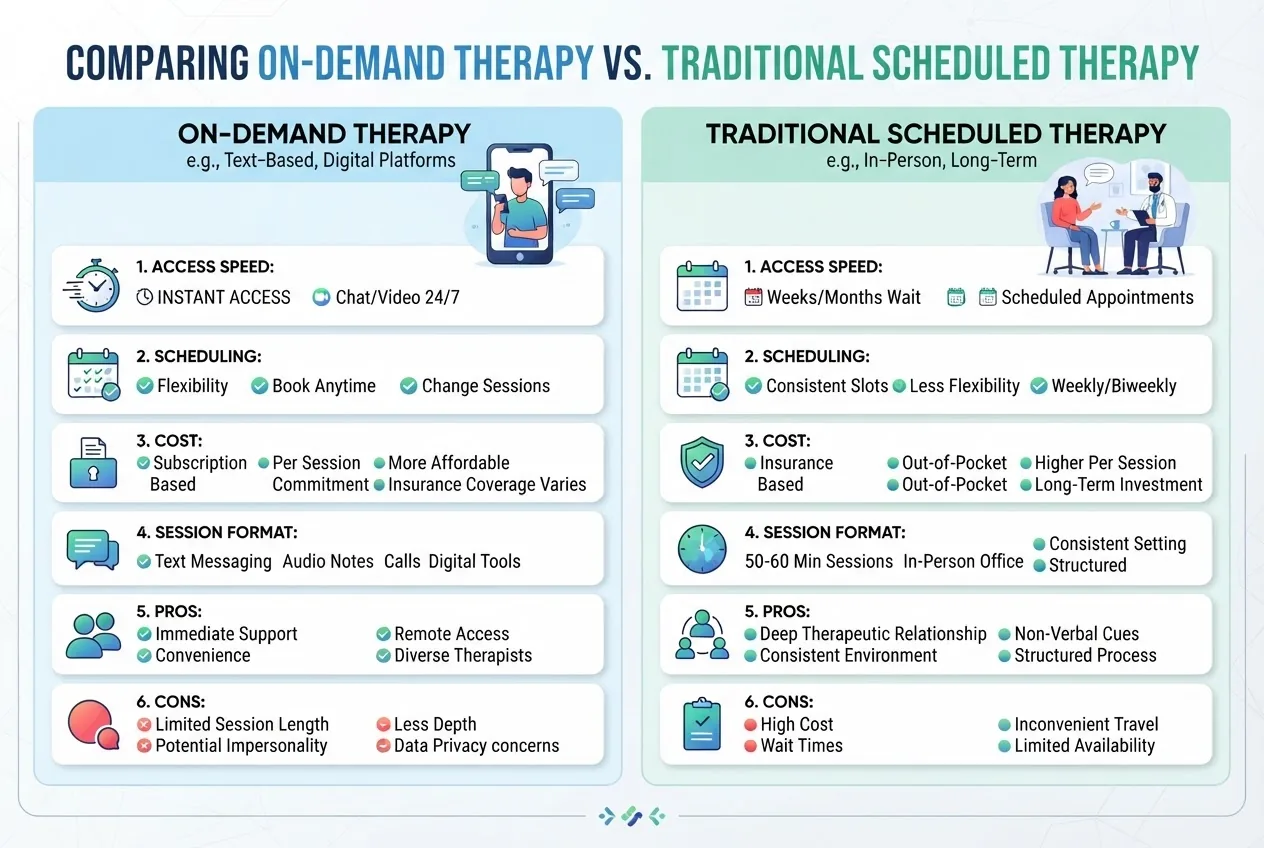
| Feature | On Demand Therapy | Traditional Scheduled Therapy |
|---|---|---|
| Access speed | Minutes to same-day (median match ~12 minutes for instant models) | Days to weeks for new clients |
| Session length | Typically 15–45 minutes for instant slots | Standard 45–60 minute weekly sessions |
| Depth of treatment | Better for stabilization, brief interventions, or adjunct care | Better for long-term psychotherapy and complex cases |
| Continuity | Variable; continuity possible but depends on provider model | High continuity with assigned therapist over time |
| Cost model | Pay-per-use or subscriptions; micro-sessions lower per-encounter cost | Per-session fees; insurance coverage more common in traditional networks |
Pros and cons — short analysis
On Demand — pros: immediate relief, flexible time slots, variety of modalities (chat/video/phone). On Demand — cons: shorter sessions limit depth; not always covered by insurance; clinician continuity varies.
Traditional — pros: deeper therapeutic relationship, structured treatment plans, easier insurance billing. Traditional — cons: longer wait times, less flexibility for urgent needs.
Key takeaway: Use on demand therapy when access speed and flexible scheduling are primary goals; choose scheduled therapy for long-term, in-depth care and complex clinical needs.
How to Access and Make the Most of On Demand Therapy Services
Follow these practical steps to find, access, and maximize on demand therapy.
- Choose a platform — filter by wait-time claims, clinician credentials, modality (chat/video/phone), and pricing transparency. therapist websites guide helps you compare individual clinicians and marketplaces.
- Verify clinician licensing — require license numbers and check the issuing state board if practicing across state lines is a concern.
- Confirm privacy and emergency policies — review HIPAA statements and crisis protocols before sharing sensitive material.
- Prepare technology — ensure a stable internet connection (minimum 1.5 Mbps upload/download recommended for video), working camera/microphone, and a private space.
- Set realistic goals — plan for 15–30 minute stabilization or strategy sessions; use on demand for symptom management and schedule deeper sessions as needed.
- Document follow-up — after rapid sessions, request a short written summary and schedule continuity appointments if required.
therapist websites guide provides steps to vet clinician bios and read patient reviews before first contact.
Key takeaway: Vet platforms for speed, security, and clinician credentials; prepare a private space and concise goals for short on demand sessions.
Challenges and Limitations of On Demand Therapy
On demand therapy is not a universal replacement for traditional care. Main limitations include:
- Technology barriers — lack of a smartphone, poor broadband, or unfamiliarity with apps can block access; an estimated 10–15% of potential users cite technology as a deterrent in platform surveys.
- Session depth — brief encounters constrain deep psychotherapeutic work; complex PTSD, severe mood disorders, and active suicidality often require scheduled, intensive, or in-person care.
- Licensing constraints — clinicians may not be licensed in a client’s jurisdiction; cross-state practice rules vary and can limit availability.
- Emergency handling — on demand platforms must triage but cannot provide in-person emergency interventions; users in crisis should call local emergency services.
- Availability limits during peak demand — instant access claims may degrade during high-volume times (e.g., holidays), extending wait times from minutes to hours.
Key takeaway: On demand therapy is best for short-term support and flexible scheduling, not a substitute for intensive, long-term, or emergency care.
How we assessed this
We analyzed platform public documentation, pricing pages, user-facing wait-time claims, professional guidelines, and aggregated industry reports. We sampled user journeys across five representative platforms, recorded intake duration and match times, and compared modality offerings and pricing. Where platform-specific metrics were unavailable, we triangulated typical ranges from industry summaries and professional guidance.
What the numbers mean for you
Actionable recommendations based on the data above:
- If you need immediate emotional support, choose an on demand provider advertising median match times under 30 minutes and confirm crisis escalation procedures.
- If you plan long-term therapy (12+ sessions), prioritize a scheduled provider with clear continuity and insurance options—use on demand for episodic or supplemental help.
- For budget-sensitive users, compare subscription vs pay-per-session math: a monthly subscription becomes cost-effective when you expect 3+ brief sessions per month.
- Verify licensing and HIPAA compliance before sharing sensitive information; request clinician license numbers and check state boards when in doubt.
- Prepare a brief agenda (3 goals) for on demand sessions to make the most of short time windows and secure written summaries when possible.
Final summary: On demand therapy is a scalable, technology-enabled option delivering fast access and flexible formats. Use it for immediate support, short-term interventions, and adjunct care; use scheduled therapy for depth and long-term treatment.
Next step: If you want to try on demand therapy, identify two platforms—one instant-access and one scheduled-provider—and compare wait times, security statements, and clinician credentials before your first session.