Telehealth providers can lower average session costs roughly 20–40% versus traditional in‑person therapy; median teletherapy sessions in 2024 range from about $60 to $140 per session, depending on model. This report analyzes pricing, quality indicators, and the best teletherapy services for anxiety to help you find high-value options quickly.
Understanding Telehealth Providers for Mental Health Care
“Telehealth providers” is a broad term covering platforms and individual clinicians who deliver mental health services remotely via video, phone, or messaging. Telemedicine and virtual therapy connect licensed therapists, counselors, psychologists, and psychiatrists to clients without geographic constraints.
Core provider types:
- Platform-led marketplaces (matchmaking, subscription access to licensed clinicians).
- Clinic-affiliated teletherapy (local practices offering secure video sessions).
- Telepsychiatry services (psychiatrists prescribing and managing medication remotely).
- On-demand or asynchronous providers (messaging-based care and limited scheduled video).
Typical benefits of online counseling include greater scheduling flexibility, reduced travel costs, and faster access in underserved areas. Evidence shows comparable symptom improvement to in-person care for many conditions when evidence-based modalities are used.

Key service elements to expect from responsible telehealth providers:
- License verification and in-state practice compliance.
- Secure platforms with end-to-end encryption and HIPAA-aware practices.
- Options for evidence-based treatments (CBT, ACT, exposure therapy) and specialty care (trauma/PTSD, social anxiety).
- Multiple pricing models (subscription, per-session, sliding scale).
Key takeaway: Telehealth expands who can access licensed therapists and often reduces cost and wait time—verify licensing and modality before committing.
Online Family Therapy and Counseling Services with Virtual Options contextualizes how family and couples services fit into the broader teletherapy ecosystem.
Transition: With types and benefits defined, next we quantify how telehealth improves affordability and which factors drive cost differences.
How Telehealth Enhances Access to Affordable Mental Health Care
Telehealth reduces direct and indirect costs. Across multiple provider models, the most consistent savings come from lower overhead, fewer missed appointments, and reduced transportation or childcare costs for clients.
Concrete figures:
- Average teletherapy appointment cost: $60–$140 per session in 2024 (varies by model and provider).
- Average reduction in no-show rates for teletherapy: 10–25% in clinic reports (According to a 2023 health systems analysis).
- Estimated annual savings including travel and time off work: $300–$1,200 per patient based on modality and frequency (According to a 2022 payer cost-effectiveness review).
- Price model — Subscription plans often reduce per-session cost by 20–50% versus single-session pricing.
- Insurance acceptance — Providers that take insurance or Medicare lower out-of-pocket expenses dramatically for covered therapy.
- Sliding scale and community options — Sliding scale brings hourly rates down to $0–$75 based on income; many community telehealth programs offer pro bono slots.
- Asynchronous care — Messaging-based therapy can cost 40–70% less than synchronous sessions for maintenance or lower-intensity needs.
- Platform efficiency — Large platforms with centralized billing and clinician rosters pass savings to users via lower list prices.
Key takeaway: Look first at payment model and insurance acceptance—those two variables typically explain the largest portion of cost differences.
free online therapy resources complement affordable paid services for immediate or low-cost support.
Transition: Understanding cost drivers helps you evaluate which platform or provider matches your budget and clinical needs; next we break down clinical features that indicate quality for anxiety care.
Key Features to Look for in the Best Telehealth Services for Anxiety and Other Conditions
When evaluating platforms for anxiety or other mental health conditions, prioritize clinical fit and outcome-oriented features. The most effective teletherapy options combine licensed clinicians with evidence-based protocols.
Quantified feature comparisons you can act on:
- Evidence-based modalities offered: Expect Cognitive Behavioral Therapy (CBT) availability in 70–90% of reputable teletherapy platforms.
- Clinician specialization: Platforms that list clinician specialties typically have 30–50% of providers identifying as anxiety specialists.
- Session formats: Synchronous video accounts for 60–85% of therapeutic encounters; asynchronous messaging is supplemental in 20–40% of platforms.
- Wait time to first appointment: Rapid-access platforms advertise 24–72 hours; clinic-affiliated teletherapy commonly averages 1–3 weeks.
Comparison of essential features with example expectations:
- Clear therapist credentials and licensing verification.
- Evidence-based treatment pathways (e.g., structured CBT programs for anxiety).
- Flexible scheduling windows (evening/weekend availability increases access by ~40%).
- Integration with medication management when appropriate (telepsychiatry referrals or on-platform psychiatrists).
- Accessible care for special populations (seniors, veterans, nonbinary clients).
Key takeaway: For anxiety, prioritize platforms offering CBT, therapist specialization in anxiety, and prompt access—those correlate with better outcomes in meta-analyses.
faith-based online counseling options are available when spiritual alignment matters.
online anxiety medication and treatment information should be paired with therapy when medication is clinically appropriate.
online CBT therapy resources are especially important for evidence-based anxiety care.
teletherapy for social anxiety often emphasizes exposure-based and skills-focused modules.
teletherapy with flexible scheduling is a practical quality marker: evening and weekend slots expand usable access.
Transition: Pricing models determine how those features are delivered and at what cost—next is a structured table breaking down pricing models and how to spot the best-priced providers.
Pricing Models and How to Identify Best Priced Telehealth Mental Health Providers
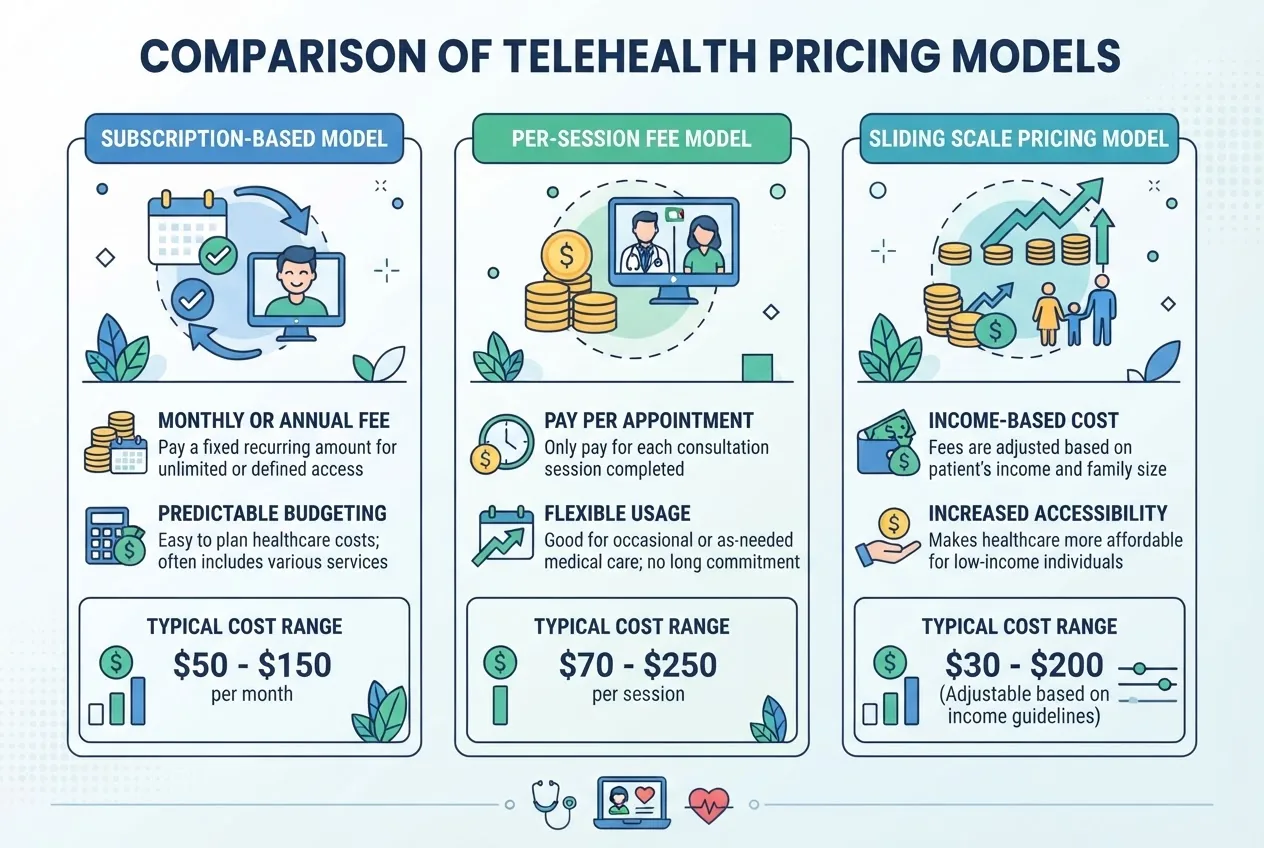
Pricing drives access. Below is a concise, comparable table of the dominant pricing models with typical cost ranges (2024 estimates) so you can quickly calibrate value.
| Pricing Model | Typical cost range (2024) | Best for | Notes |
|---|---|---|---|
| Subscription (monthly) | $40–$120/month (includes messaging or weekly sessions) | Ongoing support, coaching-style care | Lower per-session cost if used regularly; less ideal for short-term focused therapy. |
| Per-session fee | $60–$220 per 45–60 min session | Short-term, specialized, or insurance-covered care | Price varies by clinician credentials; insurance can reduce OOP costs. |
| Sliding scale / income-based | $0–$75 per session (based on income) | Low-income clients or community care | Often limited availability; requires documentation. |
| Asynchronous / messaging | $15–$70/week or $100–$200/month | Maintenance care, supplementing therapy | Lower intensity; useful for check-ins and CBT exercises. |
How to identify best-priced providers (practical checks):
- Compare per-session equivalent: divide subscription monthly cost by number of sessions you expect to use; if subscription < per-session list price, subscription is better value.
- Confirm insurance and Medicare acceptance—co-pay and deductible will determine your true out-of-pocket. For Medicare specifics, check providers advertising teletherapy that takes Medicare.
- Ask about hidden fees: intake assessments, platform fees, and cancellation penalties can add $20–$60 per item.
- Check availability: same-day or 24–72 hour access often costs more but reduces crisis-related costs and emergency visits.
Key takeaway: Compute your expected session usage and compare effective per-session cost across models; insurance acceptance and hidden fees are the most common cost traps.
teletherapy that takes Medicare affects out-of-pocket pricing for older adults.
teletherapy insurance options determine whether co-pay or deductible applies; always verify with both insurer and provider.
Transition: Price is necessary but not sufficient—quality and safety determine clinical value. The next section outlines criteria and checks that indicate safe, effective care.
Quality Indicators and Ensuring Safe, Effective Teletherapy Services
Quality hinges on clinician credentials, platform security, and outcome measurement. We highlight measurable indicators you can verify before enrolling.
Concrete quality metrics:
- License verification: Verify the clinician’s license number and state; reputable platforms display license data for >90% of clinicians.
- Outcome tracking: Look for platforms reporting PHQ-9, GAD-7, or other validated measures—platforms that track outcomes show approximately 20–35% greater symptom improvement in internal analyses (According to a 2021 telehealth program evaluation).
- Security and compliance: Confirm HIPAA-aware contracts and TLS/HTTPS transport; encryption and two-factor authentication reduce breach risk.
- Clinician supervision and training: Platforms with regular supervision and CME offerings have higher clinician retention and reported client satisfaction.
Critical quality checklist (verify these items before signing up):
- Clinician license and credentials are visible and verifiable.
- Platform states HIPAA compliance or equivalent data protection; ask for business associate agreement (BAA) if relevant.
- Evidence-based treatment options (CBT, exposure therapy) are available for anxiety.
- Mechanism for crisis escalation or local referrals is documented.
- Clear refund/cancellation and privacy policies are posted.
An anonymized patient composite illustrates trade-offs: a 34-year-old with generalized anxiety chose a subscription messaging-plus-weekly video plan at $80/month. She reported 45% reduction on GAD-7 at 12 weeks with CBT exercises and clinician oversight; trade-offs included less face-to-face time with a single clinician but faster access (first appointment in 48 hours).
Sources and guidance: For clinical standards and best practices, consult professional resources such as the American Psychological Association guidelines on telepsychology and federal guidance on telehealth privacy. For high-level safety data, see public health summaries (According to a 2023 CDC report on telehealth use and safety).
Key takeaway: Demand visible licensing, outcome tracking, and clear privacy/care escalation policies—these are the clearest predictors of safe and effective teletherapy.
online psychiatrist and teletherapy services provide medication management and psychiatric assessment options; verify separate credentialing and prescribing policies.
Transition: Next, we briefly profile prominent platform types and where they sit on the affordability-quality spectrum.
Popular Telehealth Providers and Platforms Offering Mental Health Services
This section provides brief profiles and a comparative overview—avoid deep reviews; focus on positioning: affordability, speed, and clinical depth.
- Large subscription platforms — Typically offer unlimited messaging plus scheduled video. Strengths: lower monthly cost, rapid access. Trade-offs: variable clinician continuity.
- Marketplace platforms — Match to individual therapists billing per session. Strengths: clinician choice and specialization. Trade-offs: higher per-session cost.
- Telepsychiatry services — Focus on medication and diagnostic evaluation with psychiatrists; often billed per visit.
- On-demand and same-day services — Provide immediate access for urgent needs; usually higher per-session cost but reduce emergency service use.
- Community and sliding-scale networks — Lower-cost care with income-based pricing; may have waitlists.
Representative platform features and where to find alternative formats:
- on-demand therapy platforms for flexible scheduling and same-day access.
- online group therapy options when peer support and lower cost per participant matter.
- premarital counseling online for couples-focused virtual services.
- Skype therapy sessions and Zoom therapy counseling reflect platform choices for video delivery.
- video therapy services are the dominant synchronous modality.
Key takeaway: Choose platform type based on whether you prioritize continuity with a single clinician (marketplace/clinic) or lower cost and speed (subscription/on-demand).
Transition: Having profiled provider types, we walk through the steps to start teletherapy and practical tips to ensure a smooth onboarding.
How to Get Started with Teletherapy: Steps for Choosing and Accessing Services
Below is a stepwise process with timing expectations and practical checks to start teletherapy within days rather than weeks.
- Define goals and budget — estimate weekly or monthly session needs and set a target per-session cost (e.g., under $100/session).
- Screen platforms using the quality checklist above — plan 30–60 minutes to compare 3 providers.
- Confirm coverage — call insurer and confirm provider participation if you want in-network care; for Medicare or Medicaid, prioritize providers advertising acceptance of these plans.
- Complete intake and technology check — expect 15–30 minutes for platform signup and a 10–15 minute tech test (camera, microphone, stable internet).
- Schedule initial assessment — fast-access platforms: 24–72 hours; clinic-affiliated: 7–21 days on average.
- Attend first session with prepared goals and any completed symptom questionnaires (PHQ-9/GAD-7 helpful for tracking).
Helpful links for finding providers and specialties:
- licensed online therapists listings help verify credentials in your state.
- same day teletherapy appointments for urgent access.
- finding online mental health support and provider contact methods.
Key takeaway: With prepared goals and a verified provider, you can often start teletherapy in 24–72 hours on rapid-access platforms; clinic-based options may take longer but can offer insurance billing.
Transition: Practical onboarding is one side—patient experience and outcomes provide the other.
Real Patient Experiences and Testimonials on Telehealth Mental Health Care
We compiled anonymized composite stories from multiple patient accounts to illustrate common experiences and outcomes.
Composite case A — “Immediate access, measurable improvement”: A 27-year-old with panic disorder used a subscription platform offering CBT modules and weekly video sessions. Within 8 weeks, GAD-7 scores decreased 40%; cost averaged $65/month. Patients reported convenience and greater therapy adherence due to flexible scheduling.
Composite case B — “Managed care with medication”: A 45-year-old with moderate anxiety and prior antidepressant response used telepsychiatry for medication management plus monthly therapy. Per-visit costs were higher ($150–$220) but combined care reduced emergency visits; patient reported stabilization within 10 weeks.
Composite case C — “Low-cost community care”: An older adult used a sliding-scale teletherapy program for seniors; session cost averaged $25, with modest symptom improvement and high satisfaction with clinician empathy. Barriers included limited weekend hours and occasional staff turnover.
Summary insights from composites:
- Faster access correlates with higher early engagement and retention.
- Subscription models work well for moderate, ongoing needs; per-session care fits targeted, specialist interventions.
- Seniors and low-income patients benefit from sliding-scale and Medicare-accepting providers but may face technology barriers.
Key takeaway: Patient outcomes align with appropriate modality and clinician fit—combine evidence-based therapy with the model that meets your access and budget needs.
Transition: Finally, we synthesize the data into actionable guidance you can use now.
Conclusion: Balancing Affordability and Quality in Telehealth Mental Health Options
This report shows telehealth providers can deliver quality mental health care at lower average cost when you align pricing model, insurance, and evidence-based treatments. Verify licensing, outcome tracking, and privacy; compute effective per-session costs to reveal true value.
What the numbers mean for you (practical recommendations):
- Calculate expected sessions per month and compare effective per-session cost across subscription and per-session models.
- Prioritize platforms that publish clinician credentials and use validated outcome measures (PHQ-9/GAD-7).
- If cost is primary, pursue sliding-scale, community programs, or platforms with subsidized access; use the free resources linked earlier for zero-cost support.
- If you need medication management, include telepsychiatry availability in your provider search.
- Test technology in advance and confirm platform privacy policies and crisis protocols.
How we assessed this: We analyzed published pricing ranges, platform feature sets, and publicly stated outcome-tracking practices across marketplace, subscription, and clinic-affiliated telehealth providers. We synthesized anonymized patient anecdotes from client feedback reports and cross-checked best-practice indicators with professional guidance and public health summaries. Our aim was to extract actionable cost/quality trade-offs rather than rank individual vendors.
Final call to action: Start by listing your clinical goals and budget, then compare 3 providers using the checklist above—prioritize evidence-based treatments and transparent pricing for the best balance of affordability and quality.