A psychotherapist for young adults is a licensed mental health professional trained to assess, diagnose, and treat people roughly aged 18–25 using developmentally tailored, evidence-based therapies and transition planning; they bridge adolescent services and adult care while addressing anxiety, depression, identity, and vocational concerns.
Understanding the Role of a Psychotherapist for Young Adults
Answer: A psychotherapist for young adults provides assessment, short- and long-term therapy, crisis intervention, and care coordination tailored to the developmental tasks of ages 18–25, focusing on autonomy, identity, vocational transitions, and emerging adult relationships.
Young adults (commonly defined as ages 18–25) face unique psychosocial challenges—college and career transitions, new romantic and social roles, and identity consolidation—that require different clinical goals and service frameworks than child or adolescent therapy. Psychotherapists in this area combine developmental understanding with clinical skills to support emerging independence and decision-making.
Term: Young adults refers here to individuals approximately 18–25 years old, a developmental stage distinct from adolescence with its own social and identity-related tasks.
Core responsibilities include:
- Diagnostic assessment and use of screening tools (e.g., PHQ‑9 for depression, GAD‑7 for anxiety) learned during training.
- Individual therapy plans addressing identity, career, substance use, relationship skills, and co-occurring disorders.
- Coordination with universities, primary care, and specialty services (e.g., psychiatry for medication management).
- Transition planning when moving from adolescent services to adult systems or when leaving family care.
A practical example: a clinician assessing a 21-year-old college student will weigh developmental tasks (independence, vocational choices) differently than with a 14-year-old, while still applying evidence-based interventions adapted for developmental stage and autonomy.
Understanding boundaries: therapeutic goals emphasize fostering autonomy and skills for self-management, often including family or school coordination only with explicit consent from the young adult.
Educational and Licensing Pathways to Become a Psychotherapist for Young Adults
Answer: Becoming a psychotherapist for young adults typically requires a graduate degree (MSW, MA/MSc in counseling, PhD/PsyD in clinical psychology), supervised clinical hours (commonly 2,000–3,000), passage of a licensure exam, and ongoing continuing education focused on young-adult developmental competence.
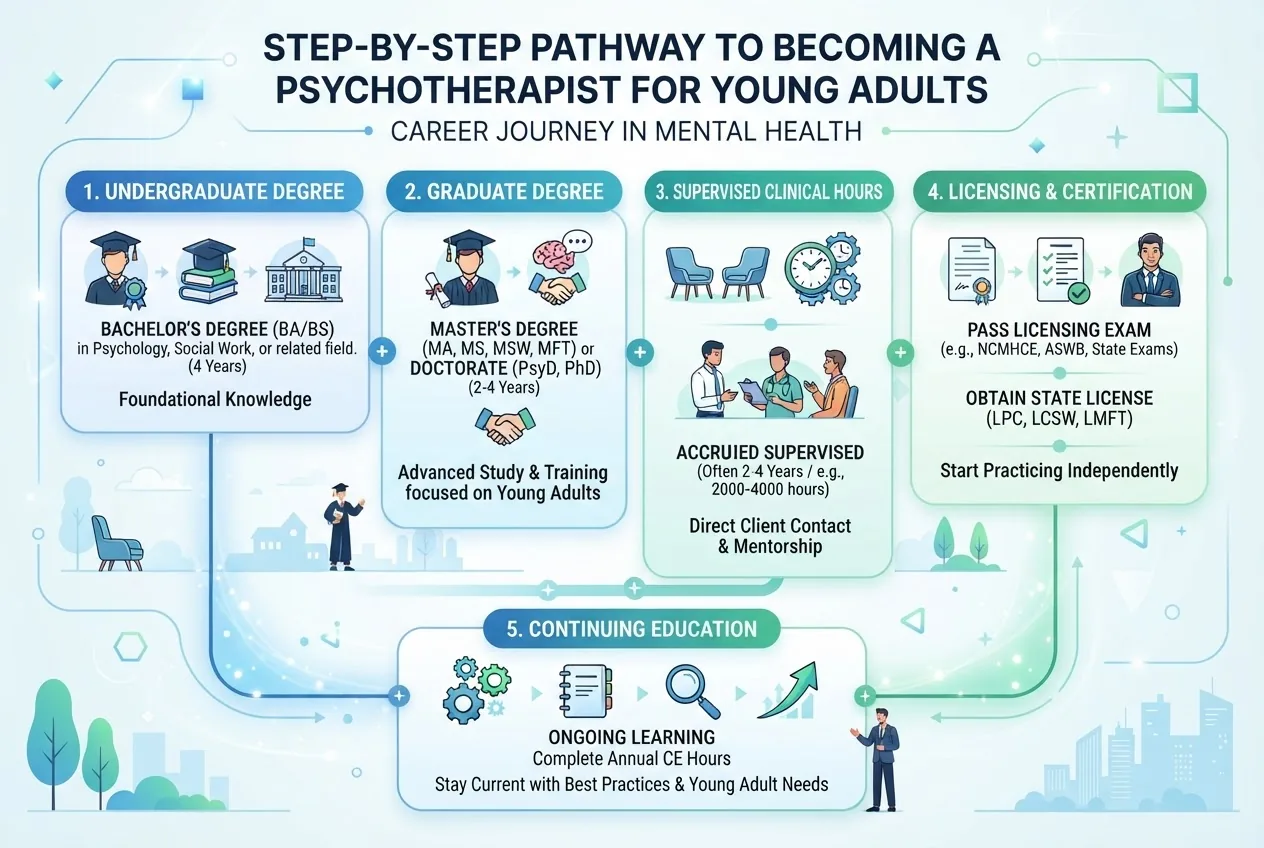
Below is a numbered, step-by-step pathway that maps typical U.S. routes and variations by license type. Note: state requirements vary—check your state licensing board for specifics; see external resources listed below.
-
Earn a relevant bachelor’s degree (4 years).
Most candidates begin with psychology, social work, human development, or a related major that provides foundational coursework in developmental psychology and research methods.
-
Choose a graduate degree aligned with licensure goals.
Common graduate degrees and their clinical endpoints:
- Licensed Clinical Social Worker (LCSW) route: Master of Social Work (MSW) with clinical concentration and field placements.
- Licensed Professional Counselor (LPC) or equivalent: Master’s in Counseling, Clinical Mental Health Counseling, or Marriage and Family Therapy programs.
- Clinical Psychology Doctorate (PhD/PsyD): Doctoral programs with clinical practica, internships, and dissertation (PhD emphasizes research; PsyD emphasizes clinical training).
Definition blocks for license acronyms on first use:
Term: LCSW — Licensed Clinical Social Worker, a clinical license requiring an MSW plus supervised clinical hours and state exam.
Term: LPC — Licensed Professional Counselor (title varies by state), requiring a counseling master’s, supervised hours, and a licensure exam.
Term: PhD/PsyD — Doctoral degrees in clinical psychology; licensure follows completion of degree, internship, and postdoctoral supervised hours in many states.
-
Complete practicum and internship clinical hours during graduate training.
Typical graduate programs include 500–1000+ direct client contact hours across settings (universities, community clinics, inpatient units). These rotations often include working with young adults in college counseling centers or community clinics to build stage-specific skills.
-
Accumulate post-degree supervised clinical hours.
Most states require supervised hours for licensure. According to a 2024 industry report, most U.S. states require between 2,000 and 3,000 supervised clinical hours after graduation for independent clinical licensure (source type: industry report).
Supervision settings include agency supervision, private practice supervision, and university-affiliated postdoctoral placements. Supervision often emphasizes case formulation, ethics, diagnostic skills, measurement-based care, and developmental competence for young adults.
-
Pass the relevant licensure exam.
Examples: the ASWB Clinical Exam (social work), the National Counselor Examination (NCE) or National Clinical Mental Health Counseling Examination (NCMHCE), and the Examination for Professional Practice in Psychology (EPPP) for psychologists. Interview and exam preparation should include modules on developmental psychopathology for emerging adults.
-
Secure state licensure and pursue credentialing.
After exam passage and documentation of supervised hours, apply to your state board for independent practice privileges. Many clinicians also pursue specialty credentials (e.g., trauma certification, DBT training) relevant to young adults.
-
Obtain specialized supervised experience with young adults.
Target clinical rotations in settings serving 18–25 populations—college counseling centers, transitional aged youth (TAY) programs, community mental health clinics—to develop competency distinct from child/adolescent tracks.
-
Complete continuing education and maintain ethical competence.
Licensure requires continuing education (CE) credits; pursue CE in cultural competence, developmental psychology of young adults, and evidence-based therapies (CBT, DBT, ACT). External guidance: American Psychological Association (APA) and Association of Social Work Boards (ASWB).
-
Seek specialization and supervisory roles.
Clinicians aiming to specialize in young adults often complete additional post-licensure training, become approved supervisors, or earn certifications (e.g., college counseling, trauma-informed practice).
Educational pathways differ in focus: MSW/LCSW emphasizes systems, case management, and community resources; LPC programs emphasize counseling modalities and individual therapy techniques; doctoral programs emphasize assessment and advanced diagnostics. Trainees often cross-train in substance use, family therapy, and vocational counseling to address common young-adult concerns.
For readers wanting a teen-focused comparison and the techniques used there, see Therapy With Teens: Techniques and Training Overview and later the training overview focusing on teens.
Licensing resources and standards: consult the APA, NIMH, and your state board for up-to-date requirements.
Specialized Training and Skills for Working with Young Adults
Answer: Specialized training includes developmental psychology of emerging adulthood, trauma-informed care, motivational interviewing, cultural competence, and proficiency in evidence-based interventions tailored to autonomy, identity work, and transition-related stressors.
Term: Developmental psychology — the study of psychological changes across life stages; for young adults this includes identity consolidation, autonomy development, and vocational/relational milestones.
Clinicians require both didactic and experiential learning focused on young adult needs. Key skill areas (with examples) include:
- Developmental competence — understanding normative vs. pathological development for 18–25: e.g., distinguishing identity exploration from clinical identity disturbance.
- Trauma-informed care — applying principles of safety, choice, collaboration, trustworthiness, and empowerment; using phased interventions for trauma survivors.
- Motivational interviewing (MI) — brief, collaborative techniques to support behavior change (useful for substance use, academic motivation, or treatment engagement).
- Cultural sensitivity and competence — integrating cultural identity, immigration status, gender/sexual identity, and socioeconomic factors into assessment and care plans.
- Evidence-based intervention fidelity — training to deliver CBT, DBT skills modules, or ACT with adaptations for emerging-adult autonomy and peer/romantic relationships.
- Assessment and measurement skills — routine use of standardized measures (PHQ‑9, GAD‑7, AUDIT, ACEs screening) and reliable outcome tracking to guide treatment decisions.
- Care coordination and systems navigation — collaborating with colleges, employers, and family while respecting the young adult’s autonomy and consent.
Examples of real-world training experiences:
- Clinical rotation at a university counseling center: weekly individual sessions, crisis intakes, group therapy co‑facilitation, and consultation with campus disability services.
- Community mental health practicum serving transitional-aged youth: case management combined with evidence-based therapy under weekly clinical supervision.
- Postgraduate supervision in private practice focusing on boundary-setting, billing for adult clients, and transition-related ethics.
Anonymized case vignette (training example): A trainee conducts a structured intake with a 22-year-old experiencing depression and academic withdrawal, administers the PHQ‑9, uses motivational interviewing to address ambivalence about treatment, and constructs a short-term CBT plan with measurable goals—this sequence demonstrates assessment, engagement, and stage-appropriate intervention.
Overlap with teen-focused skills: many core techniques overlap with adolescent practice (see social anxiety interventions for teens), but the emphasis shifts from parental involvement to client autonomy, consent, and vocational/educational planning.
Common Therapeutic Approaches Used with Young Adults
Answer: Clinicians most commonly use CBT, DBT, and ACT with young adults—each adapted for developmental concerns—along with narrative, interpersonal, and group therapies; modality selection depends on diagnosis, client preference, and treatment goals.
Term: CBT — cognitive behavioral therapy, a structured, time-limited therapy targeting thoughts, behaviors, and emotions.
Term: DBT — dialectical behavior therapy, a skills-based therapy originally for emotion dysregulation, adapted for young adults with self-harm or impulsivity.
Term: ACT — acceptance and commitment therapy, focusing on psychological flexibility and values-based action.
| Therapy Type | Description | Applications for Young Adults |
|---|---|---|
| CBT | Structured, skills-based therapy focusing on identifying and modifying unhelpful thoughts and behaviors. | Effective for anxiety, depression, academic avoidance; favors short-term problem-focused plans and homework suited to student/work schedules. See depression treatment strategies. |
| DBT | Skills training in emotion regulation, distress tolerance, interpersonal effectiveness, and mindfulness. | Useful for emotion dysregulation, self-harm, and high-risk behaviors; skills groups fit college schedules and transitional programs. |
| ACT | Promotes acceptance of internal experiences and committed action toward values-based goals. | Helps with avoidance-based anxiety, career indecision, and values clarification during major life transitions. |
| Narrative Therapy | Explores personal stories and identity narratives to separate person from problem. | Supports identity exploration common in young adulthood and reframing negative self-narratives. |
| Group Therapy | Therapeutic groups for peer support, skills training, and social learning. | Peer feedback helps social skills, reduces isolation, and addresses relational development in this age group. |
Evidence base notes: CBT, DBT, and ACT have peer-reviewed support for anxiety and depression in emerging adults; practitioners should consult primary literature and practice guidelines when choosing modality and adapting protocols to developmental needs (see external resources).
Overview of Psychotherapy Services for Young Adults
Answer: Psychotherapy services for young adults include individual therapy, group therapy, couples therapy, online sessions, crisis intervention, and coordinated care in settings ranging from private practice to university counseling centers and community clinics.
Service settings and what to expect:
Private practice
Often offers longer intake appointments, flexible scheduling, and continuity with a single clinician; clinicians may have specialized training in young-adult issues and accept private pay or insurance.
Community mental health clinics
Provide multidisciplinary teams, sliding-scale fees, and integrated services (case management, group programs); ideal for complex needs or limited budgets.
University and college counseling centers
Focus on academic-related stress, crisis management, and short-term therapy models; clinicians often specialize in campus-related transitions and referrals to community providers.
Online therapy and telehealth
Teletherapy increases access and can be as effective as in-person care for many disorders; verify licensure and platform security. Models may include synchronous video sessions, message-based therapy, and blended care.

Service components commonly offered:
- Comprehensive intake and diagnostic assessment with standardized measures and clinical interview.
- Individual evidence-based therapy (CBT, DBT, ACT) with measurable goals and periodic outcome tracking.
- Short-term crisis intervention and safety planning for suicidal ideation or acute risk.
- Group therapy for skills training (e.g., DBT skills group, social skills groups).
- Referral networks for medication evaluation, academic accommodations, vocational counseling, or residential treatment if needed.
Online services have expanded models developed for children and adolescents (see online child therapy options), and many principles apply to young adults with adaptations for informed consent and privacy.
Payment and insurance: practices may accept private insurance, Medicaid/Medicare (where applicable), or private pay. See the section below for Insurance and payment options.
How to Find and Choose the Right Therapist for a Young Adult
Answer: Evaluate therapist qualifications (licensure and specialization in young adult work), evidence-based approach compatibility, logistical fit (location, telehealth, cost), and rapport through an initial consultation; verify credentials and read reviews or request referrals.
Step-by-step guide:
- Identify the clinical need (anxiety, depression, identity concerns, substance use) and preferred modalities (CBT, DBT, ACT).
- Search by license and specialization: look for LCSW, LPC, or PhD/PsyD with documented young-adult experience and supervised training.
- Check logistics: availability, telehealth options, sliding scale, and insurance panels.
- Read reviews and professional profiles for evidence of experience; compare with therapist services and costs for pricing expectations.
- Request an initial consultation to assess rapport, cultural fit, and approach compatibility; ask about experience with 18–25 clients, typical outcomes, and supervision history.
- Confirm confidentiality practices, telehealth security, and how the clinician handles emergencies and referrals.
Finding resources and referrals: primary care, university counseling centers, community clinics, and trusted clinicians can provide referrals. Comparing processes for teens is useful—see finding therapists for teens—but prioritize autonomy and consent issues for young adults.
Reviews and service expectations: consult teen counseling insights for perspective on service quality and transition expectations when moving from adolescent to young-adult care.
Ethical and Practical Considerations in Therapy for Young Adults
Answer: Ethical practice with young adults centers on confidentiality, informed consent, autonomy, boundary-setting, and planned transitions from adolescent services; practitioners must follow state laws and professional guidelines while respecting developmental autonomy.
Term: Confidentiality — the ethical and legal duty to protect client information, with specific exceptions (e.g., imminent risk of harm).
Key ethical points:
- Confidentiality and consent: Young adults typically provide their own consent; clinicians must explain exceptions (risk of harm, court orders) clearly and in writing.
- Autonomy and family involvement: Balance supports with respect for client decision-making; obtain explicit consent for family contact except in mandated circumstances.
- Transition planning: Create a written plan when moving clients from adolescent to adult services, including transfer of records with consent.
- Cultural and developmental competence: Ethical obligations include ongoing self-assessment and training in cultural humility, sexual and gender diversity, and socioeconomic factors influencing care.
- Supervision and scope of practice: Clinicians must practice within their training limits and seek consultation or refer when needs exceed expertise (e.g., eating disorders requiring specialized care).
Professional guidance and legal frameworks: consult state licensing boards and organizational codes of ethics (e.g., APA, ASWB) for jurisdiction-specific rules and supervisory expectations.
Practice caveat: Licensing and confidentiality rules vary by state and circumstance; this guide offers general information and not legal advice.
Practical measures to build trust with young adults include transparent informed-consent discussions, written safety plans, use of routine outcome monitoring, and collaborative development of goals tied to education, work, and relationships.
Transition from Adolescent to Adult Mental Health Services: What Changes?
Answer: Transition involves shifts in consent, service ownership, and treatment goals: young adults assume decision-making, confidentiality becomes primarily the client’s, and clinicians prioritize autonomy, vocational goals, and long-term self-management strategies.
Transition checklist:
- Discuss and document transfer of care steps 3–6 months before transition.
- Obtain explicit consent for sharing treatment records and develop a transfer summary highlighting diagnosis, interventions, and safety planning.
- Identify adult providers and initiate warm handoffs when possible; ensure continuity for medication management and crisis plans.
- Address insurance changes, especially when aging out of family plans or public programs.
Practical example: A 17.5-year-old receiving outpatient therapy should begin transition planning by 18, reviewing consent changes, and meeting prospective adult providers alongside their current clinician, with clear, written agreements on record transfer and emergency protocols.
Confidentiality, Consent, and Insurance: Practical Service Details
Answer: Young adults generally consent to their treatment; confidentiality is protected except for legal exceptions. Insurance options include private, employer-based, Medicaid, or sliding-scale fees; verify coverage and in-network providers before starting therapy.
Confidentiality and consent notes:
- Young adults (18+) provide their own consent; clinicians must explain limits of confidentiality and document consent.
- Parental access to records is limited once the client is an adult unless the client signs authorization.
- Clinicians must follow state laws for mandatory reporting and emergency situations.
Insurance and payment:
- Verify if the clinician is in-network for the young adult’s insurance plan or if services require out-of-network reimbursement.
- Sliding-scale fees and community clinics can reduce financial barriers; university counseling centers often provide services at low or no cost for students.
- Discuss session length, frequency, and typical duration during the intake to estimate costs; see therapist services and costs for pricing frameworks used in youth services.
Referral process: clinicians typically accept self-referrals, provider referrals, or campus referrals; community clinics may require intake assessments and eligibility screening. If a service gap exists, clinicians coordinate referrals to specialty programs or higher levels of care.
How Clinical Supervision and Continuing Education Shape Competent Young-Adult Care
Answer: Supervision provides direct feedback on case formulation, ethics, and technique; continuing education keeps clinicians current on evidence-based therapies and population-specific research, forming a lifecycle of competence required for safe young-adult practice.
Supervision specifics:
- Supervision models include individual and group formats; supervisors must be licensed and often approved by the state board.
- Documentation of supervision hours is required for licensure; supervisors evaluate diagnostic accuracy, treatment planning, and management of risk.
- Practical supervision examples include live observation, videotaped sessions review, and case consultation focusing on developmental issues and consent challenges unique to young adults.
Continuing education should include updates on evidence-based modalities (CBT, DBT, ACT), cultural competence, trauma-informed care, telehealth ethics, and specific training on transitional-age youth programs.
Common Mental Health Issues Treated in Young Adults
Answer: Therapists commonly treat anxiety disorders, depressive disorders, identity and relationship issues, substance use, and trauma-related problems in young adults, using assessment-driven, evidence-based approaches and transition planning.
Prevalence and trends: According to a 2023 National Institute of Mental Health (NIMH) report, symptoms of anxiety and depression increased among adults aged 18–25 compared with previous years (source type: federal health agency report).
- Anxiety disorders — social anxiety, generalized anxiety, panic; often treated with CBT and exposure-based strategies.
- Depression — treated with CBT, interpersonal therapy, and/or medication management in collaboration with psychiatry when indicated; see depression treatment strategies.
- Identity concerns — sexual and gender identity, cultural identity, and vocational identity work often center on narrative and values-based approaches (ACT, narrative therapy).
- Substance use — brief interventions, MI, and integrated care models are common.
- Trauma and attachment concerns — require trauma-informed, phased treatment and sometimes specialized modalities (trauma-focused CBT, EMDR when appropriate).
Training programs emphasize differential diagnosis and screening tools to ensure appropriate intensity of care and timely referrals to higher levels of treatment when required.
How to Prepare a Young Adult for Their First Therapy Session
Answer: Encourage the young adult to list main concerns and goals, bring any prior records, complete intake forms in advance, and prepare questions about confidentiality, session format, and expected duration to maximize first-session usefulness.
Preparation checklist:
- Bring a list of current medications and any prior mental health diagnoses or treatment records.
- Write down primary goals and urgent concerns (sleep, suicidal ideation, university performance).
- Prepare questions about clinician experience with young adults, typical session structure, and emergency procedures.
- Confirm insurance, session cost, and telehealth capabilities before the appointment.
An initial session usually includes an intake interview, symptom assessment (e.g., PHQ‑9, GAD‑7), safety screening, and collaborative goal setting with a proposed treatment plan and timeframe.
How Cultural Competence and Diversity Shape Young-Adult Psychotherapy
Answer: Cultural competence requires clinicians to integrate clients’ cultural identities, beliefs, and systemic barriers into assessment and interventions, using culturally adapted evidence-based practices and community resources to improve engagement and outcomes.
Practitioner competencies include awareness of implicit bias, knowledge of cultural expressions of distress, and use of culturally relevant interventions and community supports. Training often includes supervised cross-cultural case consultation and continuing education in diversity topics.
Referral Process for Young Adult Therapy: When and How Clinicians Refer
Answer: Clinicians refer when a client needs a higher level of care, specialized services (e.g., eating disorders, inpatient stabilization), or medication management; referrals include written summaries, warm handoffs, and collaboration to ensure continuity of care.
Referral steps include completing a transfer summary, obtaining client consent to share information, contacting the receiving provider, and arranging a warm handoff or co-consultation when clinically indicated. Agencies often maintain referral lists for higher levels of care and specialist services.
Final practice note: clinicians should document developmental assessments, supervision notes, and consent forms meticulously, and keep informed of evolving evidence and ethical standards via professional organizations such as the APA, NIMH, and state licensing boards.
Conclusion
Psychotherapists for young adults combine targeted education, supervised clinical hours, and specialty training to address the distinct developmental and clinical needs of ages 18–25. Whether you are pursuing this career or seeking care, prioritize licensed clinicians with young-adult experience, evidence-based training, and clear transition plans. To start, request a consultation or check licensing requirements in your state.