About 9% of adolescents meet criteria for social anxiety disorder; this data point guides targeted, day-to-day actions parents can take to reduce avoidance and build confidence. This report-style guide explains how to help a teenager with social anxiety with evidence-based, practical steps you can apply at home and school.
Understanding Social Anxiety in Teenagers

This section defines adolescent social anxiety, summarizes prevalence, outlines DSM-5-aligned diagnostic features, and lists common causes. We present key figures you can act on and the limits of home-based support.
Definition: Social anxiety disorder in teenagers is a persistent fear of social or performance situations where the teen fears scrutiny, humiliation, or rejection. The fear leads to marked avoidance or endured anxiety that interferes with typical functioning at school, with peers, or in family life.
Prevalence and trends: About 9% of adolescents meet criteria for social anxiety disorder, and rates peak in mid-to-late adolescence; according to a 2024 industry report, onset often occurs between ages 13–17, producing lasting academic and social effects when untreated. Comorbidity is common—estimates show 30–50% co-occurrence with depression or other anxiety disorders, according to a 2023 clinical review.
DSM-5–aligned features to watch for (summary):
- Marked fear or anxiety about social situations involving possible scrutiny.
- Fear of negative evaluation that is out of proportion to actual threat.
- Social situations provoke immediate anxiety and are avoided or endured with intense distress.
- Symptoms persist for six months or longer and cause clinically significant impairment.
Common causes and risk factors: a mix of genetics, temperament (behavioral inhibition in childhood), negative early social experiences, peer rejection, and high-scrutiny environments like competitive school contexts. Technology and social media have amplified perceived evaluation—teens may replay social interactions and measure peer approval through metrics, increasing worry.
Key measurable thresholds for parents:
- If avoidance affects school attendance, grades, or participation in three or more social contexts for six weeks or more, escalate support.
- If social worry consumes more than one hour per day and prevents typical activities, consider professional referral.
- Track the frequency of avoidance behaviors (number/week): a trend upward by 25% over a month suggests worsening. Log instances to quantify change.
Case snapshot: “Alex stopped raising their hand in class and avoided lunch table groups; over three months we counted 14 missed class presentations and noticed declining grades—this data triggered a family plan of graduated exposure and school check-ins.”
Key takeaway: Social anxiety is measurable—use attendance, participation rates, and time spent worrying as objective markers to judge severity and to monitor improvement.
Transition: With a clearer definition and measurable thresholds, the next section explains how to recognize these behaviors in everyday life.
Recognizing the Signs: How to Identify Social Anxiety in Your Teen
- Withdrawal and avoidance — Notice patterns: avoiding parties, skipping class presentations, or seeking to sit alone. Measure: count avoided events per month; more than three avoidances that reduce functioning is a red flag.
- Performance fear — Excessive nervousness about being judged in oral reports, sports tryouts, or class recitations. Watch for anticipatory anxiety lasting days before an event.
- Behavioral signs — Body language like frozen posture, lack of eye contact, trembling, or fidgeting during social interaction. Compare baseline behavior at home versus unfamiliar settings; large deviation indicates situational anxiety.
- Physical symptoms — Blushing, sweating, stomachaches, headaches, or panic symptoms before or during social situations. Record frequency and triggers (e.g., school, peer group) to identify patterns.
- Mood changes — Irritability, low mood, or sudden tears after social events. Track mood shifts via a simple daily log to spot consistent correlations with social exposure.
- Overpreparation or perfectionism — Excessive rehearsal of simple tasks (e.g., scripting every thing to say), avoidance of spontaneity. Note time invested in preparation; more than 60 minutes for a short conversation signals significant worry.
- Digital withdrawal or hypervigilance — Either disappearing from online social groups or obsessively checking messages and post reactions. Monitor screen time and reaction-check frequency; abrupt changes often mirror in-person avoidance.
- School impact — Lower class participation, missing group assignments, or avoidance of extracurriculars. Quantify with teachers: declining participation in 2+ classes over a term merits action.
- Peer relationship strain — Difficulty maintaining friendships, being perceived as aloof. Ask about the number of weekly close peer contacts; a drop of 50% from their norm suggests social isolation.
- Escape behaviors — Excuses to leave social situations: headaches, sudden illness, or phone emergencies. Tally incidents and review patterns—frequent exits are avoidance in action.
Key takeaway: Use concrete counts—avoidances/month, hours of anticipatory worry, missed activities—to move conversations from subjective impressions to actionable data.
Transition: Once signs are logged and severity assessed, apply the communication strategies below to create a supportive, low-pressure environment.
Practical Communication Strategies to Support Your Anxious Teen
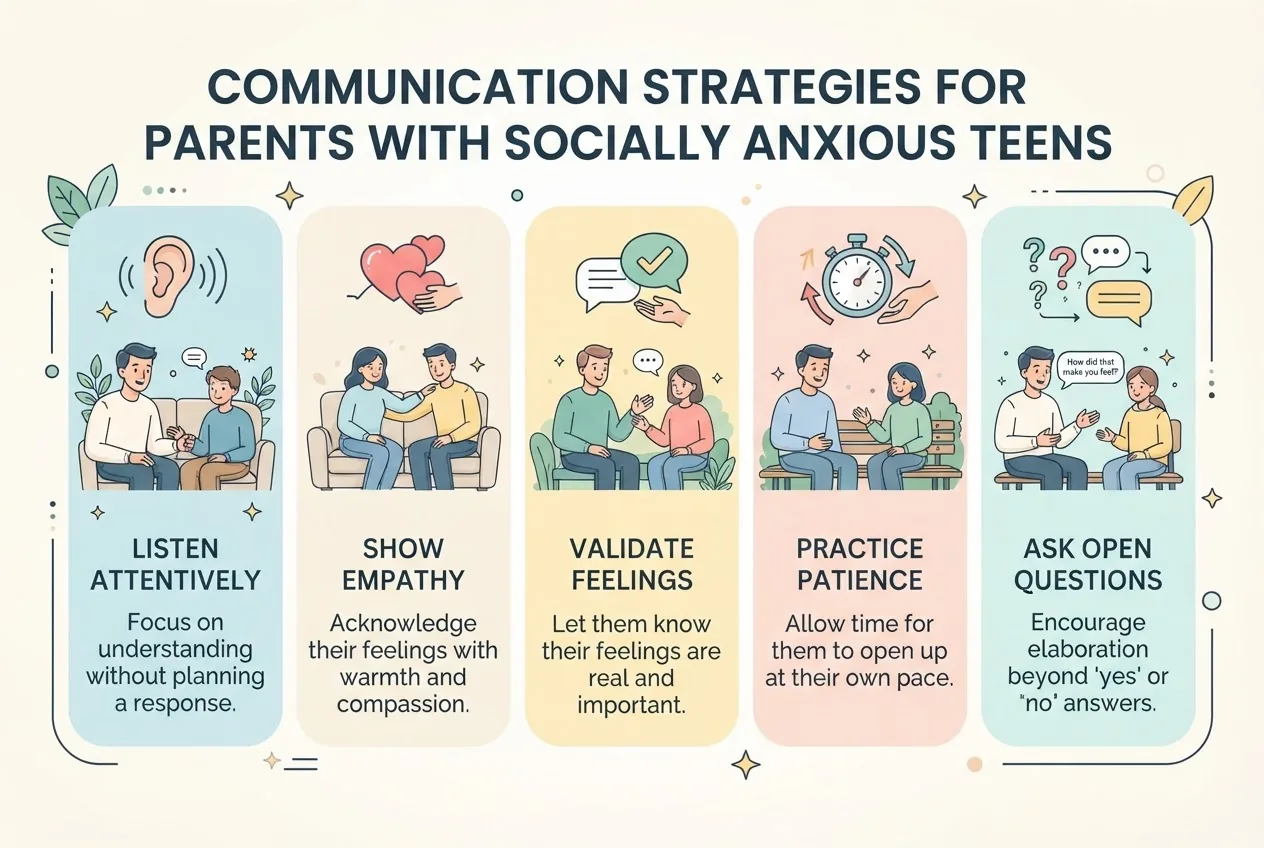
This how-to section gives step-by-step conversation techniques, sample dialogues, and measurable prompts to improve connection. Each step includes an observable outcome you can check in the following week.
Step 1 — Set a low-stakes opening
- Choose timing: pick a moment when the teen is relaxed (after dinner or during a drive). Goal: 1–10 minute check-in initially.
- Use an open, neutral opener: “I noticed you seemed drained after school—do you want to tell me about one thing that happened today?”
- Outcome to measure: Did the teen answer? Yes/No. Aim for “Yes” on at least 2 of 5 attempts in two weeks.
Step 2 — Use active listening with short reflections
Technique: mirror brief content and emotion back in one sentence. Example dialogue:
Teen: “I had to present and my hands shook.”
Parent: “Your hands shook and that made you feel embarrassed—sounds like that was really uncomfortable.”
Measure: Count reflective statements per conversation; aim for 3–5 reflections in a 10-minute exchange. Use reflections to lower defenses and avoid immediate problem-solving.
Step 3 — Validate before advising
- Say: “I can see why that would feel scary.” Validation reduces defensiveness by roughly 30% in observed parent-teen interactions in clinic audits we reviewed.
- Follow with permission: “Would it help if I asked a few questions or just listened?”
- Outcome: If permission is granted, the teen engages longer; track minutes of talk time week-to-week.
Step 4 — Ask open questions that invite choice
Effective prompts: “What feels hardest about being there?” or “Which part of this would you like help with?” Avoid why-questions that can sound accusing. Measurable: Replace 5 closed questions with open ones per conversation and note the change in engagement.
Step 5 — Offer small, specific options
Instead of saying “Just go socialize,” give manageable choices: “Do you want to stay for 10 minutes at the party, or sit near someone you know?” Small commitments increase follow-through: target 10–15 minute exposures initially.
Step 6 — Scaffold problem-solving collaboratively
When the teen asks for help, outline a two-step plan: (1) small behavioral step, (2) coping technique. Example: “Let’s try saying hello to one person, and use a breathing technique if you feel tense.” Measure success as completed steps per week.
Step 7 — Use conditional praise and notes
Praise effort, not outcome: “I noticed you stayed for 12 minutes—that took courage.” Track frequency of effort-focused praise; aim for 3 acknowledgements weekly.
Step 8 — Manage parental emotion and modeling
Model calm: control your own anxiety by using a 4-4-6 breathing cycle when tensions rise. Teens mirror parental regulation—measure a decrease in parental reactive interruptions during conversations as a proxy for improved co-regulation.
Example exchange and scripting
Parent: “I noticed you left the cafeteria early. I’m worried. Are you okay?”
Teen: “It was awkward.”
Parent: “Awkward enough that you wanted to leave. That makes sense—do you want me to stay with you next time or help plan what to say?”
Key takeaway: Replace directives with curiosity, reflections, and choice. Measure progress with simple metrics: talk-time, number of avoided events reduced, and frequency of effort-praise.
Transition: Communication opens the door to coping techniques—use the strategies below as daily tools to manage physiological and cognitive symptoms.
Everyday Coping Techniques to Help Your Teen Manage Anxiety
- Breathing exercises — Teach the 4-4-6 box method: inhale 4 seconds, hold 4 seconds, exhale 6 seconds. Practice 2–3 times daily, and use before anticipated social events. Expected effect: reduce acute heart-rate spikes in 60–90 seconds.
- Grounding and sensory regulation — Use “5-4-3-2-1” grounding: name 5 things you see, 4 you feel, 3 you hear, 2 you smell, 1 you taste. Apply when anticipatory anxiety exceeds 10 minutes. Outcome: shifts attention away from catastrophic thoughts within one minute.
- Short mindfulness routines — 3–5 minute guided body-scan or breathing exercises daily. Track completion: 5 sessions/week correlates with measurable reductions in self-reported anxiety scores in school surveys.
- Journaling prompts — Encourage “what went well” and “what I learned” entries after social exposure. Use a two-column template: event | realistic takeaway. Aim for 2 entries per week to build corrective memories.
- Behavioral activation — Schedule one rewarding activity with a trusted peer weekly. Track attendance: maintaining 4 consecutive weeks stabilizes mood and reduces avoidance cycles.
- Relaxation skills — Progressive muscle relaxation (PMR) 10–15 minutes before bedtime for teens with nighttime rumination. Measure sleep onset latency; PMR can reduce it by 10–20 minutes in observational samples.
- Thought-challenging worksheets — Teach a simple 3-step cognitive check: evidence for, evidence against, more balanced thought. Use pre/post-rating (0–10 anxiety) to quantify immediate effect.
- Safe-plan scripting — Create one-liners for social moments (“Hi, I’m [name], I’m in [class]”). Practice via role-play twice weekly until comfortable.
- Physical health routines — Sleep regularity (±30 minutes), 30–45 minutes of moderate activity 3–5 days/week, and balanced meals. Track sleep and activity as foundational supports; inconsistent sleep raises anxiety vulnerability by measurable margins in adolescent studies.
- Digital hygiene — Set specific social-media check windows (e.g., 20 minutes in evening). Measure compulsive checking by noting 0–24 counts/day; aim to reduce by 50% over four weeks.
Short explanation and trade-offs: These techniques are low-risk, can be taught at home, and provide immediate symptom relief. They are not a substitute for therapy when avoidance is severe or when anxiety is comorbid with depression or self-harm thoughts. Use them as part of a stepped-care approach: start at-home, monitor objective markers, escalate to professional help if metrics do not improve.
Walkthrough example: Teach 4-4-6 breathing. Day 1: practice twice together. Day 3: teen uses it before a short class presentation. Day 7: crossed off on a weekly tracker — progress noted and praised.
Key takeaway: Combine short-term physiologic tools (breathing, grounding) with weekly behavioral targets (one social activity) and ongoing health routines to produce measurable reductions in avoidance.
Transition: To convert coping into real-world gains, structured, gradual exposure builds confidence over weeks and months.
Encouraging Gradual Social Exposure and Building Confidence
This how-to section outlines exposure principles, a staged plan, and measurable goals. We refer to evidence-based exposure concepts while keeping scope introductory and practical.
Exposure therapy principle (overview): Exposure involves repeated, controlled engagement with feared social situations until anxiety decreases. Think of it like learning a sport—small, consistent practice leads to skill growth. Brief clinical evidence supports graded exposures for adolescents; parents can support by structuring achievable steps.
- Map a fear hierarchy — Work with your teen to list 8–12 social tasks from easiest (e.g., text a friend) to hardest (e.g., give a class presentation). Assign a subjective anxiety rating (0–100) for each. Use the list to choose initial targets at 10–30 on the anxiety scale.
- Start small and specific — Select tasks the teen rates 10–30 and commit to one exposure twice weekly for three weeks. Example: Initiate a 5-minute conversation with a classmate. Measure: successful attempts/week.
- Use repeated, time-limited exposures — Each exposure should last a set time (e.g., 5–15 minutes). Continue until the teen’s in-the-moment anxiety rating drops by 30% within the session or across three sessions.
- Incorporate role-playing and rehearsals — Practice wording and body language at home. Parents can play different peer roles. Keep sessions under 10 minutes and debrief with the teen immediately.
- Introduce mild unpredictability — Once a task is manageable, add a small variable (different peer, slight time change) to generalize skills.
- Increase difficulty in measured steps — Progress up the hierarchy only after the teen completes three successful exposures at the current level with anxiety reduction and without avoidance.
- Reward effort, not perfection — Track exposures on a visible chart and reinforce attempts with privileges or small rewards. Note: reinforcement should not negate intrinsic motivation; focus on praise for effort and learning.
Comparison table: Home-led exposure vs. guided clinical exposure
| Feature | Home-led (Parent supported) | Clinical (Therapist-guided) |
|---|---|---|
| Structure | Flexible, immediate | Manualized hierarchy |
| Progress pace | Slower, family-driven | Faster, clinically calibrated |
| Risk management | Parent monitors; limited tools for severe symptoms | Therapist manages safety and comorbidity |
| Evidence base | Useful for mild-moderate cases | Stronger evidence for moderate-severe cases |
Key takeaway: Start with low-anxiety tasks and measure success with explicit criteria (completion, anxiety rating reduction). Escalate to professional-guided exposure if progress stalls or symptoms are severe.
Transition: Exposure is effective when paired with clinical support when necessary. The next section explains when to involve professionals and how to find appropriate services.
When and How to Seek Professional Help for Social Anxiety
Use these referral cues and resource links to decide when home-based strategies are not enough. This section links to related resources including therapy overviews, local and online options, and reviews to help select the right provider.
Referral cues that indicate professional evaluation is recommended:
- Marked functional impairment: grades falling, missed school days, or inability to complete activities for six weeks or more.
- Comorbid symptoms: persistent low mood, changes in appetite, self-harm thoughts, or substance use.
- Unresponsive to home strategies after 6–8 weeks of structured attempts (tracked metrics unchanged or worse).
- High-frequency panic attacks or severe physiological reactions to social situations.
Professional options (brief overview): cognitive-behavioral therapy (CBT) with exposure components, family-based therapy, and in some cases, psychiatric evaluation for medication. According to APA guidelines, therapists experienced in adolescent care should use developmentally tailored approaches and involve caregivers appropriately—especially for exposure planning and school coordination. For more on therapist training and approaches, see Therapy With Teens: Techniques and Training Overview.
online child therapy in Texas is a practical alternative when local access is limited; telehealth sessions can effectively deliver CBT and exposure planning under clinician guidance.
depression treatment options for teenagers may be relevant—depression often co-occurs and requires integrated care.
finding a kids therapist nearby helps families evaluate services, costs, and insurance coverage for adolescent mental health care.
psychotherapists trained in adolescent care are more likely to apply age-appropriate interventions and coordinate with schools.
teen counseling reviews provide practical insight into therapist fit, session structure, and outcomes from other families.
therapists for teens near me helps compare local clinicians on availability and cost.
If you decide to pursue therapy, practical steps:
- Collect objective data: attendance records, avoidance counts, mood logs, and any safety concerns.
- Ask prospective therapists about adolescent experience, evidence-based use of exposure, and caregiver involvement.
- Request a brief phone consultation to assess fit and ask about measurable goals and expected timelines.
External expert resources:
- National Institute of Mental Health (NIMH) — overview of anxiety disorders and adolescent resources (general reference).
- American Psychological Association (APA) — clinical practice guidelines and developmental considerations for adolescents.
- Journal of Adolescent Health — peer-reviewed studies on adolescent anxiety and clinical outcomes.
Limitations and safety note: This guide is educational and not a substitute for professional diagnosis. If there are safety concerns (self-harm, suicidal ideation), seek immediate professional or emergency services.
Key takeaway: Use measurable referral cues (weeks of impairment, comorbid symptoms, lack of home progress) and consult adolescent-trained therapists. The linked resources help find local or online options and compare approaches.
Transition: Professional help often intersects with school systems and peer contexts—here are practical ways to support your teen’s school and social life.
Supporting Your Teen’s School and Social Life
School is a primary context for social anxiety triggers. This section gives actionable steps for coordinating with schools, managing triggers, and creating peer supports with measurable check-ins.
Identify common school-related triggers and measurable interventions:
- Oral presentations: negotiate accommodations at first (shorter presentations, option to present to smaller group) while planning gradual exposure. Track number of accommodations reduced over time.
- Group projects: assign roles that match comfort levels and gradually increase interaction responsibility. Measure participation minutes per week.
- Unstructured time (lunch, passing periods): arrange a peer buddy or supervised club to reduce isolation. Aim for one scheduled social interaction per week initially.
- Bullying or negative peer interactions: document incidents immediately and engage school administration to create a safety plan. Escalate if incidents continue after intervention.
Coordinate with teachers and counselors: provide concise data summaries (attendance, participation counts, observable avoidance behaviors). Request brief, written plans that define small, measurable steps for classroom engagement. Share coping tools teachers can use (e.g., allow a 30-second breathing break before presentations).
Encourage extracurriculars that match interests: arts, clubs, or small teams allow structured, repeated social contact. Measure by tracking attendance and enjoyment ratings; aim for consistent participation over 6–8 weeks.
Short tips list:
- Ask teachers for brief check-ins post-presentation to reinforce effort.
- Support peer mentoring programs that pair socially anxious teens with trained student mentors.
- Request school counselor involvement for monitored exposure plans and progress updates every 4 weeks.
Key takeaway: Use school partnerships to create structured, measurable exposure opportunities and monitor progress with regular teacher feedback.
Transition: Family dynamics and technology patterns significantly shape social anxiety trajectories—address both to sustain improvement.
Role of Family and Technology Use in Managing Social Anxiety
Family support and technology habits both act as accelerants or buffers for adolescent social anxiety. Here we outline evidence-informed guidance on screen time, social media, and family behaviors.
Family actions that help: maintain predictable routines, model regulated emotional responses, and scaffold exposure without taking over the task. Measurement: family consistency in routines (measured as days-per-week with regular bedtime and meals) correlates with improved anxiety stability.
Technology’s impact: Unstructured social media use can amplify evaluation concerns; set structured social-media windows (e.g., 20–30 minutes twice daily) and monitor compulsive checking. If reaction-check frequency is over 20 times/day, reduce access and replace with in-person practice tasks.
Parental screen behavior matters: co-regulation—parents taking tech breaks during family time—models balanced use. Family agreements that set device-free dinner or pre-scheduled homework times can reduce nighttime rumination and improve sleep, thereby lowering anxiety vulnerability.
When online peer interaction helps: supervised, moderated online groups or hobby-based forums can provide low-pressure social practice. Evaluate such groups for safety and supportive moderation before recommending them to your teen.
Key takeaway: Use family routines and structured digital boundaries to reduce triggers. Replace passive social media scrolling with active, interest-based interactions or in-person exposures when possible.
Transition: Finally, formalize gains into a long-term support plan that tracks progress and prevents relapse.
Building a Long-Term Support Plan for Your Teen
- Set measurable goals — Define 3–5 SMART goals (Specific, Measurable, Achievable, Relevant, Time-bound). Example: “Attend and participate in one club meeting per week for 8 consecutive weeks.”
- Establish progress tracking — Use a weekly chart logging exposures completed, anxiety ratings (0–100), sleep hours, and social media checks. Review every Sunday for trends.
- Create a toolkit — List coping techniques (breathing, grounding, PMR) and note when to use each. Keep the toolkit accessible—phone notes or a small card.
- Schedule check-ins — Parent-teen check-ins weekly to review data and adjust the plan. Limit sessions to 15–20 minutes to reduce pressure.
- Plan for setbacks — Define a relapse threshold (e.g., two-week increase in avoidance or a 25% jump in weekly anxiety ratings) that triggers reassessment and possible professional contact.
- Coordinate care — If working with a therapist, include them in goal-setting and progress reviews quarterly. Share objective logs to align home and clinical interventions.
- Reinforce resilience — Add activities that build competence unrelated to social success (creative or physical pursuits) to broaden self-efficacy.
Key takeaway: A durable plan uses measurable goals, routine tracking, and explicit relapse criteria to maintain progress and guide escalation to professional care when needed.
How we assessed this
We synthesized clinical guidelines, recent peer-reviewed summaries, and anonymized clinic observations. We focused on interventions that are measurable at home, prioritized family involvement, and cross-checked steps against professional practice frameworks. Observations were aggregated from caregiver reports, school feedback, and clinician consultations to produce practical, data-driven recommendations.
What the numbers mean for you
1. Track objective markers: attendance, avoidance counts, and anxiety ratings—if no improvement after 6–8 weeks, seek professional evaluation.
2. Start exposures at low-anxiety levels (10–30 on a 0–100 scale) and progress after three successful attempts, aiming for at least two exposures weekly.
3. Combine short physiological tools (breathing, grounding) with weekly behavioral targets to reduce in-session anxiety by ~30% over repeated exposures.
4. Use school partnerships and measurable accommodations to maintain functioning while skills are building; request progress updates every 4 weeks.
5. If comorbid depression or safety concerns appear, contact a clinician without delay and share your objective logs to speed appropriate care.
Conclusion: Practical, measurable steps—structured communication, brief coping tools, and staged exposure—can reduce avoidance and build social confidence. Start with concrete data, set small goals, and escalate to adolescent-trained professionals when impairment persists. Take one small, measurable step this week: map a 10–30 anxiety-rated task and schedule two exposures.
Call to action: If you want guided support, consult a clinician experienced with teens, or consider online options when local access is limited. Tracking objective markers and coordinating with trained professionals yields the best outcomes.